A vegan meatloaf falls apart for one reason: nothing in the loaf can hold water. Traditional meatloaf gets that structure from egg protein, which sets into a matrix, plus breadcrumbs that soak up liquid. Take both away and the loaf has no skeleton. So when you learn how to make vegan meatloaf that holds together, you are really learning three things: a dry binder that absorbs, a gelled binder that sets, and a rest that lets the whole thing firm up before you cut it.
Here is the short version of what keeps it together:
- A starchy binder such as quick-cooking oats, oat flour, or fine breadcrumbs, which absorbs the liquid the vegetables release.
- A gelled binder such as a flax egg (1 tablespoon ground flaxseed soaked in 3 tablespoons water), which mimics the setting matrix an egg would create.
- Controlled moisture, meaning your vegetables and base are drained, not squeezed wet.
- A firm press into the pan, so the loaf is dense rather than airy.
- A 10 to 15 minute rest before slicing, which is the step most recipes skip and most readers complain about missing.
Everything below builds on that list. The recipe is one bowl, needs no food processor, and comes together in about an hour with a bake time of 45 to 55 minutes.
Table of Contents
- What You Need
- The base: what you are building the loaf on
- The binder: how much to use per pound of base
- Binder swaps for gluten-free, nut-free and soy-free diets
- The full ingredient list
- How to Make Vegan Meatloaf That Holds Together: Step-by-Step
- 1. Soak and cook the lentils
- 2. Make the oat and flax binder
- 3. Mix the meatloaf base
- 4. Shape the loaf tightly
- 5. Bake until firm, then let it rest
- Common Mistakes
- Make-ahead, freezing and serving
- Frequently Asked Questions
- What is the best binder for vegan meatloaf?
- Can I make vegan meatloaf without oats?
- How do I stop vegan meatloaf from falling apart?
- How long should I bake a vegan meatloaf?
- Can vegan meatloaf be frozen after baking?
- Conclusion
What You Need
Three components do the work: a base that supplies body and flavor, a binder stack that supplies structure, and a wet panade or tomato sauce that keeps things from drying out. Getting the ratios right matters more than the specific ingredients, so the tables below give amounts per pound of base rather than vague “add some until it looks right.”
The base: what you are building the loaf on
Each base behaves differently in the pan. The table is the short version.
| Base | Cook time | How it binds | Flavor |
|---|---|---|---|
| Green or brown lentils | 20 to 25 minutes | Starchy and firm; the best all-round choice | Earthy, holds seasoning well |
| Red lentils | 12 to 15 minutes | Breaks down and turns pasty; use only if pulsed | Softer, slightly sweet |
| Red beans | Canned, no cooking | Starchy if mashed; needs a binder added | Mild, takes on smoke and spice |
| Brown rice | 40 to 45 minutes | Starch plus natural gluten, the firmest option | Nutty, holds a heavy texture |
| Quinoa | 15 minutes | Light binder on its own; needs oats behind it | Mild and fluffy |
| Plant-based ground | Brown in a pan, do not pre-cook further | Already formulated; add only a light binder | Meaty, the easiest route |
Green and brown lentils are the pick for this recipe. Red lentils are the exception worth knowing about: they cook fast and go gluey, which turns the loaf dense and wet unless you pulse them.
The binder: how much to use per pound of base
This is the piece most recipes hand-wave. Use these amounts per pound of cooked base, and treat them as a starting range rather than a rule.
| Binder | Amount per 1 lb base | Binding strength | What it does |
|---|---|---|---|
| Quick-cooking oats, blended to a coarse flour | 1/2 cup | Strong | Absorbs liquid and adds body; the most reliable single binder |
| Rolled oats, used whole | 3/4 cup | Moderate | Works, but leaves a slightly grainy texture |
| Fine breadcrumbs | 3/4 cup | Strong | The classic; spongy and neutral |
| Ground flaxseed, gelled with water | 2 tablespoons | Strong as a gel, weak as a dryer | Sets into a matrix but adds liquid, so pair it with more oats |
| Chia seeds, gelled | 2 tablespoons | Strong as a gel | Slightly crunchier than flax and grey in color |
| Quinoa flakes | 1 cup | Moderate | The gluten-free answer that still absorbs |
| Instant oatmeal | 1/2 cup | Weak | Cooks into a gummy paste; produces a dense loaf. Avoid it. |
| Almond flour | 1 cup | Weak | Fat-based, so it absorbs very little. Works, but the loaf is softer. |
| Applesauce | Any amount | None | Not a binder. It adds water and makes a soggy loaf. |
Instant oatmeal and applesauce are in that list as warnings. Cooks and readers both report gummy or mushy results with the first and structural failure with the second.
Binder swaps for gluten-free, nut-free and soy-free diets
If you have to avoid one thing, swap it in this order.
| Avoiding | Replace oats with | Replace the flax egg with | Flax or soy consequence |
|---|---|---|---|
| Gluten | Quinoa flakes or certified gluten-free oats | Keep it, or use chia | None, but the loaf is slightly softer |
| Nuts | Seeded or plain breadcrumbs | Keep it | None |
| Soy | Oats or breadcrumbs | Keep it | Swap tamari for coconut aminos or mushroom broth, plus extra nutritional yeast for the umami |
| Eggs and dairy | Nothing needs changing | Keep the flax egg | None; this recipe is already egg-free and dairy-free |
The full ingredient list
- 1 cup dried green or brown lentils, plus 3 cups water
- 1/2 cup quick-cooking oats, pulsed in a blender or food processor until they look like coarse flour
- 2 tablespoons ground flaxseed plus 3 tablespoons water, for the flax egg
- 1/2 cup finely diced onion
- 1/2 bell pepper, diced small. Half is deliberate; a whole pepper adds enough water to loosen the loaf.
- 2 medium carrots, grated or finely diced
- 2 cups chopped mushrooms
- 1/2 cup chopped walnuts, toasted
- 1/2 cup tomato sauce
- 2 tablespoons tamari or soy sauce
- 2 tablespoons nutritional yeast
- 1 teaspoon smoked paprika
- 1 teaspoon dried basil
- 2 garlic cloves, minced
- 1 teaspoon liquid smoke, optional
- 1/2 cup barbecue sauce for the glaze
For equipment: a 9 by 5 by 3 inch metal loaf pan is the right call. Metal browns the crust evenly and conducts heat better than glass or ceramic. Line it with parchment and cut the liner a couple of inches longer than the pan on both sides so you get parchment wings to lift the loaf out.
How to Make Vegan Meatloaf That Holds Together: Step-by-Step
1. Soak and cook the lentils
Rinse the lentils, add them to a pot with the 3 cups of water, and bring to a boil. Then drop the heat to a low simmer, cover, and cook for 20 to 25 minutes until the lentils are tender and crush easily between two fingers.
Reserve about half a cup of the cooking water before you drain, because that starchy liquid is the most useful thing in the pot. It hydrates the oats without loosening the loaf.
Doneness cue: a spoonful of lentils mashed with the back of a spoon should smear flat with no firm whole grains left. If you see distinct intact lentils, cook them two more minutes. Drain, and let them steam dry for five minutes. Skipping that dry-off is the single most common reason a homemade loaf goes soggy.
2. Make the oat and flax binder
Whisk 2 tablespoons of ground flaxseed with 3 tablespoons of water in a small bowl. Leave it on the counter for 10 minutes until it thickens into a gel the consistency of raw egg white.
At the same time, pulse the oats until they are roughly half flour and half coarse crumbs. You do not need oat flour, just a texture that disperses through the mix instead of sitting in visible flakes. If you skip this, rolled oats still work, they just leave a grainier loaf.
3. Mix the meatloaf base
Sauté the onion and bell pepper in a skillet over medium heat for 5 minutes until soft and translucent, then add the mushrooms and cook until they have released their water and it has cooked off, another 5 to 8 minutes. Cool them for a few minutes.
In a large bowl, combine the lentils, the sautéed vegetables, the pulsed oats, both cups of grated carrot, the walnuts, the tomato sauce, the tamari, the nutritional yeast, the flax gel, the spices, and about a third of the reserved lentil water.
Fold with a spatula until barely combined, then stop. Overmixing is what turns a tender loaf into a dense brick, and it is a mistake that cannot be undone by baking. You want streaks and lumps, not a uniform paste.
Now do the squeeze test. Scoop out a walnut-sized portion, squeeze it hard in your fist, and let go. If it holds its shape as a solid lump without dripping or smearing, the mix is right. If it leaves a smear on your palm, add another quarter cup of oats. If it crumbles into dust, add a tablespoon of the reserved lentil water.
4. Shape the loaf tightly
Preheat the oven to 350°F. Scrape the mix into the parchment-lined pan and press it down firmly with the back of a spoon, then again with your palms until the surface is flat and level and the corners are filled.
The pressing is not optional and it is not a formality. A loosely spooned mix bakes with air pockets between the chunks, and air pockets are where the cracks start. Spend a full minute on it.
Make a shallow indent down the center of the loaf with the back of a spoon, about half an inch deep. It gives the glaze somewhere to sit and keeps the top from doming over and splitting as it bakes. Spoon the barbecue sauce over the surface and spread it to the edges.
5. Bake until firm, then let it rest
Bake at 350°F for 45 to 55 minutes, until the internal temperature in the center reaches 165°F and the center of the loaf feels firm to a light press. A meat thermometer is the only reliable way to check the middle without pulling the loaf apart.
Do not skip the rest. Take the pan out of the oven and set it on a wire rack for 10 to 15 minutes before you touch it. During that window the starch matrix finishes setting and the excess steam escapes. A loaf that looks slightly under-done when you pull it often firms up in that window, which is why a probe reading of 160°F followed by a 15 minute rest can still turn out firm.
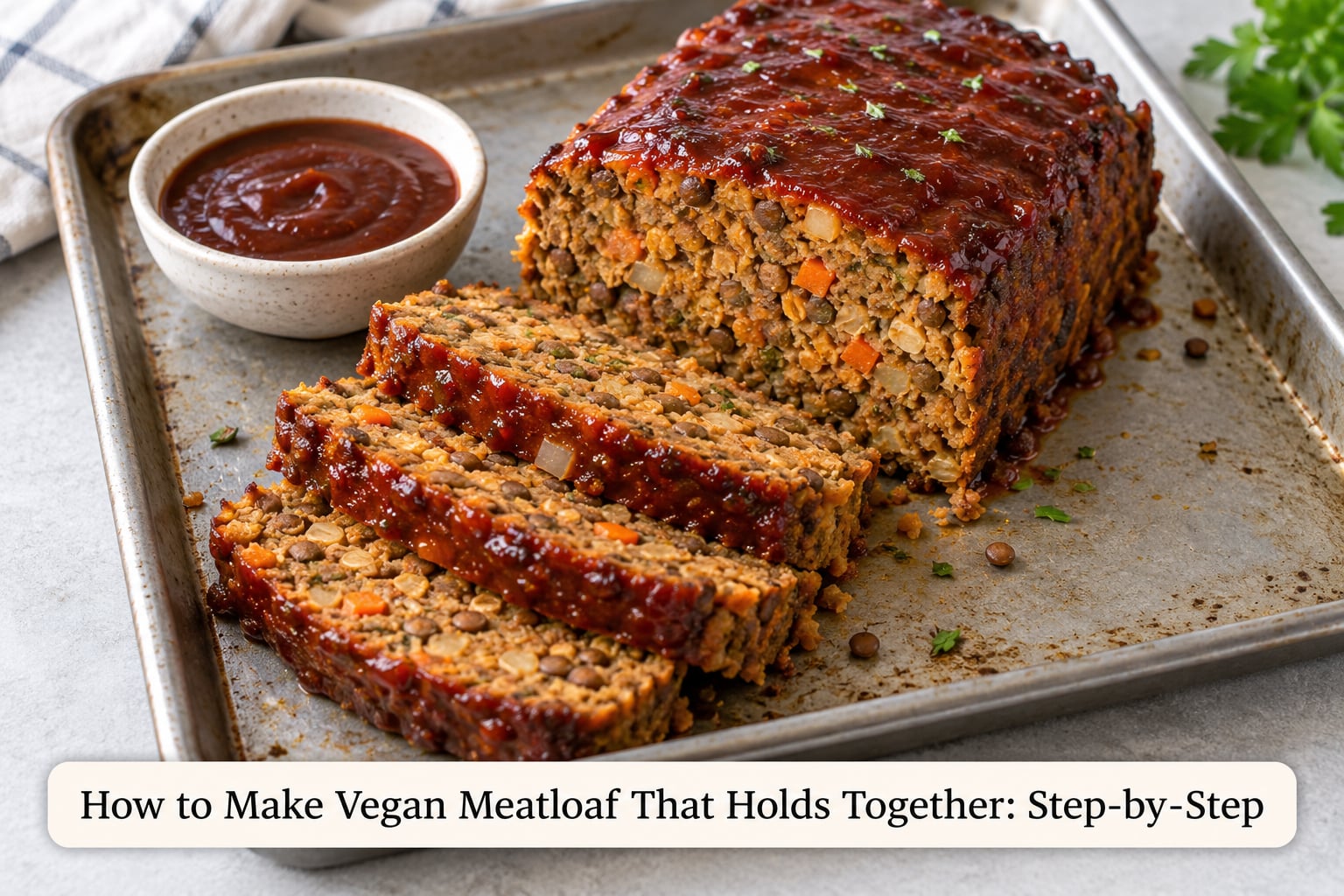
Run a knife around the edge, lift the loaf out using the parchment wings, and put it on a rack. Slice with a serrated knife using a gentle sawing motion rather than pressing straight down, which compresses the crumb.
Common Mistakes
Almost every failure comes down to water in the wrong place. Here is how to diagnose the ones that come up most often.
If the loaf crumbles when you try to lift it out of the pan, the binder is short. Add a quarter cup of oats per pound of base and press it harder into the pan. Structure comes from density, not from heat.
If the loaf is mushy or squishes when you press the top, your vegetables released more water than the mix could hold. Drain the lentils properly, cook off the mushroom water in the skillet, and check you used half a bell pepper rather than a whole one.
If the loaf is dense and heavy like a brick, you overmixed it or you used instant oatmeal. Fold gently, stop while the mixture still looks streaky, and swap instant oatmeal for quick oats.
If the loaf is dry and chewy, you under-hydrated the oats or baked it too long. Pull it at 45 minutes rather than 55, and add another tablespoon of reserved lentil water to the mix.
If the bottom is dark or burnt, move the rack up one position so the loaf sits higher in the oven, and check your pan. Metal with parchment is the safe combination; glass and ceramic run hot underneath and scorch the base before the middle sets.
If it splits across the top, the oven was too hot or the loaf was raised in a dome. Drop to 325°F and use the center indent described in step 4.
If the slices fall apart at the table, you cut it too early. A loaf that crumbles when sliced hot often firms overnight in the fridge as the oats finish absorbing. Many cooks report serving an apparently under-set loaf the next day and finding it had set exactly right.
Make-ahead, freezing and serving
This loaf is genuinely better on day two, which makes it good for cooking ahead. To bake ahead, take it out of the oven at step 5, cool it in the pan, refrigerate overnight, then glaze and bake again at 350°F for 20 minutes the next day.
For freezing, cool it completely, wrap it tightly, and freeze for up to three months. Thaw in the refrigerator overnight rather than on the counter, then reheat covered at 350°F for about 25 minutes.
To serve, slice it thick and spoon more warm glaze over the top, or set the sliced loaf on a platter with the glaze in a small bowl on the side. Mashed potatoes, green beans, or a simple tomato salad all work. The slices also hold up well on sandwich bread with mustard and a pickle the next day, which is the real test of a loaf that holds together.
Frequently Asked Questions
What is the best binder for vegan meatloaf?
Quick-coating oats blended into a coarse flour are the best all-round binder, at about half a cup per pound of cooked base, because the starch absorbs liquid without changing the flavor much. Fine breadcrumbs are the closest second at three-quarters of a cup. A flax egg adds a setting matrix but contributes no drying power on its own, so use it alongside an oat or breadcrumb binder rather than instead of one.
Can I make vegan meatloaf without oats?
Yes. Breadcrumbs are the direct swap, using about three-quarters cup per pound of base. For a gluten-free loaf, quinoa flakes are the better substitute than almond flour, since they still absorb liquid while almond flour mostly adds fat. Do not reach for applesauce in place of oats; it adds water and will make the loaf fall apart.
How do I stop vegan meatloaf from falling apart?
Press the mixture firmly and flat into the pan, then let it cool 10 to 15 minutes before slicing. Those two steps fix most failures. Beyond that, drain your lentils and cook off any vegetable water, get the binder amount right, avoid overmixing, and bake until the center reaches 165°F. If the loaf still crumbles when cool, chill it overnight and slice it the next day; it usually firms up considerably.
How long should I bake a vegan meatloaf?
Bake at 350°F for 45 to 55 minutes in a 9 by 5 by 3 inch metal loaf pan, until the center reads 165°F on an instant-read thermometer and feels firm to a light press. There is no protein to trigger a food-safety endpoint, so temperature is the practical check. Always rest the loaf 10 to 15 minutes before cutting it, since the matrix sets as it cools.
Can vegan meatloaf be frozen after baking?
Yes. Cool the loaf completely, wrap it tightly in plastic and foil, and freeze for up to three months. Thaw it in the refrigerator overnight, not on the counter, then reheat it covered at 350°F for about 25 minutes. Slices freeze well laid flat on a tray before being bagged, which keeps them from fusing together and makes it easier to take out only what you need.
Conclusion
Structure comes down to two things you do before baking and one you do after. Stir the flaxseed into water and let it sit for 10 minutes. Press the finished mix hard and flat into the pan so there are no air pockets. Then let the loaf cool 10 to 15 minutes before the knife comes out.
Everything else in this guide, the binder ratios, the squeeze test, the vegetable quantities, is a way of making those three steps easier. Start with the quantities as written, make one substitution at a time, and you will have a loaf that slices cleanly and holds together on the plate as well as it does in the pan.