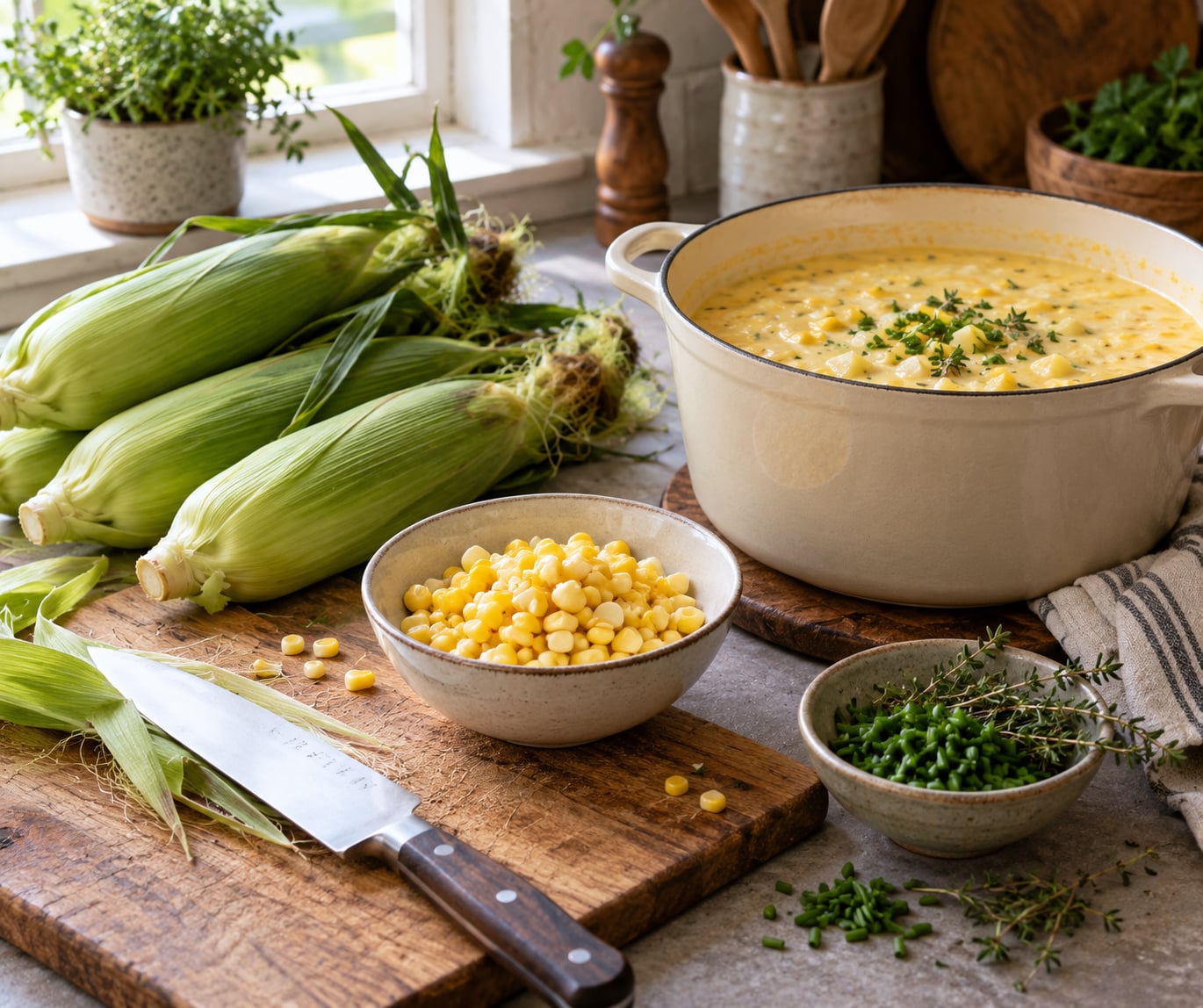
How to make corn chowder with fresh corn takes about 40 minutes start to finish, and it happens almost entirely in one pot. Sweat onion, garlic and celery in butter, add diced Yukon Gold potatoes, chicken broth and the cut kernels of four fresh ears of corn, then simmer until the potatoes give way. Blend a cup of the soup back in for a creamy body, stir in whole milk off the heat, and season with chives and a crack of pepper.
Prep is about 20 minutes, cook time is 20 minutes, and the yield is six generous bowls. The reason fresh corn matters more here than in any other soup is that the kernels and the cobs release real sugar and starch into the pot as they cook. Canned corn was blanched and drained long before it reached your kitchen, so it brings color and a faint sweetness but none of that flavor.
Fresh corn is worth the extra knife work, and only in season. This one is at its best from July through September, when the ears are heavy, squeaky and sweet enough that people eat them raw over the sink.
Table of Contents
- What You Need
- How to Make Corn Chowder with Fresh Corn: Step by Step
- Step 1: Prepare the Fresh Corn
- Step 2: Cook the Aromatics
- Step 3: Build the Broth and Vegetables
- Step 4: Blend for the Right Texture (Thickening Corn Chowder with Fresh Corn)
- Step 5: Simmer and Season
- Common Mistakes and How to Fix Them
- Frequently Asked Questions
- Can I make corn chowder with fresh corn ahead of time?
- How do I keep corn chowder from becoming too watery?
- Can fresh corn chowder be made vegan?
- Should I blend the entire batch of corn chowder smooth?
- What can I use if I do not have fresh corn?
- How long does corn chowder keep in the refrigerator?
- Conclusion
What You Need
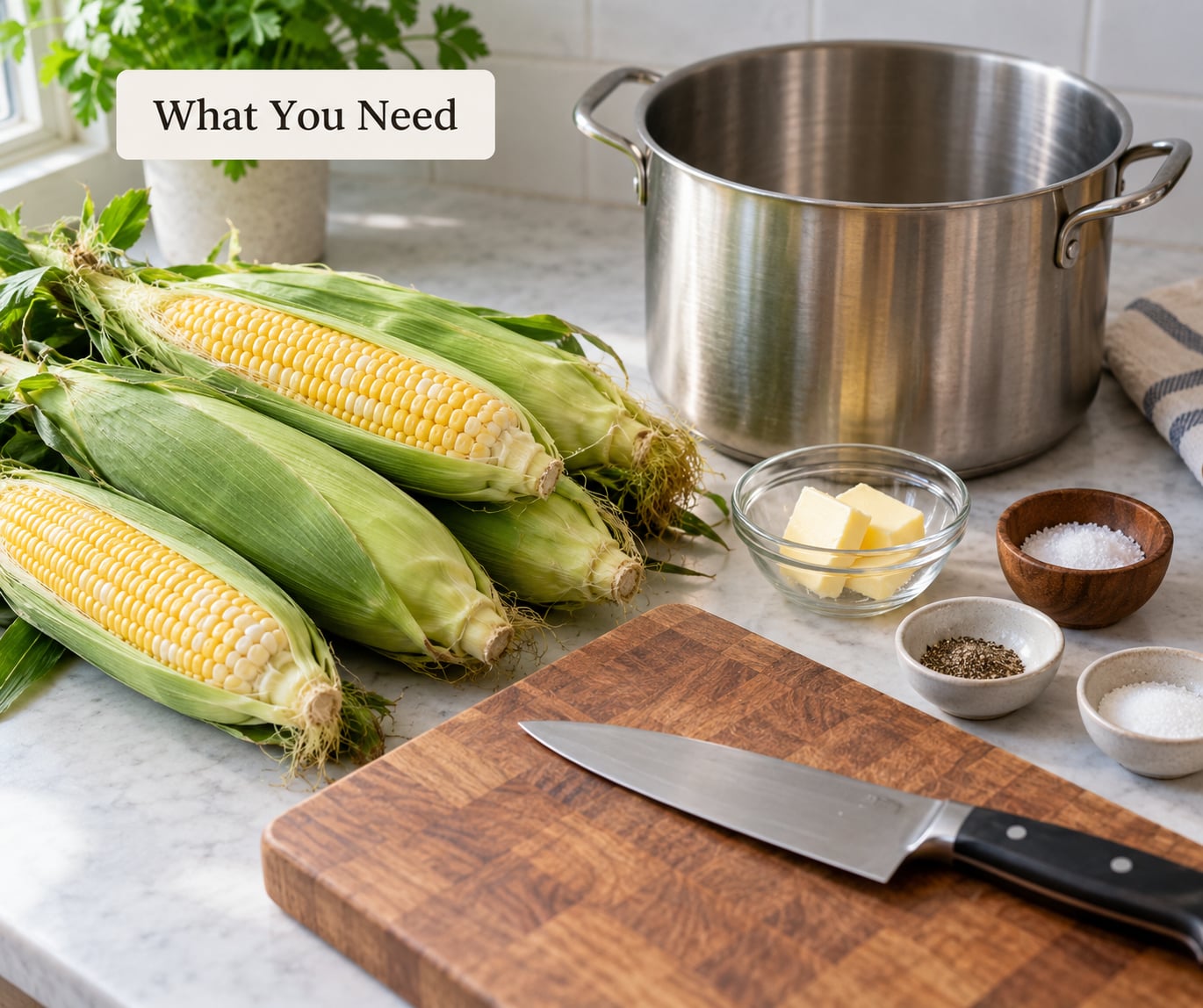
Prep: 20 minutes. Cook: 20 minutes. Serves: 6.
- 4 ears fresh sweet corn, kernels cut off the cobs, cobs reserved
- 4 slices bacon, chopped (optional, see the vegetarian swap below)
- 2 tablespoons butter, plus more for finishing
- 1 medium yellow onion, diced small
- 2 stalks celery, diced
- 1 medium carrot, diced
- 2 cloves garlic, minced
- 1 pound Yukon Gold potatoes, peeled and cut into half-inch cubes
- 4 cups low-sodium chicken broth
- 2 cups whole milk, plus more to adjust
- Half and half or heavy cream, as needed
- 1 teaspoon fresh thyme leaves, or a few sprigs tied with kitchen twine
- Salt and freshly ground black pepper
- Chopped chives or parsley for serving
Equipment is simple: a heavy 4-quart pot or Dutch oven for heat retention, a sharp chef’s knife for the cobs, and an immersion blender for the texture step. A Bundt pan makes a clean work surface for cutting kernels, though a bowl set in the sink works just as well.
Two substitutions do most of the work. For a vegetarian version, leave out the bacon and start the aromatics in olive oil, then finish with a tablespoon of butter at the end. For a gluten-free chowder, skip any flour-based roux entirely and thicken with a cornstarch slurry or blended potato, since neither contains gluten.
If you cannot get fresh corn, frozen kernels work, and so do drained canned kernels, though you will want a small pinch of sugar in the pot to round out the sweetness that blanching took out of them. Use about 2 cups of frozen or canned corn in place of the four ears.
How to Make Corn Chowder with Fresh Corn: Step by Step

Step 1: Prepare the Fresh Corn
Stand the cob upright in a shallow bowl or Bundt pan and cut down the sides with a sharp knife to remove the kernels. A cob is done when the bare core is pale, smooth and free of loose pulp; any ragged yellow bits left behind will make the chowder grainy. Roll the cob across the rim of the bowl and the kernels fall straight in.
Save the bare cobs. They are the single best flavor move in this recipe, covered in Step 3.
Step 2: Cook the Aromatics
Fry the chopped bacon in the pot over medium heat until crisp, about 4 minutes, then transfer it to a plate. Add the butter, then the onion, celery and carrot. Cook 6 to 8 minutes until the pieces soften and turn translucent at the edges but have not taken on color.
That translucent stage is your cue. If the onion browns, the chowder will taste of cooked onion rather than sweet corn, and no amount of cream hides it. Stir in the garlic and thyme for the last 30 seconds, just until fragrant.
Step 3: Build the Broth and Vegetables
Add the diced potatoes and 4 cups of chicken broth, along with the four reserved corn cobs. Bring to a boil, then turn the heat down and cover. Simmer for 10 minutes, which is long enough for half-inch potato cubes to reach tenderness.
Now lift out the cobs with tongs and discard them. They have given the broth all the flavor they have to give, and any liquid still clinging to them would only make it cloudy.
Stir in the fresh corn kernels and season with 1 teaspoon salt and several grinds of pepper. Simmer 5 more minutes. Cook the corn in the pot rather than alongside it, so its sugars and starches go into the broth instead of evaporating on a side plate.
For hot holding at a church supper or a potluck, this stage is your checkpoint: the chowder should hold a spoon at an angle before you thin or thicken it, rather than needing correcting later with everyone watching.
Step 4: Blend for the Right Texture (Thickening Corn Chowder with Fresh Corn)
Ladle about 1 cup of the soup into a blender, let it cool for a minute, and pulse until smooth, then stir it back into the pot. Blending part of the batch thickens it naturally because the potato starch and corn starch release into the liquid, and it leaves visible chunks of corn and potato everywhere else.
For a fully smooth chowder, blend the entire pot with an immersion blender instead, working in several spots to catch every corner of the bottom.
If the soup still looks loose, here is how each thickening method behaves:
- Blend a cup of soup. A natural, potato-thickened body with chunks left in, gluten-free, and done in under a minute.
- Roux (flour cooked in butter). Smooth and slightly gluey, and it thickens further as it simmers. Contains gluten, and costs 2 to 3 minutes of cooking the roux.
- Cornstarch slurry. Glossy and translucent-thick with no flour taste. Gluten-free, needing 1 to 2 minutes of simmering.
- Extra blended potato. The heaviest body, closest to a mashed potato soup. Gluten-free and finished in under a minute.
Whisk 2 tablespoons cornstarch with 3 tablespoons cold water or milk, pour it in while stirring, and simmer 1 to 2 minutes until it thickens noticeably. Cornstarch must come to a brief boil to activate, which is why it needs the pot heat the blended method does not.
Step 5: Simmer and Season
Turn the heat off and let the pot cool for a minute, then pour in 2 cups of whole milk, stirring as you go. Dairy must never reach a full boil, which is the single most common way this recipe goes wrong and curdles into broken, grainy curds. Bring it back to a bare simmer and cook 3 minutes to warm it through.
Taste and adjust. Too thin gets more broth or a splash of half and half; too thick gets a cup of warm stock stirred in at the end. Salt goes in now, because dairy needs more than it feels like it needs. Finish with a knob of butter, a handful of chives, and more black pepper than you think.
Common Mistakes and How to Fix Them
The chowder is bland. It needs more salt than the recipe lists, because milk and corn both mute salt. It also needs acid, not just cream. A teaspoon of apple cider vinegar stirred in at the table will sharpen the sweetness more effectively than any amount of butter.
It is watery. Fresh corn releases less starch than people expect, so the soup is often thinner than the photo suggests. Blend another cup of soup back in, or add a cornstarch slurry. A quick simmer uncovered for five minutes will also tighten it if you have the time.
It tastes overly sweet. You used canned or frozen corn and added sugar. Fresh corn needs no sugar at all, so if you went that route, leave it out.
It is lumpy or grainy. Rough cob cuts, or blending the whole batch too long, will do it. Strain the finished chowder through a fine mesh sieve and the grit disappears.
The milk curdled. You boiled hard after adding dairy, or added it to a pot already at a rolling boil. Scrape out the curds with a fine strainer, then whisk a fresh splash of milk into the remaining liquid off the heat. It will not be quite right, but it will be servable.
The bottom scorched. A Dutch oven holds heat well enough to scorch on a high burner after the stock goes in. Stir once when you add the broth, keep the heat just under a simmer, and use a wooden spoon on the bottom every few minutes.
A few extra notes on making it work. Fresh corn is a short season, and if you find yourself with a glut, blanch the ears for 3 minutes, cut off the kernels, and freeze them flat; they hold their sweetness well for about 6 months. For a corn cob stock worth keeping, put the bare cobs in a saucepan with 4 cups of water, simmer 15 minutes, strain, and refrigerate for up to 4 days. Use it in place of part of the chicken broth in a batch made from frozen kernels.
Leftovers keep 3 to 4 days in the refrigerator at 40°F or below, per USDA guidance. Reheat on the stove over low heat with a splash of broth, stirring often, and stop before it boils. For hot holding at a gathering, keep it at 140°F or hotter and do not let it sit out longer than 2 hours. Freeze it for up to 3 months, but add the dairy after thawing and reheating if you want the texture at its best.
Frequently Asked Questions
Can I make corn chowder with fresh corn ahead of time?
Yes, and it actually improves. Make it up to two days ahead and refrigerate, leaving the milk and chives out until you reheat. The flavors settle and meld overnight. Reheat slowly on the stove with a splash of broth, stirring often, and keep the heat below a boil or the dairy will break.
How do I keep corn chowder from becoming too watery?
Blend a cup of the soup and stir it back in, or use a cornstarch slurry made from 2 tablespoons cornstarch whisked with 3 tablespoons cold water, then simmer 1 to 2 minutes. A brief uncovered simmer also reduces it. Fresh corn gives less starch than canned creamed corn, so thickening is usually a necessary step rather than a rescue.
Can fresh corn chowder be made vegan?
Yes. Skip the bacon, start the aromatics in olive oil instead of butter, and use an unsweetened plant milk such as oat or soy for the dairy. Most brands are gluten-free too, but check the label, and stay with cornstarch rather than a flour roux if you need the chowder gluten-free as well.
Should I blend the entire batch of corn chowder smooth?
That is a matter of taste. Blend only a cup for a chunky chowder with a creamy body, which is the traditional result, or blend the full pot for a smooth soup. A potato masher works well enough in the middle of the two. Avoid a blender with a corkscrew blade if you have one, because corn skins snag in the ridges.
What can I use if I do not have fresh corn?
Frozen kernels are the closest substitute, at 2 cups for every 4 ears. Canned corn works but is noticeably sweeter and flatter after blanching, so use it without adding sugar. You can also simmer the cobs of frozen corn for 15 minutes and strain the liquid to use as a mild base in place of part of the chicken broth.
How long does corn chowder keep in the refrigerator?
Three to four days when stored covered at 40°F or below, which is the USDA guideline for cooked soups with dairy. For a longer rest, freeze it in a shallow container for up to 3 months. Reheat thawed chowder on the stove with a little broth and keep it below a full boil.
Conclusion
Start at Step 1 and do not rush it: cut the kernels cleanly off the cobs and hold onto those cobs, because simmering them in the broth for 10 minutes is where most of the fresh corn flavor comes from. After that, the pot does the work in about 20 minutes. Adjust the thickness with blended soup or a cornstarch slurry, salt it harder than feels right, and serve it with skillet cornbread and a bowl of chopped chives.