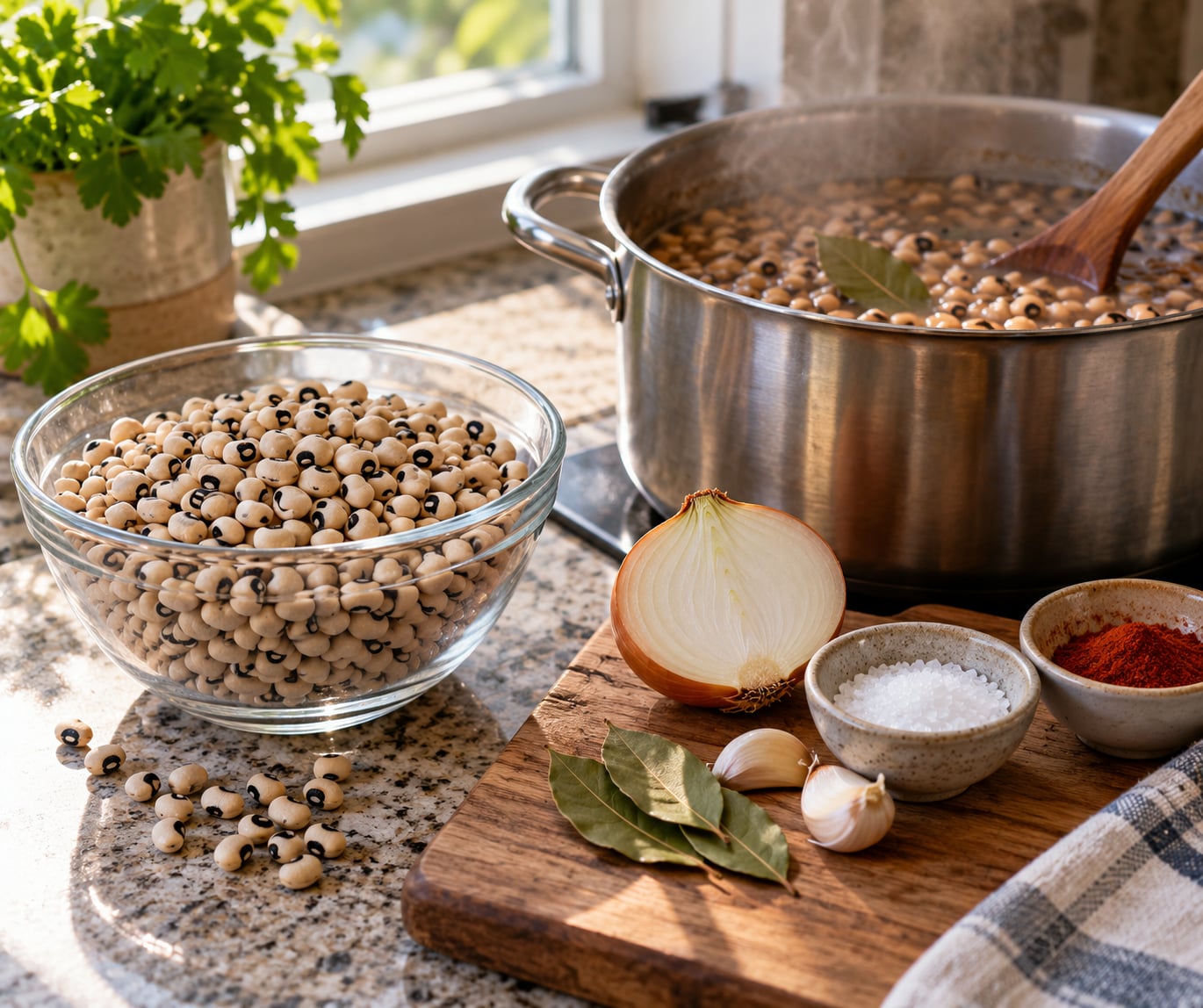
If you want the creamiest black-eyed peas, soak them overnight in cool water, then simmer them in fresh water or broth for 45 to 90 minutes until a spoon slides through one with no resistance. That is the whole method, and this guide covers the faster options too if you did not plan ahead.
Black-eyed peas go by a few names in Appalachian and Southern kitchens: cowpeas, field peas, and crowder peas when the pods are picked fresh. Dried, they are a tough little legume that needs hydration before it turns creamy, and the soak is what keeps the skins intact and the texture even.
Below is the method I use, with timings for soaked, quick-soaked, and unsoaked peas. Total hands-on time is about 20 minutes. The only real variable is the soak.
Table of Contents
- What You Need
- Step-by-Step
- 1. Rinse and Inspect the Black-Eyed Peas
- 2. Soak the Black-Eyed Peas Overnight
- 3. Use the Quick-Soaking Option
- 4. Drain and Rinse After Soaking
- 5. Cook the Black-Eyed Peas on the Stovetop
- 6. Add Seasonings and Check for Tenderness
- 7. Serve or Store the Black-Eyed Peas
- Common Mistakes
- Frequently Asked Questions
- Should I soak my black-eyed peas before I cook them?
- How long do you soak black-eyed peas before cooking them?
- Can you cook black-eyed peas without soaking them?
- What is the best liquid for cooking black-eyed peas?
- What are the common mistakes when cooking black-eyed peas?
- How do I know when black-eyed peas are done?
- Start With Overnight Soaking for the Best Texture
What You Need
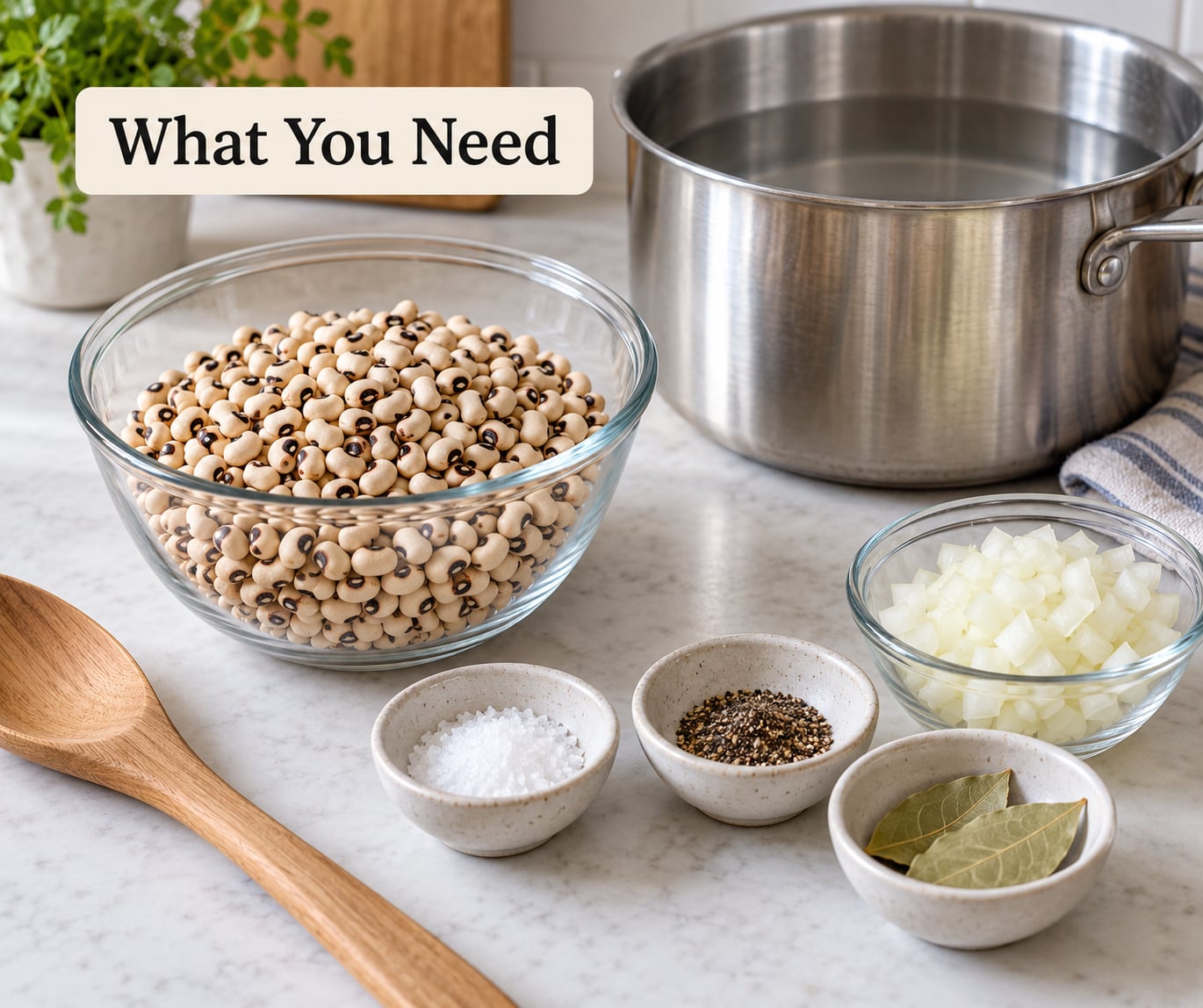
- Dried black-eyed peas — 1 cup (about 190 g) serves 4 as a side.
- Water for soaking — 3 cups per cup of peas. They nearly double in size.
- Fresh liquid for cooking — 4 to 6 cups of water, chicken broth, ham stock, or vegetable stock.
- A large bowl or pot — wide enough that the peas are not stacked more than an inch deep, and roomy enough for them to swell.
- A colander or slotted spoon for draining the soak water.
- A heavy-bottomed pot — a stockpot or Dutch oven for the stovetop simmer.
- Aromatics — 1 halved yellow onion, 4 garlic cloves, 2 bay leaves, and 1 to 2 fresh or pickled jalapenos.
- Seasoning — salt, black pepper, and either smoked paprika or a Cajun-style blend.
Make sure the soaking bowl can hold 3 cups of water plus room for the peas to expand. Crowding is the quiet reason soaks go wrong.
Step-by-Step
1. Rinse and Inspect the Black-Eyed Peas
Pour the dried peas into a colander and run them under cold water, swishing with your hand until the water runs clear. This takes about a minute and rinses off field dust and any starch left from processing.
Pick out anything that is not a pea: stones, split seeds, and dark bits. Then check for debris that will not wash away. Do not skip this step, because it is the one part of the process that cannot be corrected later.
2. Soak the Black-Eyed Peas Overnight
Put the rinsed peas in the bowl, add 3 cups of cool water, and cover them by 2 inches. Set the bowl on the counter or in the fridge for 8 to 12 hours.
When you come back to them, the peas should look plumper, slightly lighter in color, and the water should be cloudy and faintly starchy. That cloudiness is starch leaching out, and it is a good sign.
For the salt question, and it comes up constantly: a teaspoon of salt in the soaking water is fine for black-eyed peas and improves seasoning. The claim that salt dramatically extends cooking time for dried pulses is debated but matters far less here than it does for kidney beans.
3. Use the Quick-Soaking Option
Two quick methods work well. The first is a two-minute boil: cover the rinsed peas with water, bring to a full boil, boil 2 minutes, then let them sit covered for 1 hour before draining.
The second is the rapid soak used in Cajun cooking. Add cold water to the peas, bring straight to a rolling boil, then boil for 20 to 30 minutes. Drain afterward and start fresh.
Quick-soaked peas cook faster than unsoaked ones but usually take 10 to 15 minutes longer than overnight-soaked peas. They can also split more, so pour them gently rather than running the tap over them.
Can you soak too long? Yes, past about 48 hours the pea skins break down and the peas turn to mush before they cook. Two days in cool water is already pushing it; a week in a fridge is how people end up with grey water and disintegrating peas.
4. Drain and Rinse After Soaking
Drain the soaked peas in a colander and discard the soaking water. The water carries starch, dirt, and whatever you added, so none of that flavor belongs in the pot.
Give the peas a quick rinse under cold water and move them straight into the cooking pot. Some cooks change the water midway through a long soak, and it makes a real difference if you are soaking more than 12 hours and the water has gone grey.
5. Cook the Black-Eyed Peas on the Stovetop
Put the peas in the pot and add 4 to 6 cups of fresh liquid, enough to cover them by 2 inches. Add the halved onion, smashed garlic, bay leaves, and jalapenos.
Bring to a boil over high heat, then turn the heat down so the pot barely bubbles. A hard boil keeps the skins whole but toughens the centers, and that is the single most common reason peas stay crunchy. Skim any foam off the surface in the first few minutes.
Cover with a lid and simmer until tender:
| Preparation | Stovetop simmer | Pressure cooker | Slow cooker |
|---|---|---|---|
| Overnight soaked | 45 to 90 minutes | High pressure 6 minutes, then 5 minutes natural release | 2 to 3 hours on low |
| Quick soaked | 60 to 90 minutes | High pressure 8 minutes, then 5 minutes natural release | 2 to 3 hours on low |
| Not soaked | 90 minutes to 2 hours | High pressure 12 minutes, then 10 minutes natural release | 6 to 7 hours on low |
Cooking unsoaked peas straight from the bag is fine, but boil them for 10 minutes before dropping to a simmer. That pre-boil is what deactivates the lectins naturally present in dried beans, and skipping it on a long cook is a real safety concern rather than a texture preference.
6. Add Seasonings and Check for Tenderness
Wait to salt until the peas are about halfway tender. Salt at the start is fine for black-eyed peas, unlike for beans, but adding it late lets the seasoning penetrate the seeds instead of the cooking liquid.
Start with 1 teaspoon salt, half a teaspoon black pepper, and 1 teaspoon smoked paprika per cup of dried peas. Add the paprika and any hot pepper early for depth, and hold back half the salt for the end so you can taste as you go.
The doneness test is simple: press a pea against the side of the spoon. Tender peas give way with almost no resistance and the broth turns cloudy and creamy. Firm peas split at the seam and taste chalky. If they are firm, give it another 20 minutes rather than raising the heat, and add a half cup of hot water if the liquid has cooked down below the peas.
For thicker gravy the way my grandmother did it, mash a spoonful of peas against the side of the pot and stir them back in. Do it in two or three batches, not all at once, or you end up with pot-likker.
7. Serve or Store the Black-Eyed Peas
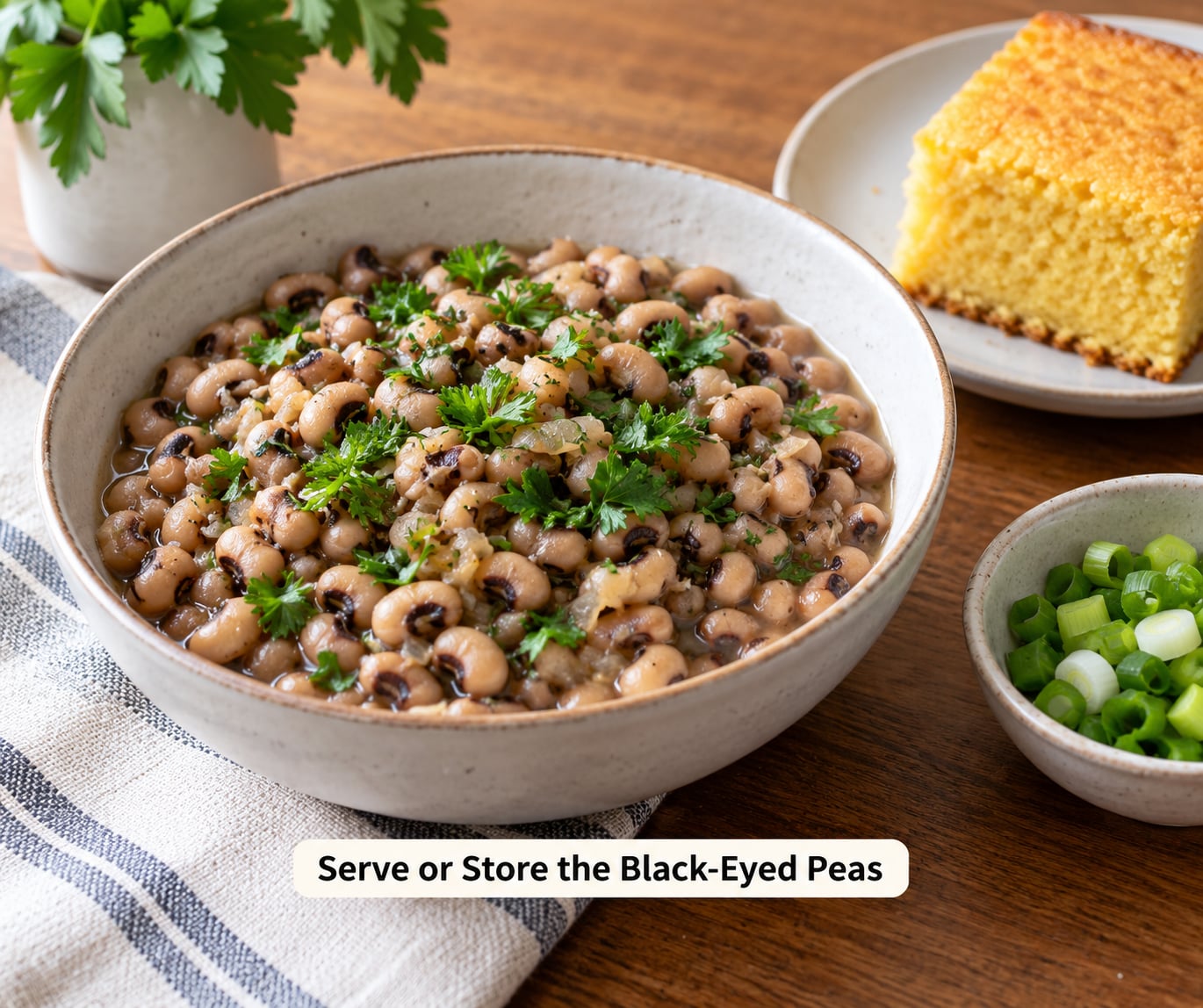
Season to taste at the table, then decide what you are making with them. Over white rice with collard greens and cornbread is the plate I grew up on. Hoppin’ John wants the peas seasoned firmly with thyme and served over rice at New Year’s, and Texas Caviar is the same pot turned into a drained, onion-heavy salsa for chips.
Cool leftovers in the pot on the stove, uncovered, for about an hour. Then move them to a container and refrigerate, using them within 3 to 4 days.
For longer storage, freeze in a sealed container with a little of the cooking liquid for up to 3 months, then thaw in the fridge and reheat with a splash of water on the stove. Microwaving dries them out and dulls the texture.
Common Mistakes
- Boiling instead of simmering. A rolling boil keeps the skins from breaking but drives all the starch out of the centers, which stay hard. Bring it to a boil once, then hold it at a lazy bubble.
- Not enough liquid. Dried peas absorb a lot as they cook, and a pot that runs dry scorches the bottom before the peas soften. Stay a full 2 inches above them and top up with hot water when the level drops.
- Filling the soaking bowl too full. Peas need room to expand. If they sit in a heap more than an inch deep, some stay dry and cook unevenly.
- Skipping the rinse. Debris and processing starch go straight into the pot, and the cooking water turns grey and slightly bitter.
- Cooking in the soaking water. You inherit every bit of dirt, starch, and salt from 12 hours in the soak. Drain it and start with fresh liquid.
- Soaking for days. More than 48 hours softens the skin enough that it splits during cooking, and the peas turn to paste. If you cannot cook within a day of soaking, freeze the drained peas instead.
- Judging by the clock alone. Age of the beans, water hardness, and your burner all shift the timing. Taste one before you turn off the heat.
Frequently Asked Questions
Should I soak my black-eyed peas before I cook them?
Soaking is optional, not mandatory. Black-eyed peas are thin-skinned and cook without one, but an overnight soak cuts the stovetop time roughly in half and gives you a more even, creamy texture. Skip the soak if you have a pressure cooker, or if you boil the peas for 10 minutes first, which deactivates their lectins. Skipping it means budgeting 90 minutes to 2 hours on the stove instead of 45 to 90.
How long do you soak black-eyed peas before cooking them?
Cover the rinsed peas with 3 cups of cool water per cup of peas and soak 8 to 12 hours for an overnight soak. The quick-soak route is a 2-minute boil followed by a 1-hour rest, or a rapid soak of 20 to 30 minutes at a rolling boil. You can soak as long as 48 hours safely, but past that the skins break down and the peas go mushy.
Can you cook black-eyed peas without soaking them?
Yes. Unsoaked peas need 90 minutes to 2 hours of gentle simmering, or 6 to 7 hours on low in a slow cooker. Boil them for 10 minutes first, then lower the heat and simmer. That initial boil deactivates the lectins naturally present in dried beans. A pressure cooker does the same work in 12 minutes plus a 10-minute natural release.
What is the best liquid for cooking black-eyed peas?
Water works fine and lets the beans taste like beans, but broth adds more body. Chicken broth is the neutral pick, ham stock or collard pot-likker gives a deep smoky flavor, and vegetable stock keeps it meatless. Use about 4 to 6 cups per cup of dried peas and hold back a cup of hot water so you can top up as the liquid cooks down.
What are the common mistakes when cooking black-eyed peas?
The big ones are boiling hard instead of simmering, using too little liquid, crowding the soaking bowl, cooking in the soak water, and soaking for more than 48 hours. Each has the same effect: tough skins and crunchy centers. Salt is not the problem people think it is for this bean, and a teaspoon in the soak water will not meaningfully lengthen the cook.
How do I know when black-eyed peas are done?
Press one against the back of a spoon. Tender peas give way with almost no resistance and the cooking liquid turns cloudy and creamy. Firm peas split down the seam and taste chalky inside. Taste three of them, not one, since the back of the pot cooks slower than the surface. If they need another 20 minutes, add the time rather than turning the heat up.
Start With Overnight Soaking for the Best Texture
If you want one answer to take into the kitchen: rinse a cup of dried black-eyed peas, cover them with 3 cups of cool water, and let them sit overnight. The next day, drain them, discard that water, and simmer them in fresh water or broth with an onion, garlic, and bay leaves until a spoon slides through with no resistance.
That soak is the whole difference between peas that turn creamy in under an hour and peas that fight you for two. Once you have that down, the rest is just seasoning and how long you are willing to wait.