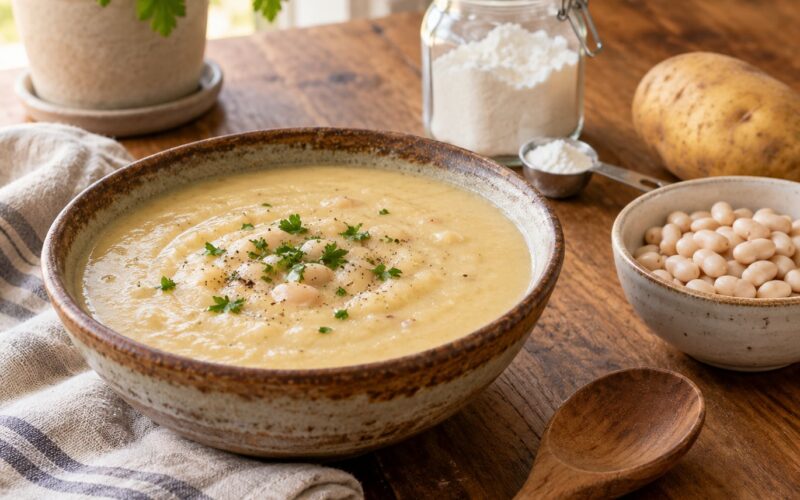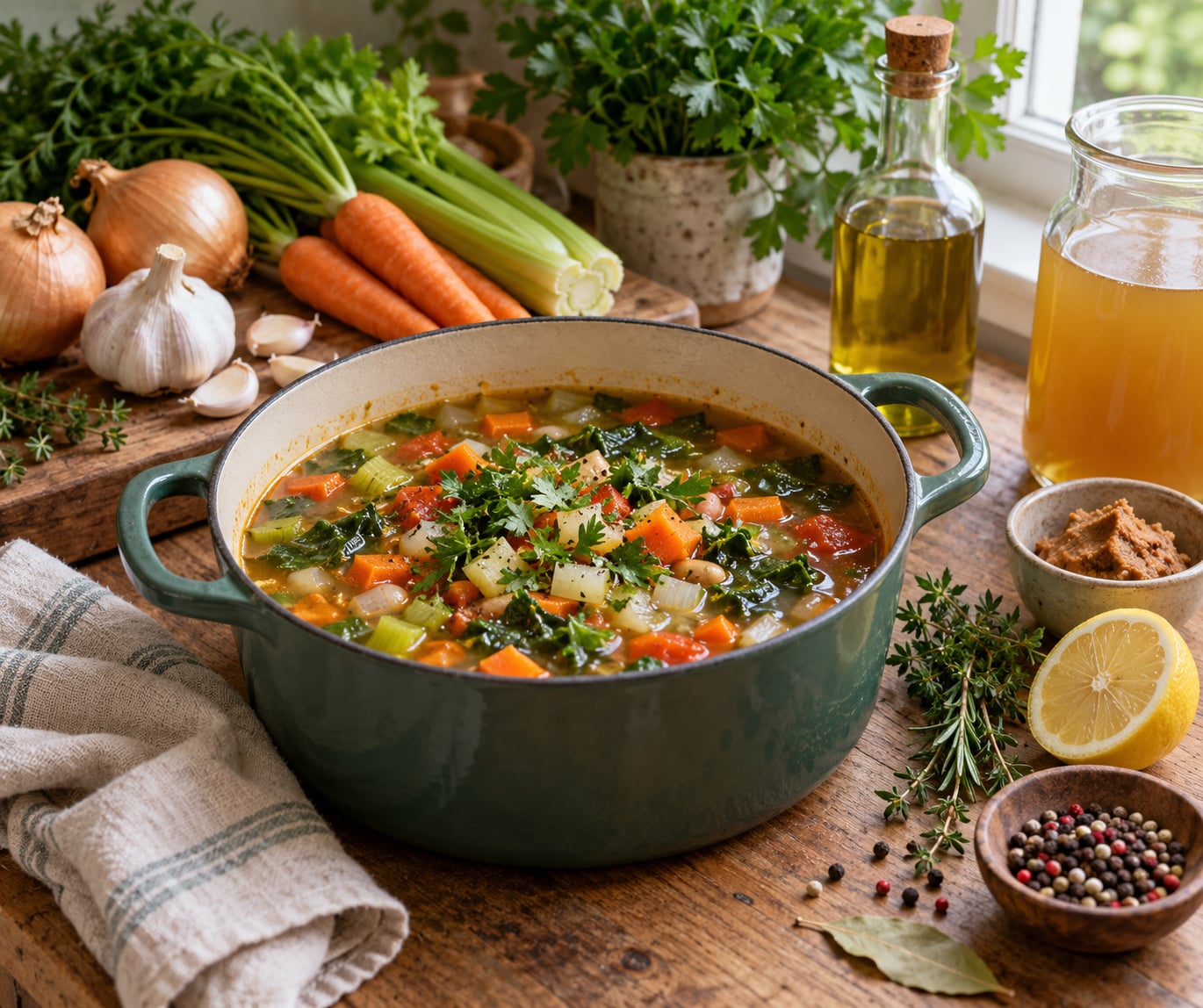
Vegan soup goes flat for one reason: it has no built-in savory backbone. Meat, dairy and long simmering hand you fat, glutamates and body for free, and a plant-based pot has to supply each of those on purpose. So the question of how to build flavor in vegan soup comes down to layering in a fixed order: fat, aromatics, salt, umami, spice, acid, then texture and fresh herbs. Most pots that taste dull skipped one or two of those, usually umami and acid. Get the order right and almost any vegetable soup improves.
This takes about 45 minutes for a weeknight pot, and none of the techniques require anything exotic. Everything below works in a soup that started from scratch and in one that already simmered and disappointed you.
Table of Contents
- What You Need
- Step-by-Step
- 1. Start with a savory aromatic base
- 2. Toast spices and use them in layers
- 3. Add umami ingredients
- 4. Build acidity and balance
- 5. Use fresh herbs and greens deliberately
- 6. Add contrast through texture
- 7. Finish, taste, and adjust
- Common Mistakes
- Frequently Asked Questions
- What is the best way to make vegan soup taste savory?
- How can I make bland vegetable soup taste better?
- What adds umami to vegan soup?
- Should I add salt, vinegar, or lemon before or after cooking vegan soup?
- Can I add miso or soy sauce to any vegan soup recipe?
- How do I thicken vegan soup without dairy?
- Conclusion
What You Need
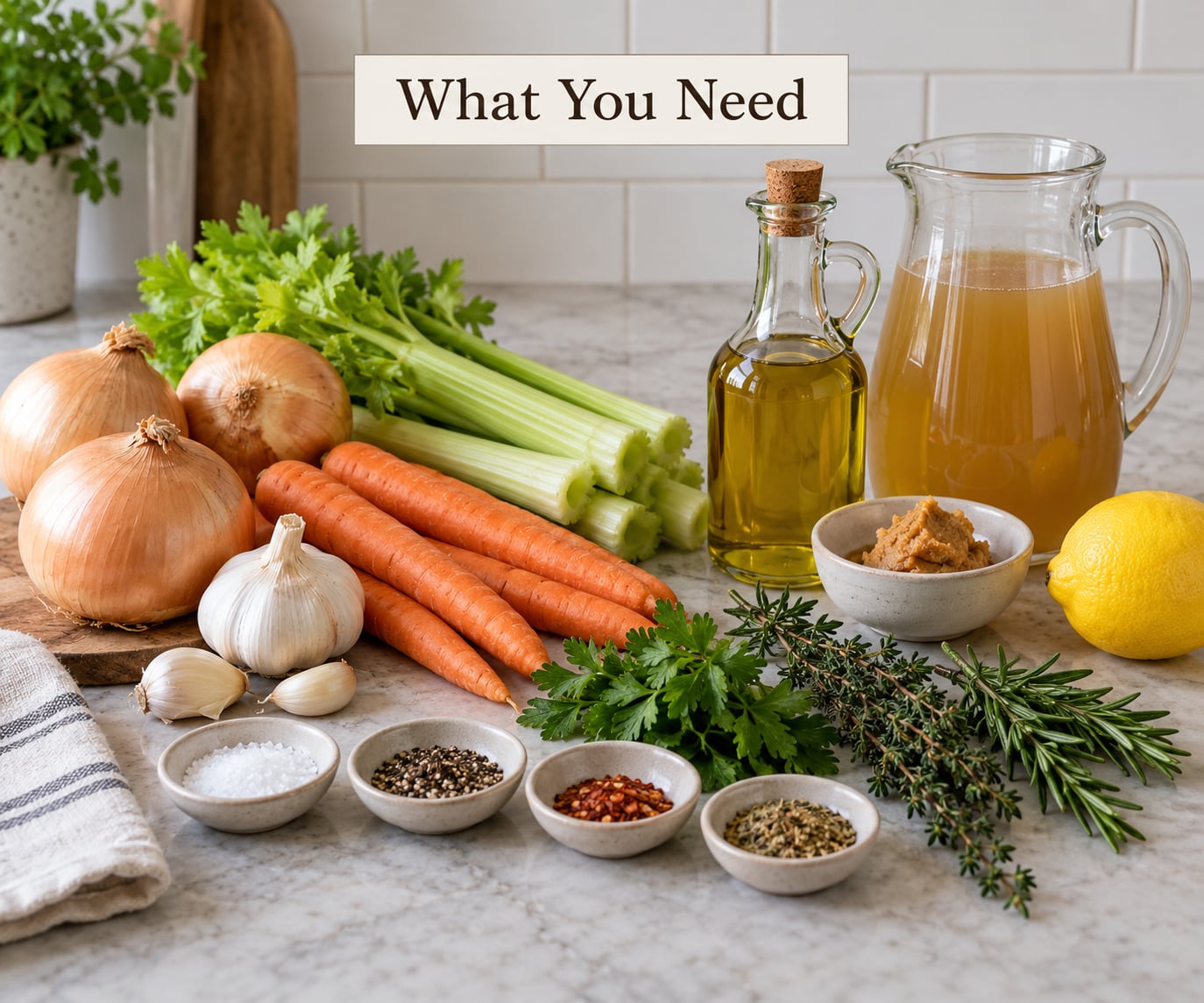
You need less than most people buy. Gather the aromatics first, because they are the layer everything else sits on: onion, garlic, celery, carrot, leek or a combination. Two or three of those, chopped fine, is enough for a pot serving four.
Next, fat for cooking. Olive oil works for most soups, and it does double duty if you keep a little back to drizzle over the bowl. A neutral oil like canola is fine for bean and corn soups where you want the vegetables in front. Ghee-style vegan butter or a spoonful of cashew butter also works when a soup needs dairy-style richness without dairy.
Umami boosters are the group people under-buy. Have at least three on hand: white or yellow miso, soy sauce or tamari, tomato paste, nutritional yeast, dried shiitake or porcini powder, or a vegetable bouillon concentrate. Kombu and dried seaweed give a gentle marine depth. A spoonful of vegan Worcestershire works too, but check the label, since traditional versions are built on anchovies.
For acid, keep two kinds: something bright and citrusy (lemon juice, lime zest) and something with more edge (sherry vinegar, red wine vinegar, balsamic, apple cider vinegar). Powdered sumac does the job of lemon in soups with warm spices.
Heat comes from whole spices and chile: bay leaf, dried thyme, cumin seed, coriander seed, smoked paprika, chile flakes, or a curry powder. Toast them whole if you can, and buy small amounts, because ground spices go flat fast.
Broth is the base liquid. Store-bought vegetable broth is the dependable choice, homemade stock is deeper but costs an afternoon, and a bouillon concentrate punches up an existing broth with one spoonful and no simmering.
For texture, plan something crunchy to scatter on top: toasted pepitas or sunflower seeds, croutons, fried shallots, or roasted chickpeas. A finishing green (kale, chard, spinach) stirred in at the end thickens the pot while adding color.
Step-by-Step
1. Start with a savory aromatic base
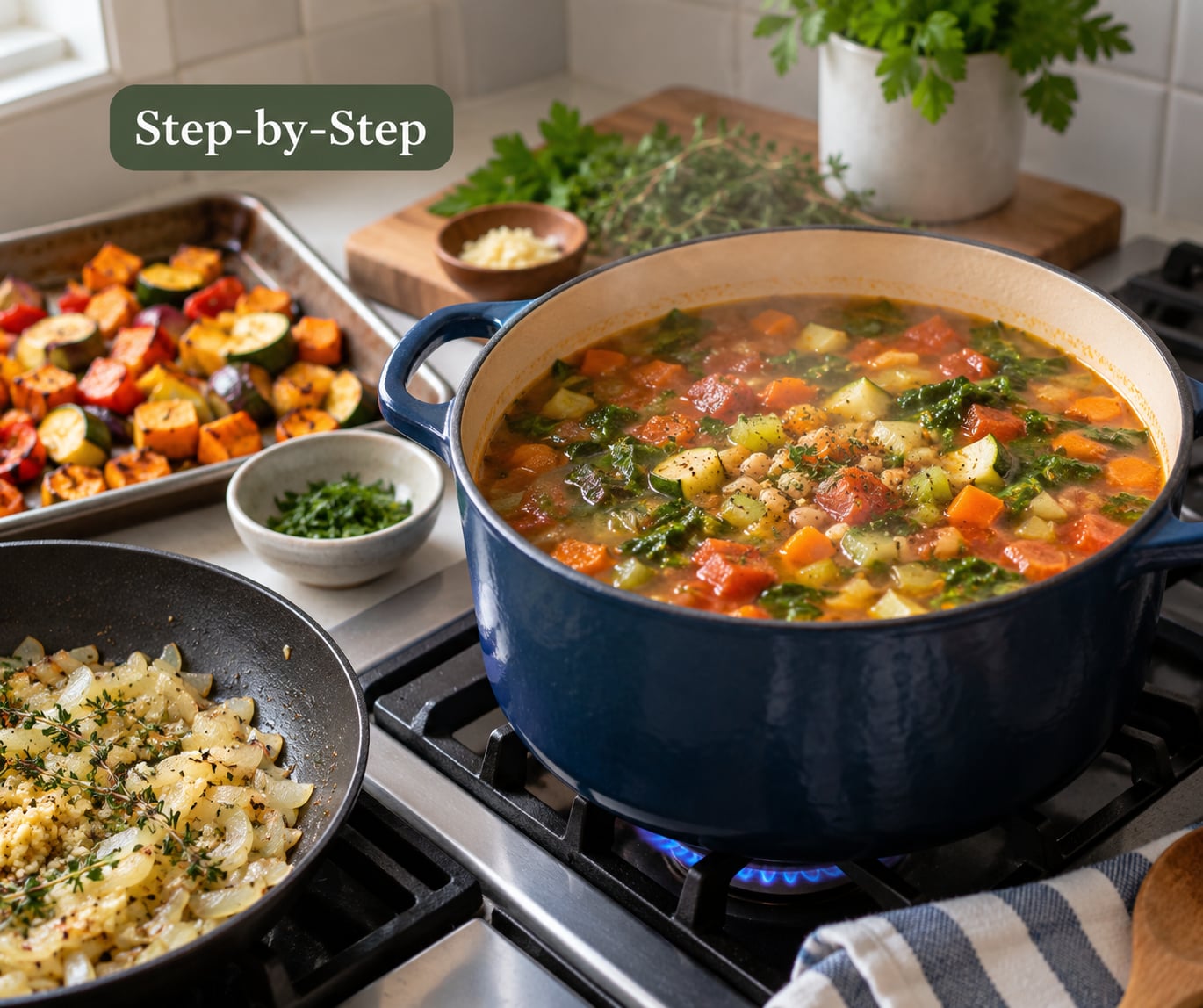
Cook your aromatics in fat before any liquid goes in. Heat a tablespoon of oil in a heavy pot over medium, add diced onion, carrot and celery, and cook 8 to 10 minutes until soft and translucent with a few golden spots. Add garlic for the last minute only, because burnt garlic turns bitter and nobody can hide it.
How you know it worked: the pot smells sweet rather than raw, and the bottom of the pot has a light golden film you can see when you push the vegetables aside. That film is the flavor base, and scraping it up with the liquid is deglazing, which is where a real soup flavor comes from.
Take it further when you have the time. Caramelize onions alone over medium-low heat for 25 to 30 minutes until deep amber, or roast a tray of onion, carrot and garlic at 425°F until charred at the edges. Charred edges concentrate sugars and glutamates, and a small amount of smoke reads as depth rather than char.
2. Toast spices and use them in layers
Blooming spices in hot fat for 30 to 60 seconds wakes up the oils that carry aroma. Add cumin, coriander, fennel seed, whole chile, or curry powder to the pan with the aromatics and stir constantly until fragrant. If it darkens past chestnut brown in that minute, it has burnt.
Split your spices instead of dumping them all in early. Put two-thirds in with the aromatics so they cook into the base, and hold the rest back for the last five minutes of simmering or for the bowl. Ground spice added only at the end tastes brighter and more aromatic than the same spice simmered for an hour, which turns dusty and flat.
Whole bay leaves and dried thyme are the exception. They need time, so they go in at the start with liquid and come out before serving.
3. Add umami ingredients
Umami is the fifth taste, the savory depth that makes a broth taste finished. Vegetables release less of it than meat does, so a vegan soup has to be given some on purpose.
- White or yellow miso: one tablespoon per quart, whisked into a little warm broth before you add it so it does not clump. Add it off the heat at the end, because long simmering flattens the aroma and destroys the live cultures.
- Soy sauce or tamari: one to two teaspoons per quart. It is salted, so cut your added salt back. Tamari is the gluten-free swap and tastes slightly less harsh.
- Tomato paste: one or two tablespoons fried in the pan until it darkens and sticks, before the liquid goes in. That caramelized paste adds more depth than a can of diced tomatoes.
- Dried mushroom powder: a teaspoon of powdered shiitake or porcini stirred into hot broth dissolves completely and reads as savoriness with no mushroom texture.
- Nutritional yeast: a tablespoon or two for a nutty, faintly cheesy note. It does not replace parmesan in a soup, but it does add body.
- Kombu: a strip added while the broth simmers and removed before serving, for a clean marine depth.
- Sun-dried tomatoes, olives or capers: a small quantity stirred in late, for a salty, fermented edge.
- Roasted onion and garlic: already built in step 1, but worth counting as an umami layer.
Two boosters in the same pot compound. A soup with tomato paste, soy sauce and a spoonful of miso tastes more savory than three times the amount of any one of them, because glutamate receptors respond to the sum.
4. Build acidity and balance
Acid is the most underused step in home soup and the fastest fix for anything that tastes heavy. Add it off the heat, tasting as you go: a teaspoon of sherry vinegar, a tablespoon of lemon juice, a splash of balsamic, or a pinch of sumac in a lentil or chickpea soup. Stop when the soup lifts, not when it puckers.
How you know it worked: the flavors separate and get more distinct instead of blurring together. A soup that needs acid tastes flat and dull at the same time, like it is behind a window.
Balance matters as much as addition. If acid makes a soup taste thin rather than bright, it needs body, which usually means reduction or blended beans rather than more vinegar.
5. Use fresh herbs and greens deliberately
Sturdy herbs such as thyme, rosemary, sage, and bay go in early and cook. Tender herbs such as basil, cilantro, parsley, dill, and chives lose their aroma in a long simmer, so stir them into the pot after you take it off the heat, or scatter them over each bowl.
Greens work the same way. A handful of kale or chard added in the last five minutes thickens the soup while it cooks, so it does more than decorate. Spinach and tender greens go in at the very end, in the pot or in the bowl.
6. Add contrast through texture
Texture is a flavor dimension and the one most home cooks skip. A pot of uniformly soft soup reads as bland no matter how well seasoned it is, because every spoonful feels the same.
Toast pepitas, sunflower seeds, or sesame in a dry pan until they pop and smell nutty, then scatter them over the top. Add croutons, fried shallots, or roasted chickpeas for real crunch. Blended legumes stirred into the pot at the end give body without dairy, and they thicken the broth enough that it feels like it has weight on the spoon.
7. Finish, taste, and adjust
Before serving, run a five-point check and adjust one thing at a time.
- Salt: does it need more than you think? If you are hesitating, add a pinch and taste again.
- Acid: a teaspoon of lemon or vinegar, stirred in off the heat.
- Umami: a spoonful of miso or a teaspoon of soy or tamari.
- Richness: a drizzle of good olive oil, a spoon of cashew cream, or coconut milk stirred in at the end.
- Texture: toasted seeds, croutons, or fried shallots on top.
Then let it sit five minutes before you taste it again. The flavors need a moment to settle, and a soup that tasted sharp straight off the burner often tastes balanced after a short rest.
If the pot is thin rather than flat, reduce it. Simmer uncovered until it thickens and the flavors concentrate, which does for flavor what evaporation does for texture. Watch it toward the end, since a pot that reduces by half can go from seasoned to oversalted quickly.
If the soup is already cooked and bland, the rescue takes under a minute. Warm it, taste, then add in this order: umami first (miso, soy, or bouillon), then acid, then salt, then a finishing oil. Add a handful of greens or a scoop of blended beans if the body is missing. Skim any oil that has pooled on top first, since old fat tastes stale and no amount of acid fixes it.
Common Mistakes
Most dull soup is not one problem. It is a specific failure, and naming the failure tells you the fix faster than adding more of everything.
It tastes flat and dull rather than salty. This is the classic one, and readers on cooking forums report it constantly: they add salt, then herbs, then more salt, and nothing changes. The missing ingredient is umami or acid, not salt. Fix it with one tablespoon of white miso per quart and a tablespoon of lemon juice off the heat.
It tastes thin and watery. Thickness is a flavor problem, not just a texture problem. Reduce the soup uncovered, stir in blended white beans or a spoonful of cashew cream soaked in hot broth, or add a finishing oil and a crunchy garnish so each spoonful has weight.
It tastes harsh or vinegary. You added acid too much or too early. Acid added before simmering tastes sharper because it keeps cooking. Pull it back with unsalted broth or water and finish with fat, which rounds sharp edges.
It tastes salty but still boring. You have hit the salt ceiling and the flavor underneath is missing. Umami boosters and roasted vegetables both add depth without adding sodium.
The aromatics burned. Garlic added with the onions burns before the onions soften, and one burnt clove flavors the whole pot. Garlic goes in for the last minute, and if you see dark brown, start the pot over.
You hard-boiled the pot. A rolling boil churns the soup, dulls aromatics, and can break emulsions. Bring it up to a bare shimmer, then hold it there with the lid slightly ajar so it reduces and concentrates instead of steaming.
Dairy-free cream went in early. Coconut milk and cashew cream split or turn grainy after a long simmer. Add them in the last ten minutes, or blend them in off the heat.
Everything went in the pot at once. Spices, acid, fresh herbs, and cream have different clocks. When they all go in at once, something is always overcooked and something is always raw. Work in the order above.
Frequently Asked Questions
What is the best way to make vegan soup taste savory?
Cook your aromatics in fat until they soften and brown, then add measured umami: about one tablespoon of white miso per quart, one to two teaspoons of soy sauce or tamari, or two tablespoons of tomato paste cooked until dark. Season with salt at each cooking stage rather than only at the end, and finish with a squeeze of lemon off the heat. Vegetables release far less glutamate than meat does, so the depth has to be supplied deliberately.
How can I make bland vegetable soup taste better?
Check the body before you add more salt. If it needs depth, stir in a spoonful of miso, a teaspoon of soy sauce, or a pinch of dried shiitake powder per quart. If it needs brightness, add a teaspoon of lemon juice or sherry vinegar off the heat. If it is thin, simmer it uncovered to reduce, blend in cooked white beans, or add cashew cream. Then finish with toasted seeds and a raw olive oil drizzle.
What adds umami to vegan soup?
The strongest pantry options are white or yellow miso, soy sauce or tamari, tomato paste fried until it darkens, and dried shiitake or porcini powder. Kombu adds clean marine depth, sun-dried tomatoes and olives add fermented saltiness, and nutritional yeast adds a nutty note. Combining two or three of these in one pot produces more savory flavor than a large amount of any single one, because the glutamate compounds.
Should I add salt, vinegar, or lemon before or after cooking vegan soup?
Salt goes in at every stage: when the aromatics hit the pan, when the broth goes in, and during the simmer, so each layer is seasoned as it builds. Acid goes in at the very end, off the heat. Vinegar and lemon added early keep cooking and taste sharper and flatter than they should, and heat dulls fresh citrus aroma. Add a teaspoon at a time and taste between additions.
Can I add miso or soy sauce to any vegan soup recipe?
Almost any savory soup takes miso or soy, and both work best with measured amounts: one tablespoon of miso or one to two teaspoons of soy per quart. Use tamari instead of soy sauce if you are avoiding gluten. Skip both in sweet soups such as butternut squash or fruit soups, where they read as salty rather than savory. Because both add salt, reduce the salt you add separately.
How do I thicken vegan soup without dairy?
Simmer the soup uncovered until it reduces, which concentrates flavor as well as body. Blend cooked white beans or chickpeas with some of the broth and stir them back in for a creamy thickness. Cashew cream blended with hot broth does the same job as cream, and it goes in during the last ten minutes so it does not split. A handful of kale or chard added at the end thickens the pot while it wilts.
Conclusion
Start with the aromatic base, because nothing downstream can rescue undercooked onions. From there work outward: a measured umami booster, salt at each stage, acid off the heat, then herbs and crunch on top. If you only change two things in your next pot, make them a spoonful of miso and a squeeze of lemon added after the heat comes off. That pair fixes most of the flat vegan soup I have encountered.