You can make jam without pectin by cooking ripe fruit with plenty of sugar and a little lemon juice until the fruit’s own pectin activates and the water boils away. It takes about 30 minutes of stirring, and the honest tradeoff is a softer, spoonable set rather than the stiff jelly commercial pectin produces.
That softer set is why this method has survived since before boxed pectin existed, and why plenty of home canners still prefer it. The fruit tastes like itself instead of tasting like the box it came from, and you can use up the soft, overripe berries sitting in the fridge before they turn.
Below is the full method, including the ratio table, the cold plate test, and what to do when the jam refuses to thicken.
Table of Contents
- What You Need
- The fruit-to-sugar ratio that matters
- Why Jam Sets Without Pectin
- How to Make Jam Without Pectin: Step-by-Step
- Step 1: Choose and Prepare the Fruit for Jam Without Pectin
- Step 2: Combine the Fruit, Sugar, and Acid
- Step 3: Cook Until the Jam Reaches the Right Set
- Step 4: Fill, Process, and Cool the Jars
- Common Mistakes and How to Fix Them
- Frequently Asked Questions
- Is it possible to make jam without pectin?
- What can I use instead of pectin for jam?
- Can you test jam on a cold plate?
- How can I fix jam that didn’t set?
- How long does homemade jam keep without pectin?
- Conclusion
What You Need
Nothing in the list is specialty. Sugar, citrus, a pot, a spoon, and jars are the whole shopping trip.
- Fruit — strawberries, blueberries, blackberries, raspberries, peaches, plums, apples, grapes, sour cherries, or any combination.
- Granulated sugar — measured by weight where you can. Use the amount in the ratio table below.
- Lemon juice — fresh or bottled. Lime juice works the same way, and grapefruit juice is fine if that is what you have.
- A wide pot — 8 to 10 inches across. A narrow pot scorches the bottom before the middle thickens.
- A long spoon or spatula, a kitchen thermometer, and a freezer for the cold plate test.
- Two or three small plates that can go in and out of the freezer.
- Jars, a funnel, a clean damp towel, a jar lifter, and a pot deep enough to hold jars for boiling-water processing.
The fruit-to-sugar ratio that matters
The ratio is the whole recipe. Too little sugar and the jam will not gel and will not keep; too much and you get candy. Weigh the sugar if you own a scale, since cup measures lie about sugar by a wide margin.
| Prepared fruit | Sugar | Lemon juice | Approximate yield |
|---|---|---|---|
| 2 cups crushed or chopped | 1 to 2 cups (200 to 400 g) | 1 to 3 tablespoons | 1 pint to 1 and a half quarts |
| 4 cups prepared fruit | 2 to 3 cups (400 to 600 g) | 2 to 4 tablespoons | 2 to 3 half-pint jars |
| 3 pounds apples or grapes | 3 to 4 pounds sugar | 2 tablespoons | 5 to 6 half-pint jars |
Follow a tested recipe for any batch you intend to can. NCHFP, the National Center for Home Food Preservation at the University of Georgia, publishes tested formulations, and changing the sugar in one of them changes its safety, not just its texture.
Why Jam Sets Without Pectin
Jam sets for three reasons working together, and commercial pectin is only a shortcut around them.
- Sugar draws water out of the fruit. Plain sugar pulls juice from the cells by osmosis, which is why a bowl of berries dusted with sugar goes to syrup at the bottom after an hour.
- Acid lines the pectin molecules up. Citrus juice drops the pH of the mixture, and pectin only links into a network when the pH is right. This is why recipes that skip the lemon juice give you syrup that never thickens no matter how long you boil it.
- Boiling removes water. Evaporation concentrates everything until the pectin network is dense enough to hold the jam in place.
Every fruit has pectin, and the amount decides how much sugar and how much cooking time the batch needs. Fruits high in pectin set on their own with less help, which is why apple and grape jam are the traditional no-added-pectin jars.
| Natural pectin content | Fruits | What it means for you |
|---|---|---|
| High | Apples, crabapples, grapes, quinces, citrus peel and seeds, gooseberries, sour cherries | Sets with less sugar and a shorter boil. No pectin needed. |
| Medium | Blackberries, raspberries, figs, apricots, plums | Sets reliably with a 1 to 1 sugar ratio and moderate cooking. |
| Low | Strawberries, blueberries, peaches, cherries, pears, mango | Needs the full 2 cups sugar per 2 cups fruit, plus lemon juice, plus time. |
Pectin also lives in apple skins and cores and in citrus peel, which is why some home canners save green apple cores or lime peel and drop them in for the last ten minutes of the boil. You fish the pieces out before filling the jars.
How to Make Jam Without Pectin: Step-by-Step
Start with 2 cups of prepared fruit and 1 and a half cups of sugar if you want a middle-of-the-road batch. Double it for a bigger pot. Total time is about 40 minutes including cooling.
Step 1: Choose and Prepare the Fruit for Jam Without Pectin
Use fruit that is ripe enough to smell like itself but still firm. Rock-hard fruit will not give up its juices in time, and mushy fruit cooks down to a paste with no structure left.
Wash everything, then hull strawberries by slicing off the top and the white core, and pull the stems from currants and gooseberries. Leave small berries whole. Mashing them tears skins and seeds and turns the finished jam gritty, so crush only the fruit a recipe tells you to crush.
Peel stone fruit if you want smooth jam, and the easiest way is a thirty-second blanch: put the fruit in boiling water, lift it out, and slip the skins off under cold water. Chop larger fruit into even one-inch pieces so it cooks at the same rate as the rest.
Step 2: Combine the Fruit, Sugar, and Acid
Put the prepared fruit in your widest pot. Add the sugar and lemon juice from the ratio table and stir over medium heat until the sugar dissolves completely, which takes about three minutes.
Dissolving sugar before the boil matters. Sugar dumped into already-boiling fruit sits in heavy crystals at the bottom, and those crystals are what turn a glossy jam grainy later.
For chia or another packaged thickener, follow the amount on that product and use it only when the recipe allows it. Chia gives a freezer-style jam in about fifteen minutes with no cooking at all, and it changes the texture, so it does not belong in a cooked canning recipe.
Step 3: Cook Until the Jam Reaches the Right Set
Bring the mixture to a full boil, then drop the heat so it holds a steady simmer. Stir often, especially as it thickens, because the bottom scorches fast once the volume drops. Skim the foam off the top as it rises. Expect 20 to 40 minutes; stone fruit and whole berries take longer than crushed berries.
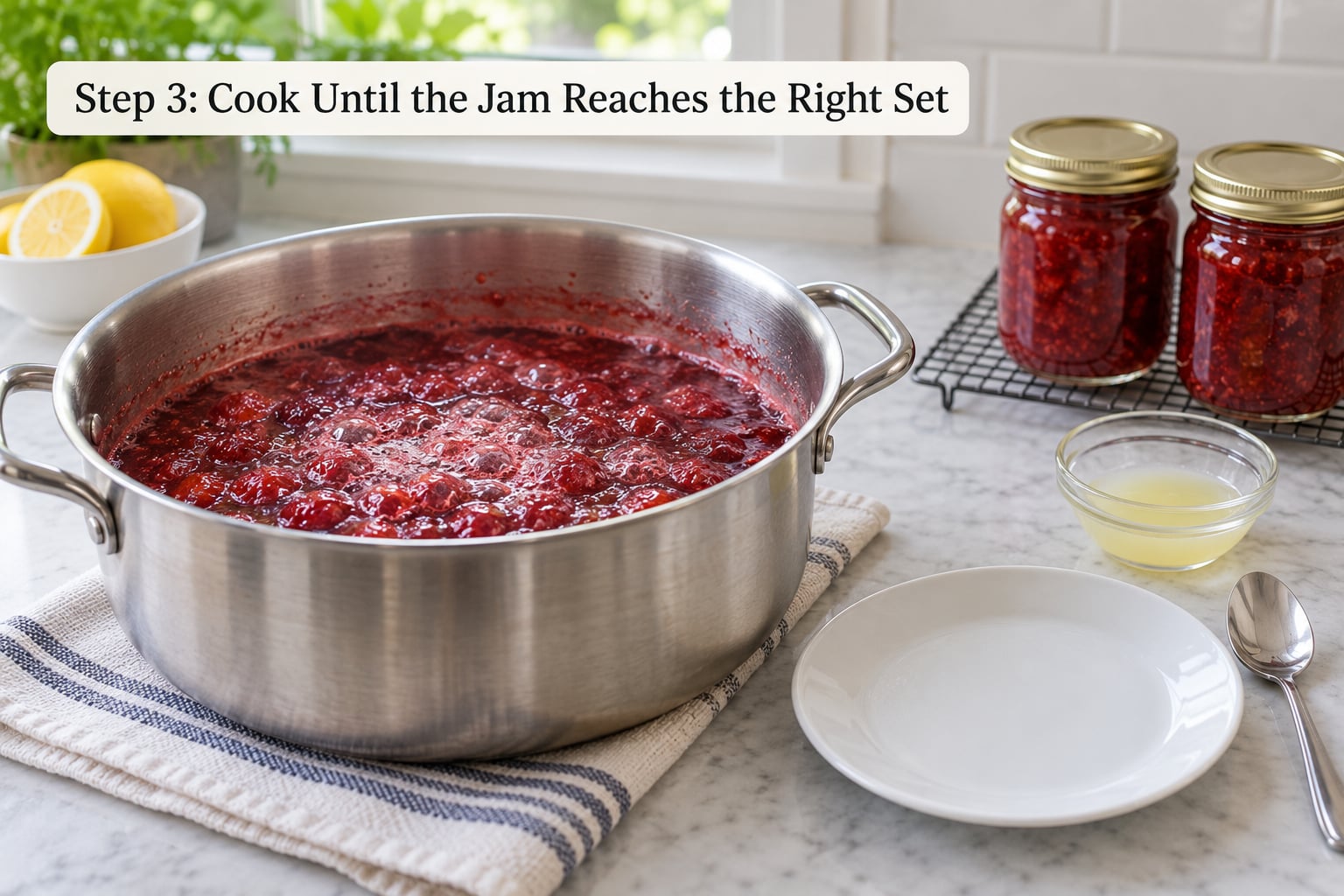
One accepted way to learn this part is the thermometer, since cooked jam sits around 220 degrees Fahrenheit, or 104 degrees Celsius, at sea level. If you live up a mountain, the boiling point drops about a degree for every 500 feet of elevation, so use the cold plate test instead of chasing a number.
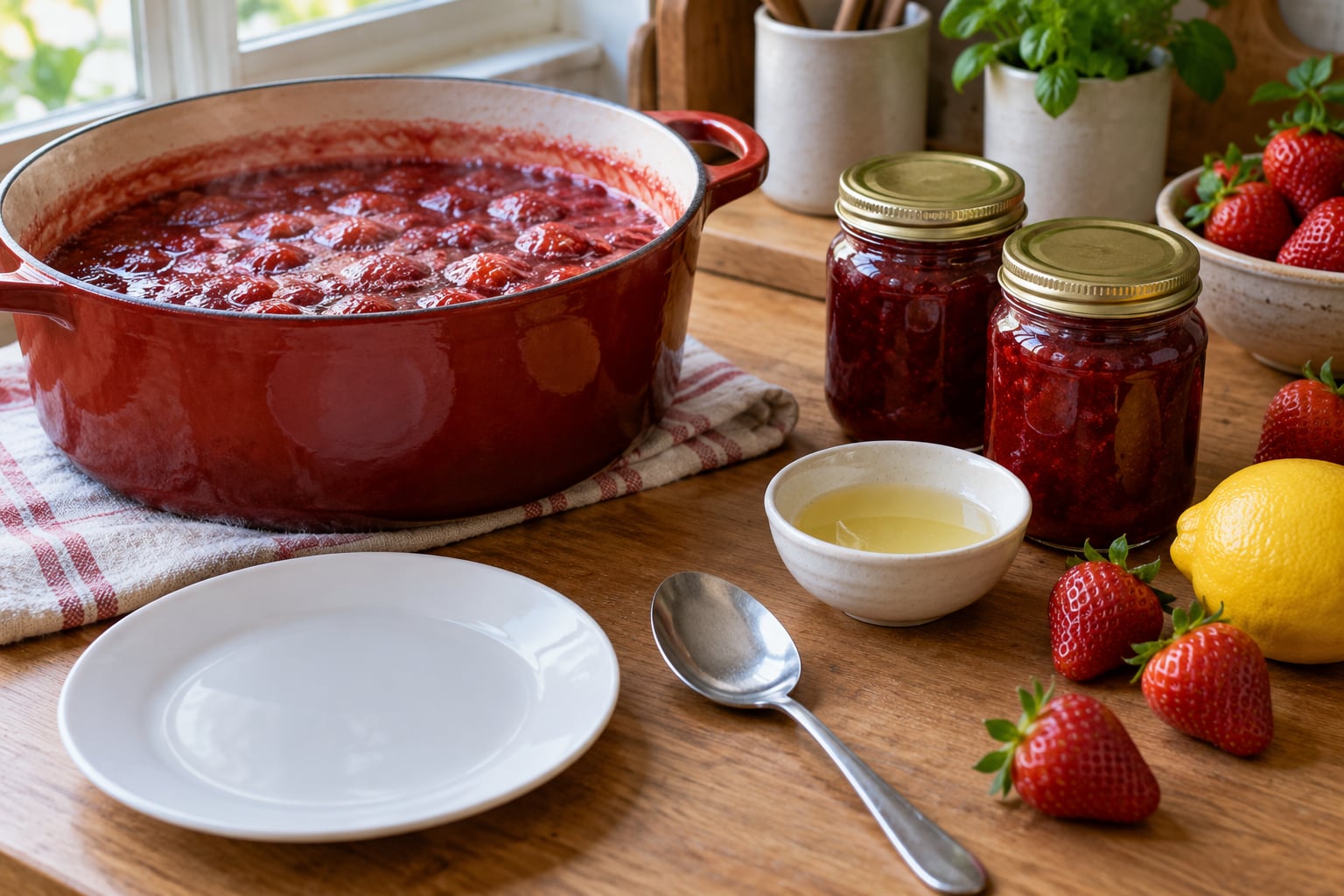
The cold plate test costs nothing and is the one most home canners actually use:
- Freeze two or three small plates in the freezer for at least 10 minutes.
- Spoon a small dab of jam onto a cold plate. Use a teaspoon, not a ladle.
- Return the plate to the freezer for one to two minutes.
- Push the edge of the jam with your fingertip. If it wrinkles and holds the shape, the set is right. If it runs flat and shiny, keep cooking and test again.
You are looking for a fine gel, not a rubbery gummy bear. A proper no-pectin set should wrinkle gently and hold a light touch, then relax slightly within a few minutes as it cools. Jam can be a touch under at this stage and still firm up as it cools, so do not push it past the wrinkle.
Step 4: Fill, Process, and Cool the Jars
Have clean jars, lids, funnel, and damp towel ready before you start cooking. Hot jam waits for nothing.
Fill the hot jars, leaving the headspace the tested recipe specifies, usually a quarter inch for most jams. Tap the jar gently on a folded towel to release trapped air, add more jam if needed, and wipe the rim clean with a damp cloth. A sticky rim will not seal.
Screw the flat band on until it is snug, then the lid band on until it just clicks. Over-tightening drives a warped band across the sealing surface and the jar will not vacuum properly.
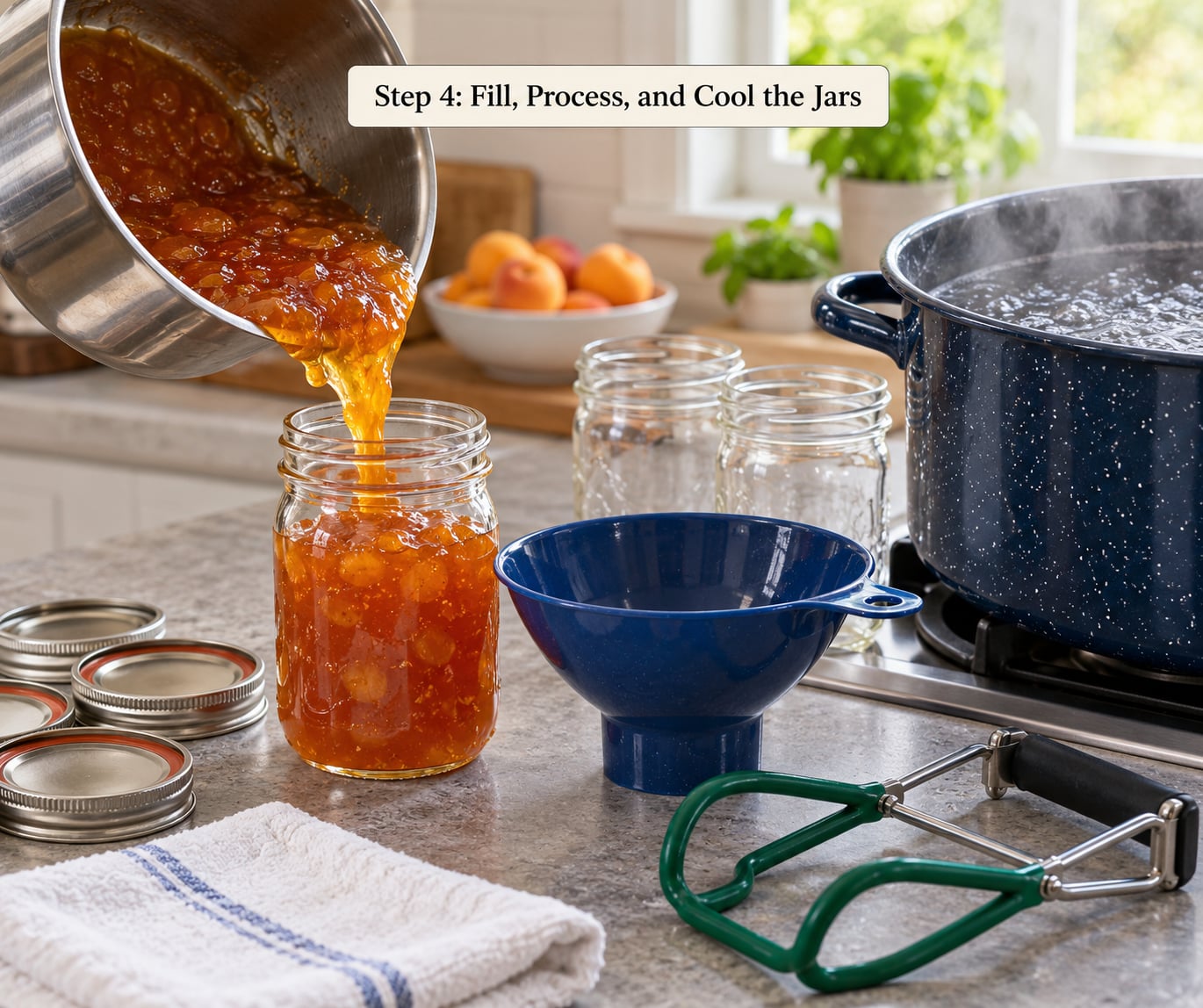
Process the jars in a boiling-water bath only when a tested recipe for that exact batch calls for it, and follow that recipe’s time. Water-bath processing is for high-acid products. A no-pectin jam with reduced sugar and no added acid is low acid, and a water bath will not make it shelf safe.
Use the refrigerator or freezer for anything you improvised. Then let the jars sit undisturbed for 12 to 24 hours before you touch a lid, because the seal finishes setting as the jar cools.
| Storage method | How long it keeps | Notes |
|---|---|---|
| Refrigerator, in sealed jars | 2 to 3 weeks | Simple and reliable. The easiest choice for a first batch. |
| Freezer, in plastic containers | 9 to 12 months for best quality | Leave 2 inches of headspace, since jam expands as it freezes. |
| Boiling-water canned, tested recipe only | 12 to 18 months for best flavor | Color and flavor fade past that, though the jars stay safe. |
Whichever route you take, use a clean spoon every time you dip in. Two weeks in the fridge and a year in the freezer are the honest numbers for a home batch.
Common Mistakes and How to Fix Them
The jam is still runny. Almost always a sugar or acid shortfall, or a test plate that was not cold enough. Boil it again and retest every two minutes. If it refuses to set after 20 more minutes, you can stir in a commercial low-sugar pectin according to its directions and bring it back to a boil, or keep it as freezer jam and skip the trouble.
The jam is too firm. You overcooked it. Warm a jar in a microwave-safe bowl for 20 seconds at a time, stirring, until it loosens. It will never return to a loose jam, only to spreadable.
Sugar crystals on top or in the jam. The classic syrup crystallized during storage. Warm the sealed jar in a hot water bath until it dissolves, or microwave in short bursts with the lid loose. Hummingbird rhubarb jam, unstrained, crystallizes faster than any I have made, so warm it before serving.
Foam that will not stop. The pot is too narrow and the jam is boiling over. Stir down, skim, and drop the heat. A spoon of butter or a squeeze of lemon cuts stubborn foam, but only add it before the set test.
Scorched fruit at the bottom. Too much heat and not enough stirring at the end of the reduction. Spoon the jam off the dark layer before filling, and next time go one notch lower on the burner in the final ten minutes.
Mold, fuzz, or an off smell. Discard the whole jar. Sugar does not make spoiled jam safe, and there is no rescuing it.
A jar that did not seal. Store it in the refrigerator and eat it first. Do not retighten the band hoping for a better result, and never re-process a jar with a bulging lid.
Frequently Asked Questions
Is it possible to make jam without pectin?
Yes. Sugar draws water out of the fruit, lemon juice activates the fruit’s own pectin, and boiling the mixture removes enough water that the pectin forms a gel. The set is softer and more spoonable than commercial pectin jam, which is why jam traditions without pectin have existed for centuries.
What can I use instead of pectin for jam?
Lemon juice, lime juice, or citric acid provide the acid that activates natural pectin. Extra sugar and a long boil thicken low-pectin fruit on their own. For freezer jam, chia seeds gel the fruit without any cooking. Cornstarch works for a sauce-style jam, but the texture is closer to pudding than preserves.
Can you test jam on a cold plate?
Freeze two or three plates for 10 minutes. Spoon a teaspoon of jam onto one, return it to the freezer for a minute or two, then push the edge with your fingertip. A proper set wrinkles and holds its shape. A runny jam smears flat and shiny, which means keep cooking and test again.
How can I fix jam that didn’t set?
Put it back on the heat and boil it again, testing every two minutes, checking that the sugar and lemon juice went in at the right ratio. If it still will not gel after 20 minutes, stir in low-sugar pectin as the package directs, bring it to a full boil, or store the batch in the freezer instead.
How long does homemade jam keep without pectin?
Sealed jars in the refrigerator keep 2 to 3 weeks. In the freezer, jam keeps 9 to 12 months for best quality. Jars processed in a boiling-water bath from a tested recipe stay safe about a year, with the best flavor in the first 6 to 12 months. Any improvised batch goes in the fridge or freezer.
Conclusion
Pick a tested recipe for the fruit you have, because the sugar and acid ratios are what make the batch set and what make it safe. Wash your jars and get them out before the pot goes on the burner, and measure the sugar by weight if you can.
Then trust the cold plate rather than your eyes. A gentle wrinkle at 220 degrees Fahrenheit, cool the jars 12 to 24 hours before you touch them, and keep anything improvised in the refrigerator.