To season beans like Southern cooking, you build flavor in layers instead of adding salt at the end: render smoked pork fat or use a smoked stand-in, saute onion and garlic in that fat, bloom pepper and spices in it, then simmer the beans slowly in bouillon so the broth drives itself into them. A small splash of vinegar or mustard in the last few minutes is what separates a pot that tastes seasoned from one that merely tastes salty.
Most bland pots of beans trace back to seasoning too little, too late, or leaning on salt alone. Beans absorb flavor rather than giving it off, so a spoonful of dry spice stirred in at the end does almost nothing, while a teaspoon of vinegar at the finish makes everything you already put in taste louder.
The whole method works on dried beans, canned beans, or a bag of fresh shelled ones, and it scales without much fuss. A pot of pinto beans takes about an hour and a half of gentle simmering, most of it hands-off, and the seasoning base alone is worth making once and keeping in a jar. Last updated October 2026.
Table of Contents
- What You Need to Season Beans Like Southern Cooking
- Step-by-Step: Building Southern Style Beans From Scratch
- Build the Southern Seasoning Base
- Cook the Beans Until Tender and Flavorful
- Finish and Serve
- Common Mistakes When Seasoning Beans
- Frequently Asked Questions
- What is the best way to season beans like Southern cooking?
- Can I season canned beans instead of cooking them from scratch?
- How do I make seasoned beans taste smoky without a grill?
- What spices go best with beans for a Southern-style flavor?
- How much salt should I add to beans?
- Can I make Southern-style seasoned beans vegan and gluten-free?
- The Short Version
What You Need to Season Beans Like Southern Cooking
You need very little to pull this off, and nearly all of it is a pantry item. The essentials are beans, a fat, an aromatic, a smokiness source, a salty liquid, and an acid. Everything else is a variation on that list.
Here is the base formula. Amounts are per pound of dried beans, which is roughly eight cups soaked, and they scale linearly, so double everything for a potluck batch.
| Ingredient | Amount per pound of dried beans | What it contributes |
|---|---|---|
| Smoked pork | 1 smoked ham hock, or 4 slices bacon, or 1/3 cup bacon grease | Smoke and savoriness, plus gelatin from the bone that thickens the broth |
| Yellow onion | 1 large, diced | Sweetness and body; the backbone of the pot |
| Garlic | 4 to 6 fresh cloves, smashed | Pungent depth; jarred minced garlic is a downgrade in every application |
| Smoke or savoriness source | 2 chicken bouillon cubes, or 1 ham base scoop | Salt and meat-stock depth in the cooking liquid |
| Liquid | 6 to 8 cups water or chicken broth | The cooking medium that carries flavor into the bean |
| Black pepper | 2 teaspoons cracked | Warmth and a little heat; bloom it in fat |
| Smoked paprika or chipotle | 1 to 2 teaspoons | Smoke without meat, for the vegan and no-meat version |
| Red pepper flakes or cayenne | 1/2 teaspoon to 1 teaspoon | Heat that wakes up the pot; easy to overdo |
| Apple cider vinegar | 1 tablespoon, added at the end | The finishing lift that makes everything else read as seasoned |
| Kosher or smoked salt | 1 to 2 teaspoons, added in stages | Seasoning across the cook rather than all at once |
Substitutions are where this gets forgiving. A smoked turkey neck or wing works in place of the ham hock, ham base or a spoon of the bean pot’s own grease covers it when you have no pork at all, and smoked paprika plus a chopped chile in adobo sauce is the version most cooks land on when they want the smoke without the meat. Onion powder and garlic powder stand in when you have no fresh aromatics, using about a teaspoon each, though they never taste quite the same.
On salt: smoked salt and blended seasoning salt are not the same thing. Smoked salt carries a hint of wood flavor; seasoning salt is mostly salt with garlic, onion and pepper already ground in, so it seasons and seasons again. Use one or the other, and taste before you add more.
One safety note that gets skipped constantly. Red kidney beans contain a natural toxin called phytohemagglutinin, which is destroyed by proper cooking, and the ten-minute boil that softens their skins is the important part, not the soak. If you soak kidney beans, discard that water and start fresh, and never cook them slowly from cold water alone.
Step-by-Step: Building Southern Style Beans From Scratch
Build the Southern Seasoning Base
The seasoning base is a ten-minute job at the start, and it is the step that separates good beans from great ones. Render your bacon, or brown the ham hock, in a heavy pot, and if you are working with no meat, melt butter or olive oil instead and add 1 to 2 teaspoons of smoked paprika or chipotle to stand in for the missing smoke.
Into that fat goes the diced onion and the smashed garlic, and you cook them over medium heat until the onion is translucent and just starting to brown, about 6 to 8 minutes. Add the black pepper and the red pepper flakes at that moment, not earlier, and give them 30 seconds in the hot fat to bloom. Dry spices scattered into wet beans taste dusty; spices bloomed in fat taste round and carry into the broth.
From there you adjust the blend. For mild beans, leave out the chile and go heavy on the onion. For smoky beans, double the paprika or add a chipotle in adobo, chopped, seeds and all. For spicy, work up the cayenne a quarter teaspoon at a time. For herb-forward beans, hold the fresh herbs back to the very end, because parsley and cilantro added at the beginning of a long simmer turn dull and grassy.
Pour in your liquid and the bouillon, stir to scrape up every browned bit from the bottom of the pot, and you have your base ready for the beans.
Cook the Beans Until Tender and Flavorful
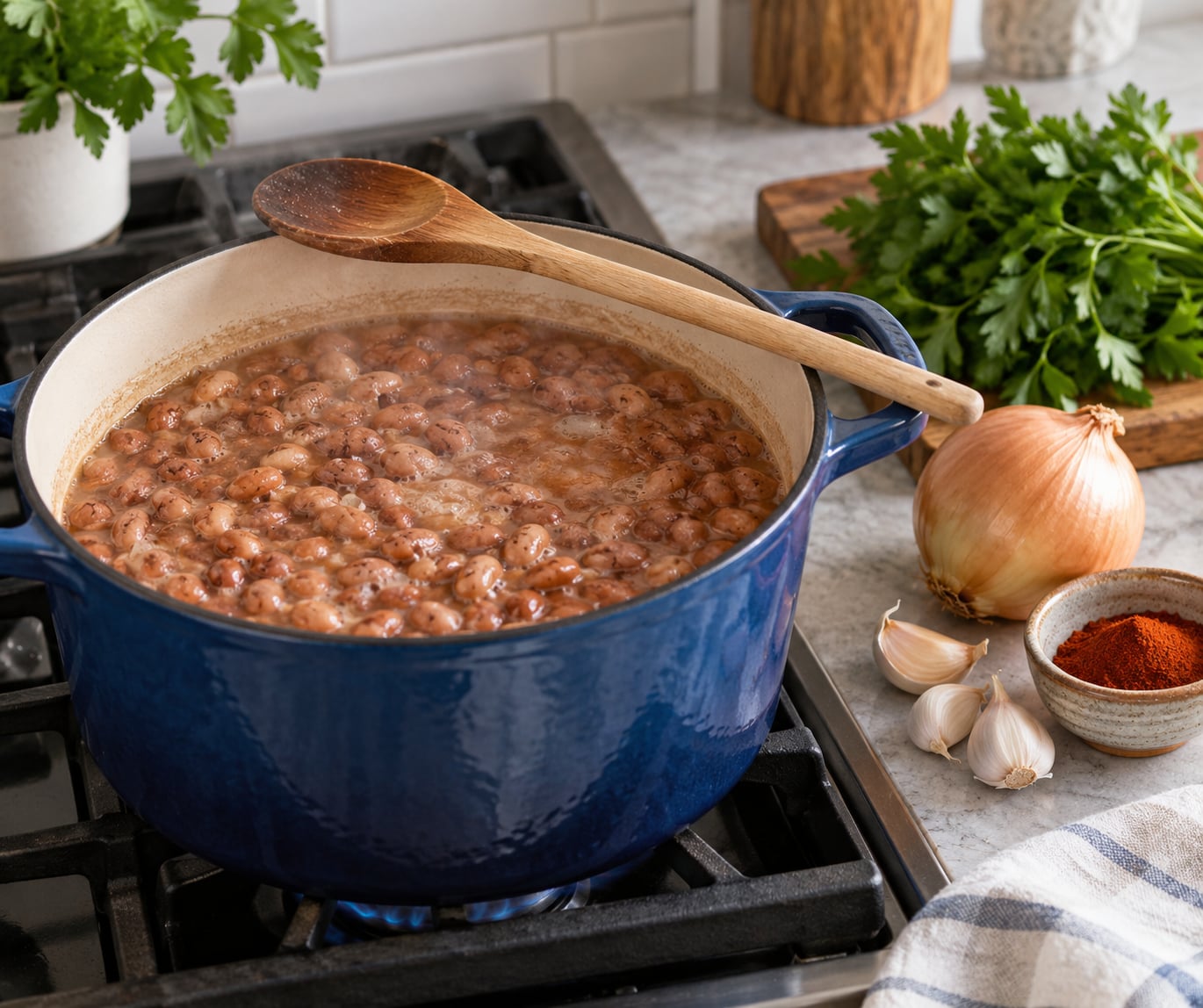
Beans need a simmer you can barely hear, not a rolling boil. A hard boil skins the outside while the center stays hard, and the agitation is what turns a pot of tender beans into mush by accident. Bring the pot up to a boil once, then drop the heat until you see a bubble every second or two.
For dried beans, soak overnight in cold water with a tablespoon of baking soda if you want to cut the cook time, or skip the soak and boil them straight through. Either way the beans go into the pot with the seasoning base, not into plain water first. Keep the liquid at least an inch above the beans and top it up with hot water as it absorbs.
Timing depends on the bean and on how old the bag is, so go by feel rather than the clock. Pinto, black and kidney beans run 90 minutes to 2 hours. Navy and great northern beans are faster, around 60 to 90 minutes. Lima and butter beans take about 60 to 75 minutes. A kidney bean should crush easily between two fingers at the end, with no resistance left in the center, and pinto beans should bend without snapping.
Salt in two stages. Put a modest amount in with the bouillon and again after the beans have softened about two-thirds of the way, then hold the rest until the pot is finished. Smoked meat and bouillon are both already salty, and salt added at the end tastes stronger than the same amount added early, so most of a well-seasoned pot is salted in the final fifteen minutes.
Add the acid near the end, once the beans are tender. Vinegar, mustard or pickle brine go in for the last 10 to 15 minutes of simmering, or off the heat entirely, and more than a tablespoon per pound will sour the pot rather than lift it.
A slow cooker on low gives you the same gentle simmer, roughly 6 to 8 hours with a presoaked bean and 8 to 10 without. A pressure cooker needs less water than a stovetop pot since none escapes, so use about 4 cups for a pound of beans, add the seasoning base as usual, and pressure cook for about 30 to 40 minutes with a natural release. The tradeoff is texture: a pressure cooker leaves far less window to stop before mush, so check early rather than at the end.
For canned beans, skip the long cook. Rinse them, then simmer them in your seasoned broth for 20 to 30 minutes so they take on the flavor instead of just warming through. A comment-technique home cooks like: boil 4 cups of water with a few cubes of bouillon, onion and a strip of pork for an hour to build broth, then add the rinsed beans and cook them only for the can’s stated time, holding all extra salt until the very end. It takes longer than opening the can, but the pot tastes like it simmered all day.
Store cooked beans in the refrigerator for three to four days, or freeze them flat in a bag with as much air pushed out as you can manage, for up to two to three months. Beans reheated the next day always taste better than beans served the hour they were cooked, because the liquid has had time to soak in.
Finish and Serve
Finish beans with a final taste and a final salt, then add the things that would have faded in a long simmer. A knob of butter or a drizzle of olive oil stirred in at the end gives the broth a gloss, fresh parsley or cilantro goes on now rather than earlier, and a spoonful of pickled onion or a splash of hot sauce does more work than another pinch of salt.
The classic table is cornbread, especially a buttermilk cornbread dipped in the pot’s own broth, plus a pile of cooked greens, white rice, or biscuits. Beans also carry over well into next-day meals: spoon them over rice with a fried egg, blend them into soup with broth and a handful of greens, or mash them with olive oil and garlic for a quick spread.
By bean type, the seasoning shifts. Soup beans want a full smoked hock, more black pepper, and a longer simmer. Pot beans and side beans want the base as written with a modest chile. Lima and butter beans are delicate and buttery, so they take garlic, black pepper and a light hand on the salt, plus a squeeze of lemon at the end. Green beans are cooked fast and hot, so you render smoked sausage or bacon first, bloom pepper flakes in the fat, and keep them just tender-crisp, about 6 to 8 minutes in a hot pot.
Baked beans are their own system rather than a variation. The base pot beans get drained of most of their liquid, then baked with molasses and brown sugar for sweetness, apple cider vinegar for edge, yellow mustard for a little bite, and either bacon or smoked paprika on top. A workable ratio per pound of dried beans is about a third cup of molasses, a third cup of brown sugar, a quarter cup of brown sugar substitute or light honey if you want more, 2 tablespoons of vinegar, and 1 tablespoon of mustard. Bake covered at 350°F for about an hour, then uncovered for 20 minutes to thicken.
Refried beans run the opposite direction, toward fat and garlic. Mash cooked beans with a splash of their liquid, then fry fresh garlic in olive oil until pale gold, pour the hot oil over the mash, and work it in. Infuse a quarter cup of oil at a time and you get the gloss and body of a restaurant version, and 16 cloves of garlic is not a mistake at that stage. Salt and pepper go in last.
All of this works without meat, and it works gluten-free as long as you leave the flour-thickening out of it. Skip the pork, use smoked paprika, chipotle or smoked salt for the smoke, and use a fat you eat; the only gluten trap in a pot of beans is a thickening roux, and you do not need one.
Common Mistakes When Seasoning Beans
These are the failures behind nearly every disappointing pot, and each one has a specific fix.
Salting the whole pot at the start. Beans shed their skins less readily in salty water, so the texture comes out tough. Stage it instead: a light hand early, the rest after the beans are tender.
Seasoning only at the very end. A last-minute stir of dry spices lands on wet beans and slides off. Bloom the spices in fat at the beginning, and keep the last-minute seasoning to salt, acid and fresh herbs.
Using a hard boil. Constant agitation softens the beans unevenly and turns them to paste. Bring to a boil once, then hold at a barely-there simmer.
Skipping the fat. Onion and garlic dropped straight into water never brown and never release their flavor. Saute them in butter, oil or rendered bacon grease until translucent and beginning to color.
Leaving out the acid. This is the one that leaves a pot tasting flat and slightly dusty even when it is well salted. A tablespoon of cider vinegar, a teaspoon of yellow mustard or a splash of pickle brine at the end changes how the whole pot reads.
Relying on a no-salt seasoning blend alone. Dry seasoning on wet beans has nothing to cling to, and blends built without salt often taste unfinished. Use the blend with fat and liquid, and add your own salt to taste.
Adding fresh herbs at the beginning. Parsley, cilantro and basil cooked for two hours go flat and brown. Add them off the heat.
Forgetting the double-sodium problem. Bouillon, ham base and smoked meat are all salty at once, which is where people overshoot. Season in layers, taste the broth at 30 minutes and again when the beans are done, and hold back more than feels right until the last check.
Cooking past texture. Beans keep softening for several minutes after the heat drops, so pull the pot a touch earlier than you think. A gently simmered batch with a little bite left in it is far better than a mushy one.
Frequently Asked Questions
What is the best way to season beans like Southern cooking?
The best way to season beans like Southern cooking is to layer flavor instead of adding salt at the end. Render smoked pork fat, saute onion and fresh garlic in it, bloom black pepper and red pepper flakes, then simmer the beans slowly in chicken bouillon. Salt in stages as the beans soften, and finish with a tablespoon of apple cider vinegar to lift the broth.
Can I season canned beans instead of cooking them from scratch?
Yes, and it takes about 30 minutes. Rinse the canned beans, then simmer them in a broth you built from bouillon, onion, garlic and any smoked pork for 20 to 30 minutes. The broth, not the can, is what seasons them, so add no extra salt until the beans are done and taste them last.
How do I make seasoned beans taste smoky without a grill?
Use smoked paprika, chipotle in adobo, smoked salt, ham base or a few drops of liquid smoke. Smoked paprika gives broad, gentle smoke and chipotle adds real heat, so start with a teaspoon of paprika and add a chopped chipotle if you want more. Liquid smoke is potent, so a teaspoon is usually plenty in a whole pot.
What spices go best with beans for a Southern-style flavor?
Black pepper, smoked paprika, red pepper flakes and cayenne are the core Southern-leaning spices, with cumin and garlic powder optional for a deeper, more Southwestern style. Warm all of them briefly in fat before the liquid goes in. The order matters less than the fat, since dry spice stirred into wet beans simply slides off the surface.
How much salt should I add to beans?
There is no single number, because bouillon, ham base and smoked meat all bring sodium of their own. Add a light layer at the start, another after the beans are two-thirds tender, and hold the rest until the pot is finished, tasting each time. Salt added at the end tastes stronger, so use less of it than you expect.
Can I make Southern-style seasoned beans vegan and gluten-free?
Yes, on both counts. Leave out the pork entirely and build the smoke with smoked paprika, chipotle in adobo, smoked salt or ham base, sauteing your aromatics in olive oil. Beans and their broth are naturally gluten-free, so just skip any roux or flour thickener, and check that your bouillon and smoked salt are certified gluten-free if you are strict.
The Short Version
Start with the fat, not the salt. Render your pork or melt butter, saute the onion and fresh garlic until translucent, bloom the pepper, then add the beans and bouillon and let everything barely simmer until the beans give way under a spoon.
Taste at 30 minutes, salt again once the beans are nearly tender, and add the vinegar at the end. That sequence is the whole answer to how to season beans like Southern cooking, and it works just as well on a pot of lima beans as it does on baked beans with molasses and cornbread on the side.