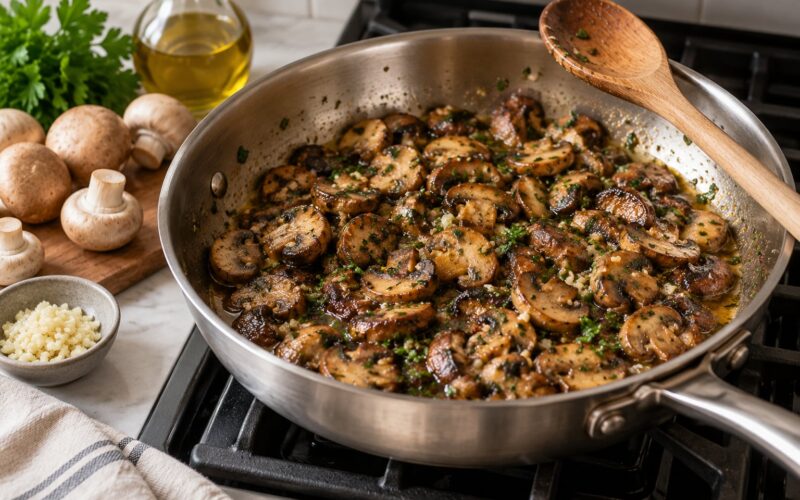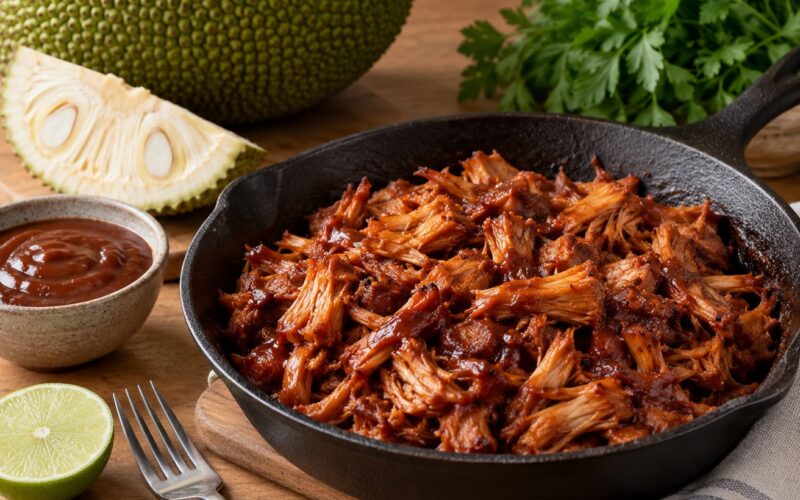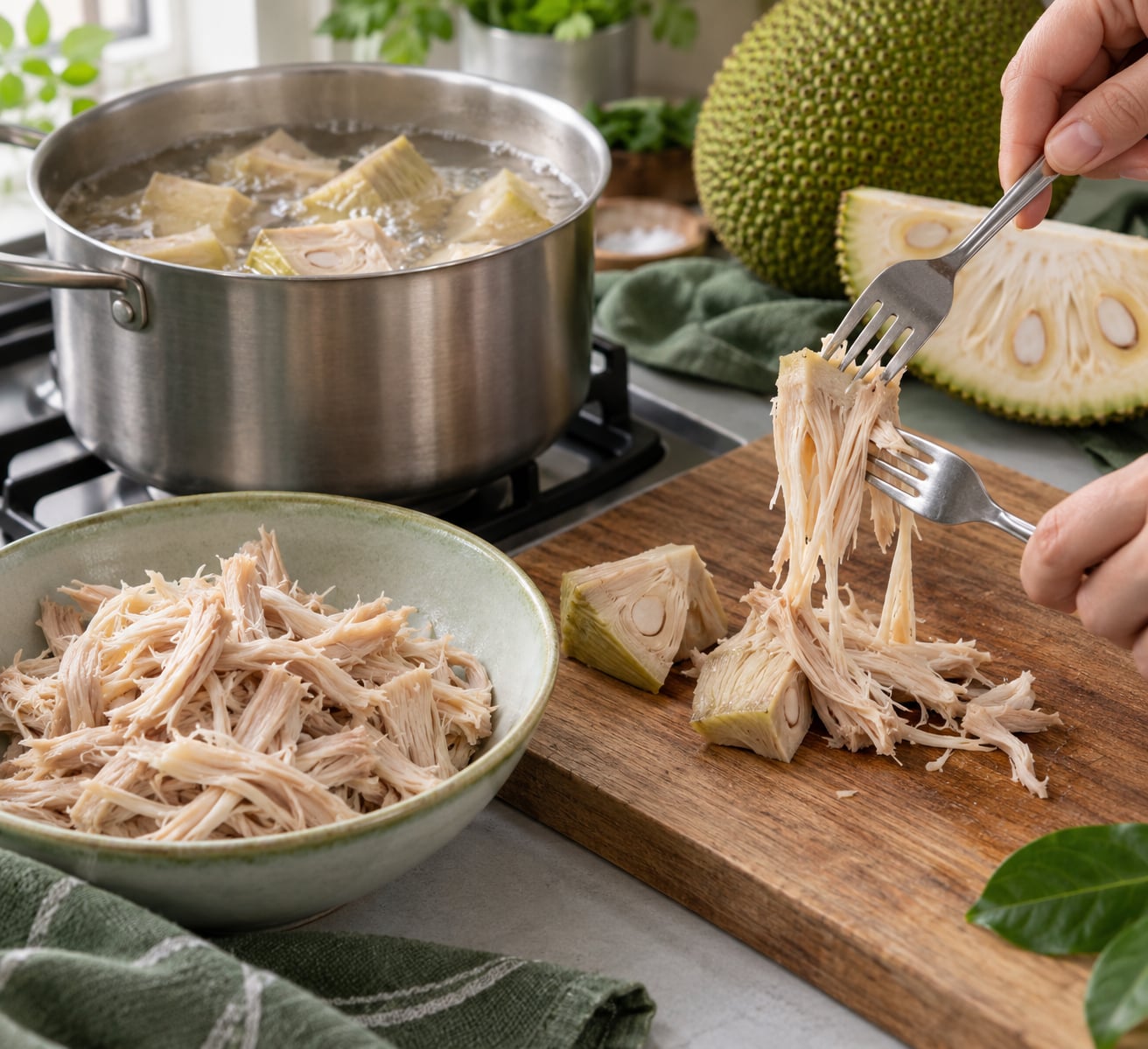
To cook jackfruit so it shreds, buy young green jackfruit, cut it into even chunks, and simmer it in salted water until a fork slides through the thickest piece with no resistance. Drain it, cool it a few minutes, then pull it apart with two forks into long strands. The whole thing takes about 35 minutes start to finish, and no special equipment.
The reason so much advice on this fails is that people treat shredding as a step you perform on jackfruit, when really it is a texture you have to cook into the fruit first. Undercooked jackfruit tears into rubbery strings. Overcooked jackfruit collapses into mush. The window between those two is wide, and it is easy to hit once you know what to look for.
Table of Contents
- What You Need
- Step-by-Step
- 1. Trim and Separate the Jackfruit
- 2. Simmer Until the Fibers Loosen
- 3. Test the Texture and Drain the Fruit
- 4. Shred Into Clean Strands
- 5. Season or Use Immediately
- Common Mistakes
- Frequently Asked Questions
- Why is my cooked jackfruit still tough?
- Can you use ripe yellow jackfruit for shredding?
- Can canned jackfruit be cooked until it shreds?
- Should jackfruit be shredded while hot or cold?
- How long does cooked shredded jackfruit last?
- Can I cook jackfruit in a pressure cooker or Instant Pot?
- Conclusion
What You Need
Jackfruit (Artocarpus heterophyllus) is a large tropical fruit, and only one stage of it is useful here: the young, green, unripe fruit. That immature flesh is built from dense fibrous strands held together by firm pectin, which is exactly why it can stand in for pulled pork once you soften that pectin and then pull the strands apart.
Mature yellow jackfruit will not work for this. Ripe flesh is sweet, soft and already collapsing, so it shreds into a purée rather than into strands. If you are shopping for the fruit itself, choose a firm green one that still has slight give at the skin, with no trace of yellow.
Canned young green jackfruit is the practical route for most kitchens. Two forms sit side by side on the shelf:
- Canned in brine (also labeled as salted water or brine) is softer and shreds faster, but it carries noticeable salt. Rinse it well, or your finished dish tastes like the ocean.
- Canned in water is neutral in flavor and needs longer cooking. This is the better can when you plan to season heavily, especially with spice or curry.
Check the label and buy the youngest fruit you can find. Cans packed with pale green, firm-looking pieces will shred better than ones with dull olive pieces that have sat for a while. Frozen chunks work too, and they behave like the fresh fruit in every way except convenience.
For a test batch, open two 20-ounce cans, which gives you roughly four to five servings once cooked down. You will also want a chef’s knife, a cutting board, a pot or skillet with a lid, a slotted spoon or colander, and two standard forks. That is the entire equipment list.
Whatever you use, check the chunky canned pieces and cut any that are much larger than the rest into smaller pieces. Uneven chunks are the single most common reason a batch shreds inconsistently, with some bites turning to paste while others stay tough. Getting the pieces to a similar size solves more problems than any other habit in this process.
Step-by-Step
What follows is the boil-and-shred method I use most often, because it is forgiving and hard to ruin. Simmering in plain salted water first, then seasoning afterward, gives you full control over flavor and stops a salty brine can from locking into the finished dish.
1. Trim and Separate the Jackfruit
For a can, tip the fruit into a colander and drain it thoroughly. Rinse under cool water and run your fingers through the pieces to wash off the surface brine. Pat the fruit dry and spread it on the board.
For a whole fresh fruit, cut it in half through the stem end with a heavy knife, working around the large central core. Scoop out the white core and any pale seeds, both of which stay firm no matter how long you cook them. Then pull the firm green rind off each wedge with your hands or a paring knife.
Cut the usable flesh into chunks roughly the size of a large walnut, two to three inches across at the widest point. Smaller pieces fall apart before the larger ones soften, so keep them in the same neighborhood.
2. Simmer Until the Fibers Loosen
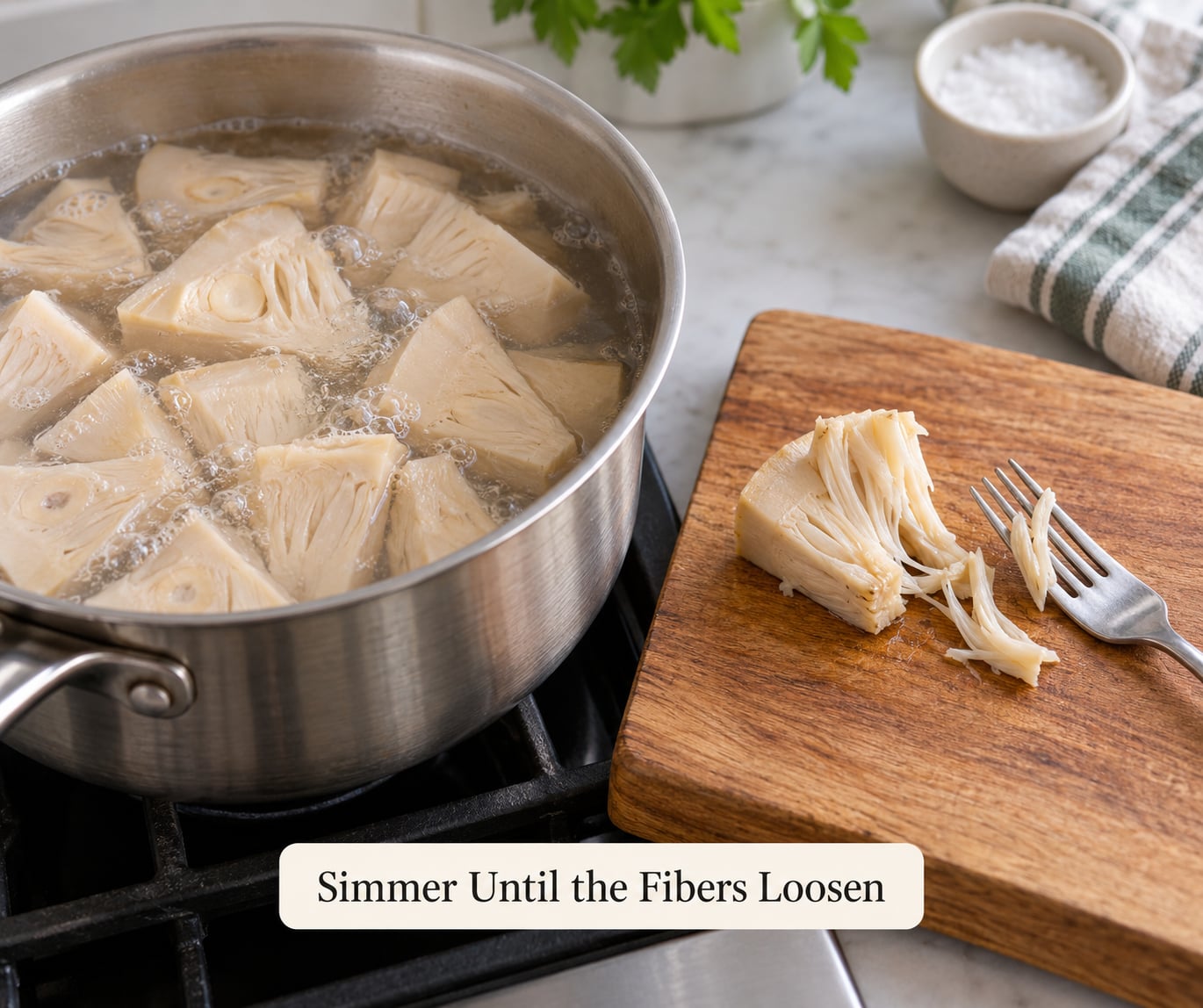
Put the chunks in a pot and add enough cold water to cover them by an inch. For every quart of water, stir in a generous teaspoon of salt. Optional aromatics that will not fight a later sauce: a halved onion, two smashed garlic cloves, a few black peppercorns, or a bay leaf.
Bring the pot to a boil, then drop the heat until the water barely moves. This is the step people skip. A rolling boil chews the outside of each chunk to paste while the center stays hard, which is exactly the combination that will not shred.
Cover with a tight lid and simmer for 25 to 35 minutes. The lid matters more than it looks: it traps steam, keeps the fruit sitting in moisture, and lets heat move into the center of the chunk instead of evaporating away from the surface. Water-packed fruit usually needs the full 35. Brine-packed pieces soften faster, so start checking at 20.
The clock is only a rough guide. The real test starts once the fruit can take a poke.
3. Test the Texture and Drain the Fruit
Pull one of the thickest chunks out and slide the tines of a fork into its side. You want them to enter with almost no resistance, like sliding into a warm slice of roast. If the fork meets a distinct wall of dense flesh, put it back and give it five more minutes.
Next, break a small piece open with the fork and pull the two halves apart slowly. The fibers should separate into clean strands on their own, with almost no force. That separation is the definitive cue, and it matters more than any timer.
Drain the fruit in a colander for a few minutes, then let it sit in the pot off the heat for three to five minutes. You are not trying to cool it to room temperature, only to take the edge off so you can handle it comfortably.
Do not let it sit in the cooking liquid for the rest of the prep, and do not rinse the cooked fruit. That water is seasoning now. If your batch looks loose and watery after draining, spread it on a baking sheet for five minutes or set the colander over a bowl and let it drip.
4. Shred Into Clean Strands
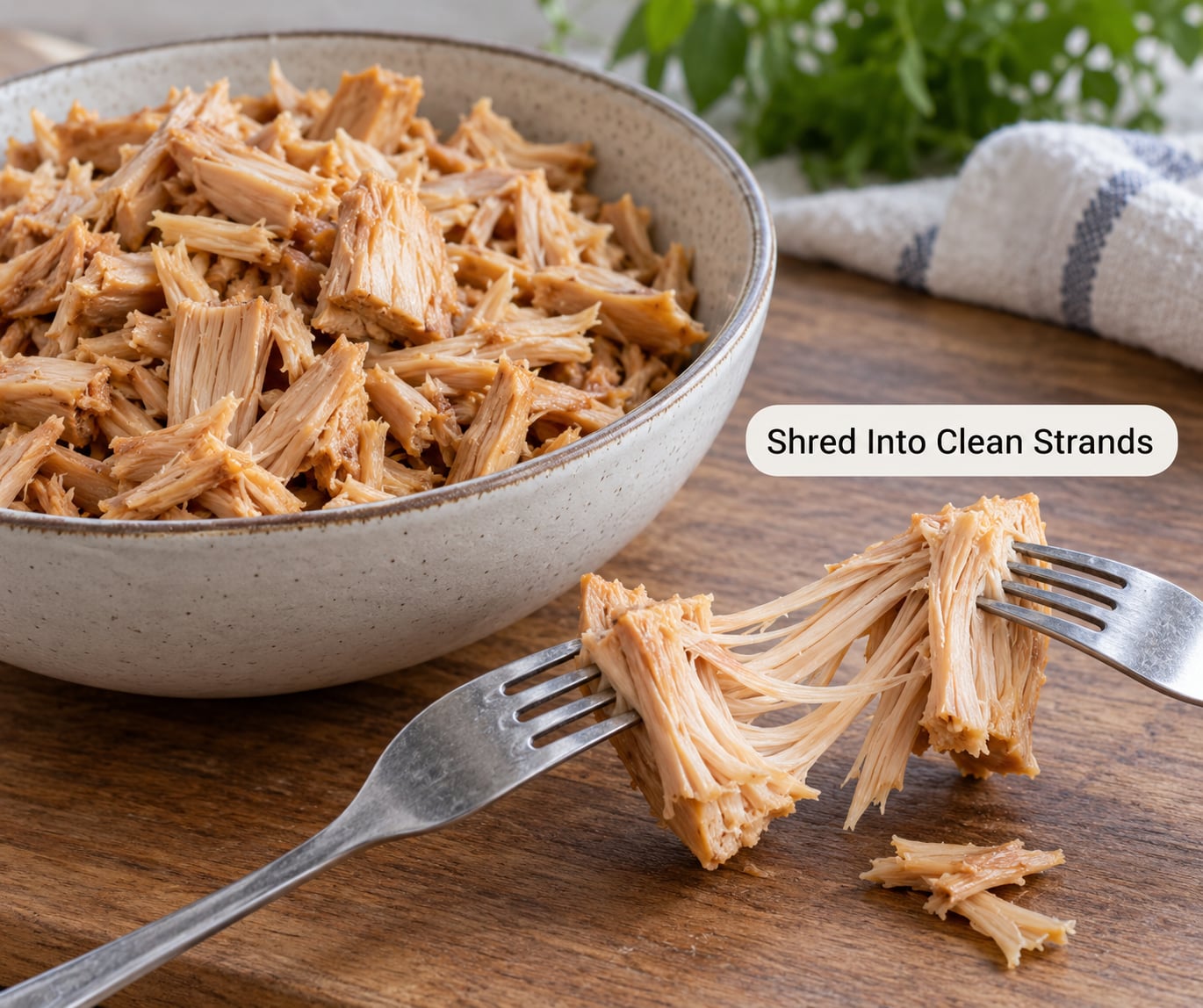
Set one piece on the board, hold it down lightly with one fork, and pull the second fork toward you in long strokes. Turn the piece, repeat, and keep going until little or nothing solid is left.
Pull with the grain whenever you can find it. The strands run in a direction through each chunk, and tearing against them creates short, broken bits instead of the long pulls you want for a sandwich.
If you hit a tough fiber that refuses to give, set that piece aside rather than fighting it. Those strings are the fruit’s sinew, concentrated near the core, and pulling harder just produces a mess. Most of the time they get skipped by the eater anyway.
Work in batches and keep the texture loose. Mashing instead of pulling, or crushing each piece while shredding, gives you the wet, clumped texture people mistake for bad jackfruit.
Two forks are the classic tool and the most controllable one. Hands work fine for smaller quantities once the fruit is properly cooked. A stand mixer with a paddle attachment does the job in about fifteen seconds on low speed, which is useful when you are doing two cans at once, though the strands it makes are shorter.
5. Season or Use Immediately
Season to taste while the fruit is still warm. Warm strands drink up sauce, and cold ones stay slick and separate.
For pulled-pork style barbecue, warm a teaspoon of neutral oil in a skillet, add the shredded fruit, then two-thirds of your barbecue sauce and a splash of water. Simmer for 8 to 10 minutes until thickened, then fold in the rest of the sauce off the heat so it stays bright.
For curry, bloom cumin, coriander, turmeric or garam masala in oil for 30 seconds before the jackfruit goes in, then add a splash of coconut milk and simmer 6 to 8 minutes. The spice goes on the hot oil first, not at the end, or you will taste it raw.
For neutral seasoning, salt and black pepper are enough, and this is the version that works best in tacos, nachos and grain bowls where other toppings carry the flavor.
For storage, keep shredded jackfruit in an airtight container in the fridge for up to four days, or freeze it in a flat bag for up to three months. Reheat leftovers until steaming hot all the way through, which for most home fridges means 165°F, and add a splash of water or broth if the strands have dried out.
Common Mistakes
Almost every disappointing bowl of jackfruit traces back to one of the handful of problems below.
- Wrong maturity. Ripe yellow jackfruit cannot be saved by cooking. It shreds into a sweet, watery mush instead of strands. Buy young green fruit, canned or fresh.
- Undercooking. The fix is the fork test, not another five minutes on the clock. Push the tines into the thickest piece and pull a strand apart before you drain.
- Cutting pieces too small. Chunks smaller than a walnut turn to paste before the larger ones soften. Keep everything around two to three inches wide.
- A rolling boil. High heat scorches the outside and leaves the middle firm. Bring to a boil once, then drop to the lowest simmer that still shows movement.
- Draining too long. Letting cooked fruit sit in liquid for 20 minutes while you prep the rest dilutes the flavor and leaves strands slick. Drain promptly and let it cool only a few minutes.
- Pulling with one fork. A single fork tears and smears. You need one fork to hold the piece and the other to pull, working in the same direction every time.
- Seasoning before testing. Adding sauce early locks moisture in a sealed surface, and you cannot judge texture once it is coated. Season after the two-fork test passes.
- Undrained brine. Salt you cannot see is the reason a finished dish tastes overly salty. Rinse the raw pieces under running water and work the brine between your fingers.
One more tip that gets skipped: taste the cooking water before you add salt. Water-packed jackfruit releases very little of its own flavor, so a properly salted pot is the whole seasoning foundation for a plain shred.
Frequently Asked Questions
Why is my cooked jackfruit still tough?
Almost always one of four things. You used ripe or overripe fruit, which cannot shred no matter how long you cook it. Your chunks were too large to heat through in the time you gave them. You simmered rather than cooked, so the water never got hot enough to soften the pectin. Or you checked the clock instead of the texture. Push a fork into the thickest piece and pull it apart; it is ready when the strands separate with no force.
Can you use ripe yellow jackfruit for shredding?
No. Ripe jackfruit is soft, sweet and fibrous in a different way, so it collapses into a purée when you cook it instead of pulling into strands. It is delicious eaten fresh, in smoothies or as a tropical fruit salad, but it will never imitate pulled pork. Only the young green unripe fruit has the firm long fibers that shred. If the can says mature, ripe or ready-to-eat, put it back on the shelf.
Can canned jackfruit be cooked until it shreds?
Canned young green jackfruit is the easiest way to get a shreddable result. Drain it, rinse it to knock off surface brine, cut any oversized chunks down to match the rest, and simmer it in salted water with a tight lid for 25 to 35 minutes at a bare simmer. Test with a fork until the strands separate cleanly. Canned fruit has already been partly cooked, so it reaches shredding texture faster than fresh and usually needs less time under pressure.
Should jackfruit be shredded while hot or cold?
Shred it warm, right after it has drained and cooled for three to five minutes. Warm strands are flexible and separate cleanly, and they absorb sauce faster because their surfaces are soft. Cold or chilled jackfruit tends to stay slick and refuse to pull into long strands. If you have already shredded it and it went cold, warm it in a dry skillet for a few minutes and pull it apart again; it usually behaves normally.
How long does cooked shredded jackfruit last?
Keep it in an airtight container in the fridge and use it within four days. For longer storage, freeze it flat in a freezer bag for up to three months, then thaw it in the fridge overnight. When reheating, bring it to 165°F and stir in a splash of water or broth, since shredded fruit loses moisture quickly and dries out faster than it reheats. Sauce it after reheating, not before, so the strands stay distinct.
Can I cook jackfruit in a pressure cooker or Instant Pot?
Yes, and it is the fastest route to shreddable fruit. Add the drained and rinsed chunks with about one cup of water or broth, seal the pot, and cook at high pressure for 8 to 10 minutes for canned pieces or 12 to 15 minutes for fresh chunks. Let the pressure release naturally, then open carefully and shred. The liquid is concentrated and sometimes thick, so drain off most of it first and use it as braising liquid for the sauce.
Conclusion
Start with young green jackfruit, never the ripe yellow kind. Trim out the core and any hard fibers, cut the flesh into even pieces about the size of a walnut, and simmer it covered in salted water at a bare simmer until a fork slides through with no resistance. Drain it for a few minutes, shred while it is still warm, and season afterward. That sequence, in that order, is what turns a can of jackfruit into strands that behave like pulled pork.