Most broken sauces come back in under two minutes. Take the pan off the heat, whisk in a tablespoon of cold water or a single ice cube, and stir gently until the fat and water knit together again. That one move fixes the majority of splits home cooks hit.
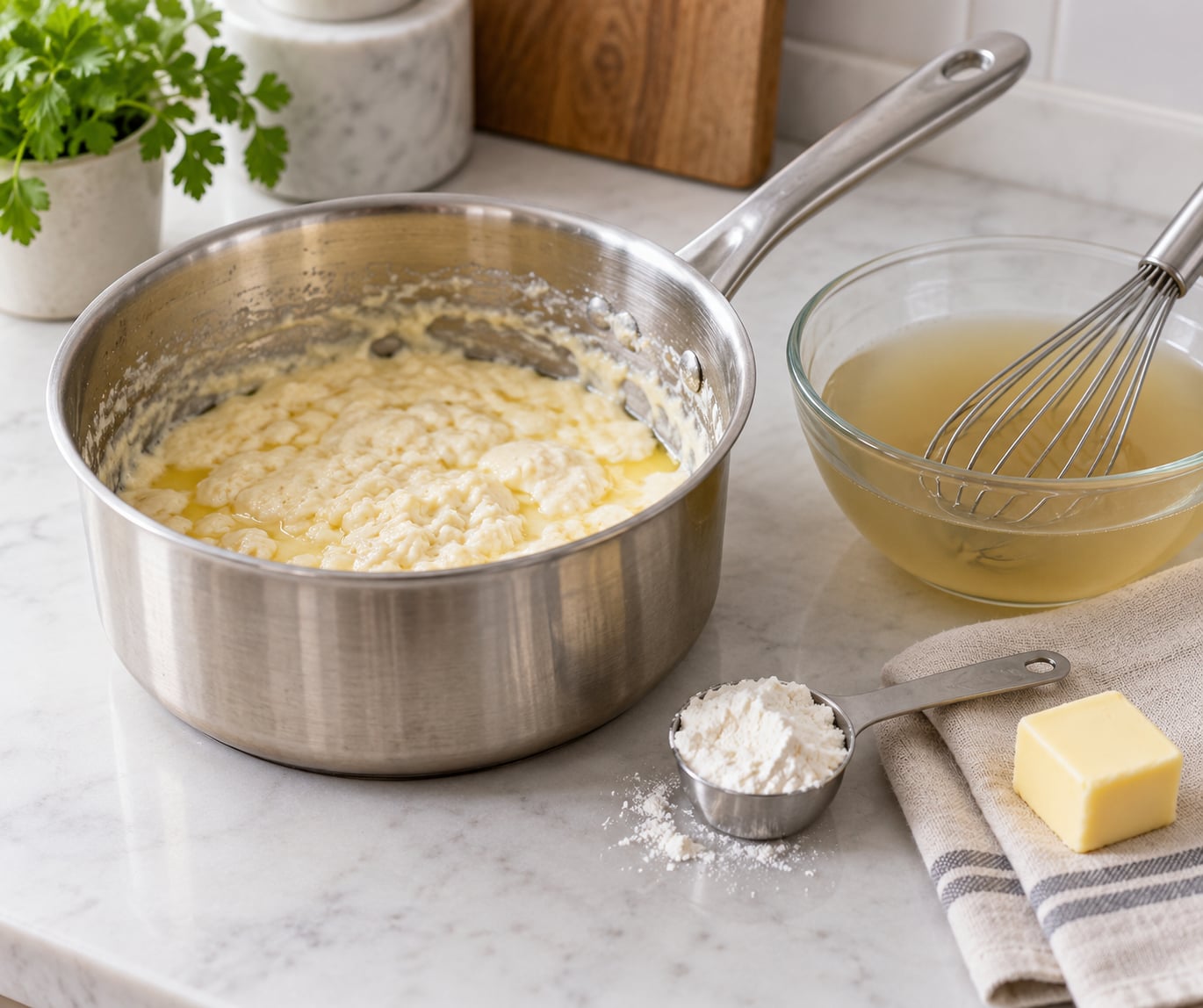
A broken sauce is one whose fat and water have separated from the emulsion that was holding them together. You see it as oily droplets pooling on the surface, a grainy or curdled texture, or a sauce that has gone thin and watery. Knowing how to rescue a broken sauce starts with naming which of those you are looking at, and once you do, picking the right fix takes guesswork out of the last five minutes before dinner.
Updated for 2026. These are the fixes I reach for first, tested on the weeknight sauces most kitchens actually make: hollandaise, cheese sauce, cream sauce, vinaigrette, gravy and pan sauce.
Table of Contents
- What You Need
- Step-by-Step: How to Rescue a Broken Sauce
- How to Rescue a Broken Sauce: Separate or Split
- How to Rescue a Broken Sauce: Too Thick or Sticky
- How to Rescue a Broken Sauce: Clumpy or Lumpy
- How to Rescue a Broken Sauce: Thin or Runny
- How to Rescue a Broken Sauce: Scorched or Burnt Flavor
- Common Mistakes
- Frequently Asked Questions
- Can a broken sauce be fixed?
- How do you rescue a sauce that is too salty?
- Is a separated sauce safe to eat?
- How do you repair a sauce that has been sitting too long?
- How do you stop sauces from breaking in the first place?
- Conclusion
What You Need

Almost nothing. A broken sauce is fixed with liquid, agitation, or a fresh emulsifier, and you probably have all three within arm’s reach of the stove.
- A cold splash of liquid. Water, broth, or a tablespoon of cold milk. This is the first tool and often the only one you need.
- A fresh emulsifier. One egg yolk, a teaspoon of prepared mustard, or a spoonful of mayonnaise. The yolk in mustard and the lecithin in mayonnaise are what let fat and water hold together again.
- A whisk. A balloon whisk gives you the surface area to re-emulsify in seconds. A wooden spoon is not enough here.
- An immersion blender for stubborn vinaigrettes and cold emulsions, if you own one.
- A fine-mesh sieve for grainy cheese sauces that can be strained rather than rebuilt.
- A little extra fat. Cold butter cubes off the heat thicken, gloss, and mellow acidity in a single move.
One safety note before you start tasting. Sauces cook hot enough to burn, so move the pan to a cool burner and give it thirty seconds before you dip a spoon in. If you are not serving the sauce right away, cool it in a shallow container and refrigerate within two hours.
Step-by-Step: How to Rescue a Broken Sauce
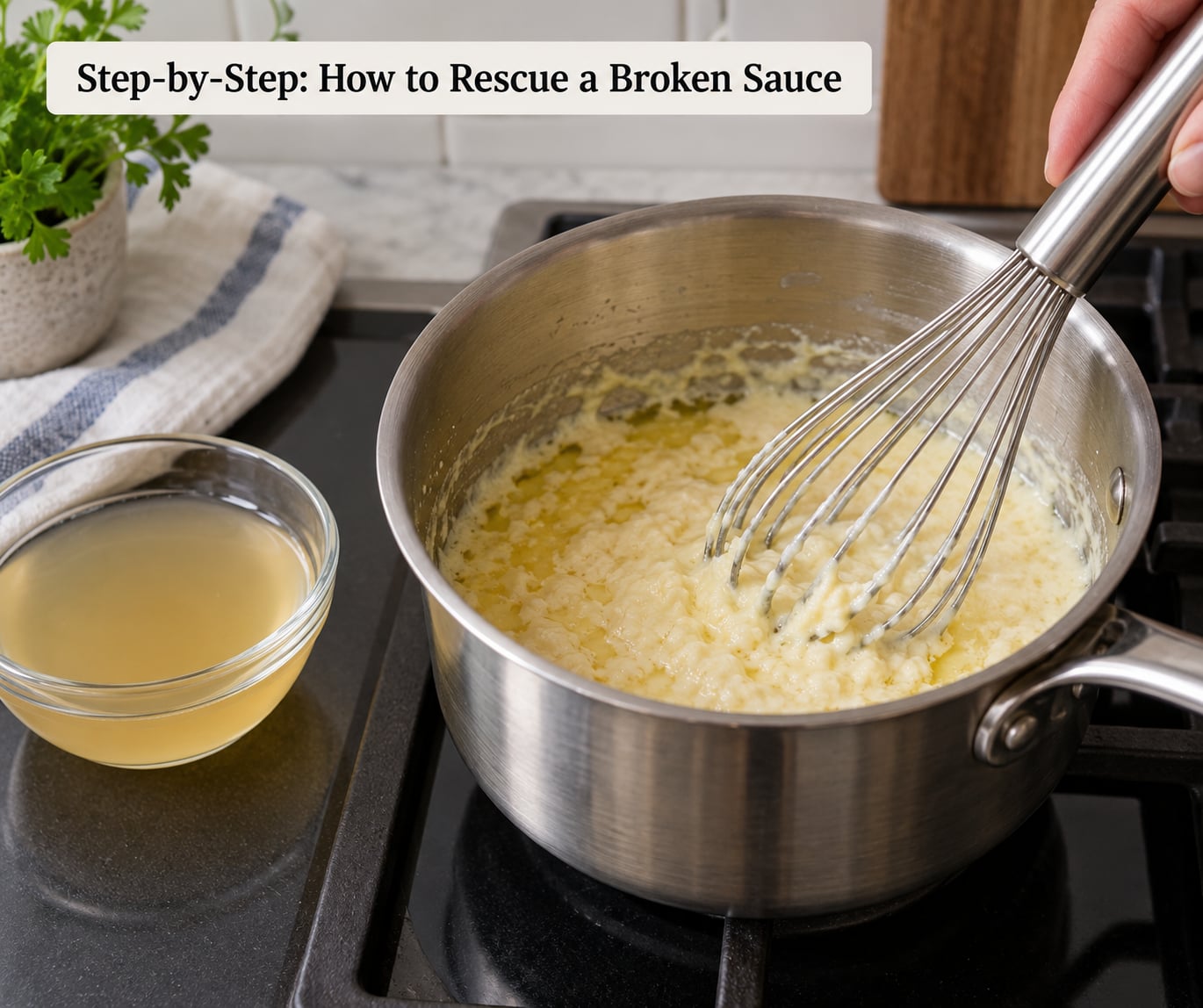
The order matters more than the ingredients. Work through these five moves in sequence and stop at the first one that brings the sauce back.
- Stop the heat. Pull the pan off the burner entirely. Adding heat to a broken emulsion makes it worse, because the fat gets more mobile and the droplets run together instead of staying dispersed.
- Name the break. Oily droplets and a thin top layer means separation. Tight, gluey, paste-like means it reduced too far. Small lumps or a grainy curd means clumping. Watery and loose means it is thin. Burnt smell means scorching.
- Choose the matching fix. Each failure below has its own repair. Using the wrong one is how people end up with a broken sauce that now tastes of raw flour.
- Make the correction in small doses. A tablespoon of cold liquid or one ice cube at a time. You can always add more, but you cannot take it back out.
- Bring it back up gently. Once the texture returns, warm the sauce over low heat with constant motion, tasting as you go. The right endpoint is glossy and coat-the-back-of-a-spoon thick.
How to Rescue a Broken Sauce: Separate or Split
This is the fix that handles a split hollandaise, a broken béarnaise, a separated vinaigrette, a mayonnaise that has turned, and any butter sauce that has gone oily. Emulsions break for a handful of reasons: fat added faster than the emulsifier can coat it, the sauce getting too hot, or a fridge cycle that solidified the fat and left the water behind.
Start with a tablespoon of cold water whisked in off the heat. The cold corrects the temperature and the whisk supplies the agitation that pulls the droplets back into suspension. Add it slowly, whisking the whole time, and watch the sauce turn glossy as it goes.
If a splash of water is not enough, give the sauce a fresh emulsifier to build on. Put one fresh egg yolk and a teaspoon of prepared mustard in a wide bowl, then trickle the broken sauce into it while whisking constantly. The yolk has enough lecithin to coat every droplet that comes in contact with it.
Finish with a cube or two of cold butter whisked in at the end if you want more body and shine. Success looks like a sauce that flows in a slow, unbroken ribbon off the spoon rather than streaking oil and liquid.
Two things to avoid: more fat and more heat. Both push droplets together instead of apart. Forum cooks on Reddit and in cooking groups keep repeating the same warning, and it is right most of the time.
How to Rescue a Broken Sauce: Too Thick or Sticky
A sauce that has reduced past the point of usefulness is fixed with liquid, not stirring. Add warm broth, water, or milk a tablespoon at a time while whisking, and stop the moment the thickness looks right.
Starchy pasta water is better than plain water here because the dissolved starch thickens as it comes back to a simmer, so the sauce stays put on the plate instead of sliding off. For a cream sauce, cold cream blended in off the heat loosens it without thinning the flavor the way water does.
Once it flows properly, re-season. Reduction concentrates salt and acid along with the body, so a sauce loosened after reducing almost always needs another pinch of salt and a few drops of acid. Taste again after it comes back to a simmer, since salt dissolves differently in cold and hot sauce.
How to Rescue a Broken Sauce: Clumpy or Lumpy
Clumping comes from three places: starch that cooked unevenly, cheese that seized, or dairy that boiled too hard. The repair depends on which one you are dealing with, and the syrupy glaze trick only belongs to the first.
For a starch-based sauce such as béchamel or velouté, whisk cold milk or water into the lumps a little at a time. Cold liquid gives the starch somewhere to disperse before the heat can set it again. Keep the pan off the burner while you do this, then bring it back slowly.
For a grainy cheese sauce, strain it. Push the sauce through a fine-mesh sieve and you lose a little body but keep every bit of flavor, which is usually the better trade. Shredded cheese with anti-caking agents also clumps more readily, so buy block cheese and grate it yourself when a cheese sauce matters.
If the lumps came from boiling dairy, the dish may need starting over; there is no unsticking curdled cream. Check the texture before serving and keep the flame low next time. Simmer bubbles gently, with nothing more vigorous than a lazy blip.
How to Rescue a Broken Sauce: Thin or Runny
A thin sauce can be rescued three ways, and the fastest one depends on what you have. Reduce it, thicken it with a slurry, or finish it with cold fat.
Reduction is the purest fix. Put the sauce back over medium heat and let it simmer until it coats a spoon, stirring often so it does not catch on the bottom. Reduction concentrates flavor as it thickens, which is why it tastes better than anything you stir in.
A slurry works when you need speed. Mix one teaspoon of cornstarch with one tablespoon of cold water in a cup, whisk it smooth, and stir it into the simmering sauce. Cook for a full minute after it goes in so the starch gelatinizes and you lose the raw, floury taste. Never dump dry cornstarch straight into a sauce; the lumps that creates are the problem you are trying to fix.
Finishing fat is the gentlest option for a sauce that is only slightly loose. Whisk in cold butter or cream off the heat for a glossier finish and a rounder mouthfeel, no cooking time required.
One warning: adding a large amount of starch at once is how a thin sauce turns gluey. Slurries go in one tablespoon at a time, with a minute of cooking between additions so you can taste and stop.
How to Rescue a Broken Sauce: Scorched or Burnt Flavor
A scorched sauce can sometimes be trimmed and sometimes cannot, and the honest test is smell rather than taste. If the burnt smell hits you the moment you lift the lid, the bottom layer is done and no amount of dairy will hide it.
When only the bottom is burnt, spoon the good sauce off the top into a clean pot, leaving the burnt layer behind. Then add fresh fat or liquid: a knob of cold butter, a splash of broth, a spoonful of cream. That dilutes the smoke and restores some roundness.
Stirring in a spoonful of strong, sharp, salty things can mask a little char. A little tomato paste, Worcestershire, mustard, or a squeeze of lemon will pull the eye away from bitterness. Be honest about the limit, though. Sauce that tastes of ash no matter what you add is a dish that should be abandoned, and I have thrown out a pan more than once rather than serve something bitter at the table.
If the whole pot is scorched, the salvageable move is to turn it into a different dish: a thin burnt cream sauce stretched with stock and pureed into soup, or a scorched tomato sauce cooked down into a concentrate for a stew. A new plan beats a stubborn one.
Common Mistakes
Nearly every failed rescue traces back to one of these, and all of them are easy to avoid.
- Adding too much liquid at once. A tablespoon, wait, then another. Over-correction is the most common reason a saved sauce ends up bland and thin.
- Turning the heat up to fix the look. Boiling dairy or egg sauce is what breaks emulsions in the first place. Low heat, constant motion.
- Pouring the broken sauce into a fresh batch. This drags the failure forward and dilutes the good batch you already have.
- Banging the pan or the spoon on the counter. Vibration shocks the emulsion apart. Set things down.
- Re-seasoning before you correct the consistency. Salt and acid taste completely different in a thin sauce than in a thick one. Fix the body, then season.
- Trying to rescue a scorched sauce without removing the burnt portion. You cannot stir out smoke; you have to lift it off the bottom.
Prevention is easier than any rescue. Add melted fat a teaspoon at a time with the whisk running, keep a bowl of cold water next to the stove for exactly this emergency, never let an egg or dairy sauce come to a boil, salt at the end rather than at the start, and save your pasta water. For egg emulsions like hollandaise, a second set of hands whisking while the first pours is the difference between a smooth sauce and a scramble.
Temperature numbers help more than instinct here. Egg yolks start setting around 180°F, which is where hollandaise and béarnaise cross the line into scrambled. Starch begins to gelatinize near 140°F, so a béchamel needs to come to a gentle simmer to thicken properly. Nothing else should be anywhere near a rolling boil.
Frequently Asked Questions
Can a broken sauce be fixed?
Yes, most of the time. If the fat and water have merely separated, whisk in a tablespoon of cold water or an ice cube off the heat, then add a fresh emulsifier such as an egg yolk or prepared mustard and trickle the sauce in. A grainy cheese sauce can usually be strained. What you cannot rescue is a burnt flavor, which needs to be lifted off or the dish abandoned.
How do you rescue a sauce that is too salty?
Dilution is the only reliable answer, so add unsalted liquid a little at a time: broth, water, unsalted cream, or plain rice. Taste after each tablespoon, because you want to land at seasoned rather than bland, and you can always keep going but never undo it. A final knob of cold butter rounds out the sharpness without needing more salt.
Is a separated sauce safe to eat?
A split sauce is not a food safety problem in itself. Emulsions fail for physical reasons, heat and timing, not because anything has spoiled. Judge it the way you would any leftover: if it smells off, sits out longer than two hours, or was refrigerated and then reheated more than once, discard it. Cool leftovers in shallow containers and reheat to 165°F before serving.
How do you repair a sauce that has been sitting too long?
Whether it sat on the stove or in the fridge, a thick skin on top usually means the same thing: the sauce needs liquid and motion. Warm it gently, whisk in cold water or broth a tablespoon at a time, and bring it back to a low simmer. If it formed a skin, pull it off first, since blending it back in leaves an unpleasant texture.
How do you stop sauces from breaking in the first place?
Heat control and pacing do most of the work. Add melted fat or cheese in small additions while whisking, keep egg and dairy sauces well below a boil, whisk constantly rather than letting the pan sit, and salt at the end. Keeping a bowl of cold water beside the stove means a split can be caught in seconds instead of rescued from the bottom of the pan.
Conclusion
First move: take the pan off the heat. Then look at what actually went wrong, whether it is separated, too thick, lumpy, too thin or scorched, and use the smallest fix that matches. Learning how to rescue a broken sauce is mostly a matter of matching the symptom instead of throwing everything in the pot, and a tablespoon of cold water off the heat solves more cases than any other single move.