Toasting whole spices in a dry pan before you grind them is the step most people skip, and it is the step that matters most. Warm, dry heat releases the aromatic oils trapped inside seeds, bark, pods and berries; the spices go from dusty and flat to fragrant and deep. Cool them completely, grind them, and use the powder within a month or so.
If you have ever wondered how to toast and grind whole spices without ending up with a bitter, dusty jar in the back of the cupboard, the job takes about ten minutes of active time, plus however long you let the pan and the spices cool. It costs almost nothing beyond the spices you already buy, and the equipment can be as simple as a skillet or as quiet as a jar and a rolling pin. No grinder required.
Table of Contents
- What You Need
- Step-by-Step: How to Toast and Grind Whole Spices
- Choose and Measure the Spices
- Toast the Spices Gently
- Cool the Spices Completely
- Grind to the Texture You Need
- Store Ground Spices for Best Flavor
- Common Mistakes
- Frequently Asked Questions
- Do all whole spices need to be toasted before grinding?
- What is the best way to grind spices without a spice grinder?
- How do I know when whole spices are toasted enough?
- Can I grind toasted spices while they are still warm?
- How long do freshly ground spices stay fresh?
- Which spices should not be toasted?
- Conclusion
What You Need
The core setup is short. Everything else is a substitute.
- Whole spices in the form you need: seeds (cumin, coriander, fennel, mustard), bark (cinnamon), pods (cardamom), berries (allspice, black peppercorns), or buds (cloves).
- A dry skillet or saucepan with a handle you can shake. No oil, no butter, no spray.
- A heatproof plate or bowl to tip the spices onto the moment they come off the burner. This matters more than people expect.
- A wooden spoon or spatula for stirring.
- A grinder: a small spice grinder, a clean coffee grinder, a mortar and pestle, or a pepper mill. A zip-top bag and a rolling pin also work.
- Small airtight jars with lids, and a marker or label tape for dating the batch.
A kitchen thermometer is not necessary. Neither is a timer you have to watch, though a phone timer helps if you are toasting more than one spice in a row.
Step-by-Step: How to Toast and Grind Whole Spices
Choose and Measure the Spices
Measure what you will actually cook with in the next month. Most home kitchens waste ground spice because a big batch gets made once and forgotten in the back of a cupboard.
Rough guide: a couple of tablespoons of whole seeds makes about a tablespoon of powder. Volume conversions are unreliable because particle size and packing change, so weigh it if you can. A kitchen scale is more honest than a spoon here.
Keep different spices separate when they toast at different rates. Cumin and black peppercorns can share a pan. Cinnamon bark and cloves cannot, because the bark scorches long before the buds darken.
Toast the Spices Gently
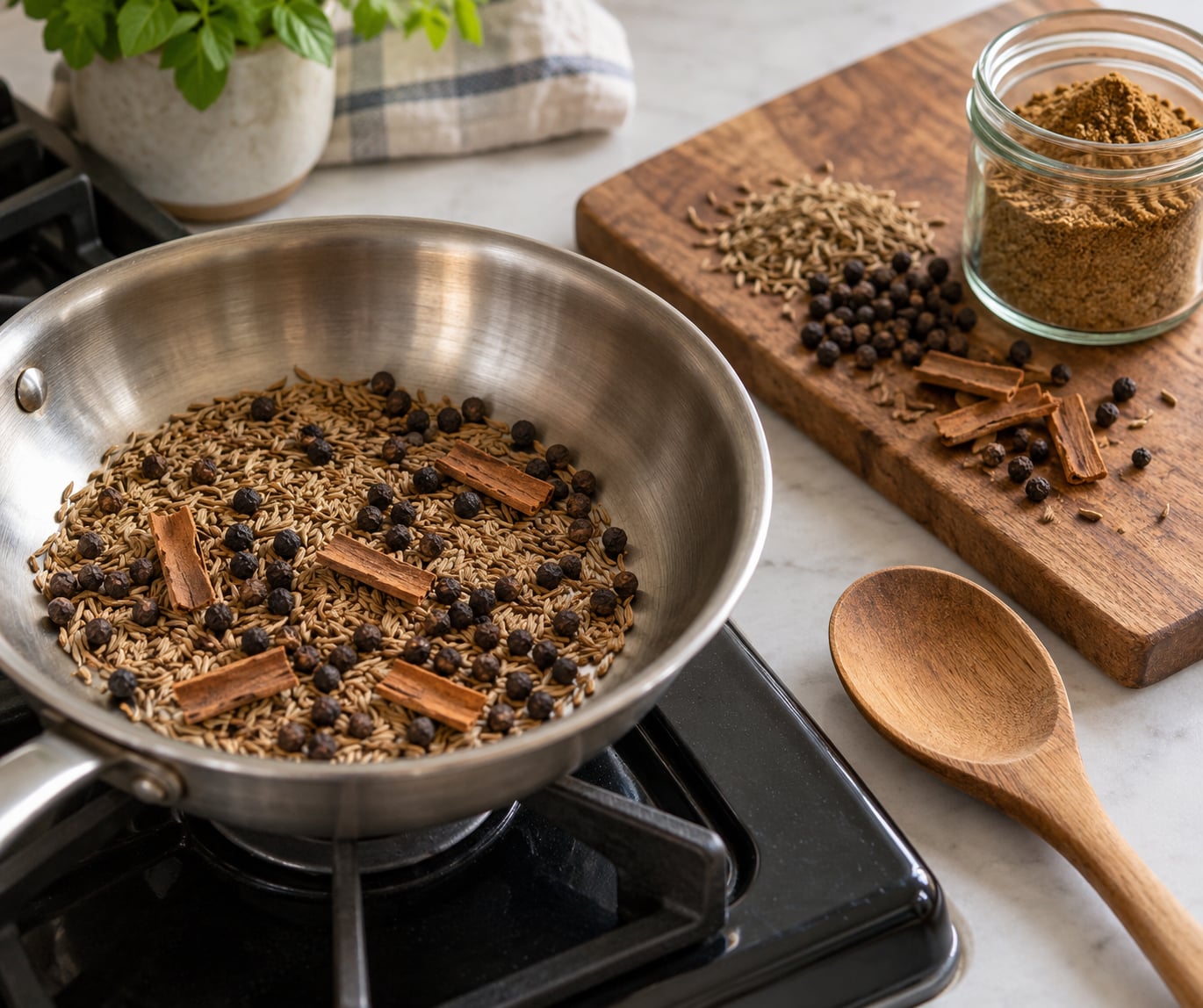
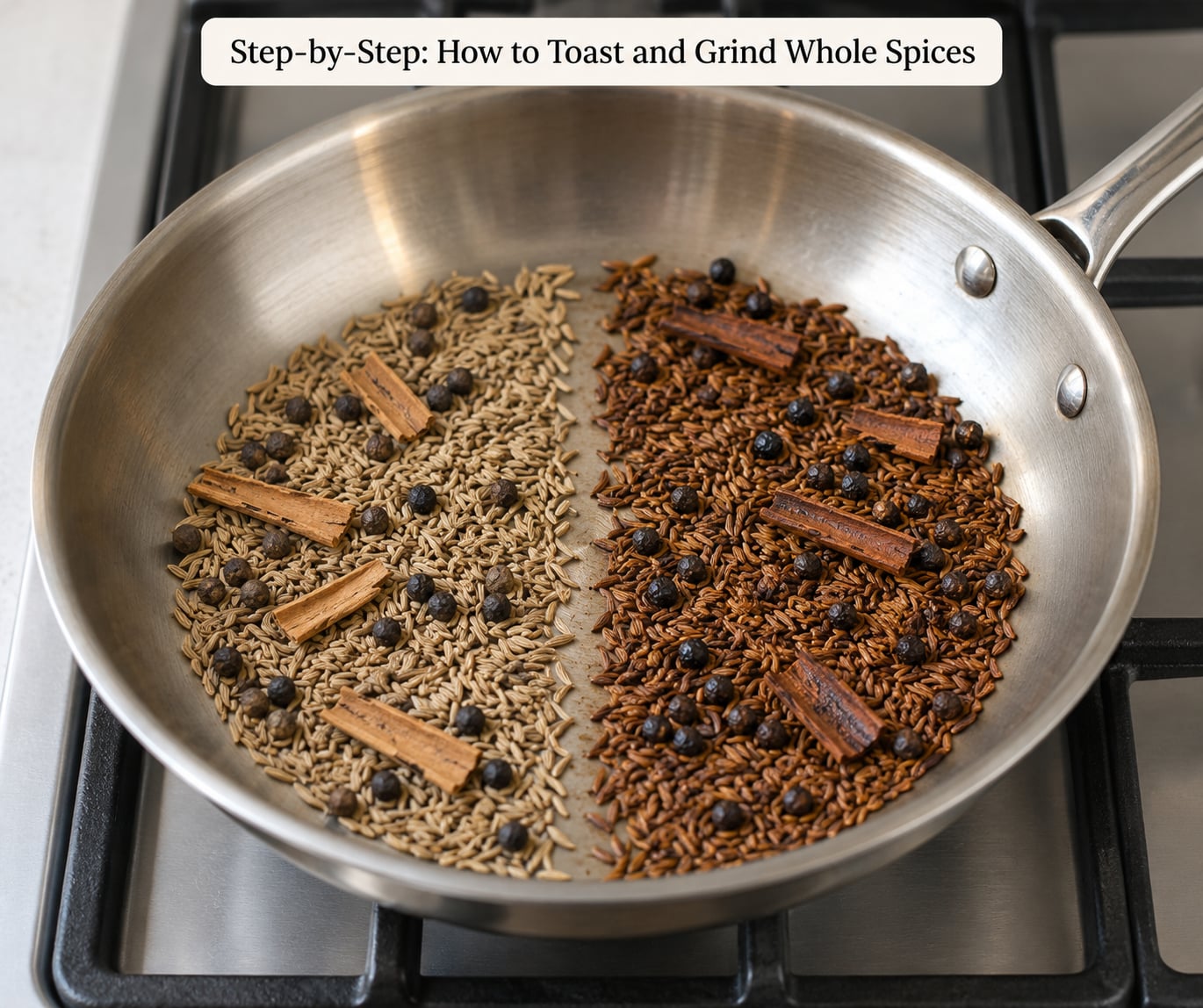
Heat a dry skillet over medium-low heat. If you can hold your palm a few inches above the pan and it feels comfortably warm rather than hot, that is close enough.
Add the spices in a single shallow layer. More than that and the bottom layer burns before the top layer warms. Stir constantly with a wooden spoon, and shake the pan by the handle every few seconds so nothing sits still.
Most small batches finish in 1 to 3 minutes. Seeds darken by a shade and start to smell nutty rather than dusty; peppercorns puff slightly and give off a sharp, warm scent; bark and buds darken and turn brittle. Follow the nose, not the clock, since every spice and every pan runs differently.
The instant it smells right, tip the spices onto a cool plate and spread them in a thin layer. Residual heat in the pan keeps cooking whatever is sitting in it, which is the single most common way people accidentally burn a batch.
Oven alternative. Heat the oven to 300F and spread the spices on a rimmed baking sheet. Roast 5 to 8 minutes, stirring once or twice, and watch them the same way you would watch a pan. Pull the sheet the moment they darken and smell fragrant, because the sheet keeps cooking too.
Microwave alternative. Thirty to forty seconds on full power for a small batch, in a loose pile on a paper plate, stirred halfway through. It is uneven at the edges, so check more often than you think you need to. The microwave is a reasonable last resort and a poor first one.
Cool the Spices Completely
Wait until the spices are room temperature to the touch, usually 10 to 15 minutes on that plate. Do not shortcut this by dumping hot spices into a grinder or a jar.
Two things go wrong with warm spice. Steam and condensation form inside a closed jar, which clumps the powder and dulls it. And a grinder running hot on hot seeds can smell permanently like that spice for weeks, which ruins the next thing you grind.
Grind to the Texture You Need
Pick a tool, then grind in short pulses and check often. Long grinding heats the powder and makes fine dust that is hard to measure and easy to scorch later.
- Small spice grinder: fastest option, best texture, least forgiving. Grind in one-second pulses, shaking the grinder between them.
- Clean coffee grinder: excellent results, especially for seeds. Grind a batch, then run it for a few seconds with a spoonful of dry rice to clear out residue.
- Mortar and pestle: slow and physical, but the only option that gives you texture control. Crush to a coarse rubble for stocks and rubs, keep grinding for a fine powder for cakes and spice blends.
- Pepper mill: fine and consistent for peppercorns, and useless for anything else.
- No grinder at all: put the cooled spices in a zip-top bag, seal it, and roll it under a rolling pin or the flat side of a heavy knife until you hear the seeds break. For stubborn bark and cloves, lay the pieces on a sheet pan and press them flat with the knife blade, then gather and bag them.
Coarse is right for dry rubs and braises. Medium is right for most everyday cooking. Fine is right for cakes, pies and anything where you want the spice to disappear into the batter.
Not every spice behaves the same way, and that difference matters more than the tool you own:
| Spice | Form | Time in the pan | Grinding note |
|---|---|---|---|
| Cumin seed | Seed | 1 to 2 min | Soft, grinds to powder fast. Scorches quickly. |
| Coriander seed | Seed | 1 to 2 min | Husky and slow to brown. Round and light. |
| Fennel seed | Seed | 1 to 2 min | Large and uneven; sift out the dust. |
| Yellow mustard seed | Seed | 30 to 60 sec | Pops and jumps. Keep the pan moving. |
| Black peppercorn | Berry | 2 to 3 min | Puffs slightly. Hardest to get truly fine. |
| Cloves | Bud | 2 to 3 min | Very hard. Toast thoroughly and they crack cleanly. |
| Nutmeg | Seed | 2 to 3 min | The hardest nut to grind. Use a spice grinder if you have one. |
| Cinnamon | Bark | 2 to 3 min | Watch it closely; the edges scorch long before the center warms. |
| Cardamom pods | Pod | 1 to 2 min | Toast pods whole, crack them, grind the seeds and toss the husks. |
| Star anise | Fruit | 1 to 2 min | Breaks into points that catch in a mortar. Grind off the burner. |
Ground spice does not keep. It is at its best in the first few weeks, noticeably softer by a couple of months, and mostly aroma-free by the time six months pass.
Store Ground Spices for Best Flavor
Pour the powder into a small airtight jar, press the lid down, and write the date and the spice on masking tape on the lid. Labeling is not fussiness; it is how you avoid using a jar you opened last winter and thought was fine.
Store the jars in a cupboard away from the stove, not in a container sitting on the counter next to the range. Heat and light both push the volatile oils out of the powder faster than air does.
Make a month at a time. Two tablespoons of whole cumin becomes roughly a tablespoon of powder, and a tablespoon of powder is about a month of weeknight cooking in a household that uses spice regularly. Whole spices in a sealed jar keep for a year or more, so there is no reason to grind ahead.
Common Mistakes
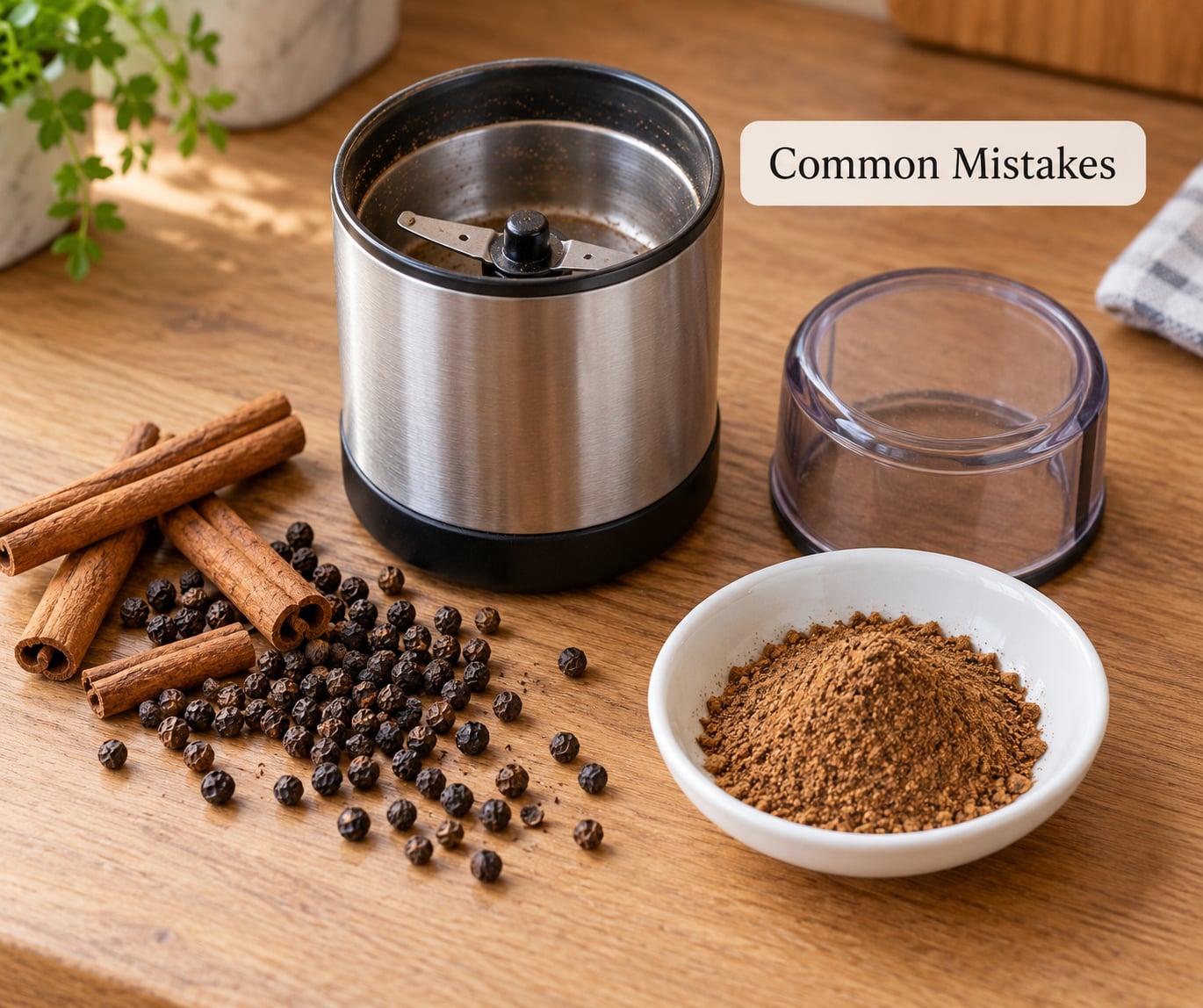
Almost every ruined batch traces back to one of these.
- Heat set too high. Medium-high browns the outside of the seeds before the inside releases its oils, and the result tastes acrid. Drop to medium-low and accept a longer toast.
- Leaving the pan. It takes seconds. A skillet off the burner still has enough stored heat to scorch a thin layer of seeds in under a minute.
- Forgetting to move the spices off the heat. Tip them onto a cool plate the second they smell right. A hot pan finishes the job you were trying to stop.
- Grinding warm spice. Condensation clumps the powder, and heat can bake a spice smell into the grinder that follows you into the next batch.
- Grinding in one long run. The powder heats, the fine particles turn dusty, and the aroma leaves. Pulse, check, stop.
- Mixing spices with different cook times. Bark and buds in the same pan means one of them is always wrong. Toast in batches by cook time, not convenience.
- A crowded pan. Two layers toast unevenly. If the batch will not spread out, split it.
- Using a burned batch. There is no fix. Grinding a blackened seed spreads the bitterness through everything it touches, so throw it out and start over.
- One grinder for everything. Coffee residue in a savory blend, chile heat that lingers in a cinnamon jar, salt that seasons your pepper. Use a dedicated grinder for salt and chile if you make those often, and wipe the blade area between unrelated spices.
On cross-contamination, a practical rule is to dedicate one cheap grinder to spices you use most, and accept that a second grinder is worth it once you start making blends with salt or dried chiles. If you grind dried chiles, do it while the powder is coarse and open a window; fine chile dust irritates lungs, and that is not a small thing.
One more note from cooks who do this weekly: use a dry spoon to scoop spices out of the jar. A wet spoon carries moisture into the powder and shortens its life.
Frequently Asked Questions
Do all whole spices need to be toasted before grinding?
No. Toasting matters most on seeds, bark, pods and buds such as cumin, coriander, mustard seed, cinnamon, cloves and cardamom, where the oils are trapped in intact cells. It is optional for a spice that goes into a long cook, like black peppercorns in a pot of beans, because hours of simmering soften them anyway. Toast spices that go into a finished dish, and skip it for the ones buried in a long braise.
What is the best way to grind spices without a spice grinder?
Put the cooled toasted spices in a zip-top bag, seal it, and roll it under a rolling pin or the flat side of a heavy knife until you hear the seeds crack. For bark, cloves, or nutmeg, press the pieces flat on a sheet pan with the knife blade first, then bag and crush them. A mortar and pestle gives finer control if you have one. Sift out the fine dust and keep it, it is the part that flavors a pot.
How do I know when whole spices are toasted enough?
Smell first. Raw cumin smells dusty and green, toasted cumin smells nutty and warm. Watch the color too, seeds should be a shade darker than they started, and peppercorns should puff slightly and smell sharp. Bark should look deeper in color and sound brittle when you rattle it. Listen for a change from silence to a faint crackle, and pull the batch the moment the aroma arrives, since the pan keeps cooking it after that.
Can I grind toasted spices while they are still warm?
You can, but you should not. Warm spices carry steam, and grinding them into a closed jar creates condensation that clumps the powder. The heat can also bake the aroma into the blade housing and follow you into the next spice you grind, which is how a coffee grinder ends up tasting like cumin forever. Wait 10 to 15 minutes until they are room temperature to the touch.
How long do freshly ground spices stay fresh?
Treat ground spice as a short-lived ingredient. It tastes strongest in the first few weeks, softens noticeably after a couple of months, and by six months most of the aroma is gone even if it is still safe to eat. Whole spices keep their aroma in a sealed jar for a year or longer, so the fix is to grind small batches and repeat. Two tablespoons of whole cumin makes about a tablespoon of powder, roughly a month of cooking.
Which spices should not be toasted?
Skip the pan for dried chiles and other hot peppers if you are sensitive to capsaicin, since toasting releases some of the burn and the dust irritates lungs. Paprika is best left alone too, because heat dulls its sweetness. Any spice that is already ground should not be toasted, since the fine powder burns in seconds before it develops anything. And skip a hard sear on anything you plan to use in a pale sauce, where a darker color reads as burnt.
Conclusion
Start with a small test batch of one spice you use most, over medium-low heat, and put your nose over the pan the whole time. The second it smells nutty rather than dusty, tip it onto a cool plate, wait until it is room temperature, grind only what you will use in the next month, and date the jar. That is how to toast and grind whole spices without buying another jar of powder you will not finish.