Most home bakers eventually ask the same question: why do my biscuits come out hard instead of fluffy? The answer is nearly always mechanical rather than ingredient-based, which is good news, because mechanics are easier to fix than a recipe you did not write.
That is the frustrating part. A biscuit recipe is not complicated, and the ingredient list barely matters. The same recipe can give you a torn-apart, crumbly biscuit or a tall flaky one depending on how gently the dough was handled and how hot the oven actually was.
Here is how to narrow it down. Work through the causes in order, and change one variable per batch, because biscuits fail fast and every fix you stack at once makes the real problem harder to find.
Table of Contents
- Why Do My Biscuits Come Out Hard Instead of Fluffy?
- The Biscuit Texture Problems: Causes and Fixes
- How Does Flour Choice Make Biscuits Hard?
- How Much Fat and Liquid Keep Biscuits Tender?
- Why Does Overmixing Make Biscuits Tough?
- Reading the dough for overworking
- How Can I Tell If My Leavening Is Working?
- Why Does Oven Temperature Change Biscuit Texture?
- How Do I Keep Biscuits Fluffy from Mixing to Baking?
- Frequently Asked Questions
- How can I tell if biscuit dough is overworked?
- What happens if you overmix biscuit dough?
- How do I soften hard biscuits after baking?
- What makes biscuits rise better, baking powder or baking soda?
- What do I do if my biscuit dough is too wet?
- How do I make canned biscuits better in the oven?
- Start With the First Fix
Why Do My Biscuits Come Out Hard Instead of Fluffy?
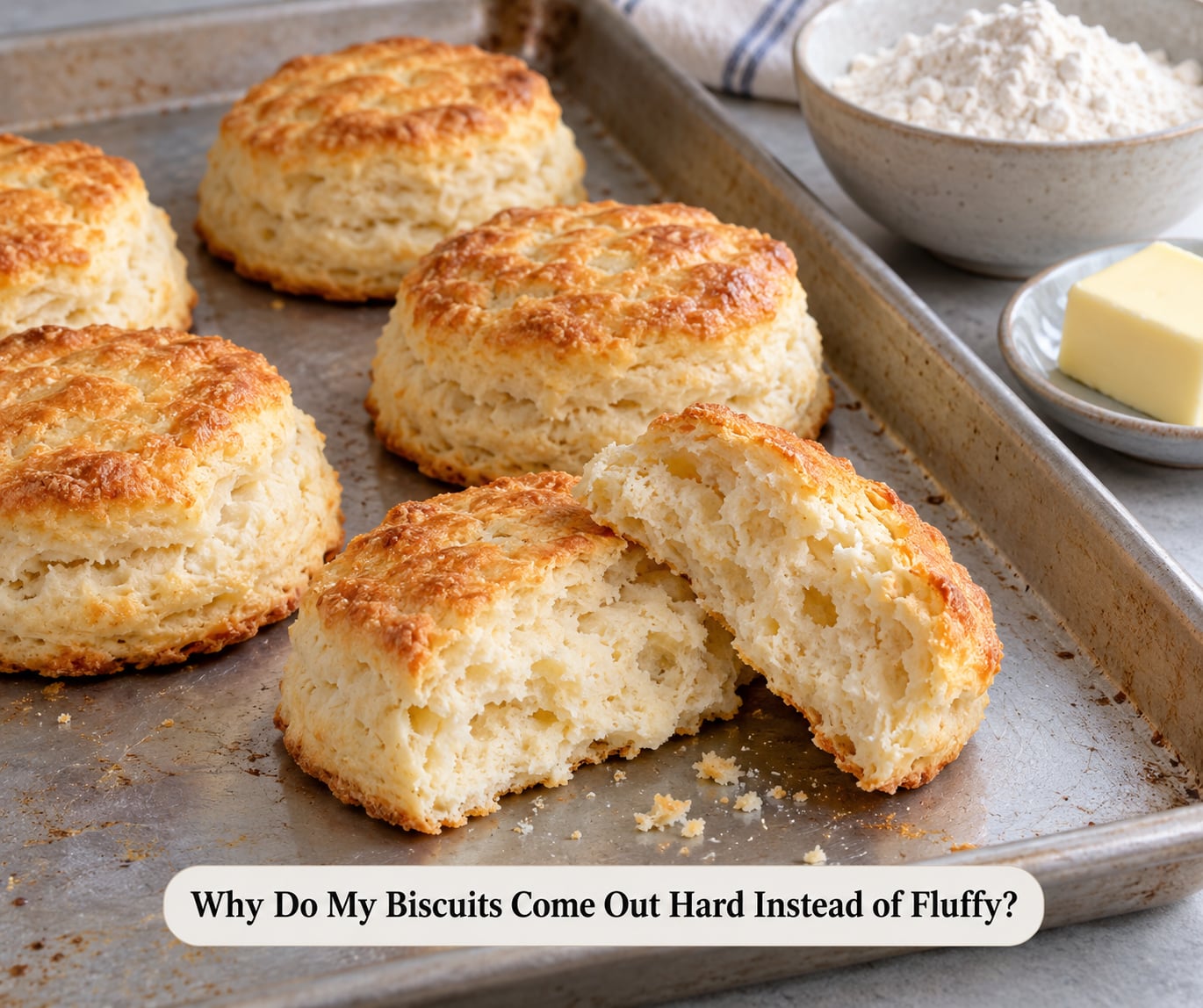
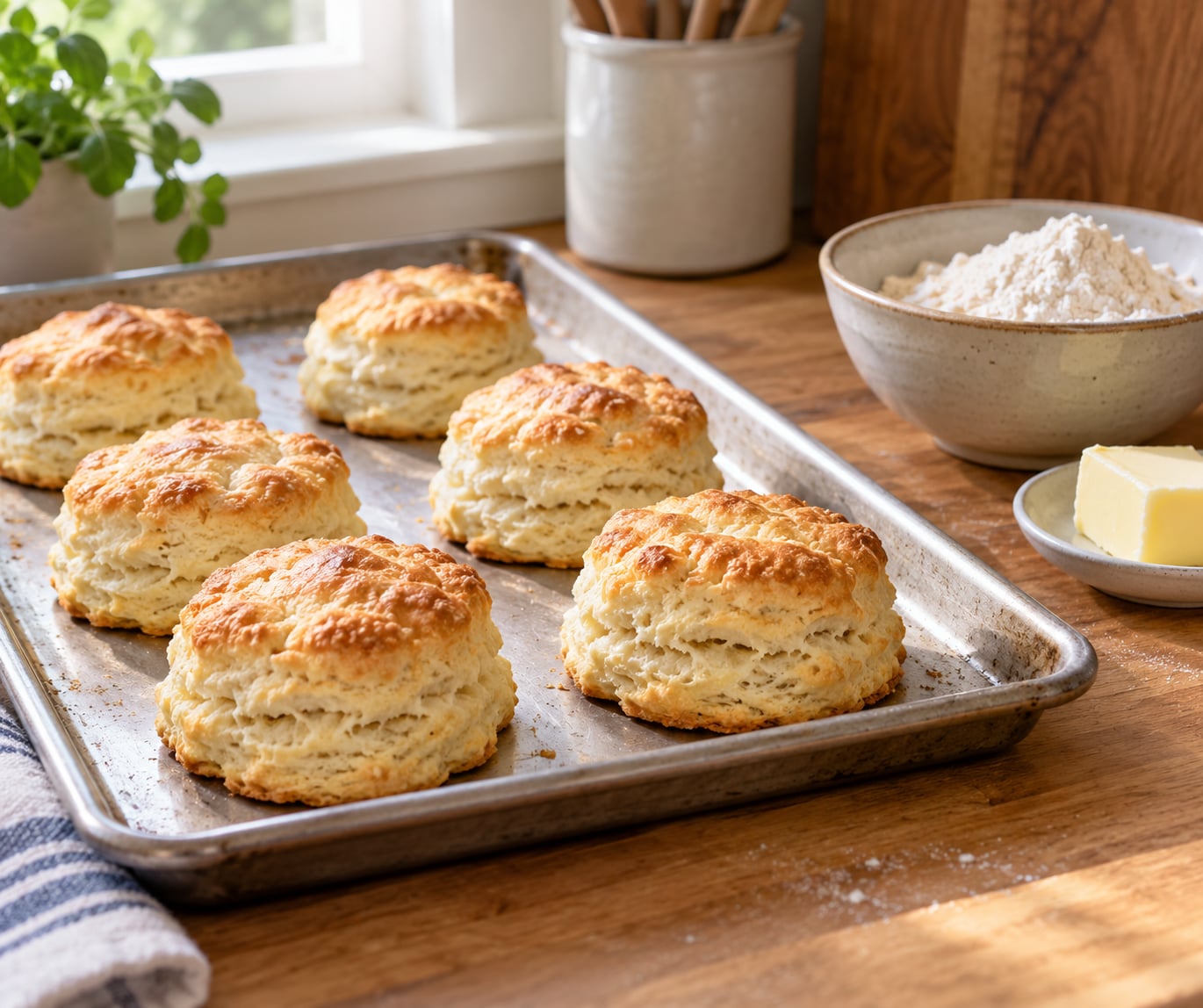
Hard biscuits come down to five things: dough that got handled too much, flour packed too tightly into the measuring cup, not enough fat or liquid, leavener that has gone flat, or an oven that never reached temperature. Biscuit dough is meant to stay barely mixed, and every extra stir, knead, or roll builds a gluten network that makes the dough spring back, shrink, and bake firm.
Each cause leaves a different fingerprint, which is what makes this fixable:
- Dough worked too much. Tough, chewy, dense center that springs back when you press it. Fix: mix only until the dough holds together, and never use a rolling pin.
- Flour packed down into the cup. Dry crumb, cracked tops, biscuits that crumble at the cut line. Fix: scoop and level, or better, weigh the flour in ounces.
- Too little fat or too little liquid. Firm, dry, short crumb with no flake. Fix: keep the butter cold and add milk or buttermilk a tablespoon at a time.
- Leavener that has lost its punch. Flat biscuits that spread in the oven and never gain height. Fix: test the baking powder in hot water and replace it if it fizzles weakly.
- Oven too cool or too hot. Pale, flat tops with burnt bottoms, or a well-risen biscuit that dries out by the end of the bake. Fix: verify with an oven thermometer and adjust the rack.
If your biscuits are chewy rather than merely firm, stop reading and check the first item. Toughness almost always means gluten development, and no temperature setting will fix that after the fact.
The Biscuit Texture Problems: Causes and Fixes
Match what you are looking at to the likely cause. This is the fastest way to diagnose a bad batch without re-baking the same recipe five times.
| What the biscuit looks like | Likely cause | What to change |
|---|---|---|
| Dense, heavy, chewy crumb | Dough overworked or kneaded | Cut mixing short; press and fold only |
| Flat and spread, low height | Leavener weak, or butter melted before mixing | Test baking powder in hot water; chill the fat |
| Dry, crumbly, falls apart when cut | Too little fat or liquid, flour over-floured at the bench | Add cold butter, add liquid a spoonful at a time |
| Cracked, split tops | Dough too dry and surface worked | Handle the top gently, press straight down without dragging |
| Tops pale, bottoms dark | Oven too hot, or rack too low | Drop 25 degrees, move the rack up one position |
| Rises unevenly across the tray | Uneven baking surface | Use one heavy metal sheet, not a crowded half-sheet |
| Firm by 20 minutes after baking | Overbaked or thin | Pull at the earliest sign of golden tops; bake 10 to 14 minutes |
| Rises well, then sinks in the oven | Oven too cool at the start, leavener releases late | Preheat fully; use double-acting baking powder |
One note on the crumbly rows. Too-crumbly is the mirror failure of too-hard, and a lot of bakers land there because they were told to never touch the dough and under-mixed to the point of cracking. A biscuit should flake. If it shatters into sand, your fat or liquid is short.
How Does Flour Choice Make Biscuits Hard?
Flour changes the texture more than most people expect, because all-purpose flours sit in a wide protein range. Higher protein means stronger gluten and a dough that turns tough faster when you handle it. A southern baker reaching for White Lily, which is a lower-protein cake-style flour, is doing something deliberate with texture.
The everyday mistake is packing the measuring cup. Scooping flour and tapping it down can add fifteen to twenty percent more flour than the cup level, and that extra flour drinks up the liquid and dries the crumb. Weighing the flour by weight is the single highest-leverage change most home bakers can make.
On a long thread at The Fresh Loaf, one baker traced weeks of crumbly, dense biscuits to flour measurement. Weighing the flour at 4.25 ounces per cup instead of scooping fixed the crumb, and that change did more than anything else they tried. Same recipe, same oven, better biscuits.
- Higher-protein all-purpose flour is more forgiving of kneading but turns tough fastest. Use it for hand-pressed biscuits, not rolled ones.
- Lower-protein cake or biscuit flour gives a shorter, more tender crumb and holds layers with less handling.
- Self-rising flour already carries baking powder and salt. Adding more leavener on top is the fastest route to flat, soapy-tasting biscuits.
- Gluten-free blends hydrate differently and can still turn tough from over-handling, since starches break down under kneading. Treat them even more gently.
If you have a kitchen scale, use it. Volume measures carry an error margin that no recipe can correct for.
How Much Fat and Liquid Keep Biscuits Tender?
Cold fat is what makes flaky layers. Solid butter or shortening scattered through the flour melts in the oven, and the steam it releases pushes the dough apart into visible layers. Warm fat just blends into the flour before it ever reaches the heat, so you get an even, dull crumb with no flake at all.
Fat also slows gluten formation by coating the flour proteins, which is the whole reason biscuit dough is mixed briefly. Lard works the same way and carries more flavor, which is why older Southern and Appalachian recipes lean on it.
Liquid works as a counterweight. Too little and the dough is shaggy in a dry way, and it cracks and crumbles when you cut it. Too much and it spreads, because the dough relaxes and the butter layers collapse together before the leavener sets the structure.
Judge hydration by feel, not by the clock:
- Too dry means the dough shatters when you squeeze it and holds no shape at the cut line. Add cold buttermilk or milk one tablespoon at a time.
- About right means the dough holds together when pinched but the surface still looks rough and torn. That rough look is called a shaggy dough, and it is the target.
- Too wet means it sticks to your palm and slumps when you set it down. Add a tablespoon or two of flour, then chill the dough twenty minutes before cutting.
Nobody measures hydration as a percentage for a biscuit. It is a pinch test, and your hands are the instrument.
Why Does Overmixing Make Biscuits Tough?
Wheat flour holds two proteins, glutenin and gliadin, that link into an elastic network when they meet water and are worked. A little of that network gives bread structure and chew. A lot of it makes a biscuit chew like a biscuit made for dunking in coffee, which is not what anyone wants.
In a proper biscuit the fat interrupts that linking, because butter coats the proteins and keeps them from joining. Every stir, knead, or roll reverses some of that coating and rebuilds the gluten. That is why recipes say to cut the butter in until the mixture looks like coarse cornmeal and then stop.
Reading the dough for overworking
You can tell after the fact, which answers the question bakers ask most often:
- The dough is smooth and elastic instead of rough and torn.
- It springs back to a ball immediately when you squeeze it.
- The surface has gone glossy and slightly warm from handling.
- It sticks to your palm instead of releasing cleanly.
If you have already gone too far, chill the dough for twenty minutes and give it two or three gentle presses instead of more mixing. Resting lets the gluten relax, so the dough becomes workable again. You will not fully undo it, but you can stop the bleeding. And skip the rolling pin completely; pressing with a flat hand is the whole technique.
Chilling is not a substitute for technique, either. One r/AskCulinary baker froze the butter cubes and chilled the finished dough for twenty minutes and still got flat, bread-like biscuits, because the dough had been mixed too far in the first place.
How Can I Tell If My Leavening Is Working?
Test baking powder in hot water. Put a teaspoon in a cup of hot water. Strong fizzing immediately means it is fresh, a few bubbles means it is weak, and nothing means it is dead and should be replaced. Baking powder loses potency once it absorbs moisture, and old cans from the back of the pantry are the usual culprit.
Understand what each leavener needs. Double-acting baking powder reacts with heat as well as moisture, so it works in dough with or without acid. Baking soda needs an acid to activate, and buttermilk supplies one. If you use soda with plain milk or water, you are asking for flat biscuits.
Too much soda does not raise more. It throws the balance off, kills flavor, and leaves a metallic or soapy aftertaste. Several bakers on The Fresh Loaf cut their leavening in half, down to half a teaspoon of each, and got a better rise than they had with a full teaspoon.
Read the symptom before blaming the leavener:
- Flat but spread out points to weak or absent leavening, or butter that melted into the dough.
- Dense and heavy with height points to overworked dough, not leavener. Adding powder here makes it worse.
- Rises on one side only points to uneven oven heat, so rotate the tray once at the halfway mark.
- Soapy or bitter taste points to excess baking soda.
Measure leaveners with a spoon you can level, and never pack them down. Baking powder by weight is about 4 grams per teaspoon, which removes the guesswork entirely.
Why Does Oven Temperature Change Biscuit Texture?
Biscuits rely on oven spring, the burst of expansion in the first few minutes as gas cells heat and fat turns to steam. A cool oven kills it. The leavener reacts slowly, the fat melts late, and the biscuit spends its rise as a flat, dense puck.
Bake biscuits at 425 to 450 degrees Fahrenheit on a heavy metal sheet with nothing on it. Metal conducts heat into the bottom of the dough, which is what gives you a crisp base and lift. Silicone mats and parchment insulate, and several bakers report noticeably weaker rise on them compared with bare metal.
Preheat the full time, even when the oven has been on for twenty minutes while you make the dough. Give it a thermometer if you doubt it, since ovens run anywhere from 25 to 50 degrees off the dial.
- Oven too cool: raise the temperature by 25 degrees, extend the bake by a minute or two, and move the rack up one position.
- Oven too hot: drop to 425, use the rack just below center, and pull the tray the moment the tops turn golden.
- Convection oven: drop the recipe temperature by 25 degrees, since moving air browns the tops faster.
- Baking stone or steel: good for crust, but a stone stores heat and keeps the underside dark. Bare aluminum is the safer default for biscuits.
Do not open the door during the first ten minutes. Every opening drops the temperature, and a stalled oven spring means a dense biscuit no matter how good the dough was.
Above 5,000 feet, drop the baking temperature by about 15 degrees and check the dough two minutes early, since thin air makes leavening gases expand faster and the tops set sooner.
Canned and frozen dough needs less help than homemade. Skip the oven preheat beyond five minutes, do not thaw the dough, and put the pan in a cold or barely warm oven so it starts heating with the pan. That one change does more for canned biscuits than any other.
How Do I Keep Biscuits Fluffy from Mixing to Baking?
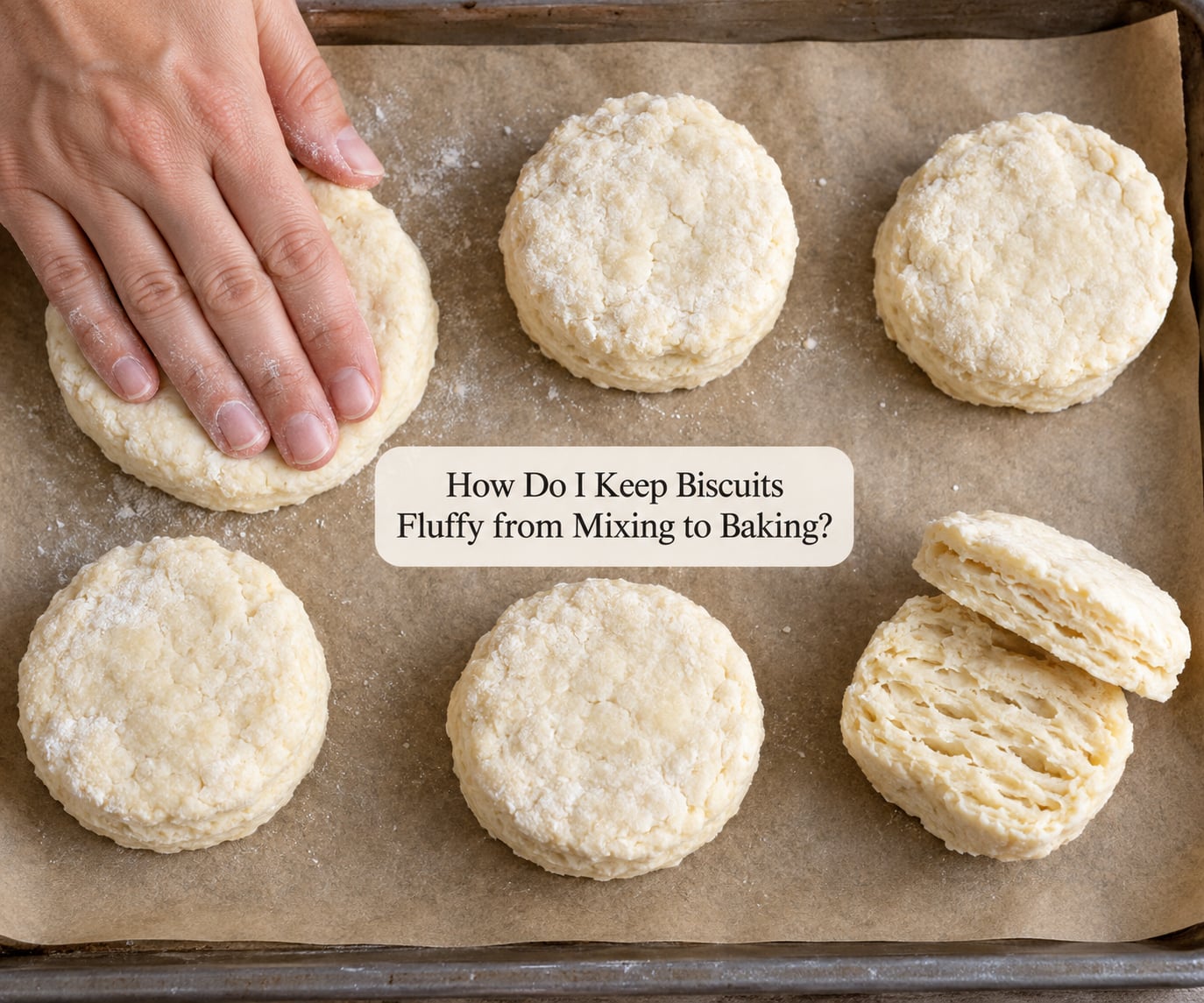
This is the repeat-test version that works. Run it two or three times and the pattern becomes obvious.
- Chill the fat. Cut the butter into cubes and freeze it for fifteen minutes, or use it straight from the fridge. Cold fat keeps layers separate.
- Use a cold bowl. Warm bowls melt the fat before it reaches the flour. Ten minutes in the freezer helps more than it sounds like it should.
- Weigh everything. Flour, leavening, and salt by weight. Volume measures are where most hard biscuits start.
- Cut the fat into the flour until it looks like coarse cornmeal. Then add liquid and stir with a spoon until there is no dry flour left. Stop there.
- Press and fold three or four times. Flour the counter with a light hand, pat the dough to roughly three-quarter-inch thickness, and fold it like a letter. Never roll it.
- Cut straight down with a sharp cutter. A twisting motion compresses the edges. Wipe the cutter between cuts so it does not drag.
- Bake immediately. Twenty minutes of chilling is useful if the dough feels sticky, but every extra minute at room temperature softens the fat.
- Check the oven before the dough goes in. A thermometer at 450 and the tray on a bare metal sheet, rack just below center.
- Bake 10 to 14 minutes at 450 degrees. Pull at the earliest sign of golden tops. Do not wait for deep browning.
Change one thing per batch. If you adjust the flour, the butter, and the temperature at once, you have no idea which one fixed it, and the next failure is just as random.
Frequently Asked Questions
How can I tell if biscuit dough is overworked?
The signs show up in the dough before baking. Overworked dough looks smooth and glossy instead of rough and torn, springs back hard when you squeeze it, and sticks to your palm. Proper biscuit dough stays a little ragged, holds together when pinched, and releases from your hand. If yours already feels elastic, chill it twenty minutes and press it a few more times rather than kneading again.
What happens if you overmix biscuit dough?
Water plus working links the glutenin and gliadin proteins in wheat flour into an elastic network. Biscuit fat is supposed to coat those proteins and block that linking, and every extra stir, knead, or roll undoes the coating. The result is a dense, chewy biscuit that springs back and shrinks in the oven instead of a tender flaky one. No temperature adjustment will fix dough that was overworked.
How do I soften hard biscuits after baking?
You cannot undo the gluten, but you can add moisture back. Lightly brush the warm biscuits with melted butter, then wrap them in a clean towel and hold for ten minutes. The trapped steam softens the crumb. For a batch serving later, store them in a sealed container with a slice of bread, which gives off moisture the biscuits absorb overnight. Slightly stale biscuits revive well this way.
What makes biscuits rise better, baking powder or baking soda?
Baking powder is the right choice for most biscuit recipes, especially ones with milk. Double-acting powder reacts with moisture and heat, so it lifts without needing an acid. Baking soda only works when paired with an acid like buttermilk or vinegar, and it needs roughly twice the amount to give the same lift. Using soda with plain milk leaves you with flat biscuits and a soapy aftertaste.
What do I do if my biscuit dough is too wet?
Add flour a tablespoon at a time and pinch the dough to test it. The target is a shaggy dough that holds together but still looks torn and rough. If the dough is sticky enough that it clings to your palm, work in another tablespoon or two of flour, then chill the dough for twenty minutes before cutting. Chilling firms the fat back up and makes the rounds hold their shape.
How do I make canned biscuits better in the oven?
Put the pan in a cold or barely warm oven and let it heat with the biscuits rather than preheating fully. That slow start gives the leavening time to activate before the fat melts. Do not thaw frozen dough, keep the biscuits on their own sheet with no silicone mat, and check them two minutes earlier than the package says. Overbaking is the usual reason canned biscuits taste hard.
Start With the First Fix
If you are still puzzling over why do my biscuits come out hard instead of fluffy, start in this order and stop as soon as the texture changes.
- Re-read the recipe and measure everything by weight, especially the flour.
- Use butter straight from the fridge, and keep the mixing short.
- Test the baking powder in hot water and replace it if the fizz is weak.
- Check the oven with a thermometer and bake on bare metal at 450 degrees.
Most batches turn around after the first or second change. And if the biscuits are chewy rather than dry, skip ahead and fix the handling.