If your sourdough starter is not rising, the cause is almost always boring rather than fatal. It is too cool, too thin to trap gas, too young, underfed at a tiny ratio, or overfed and diluted. Measure every feed in grams, keep the jar near 75-85F (24-29C), and give a brand new starter a full two weeks before you decide anything is wrong.
I have kept starters in a cold Appalachian kitchen where the thermostat sat at 65F for most of the winter, and I have also killed one by feeding it 1:5:5 out of enthusiasm. Both failures looked identical from the outside: a jar that sat there doing nothing. The fixes were completely different, which is why this guide starts by telling symptoms apart rather than guessing.
Below is the order I actually work through when a starter stalls: what you are seeing, how warm it is, how much food you gave it, how thick it is, how old it is, and last, whether it is contaminated.
Table of Contents
- Why Is My Sourdough Starter Not Rising?
- How to Tell Whether Your Starter Is Weak, Dormant, or Dead
- The 8 Most Common Reasons a Sourdough Starter Is Not Rising
- 1. You fed it too little to matter
- 2. Your kitchen is too cold
- 3. The feeding was too watery
- 4. The feeding was too stiff and dry
- 5. You switched to rye or whole grain recently
- 6. Not enough time has passed since the last feed
- 7. The jar is contaminated
- 8. You are testing it in a way that hides the answer
- Temperature and Feeding Schedule
- Starter Hydration and Flour Choice
- How to Fix a Starter That Has Been Neglected
- How to Test Starter Activity Correctly
- When a Sourdough Starter Is Not Rising Because of Contamination
- How to Keep Your Starter Rising Between Bakes
- Why Is My Sourdough Starter Not Rising? Quick Troubleshooting Checklist
- Frequently Asked Questions
- How long should a sourdough starter take to rise the first time?
- Why does my sourdough starter rise in the jar but not in dough?
- Can a sourdough starter be too old to rise?
- Should I feed my sourdough starter every day?
- Is a sourdough starter supposed to smell sour or bad?
- What temperature is best for a sourdough starter to rise?
- Conclusion: Start With Temperature and Feeding Strength
Why Is My Sourdough Starter Not Rising?
A sourdough starter that will not rise is usually too cold, too runny to hold gas, too young, underfed at a tiny ratio, or overfed and diluted. Measure your feed in grams, keep the jar around 75-85F (24-29C), and give a young starter two full weeks before you call it dead.
Here is what is happening inside the jar. Wild yeast and lactobacilli feed on sugars in the flour, and as they work they produce carbon dioxide. That gas only shows up as a rise if the starter is thick and elastic enough to trap it, the way a balloon traps air.
So a starter that is watery enough to pour has no structure to hold gas, and a starter that sits at 65F produces gas too slowly to outpace its own weight. Neither problem is fixed by feeding more flour. They are fixed by changing the temperature, the consistency, or the size of the feed.
One more thing worth saying plainly: a starter that has not visibly doubled in a single feeding is not automatically dead. Plenty of perfectly healthy cultures rise slowly and quietly.
How to Tell Whether Your Starter Is Weak, Dormant, or Dead
These three states get lumped together, and treating them the same is what makes people throw out healthy starters. Mark the jar level with a rubber band or piece of tape before you feed, then judge what happens against that line.
A weak starter is alive but underpowered. It bubbles at the edges, smells tangy or yeasty, and may swell a little without doubling. It usually takes twelve hours or more at room temperature. The answer is a bigger feed and a warmer spot.
A dormant starter has been refrigerated, neglected, or starved. You see a dark layer of liquid on top, which bakers call hooch, and little or no activity. Hooch by itself is not mold and not a death sentence. The yeast has simply gone to sleep on the floor of the jar.
A dead starter has stopped responding altogether. After two or three generous feedings at a proper temperature, nothing happens: no bubbles, no dome, no sour smell, nothing to stir down. That is when you start over, and even then, mold is the cleaner line to draw.
Before you read another word, match your jar to one of these:
| What you see | Most likely cause | What to do | Expected time to rise |
|---|---|---|---|
| Bubbles on the jar walls, no expansion | Underfed or too cool | Double the flour and water, move to 80F (27C) | 6-10 hours |
| Dark liquid layer on top, no smell of sour | Dormant starter that has been refrigerated or neglected | Pour off the hooch, feed 1:2:2 with fresh flour | 12-24 hours |
| Starter pours like milk, no dome possible | Hydration too high | Add flour until it is the texture of thick pancake batter | 8-12 hours after thickening |
| Rises fast, then collapses flat before you get to it | Left past peak and hit the acidity wall | Feed at peak, shorten the time between feedings | 4-6 hours to peak |
| Sharp acetone or nail-polish smell | Overfed or starved too long | Discard most of it, feed a small amount of strong starter | 10-14 hours |
| Nothing at all after several warm feedings | Contamination or a dead culture | Check for mold and pink or orange streaks; discard if present | Not worth waiting |
The 8 Most Common Reasons a Sourdough Starter Is Not Rising
1. You fed it too little to matter
The single most common self-inflicted problem is a 20g starter, 20g flour, 20g water feed. In grams that is a genuine 1:1:1, but the absolute quantities are so small that there is not enough culture or enough fresh food to build a real population.
Start at 50g starter, 50g flour, 50g water. That is still one-to-one-to-one, just at a size where the yeast has something to work with.
2. Your kitchen is too cold
Yeast slows noticeably below 70F (21C) and crawls under 68F (20C). A starter in a 65F room can look dead for a full day and be perfectly fine.
This is the cause I run into most often. Read the temperature section below before you change anything else, because heat fixes more stalled starters than feeding changes do.
3. The feeding was too watery
Water-heavy starters feel like slack pancake batter and never dome. Without a gluten structure to hold the carbon dioxide, the gas escapes and the jar looks quiet.
Stir in extra flour until the mixture pulls away from the side of the jar and leaves a clean trail when you drag a spoon through it. The target people describe as very thick pancake batter is right.
4. The feeding was too stiff and dry
The opposite error also stalls a starter. A dough that is stiff enough to hold a shape will not move, so it never looks active even while the culture is fine underneath.
Slack it back with a splash of water until it domes slowly on its own. A starter that sits still and then slowly swells over several hours is working.
5. You switched to rye or whole grain recently
Rye and whole wheat flour are loaded with minerals and enzymes, so a starter fed with them often goes wild for a day or two and then goes dense and sluggish while it catches up.
That dense middle stretch reads as a stall. Feed whole grain for a few days to wake things up, then return to a blend that is at least half white flour for bulk baking.
6. Not enough time has passed since the last feed
People check a jar four hours after feeding and decide it failed. At 75-85F (24-29C) a healthy starter usually needs four to six hours to double, and at 68F the same starter can take twelve to twenty-four.
Wait a full cycle before you feed again. Feeding a starter that has not peaked keeps it in a permanently underfed state.
7. The jar is contaminated
Persistent fuzzy mold, pink or orange streaks, or a rotten smell that does not clear after a refresh all point away from a simple feeding problem. There is no way to rehabilitate a contaminated culture.
8. You are testing it in a way that hides the answer
Testing a spoonful of starter in a cup of plain flour, or judging activity by a dense dough that refuses to dome, tells you very little. Testing methods have their own limits, which I walk through further down.
Temperature and Feeding Schedule
Temperature is the lever with the largest effect and the one most people leave alone. Rise speed roughly halves for every ten degrees Fahrenheit you take off the yeast’s preferred range, which is why a starter can behave like two different cultures in two different houses.
| Kitchen temperature | What the yeast is doing | Typical time to double |
|---|---|---|
| Below 65F (18C) | Dormant, may never start | More than 48 hours |
| 68F (20C) | Very sluggish | 12-24 hours |
| 70-74F (21-23C) | Slow but reliable | 8-12 hours |
| 75-85F (24-29C) | Ideal range | 4-6 hours |
| Above 90F (32C) | Stressed, can stall or go sour fast | Erratic |
If your kitchen runs cold, give the starter a warmer home. Setting the jar in a bowl of water from a kettle, with the water just warm to the touch, works well. The oven with only the light on, the top of the refrigerator, or a small insulated cooler all raise the surrounding temperature a few degrees without any equipment.
Feeding frequency follows the temperature. Once a day is enough at 75F and above. In a cool room, feed twice a day, and mark each feeding on the jar so you do not double-feed by accident.
For an established starter, move to a 1:2:2 or 1:3:3 ratio by weight. Two parts flour and water for every one part starter gives the culture more food and more room to expand than the 1:1:1 baseline that new starters need.
Starter Hydration and Flour Choice
Hydration changes how a starter behaves in your hands and how it holds gas. A liquid-heavy starter at 100 percent hydration flows and never domes. A stiff starter at 60 percent sits as a lump and takes longer to show you anything. Most people settle between 75 and 85 percent for daily maintenance.
Weight matters more than volume here, and this is where a lot of beginner measurements go wrong. One cup of flour weighs about 120 grams, while a cup of water weighs about 240. Scoop a cup of each and your supposed 1:1:1 feeding is really closer to one part starter, two parts water, one part flour by weight. That thin, watery mix is exactly the consistency that will not rise.
Flour choice matters next. A blend of white and whole wheat gives you activity plus manageable dough handling. White AP flour alone ferments more slowly because it carries fewer nutrients, and a brand new starter fed only white flour can look completely inert while it is still establishing itself. A small share of whole rye wakes a sluggish culture up faster than anything else short of heat.
How to Fix a Starter That Has Been Neglected
A neglected starter is nearly always recoverable. Pour off any liquid on top, then work through this plan one feeding at a time. Each day below assumes a 1:2:2 feed by weight at 80F (27C) or warmer.
| Day | Action | What you should see |
|---|---|---|
| Day 1 | Discard all but 50g of starter, feed with 50g flour and 50g warm water | Faint sour smell by evening, no visible rise yet |
| Day 2 | Look for bubbles on the walls before discarding anything | Bubbling at the edges, maybe 20-30 percent rise |
| Day 3 | If it doubled, feed 1:2:2 again and warm the spot further | A visible dome that collapses when you shake the jar |
| Day 4 | Reduce back to 1:1:1 to rebuild strength if the rise was weak | Consistent rise within six hours |
| Day 5-6 | Feed once a day at 1:1:1 and mark the jar each time | Doubling reliably every cycle |
| Day 7 | Test with the jar method, then start baking | Float test or a clean double in four to six hours |
If nothing moves across all seven days, add a pinch of dry active yeast with the feed on day one. It is a nudge, not a rescue, and it will not fix a culture contaminated with mold, so treat it as a last resort rather than a habit.
Small amounts of pineapple or lemon juice in the water can also nudge a lagging culture by raising acidity slightly. Use a teaspoon per feeding at most. More than that and you are making a different thing entirely.
How to Test Starter Activity Correctly
Mark the level of your starter on the jar with a rubber band, feed it, and watch the line. A rise that pushes past the band and a top that domes before it deflates is what you are looking for.
The float test works too, with limits. Drop a spoonful into water or into a small glass of feed. A starter that floats has enough gas to be usable, but a starter that sinks can still be perfectly active, so a sinking result tells you very little.
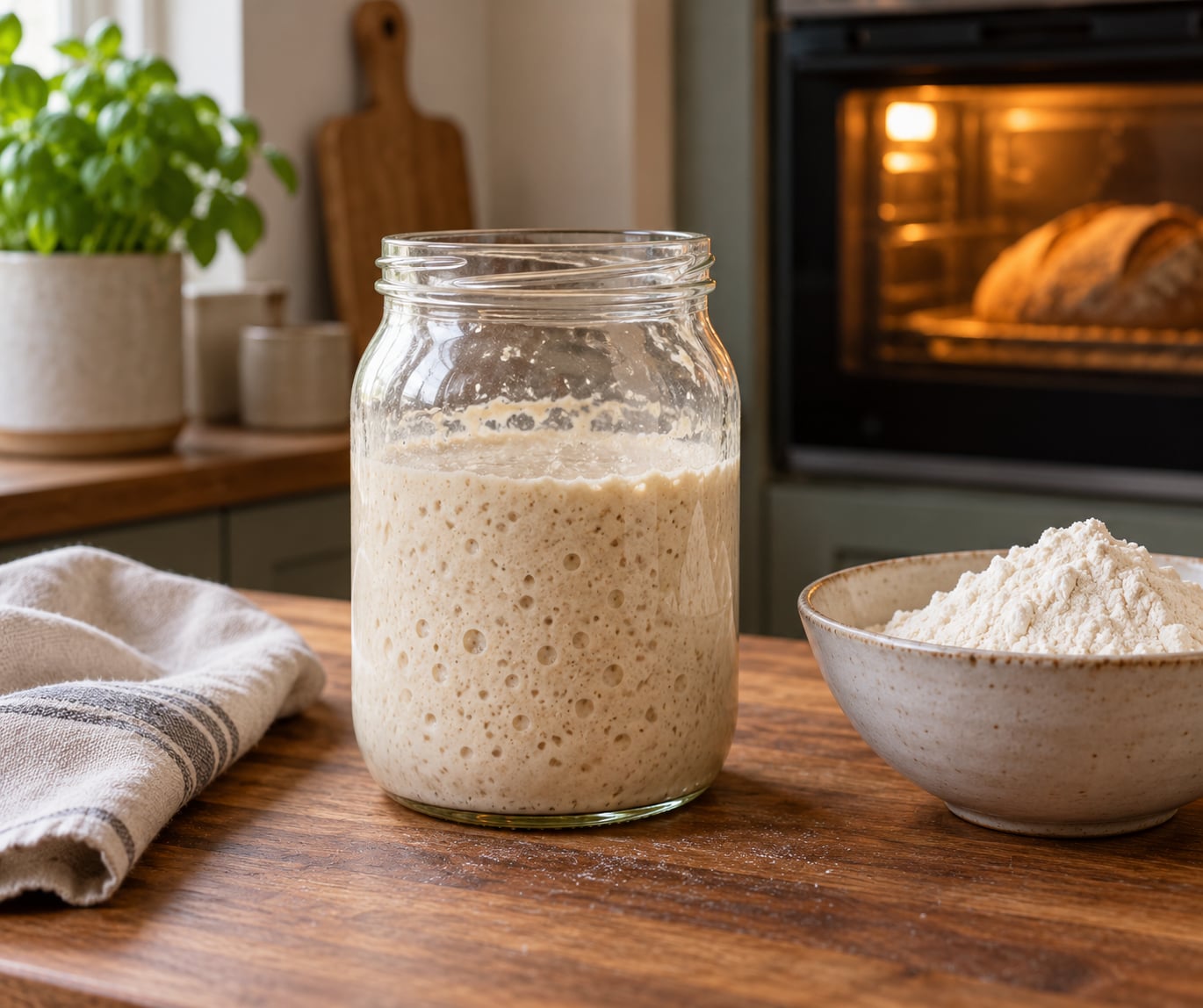
What you are really checking is whether gas production is matching the food supply. Signs of a working starter are bubbles along the sides, a domed top at peak, a tangy yogurt or acetone smell, and a texture that is elastic and jiggly. Signs of trouble are a flat surface, no bubbles at all, and a thin watery liquid instead of a paste.
When a Sourdough Starter Is Not Rising Because of Contamination
Normal sourdough activity smells sharp. Nail polish remover smells mean the culture went hungry and produced acetone as a byproduct, which is recoverable. What is not recoverable is fuzzy mold in white, green, black, or orange, pink streaks running through the flour, and a smell that is rotten rather than sour.
Hooch is not contamination. That dark liquid on top is yeast and bacteria settling out under refrigeration or neglect. Pour it off and feed; the culture underneath is usually fine.
The rule most sourdough communities agree on is simple: only stop if it molds. Everything else, including a week of complete stillness, is worth another warm feeding. If you do find mold, discard the whole jar, wash it, and start fresh. Attempting to scrape mold off the top leaves spores behind in a wet, warm culture that will simply return.
How to Keep Your Starter Rising Between Bakes
If you bake every week or more, keep the starter at room temperature and feed it once a day at 1:1:1. That is the least work and the most reliable option.
If you bake monthly, refrigerate it. Feed it, let it double, then refrigerate it. Expect slow activity while it is cold and plan on two or three room temperature feedings to bring it back before you bake.
Feed at peak rather than after it falls. That single habit is the difference between a culture that strengthens over months and one that slowly weakens while staying technically alive. The discard you set aside at each feeding becomes tomorrow’s pancakes, crackers, or soda bread, so the upkeep stops feeling wasteful.
Traveling is its own case. Dry a portion of the starter on paper until it is completely dry, then bag it. Dried starter keeps for weeks in a bag and comes back with two or three feedings.
Why Is My Sourdough Starter Not Rising? Quick Troubleshooting Checklist
Run through these in order and stop as soon as the jar responds.
- Check the kitchen temperature and move the jar somewhere between 75 and 85F.
- Increase the size of the feed to at least 50g starter, 50g flour, 50g water.
- Confirm you are weighing in grams, not measuring in cups.
- Adjust hydration until the starter holds a thick pancake batter texture.
- Switch part of the flour to whole wheat or rye for a few feedings.
- Stop feeding until the jar actually doubles, then feed it again.
- Wait a full eight-hour cycle before judging the result at a cool room temperature.
- Look for mold or pink and orange streaks. If you find them, discard and start over.
If you want to check that question before anything else, the answer is almost always one of the first three items on that list.
Frequently Asked Questions
How long should a sourdough starter take to rise the first time?
A brand new starter usually shows bubbles around day two, goes flat and quiet between days four and seven, and produces its first real rise somewhere between days eight and fourteen. A dependable starter can take three to four weeks. If nothing happens after two weeks of warm daily feedings, work through temperature, feed size and hydration again rather than starting over.
Why does my sourdough starter rise in the jar but not in dough?
Most often the jar rise is real but the leaven you added was small or already past peak. Use enough starter to make up a meaningful portion of the dough, feed it so it doubles within the time your dough needs, and check that the dough itself is not too cold or too stiff to hold gas.
Can a sourdough starter be too old to rise?
Age alone does not kill a starter. A decade-old culture fed regularly will rise just like a young one. What stops activity is cold, neglect, dilution from overfeeding, or contamination with mold. Old starter also tends to be weaker and slower, so give it a larger feed until it doubles on its own.
Should I feed my sourdough starter every day?
Once a day is right at 75F and above. In a cooler room, feed twice a day so the culture is not sitting hungry for two long stretches. Never feed a starter that has not peaked yet, because that keeps it permanently underfed and it will gradually lose strength.
Is a sourdough starter supposed to smell sour or bad?
A healthy starter smells pleasantly tangy, like yogurt or slightly sour bread. Acetone or nail polish remover smells mean the culture was starved or overfed, which is fixable. Rotten, chemical, or foul smells, or any visible pink or orange discoloration, mean contamination, and the starter should be discarded.
What temperature is best for a sourdough starter to rise?
Aim for 75 to 85F, or 24 to 29C. Below 70F yeast slows down sharply and under 68F it barely moves, while above 90F the culture gets stressed and can stall or turn sour fast. If your kitchen cannot hold that range, move the jar rather than trying to change the room.
Conclusion: Start With Temperature and Feeding Strength
If your sourdough starter is not rising, do two things before anything else. Put the jar somewhere between 75 and 85F, then feed it 50g starter, 50g flour, and 50g water by weight and watch it for a full cycle without feeding it again.
Most stalled starters are fixed by that one change. Hold out for a full two weeks before replacing a young culture, and discard only when you see mold.