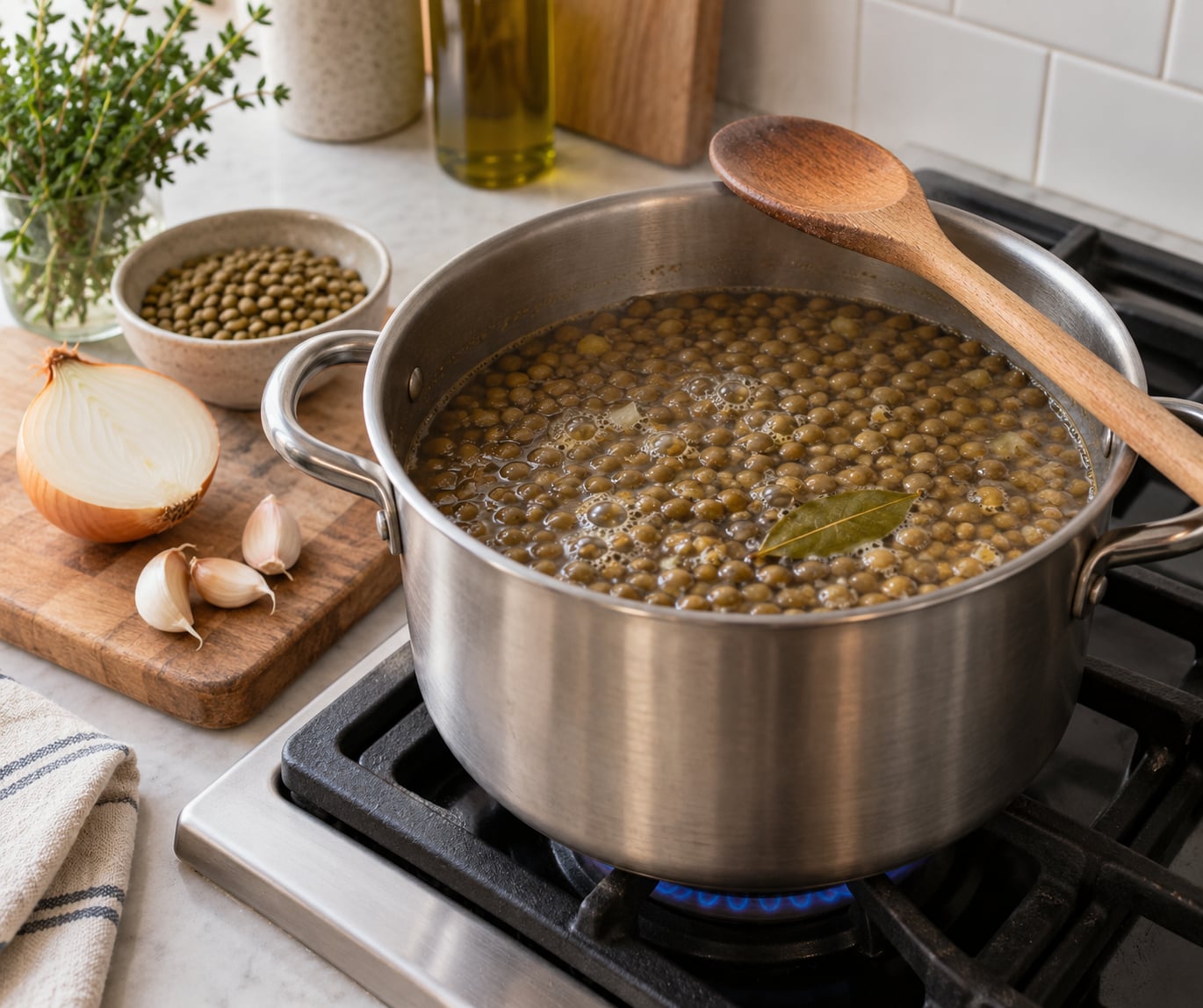
Lentils turn to mush for three reasons: too much liquid, too much heat, and seasoning added too early. Cook them in a barely-bubbling simmer, hold back the salt and vinegar until they are tender, and take them off the heat a few minutes before you think they are done. From a cold pot to a firm, spoonable lentil takes about 30 minutes for green and brown varieties, 20 for red.
The whole thing is a texture job. If you are making a lentil salad or a grain bowl, a mushy lentil ruins the dish. If you are making soup or dal, breakdown is the point.
Table of Contents
- What You Need
- Step-by-Step: How to Cook Lentils So They Do Not Turn to Mush
- Step 1: Choose the Right Lentils
- Step 2: Rinse and Inspect the Lentils
- Step 3: Use a Controlled Amount of Liquid
- Step 4: Bring Them to a Simmer
- Step 5: Test for Tenderness Without Overcooking
- Step 6: Stop Cooking and Drain or Serve
- Common Mistakes That Turn Lentils to Mush
- Tips for Keeping Lentils from Turning Mushy
- Frequently Asked Questions
- How do I keep lentils from becoming mushy?
- Why are my lentils turning to mush even though I simmered them gently?
- Can I use canned lentils without making them mushy?
- How long should I cook green, brown, red, and black lentils?
- Should I add salt or acid while cooking lentils?
- How can I soften cooked lentils without cooking them longer?
- Conclusion
What You Need
- Lentils. French green (Le Puy) or beluga hold their shape best. Plain green and brown are softer. Red and yellow are meant to collapse.
- Water or broth. Broth adds flavor; salted broth seasons the lentils from the start, which you may want to avoid.
- A heavy-bottomed pot with a lid. Thin steel pans scald the starch on the bottom and cook unevenly. A Dutch oven or a stockpot works well.
- A fine mesh sieve or colander, for draining, plus a separate bowl so the hot liquid does not wilt the salad greens sitting next to it.
- A tasting spoon. This is the actual doneness instrument. A timer is a guide, not the answer.
- Optional: aromatics such as a halved onion, a bay leaf, garlic cloves, or a spoon of cumin seed. They season without crowding the pot.
A lid is optional for the plain method and useful for soups. Leave it off if you want a firm texture and a little reduction in the pot; put it on if you are building a broth around the lentils.
Step-by-Step: How to Cook Lentils So They Do Not Turn to Mush
Step 1: Choose the Right Lentils
Variety does more for texture than any technique tweak. French green lentils (Le Puy) and black beluga lentils have a firm seed and a thick skin that resists splitting. Plain green and brown lentils are a softer, larger variety that plumps fast and gives way sooner. Red and yellow lentils are split, with no skin at all, so they are built to dissolve.
Here is what each one does on the stovetop. Times assume 1 cup of dried lentils in unsalted water, starting the clock after the boil.
| Lentil | Cook time | Result when you stop on time |
|---|---|---|
| French green / Le Puy | 20 to 25 minutes | Very firm, holds shape, peppery flavor |
| Black beluga | 20 to 25 minutes | Firm, glossy, holds shape |
| Plain green | 20 to 25 minutes | Firm at the center, softens quickly after |
| Brown | 20 to 25 minutes | Tender, mild, holds shape reasonably well |
| Red / yellow | 15 to 20 minutes | Soft and creamy, part of the way to collapse |
| Split red (masoor dal) | 15 to 20 minutes | Collapses, thickens the liquid |
| Split yellow (moong dal) | 20 to 25 minutes | Collapses, creamy dal |
Green and French green are not the same thing, even though packages and recipes use the words loosely. Swapping one for the other is the single most common reason a home cook follows a reliable cook time and still ends up with paste.
Step 2: Rinse and Inspect the Lentils
Put the lentils in a fine mesh sieve and run cold water over them until it runs clear, about a minute. Stir with your hand while the water flows so the silt and field debris come out. Pick out anything that looks shriveled or has a stone in it.
Rinsing removes surface starch that would otherwise cloud the liquid and thicken it into a paste. Skipping the rinse is not the biggest cause of mush, but it makes the cooking liquid murky and the texture heavier.
Old lentils cook in roughly twice the time and shed their skins as they go, which looks like failure even when the texture is fine. If your lentils came from an open bag and you do not know how old they are, plan on extra time and test early.
Step 3: Use a Controlled Amount of Liquid
Use 2 to 2.5 cups of water or broth per cup of dried lentils for a firm result. That is enough to come to a boil and stay covered by about an inch, with a little extra in reserve for topping up. Add 3 to 4 cups if you are making soup.
Excess liquid is the most common cause of a thin, watery batch that turns to paste as you stir it. People add too much because they are afraid of burning, then simmer for the full cook time, and by the end there is not enough starch structure left to hold a shape. Start at the lower number and keep a kettle of hot water on the stove.
If the pot looks dry before the lentils are tender, add hot water a quarter cup at a time. Cold water drops the temperature and stalls the cook.
Step 4: Bring Them to a Simmer
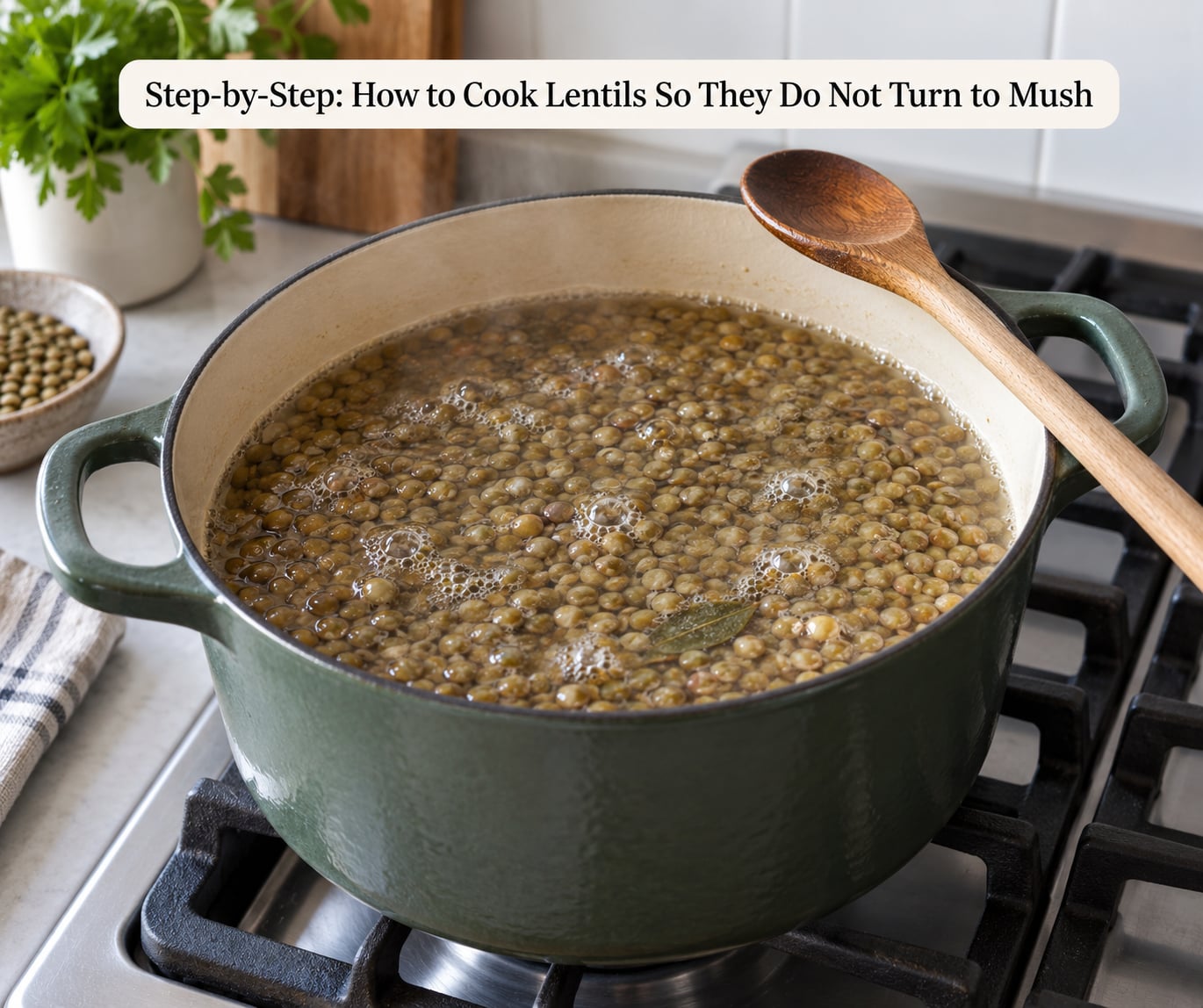
Bring the pot to a full boil over high heat, then drop the heat to the lowest setting your stove has. Leave the lid off. A gentle simmer here means two or three small bubbles breaking the surface per second, with the lentils barely moving. If you see a rolling boil, you are too high.
That distinction is the mechanism behind most mushy batches. A lentil is roughly a third starch, and a rolling boil agitates the thin skins until they shear, pushing that starch into the water. The liquid turns cloudy and thick, and the skins slip off so the beans lose their structure. At a lazy simmer the lentils swell and soften from the inside while the skins stay whole.
On an electric stove, the lowest setting can still boil hard. Set it to one notch above low, or use a diffuser plate, a lower ring, or a lower rack so the pot sits away from the hottest coil. On gas, run it just below the smallest flame and check the pot rather than the dial.
Give the pot a stir every ten minutes so nothing catches the bottom.
Step 5: Test for Tenderness Without Overcooking
Start testing five minutes before the time in the table, and keep testing. Take one lentil out, press it between your finger and thumb, then taste it.
You want a tender skin and a center with a distinct bite. The spoonful test works too: spoon some onto a plate and tip it. Lentils destined for a salad hold their place. Lentils for soup slump slowly. If the spoon test shows them falling apart, they have gone past the point of no return and extra cooking will not help.
Do not trust the clock alone. Pot size, water hardness, lentil age, and how hard your stove runs can move cook time by five minutes in either direction, and a batch that sits after you turn the heat off keeps cooking from residual heat.
Step 6: Stop Cooking and Drain or Serve
Turn off the heat the moment the texture is right. If you are serving them as a side or in a salad, drain them right away in a sieve over a bowl and spread them on a sheet pan or a plate so they cool fast and stop taking on water. Season while they are still warm.
If they are going into a soup, leave them in the pot with the heat off for a couple of minutes and taste again before serving. Warm lentils will soften further in the bowl, so pull them a shade firmer than you want them at the table.
Save the cooking liquid if you like. It is starchy and works as a thickener for soup, a base for a vinaigrette, or a swap for water when cooking rice or grains.
Common Mistakes That Turn Lentils to Mush

Almost every mushy batch comes down to one of these six.
1. Too much liquid. Start at 2 cups of water per cup of lentils, not 4. Add more only when the pot looks dry, and add it hot.
2. Cooking at a rolling boil. Once the pot boils, drop it to the lowest heat. Two or three bubbles per second is the target.
3. Cooking past the texture you want. Lentils go from firm to soft to broken down faster than most people expect. Start tasting five minutes early and taste every two minutes after that.
4. Salt and acid at the start. Salt and vinegar added before the lentils are tender toughen the skins and hold water out of the seed. Add both after they cook. Season with salt, then finish with lemon juice, vinegar, or a mustard vinaigrette.
5. A crowded pot. Lentils need room to move. If the pot is more than a third full, split the batch or use a bigger pot, or they press against each other and cook unevenly.
6. Letting them sit. Lentils left sitting in hot liquid keep absorbing it and keep cooking. Drain them for anything that is not a soup, or remove them from the broth before the dish sits.
Tips for Keeping Lentils from Turning Mushy
Texture is also a dish decision. If you are building a lentil soup or an Indian dal, cook the red or split lentils and let them go all the way. If you are building a salad, a taco filling, or a grain bowl, cook the lentils separately and add them at the end.
Cooking them alongside the rest of the soup is what causes sogginess, because the lentils sit in liquid while the other ingredients cook. Simmer broth, vegetables, and seasoning first, then add pre-cooked firm lentils for the last five minutes.
Use firm lentils as a topping. A spoonful over a bowl of soup, a scatter over roasted squash, or a layer under a grain bowl keeps the bite intact and adds protein without softening anything.
For leftovers, spread cooked lentils in a single layer rather than piling them in a container, let them cool uncovered for a short while, then cover and refrigerate. A thin film of oil on the surface keeps them from drying out. Cooked lentils keep in the refrigerator about three to four days and freeze well for up to two or three months in a sealed container with a little liquid.
Reheat gently in a dry pan for a minute or two, or warm them in a splash of their own liquid. Avoid reheating them in a soup pot for a long time, which puts you back at mush.
Three dressings that suit firm lentils:
- Lemon and herb. Olive oil, lemon juice, chopped parsley or dill, a spoonful of Dijon, salt.
- Cumin and chile. Olive oil, a teaspoon of cumin, dried red chile flakes, garlic, vinegar, salt.
- Garlic vinaigrette. Mashed garlic, mustard, red wine vinegar, olive oil, black pepper.
In a pressure cooker or Instant Pot, cut all cook times roughly in half and use less liquid than the stovetop method, since there is no evaporation. Let the pressure release naturally for ten minutes before you open it, then check. A fast release keeps cooking going in the pot and is a frequent reason pressure-cooked lentils come out soft.
Frequently Asked Questions
How do I keep lentils from becoming mushy?
Rinse them, use 2 to 2.5 cups of liquid per cup of lentils, bring to a boil, then drop to the lowest heat until you see only two or three bubbles per second. Hold salt and vinegar until the end, start tasting five minutes early, and drain promptly for anything that is not a soup.
Why are my lentils turning to mush even though I simmered them gently?
The usual culprits are too much liquid, salt or acid added early, and cooking past the point you wanted. Old lentils also cook longer and shed their skins, and red and yellow lentils are designed to break down. If you followed the time and still got paste, check the pot size and your heat setting, and start testing earlier next time.
Can I use canned lentils without making them mushy?
Yes, and it is easier than cooking from scratch. Rinse and drain them, then use them right away in a salad, bowl, or taco filling where no further liquid is added. Canned lentils are already soft, so do not simmer them in soup or stew. Holding them in broth, even briefly, is what turns them to paste.
How long should I cook green, brown, red, and black lentils?
French green and beluga take 20 to 25 minutes, plain green and brown take 20 to 25 minutes, and red and yellow take 15 to 20 minutes, starting the clock after the boil. These times assume about 2 cups of liquid per cup of lentils. Test five minutes early, since old lentils take much longer than a package suggests.
Should I add salt or acid while cooking lentils?
No. Salt and acidic ingredients such as vinegar, lemon juice, or tomato added before the lentils are tender toughen the skin and slow the softening of the seed, which is one cause of both mushiness and uneven texture. Simmer them in plain water or unsalted broth, then season with salt and finish with acid once they are tender.
How can I soften cooked lentils without cooking them longer?
Warm them in a small amount of their starchy cooking liquid, broth, or water on low heat for five to ten minutes, stirring now and then. That hydrates them back toward tender without the aggressive heat and long simmer that turns them to paste. Add salt and a squeeze of lemon at the end for seasoning.
Conclusion
Start with the variety. French green or beluga if you want a firm bite, plain green or brown for a middle ground, red and yellow only when you want them to break down and thicken what they are in.
Then rinse, measure 2 cups of liquid per cup of lentils, bring it to a boil, and drop the heat until you count two or three bubbles per second. Taste from five minutes early, season with salt and acid only once they are tender, and drain or serve right away while there is still a bite in the middle.