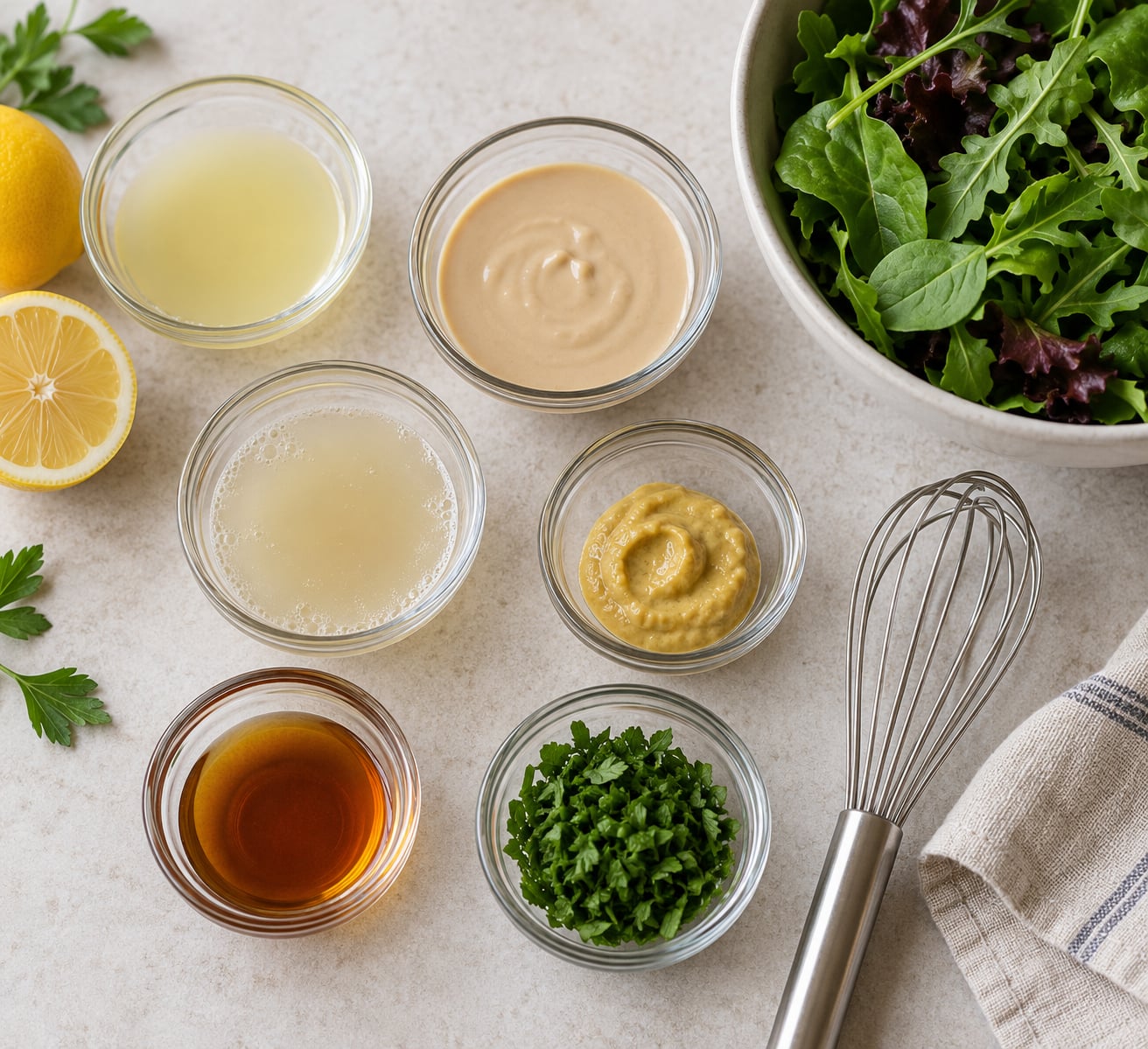
The honest answer is yes: salad dressing without oil works, and once mustard, tahini or aquafaba is doing the emulsifying, most people cannot tell it apart from the oil-based version. You build it on an acid (vinegar or citrus), then add something that suspends the flavor and clings to the greens, because that clinging job is what oil was doing. Learning how to make salad dressing without oil takes about five minutes and a jar.
Most people land here for one of four reasons. One tablespoon of oil carries roughly 120 calories and 14 grams of fat, which is often more than the salad itself. Others are avoiding seed oils like soybean and canola, which show up in a startling number of bottled dressings. Third, plenty of cooks want a dairy-free or whole-food plant-based dressing that still tastes like dinner. Fourth are nut and seed allergies, which rule out the cashew and tahini recipes everybody else is making.
The mistake that ruins most first attempts is simply leaving the oil out. What you get is a watery cup of vinegar that pools at the bottom of the bowl. So before we get to the methods, here is the whole idea in one line: acid for brightness, an emulsifier for body, a little sweetener for balance, and salt.
Table of Contents
- What You Need to Make Salad Dressing Without Oil
- Step-by-Step: Five Methods That Actually Work
- How to Make Salad Dressing Without Oil with Lemon Juice and Vinegar
- How to Make Salad Dressing Without Oil with Tahini
- How to Make Salad Dressing Without Oil with Aquafaba
- How to Make Salad Dressing Without Oil with Silken Tofu
- How to Make Salad Dressing Without Oil with Fruit or Vinegar
- Common Mistakes When Making Salad Dressing Without Oil
- Frequently Asked Questions
- What is the best substitute for oil in salad dressing?
- How can I make salad dressing creamy without oil?
- Can I use yogurt or silken tofu instead of oil?
- How long does homemade oil-free dressing last?
- Why is my dressing separating or becoming watery?
- Can I make salad dressing without oil ahead of time?
- Conclusion
What You Need to Make Salad Dressing Without Oil
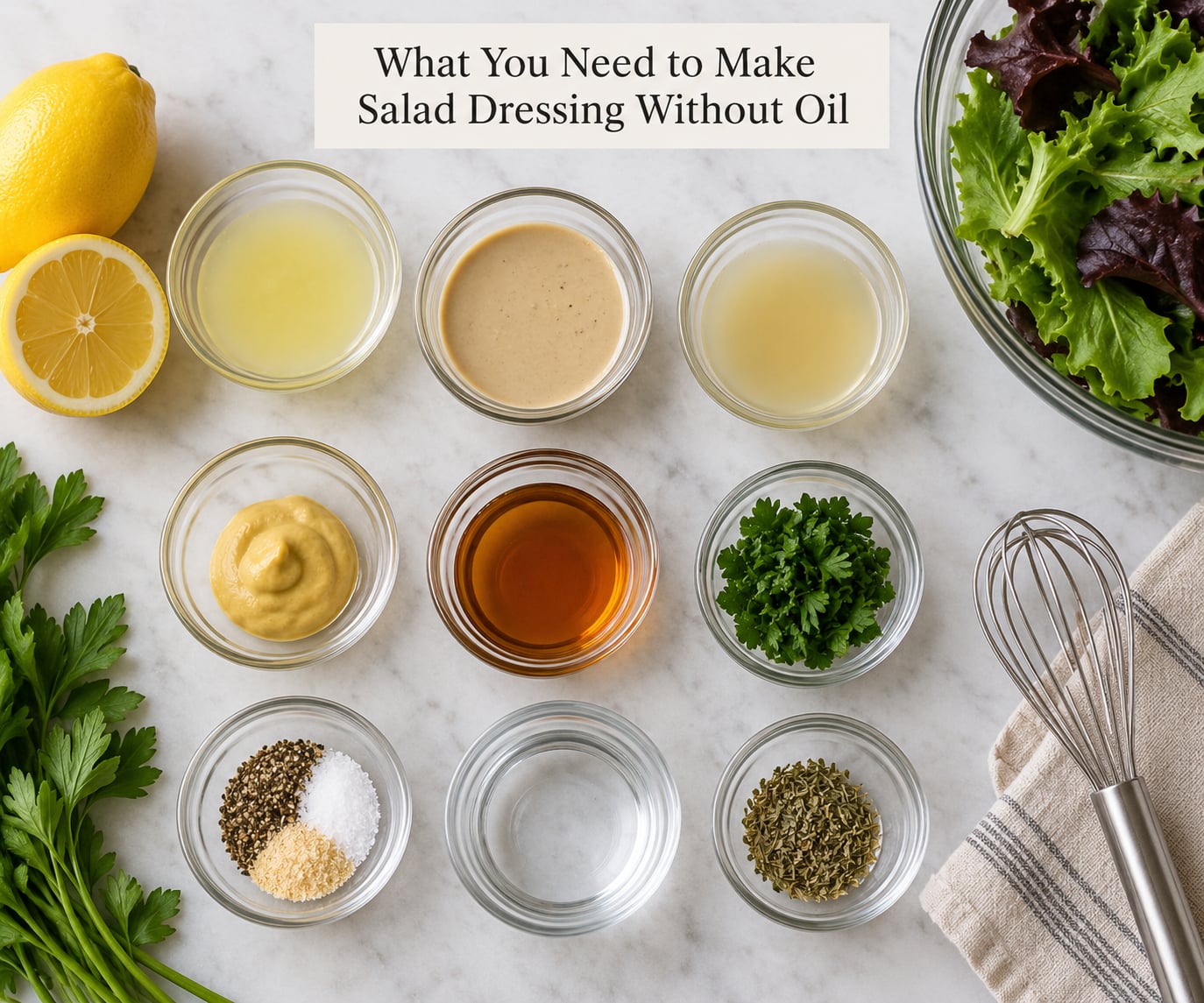
The essentials. You need an acid and you need an emulsifier. Everything else is a dial you turn to taste.
- Acid: lemon or lime juice, rice vinegar, white wine vinegar, balsamic, or apple cider vinegar. Balsamic and cider carry their own sweetness, so they need less added sweetener.
- Emulsifier or thickener: Dijon or yellow mustard, tahini, aquafaba, silken tofu, blended cashews or white beans, nutritional yeast, miso paste, or a tablespoon of thick water saved from soaking cashews.
- Seasoning: salt, black pepper, garlic powder, onion powder, dried dill, parsley, chives, or chili flakes.
The optional extras. A teaspoon of maple, date, or sorghum syrup takes the sharp edge off vinegar, which is what makes a dressing feel finished rather than sour. A teaspoon of miso or tamari adds savory depth in a way plain salt cannot. Fresh herbs go in at the end because heat kills their aroma.
One last practical note. Every creamy base needs a small amount of extra liquid to loosen it, and that liquid is usually water, aquafaba, or lemon juice. Start with a teaspoon, whisk, then add another. Thick dressings almost always loosen on the second or third try, and it is much easier to add liquid than to try to fix it later.
| Thickener | Resulting texture | Flavor it adds | Best for |
|---|---|---|---|
| Dijon or yellow mustard | Lightly thickened, emulsified | Pungent, sharp, classic | Thin vinaigrette styles |
| Nutritional yeast | Medium body, slightly grainy | Savory and cheesy | Everyday oil-free dressing |
| Tahini | Thick and creamy | Nutty, slightly bitter | Ranch and garlic styles |
| Soaked cashews | Very thick, smooth | Mild, neutral | Caesar and green goddess styles |
| Silken tofu | Smooth and light | Very neutral | Soy-friendly creamy dressings |
| Aquafaba | Light, foamy, clingy | None | Egg-free emulsifying |
| Miso paste | Lightly thickened | Deep umami | Boosting a thin dressing |
| White beans | Thick and earthy | Bean flavor | Nut-free and seed-free ranch |
Step-by-Step: Five Methods That Actually Work
How to Make Salad Dressing Without Oil with Lemon Juice and Vinegar
This is the 3-2-1 formula that circulates most widely in plant-based cooking circles, and it is the fastest route to a balanced result. Start with 3 tablespoons lemon juice, 2 tablespoons vinegar, 2 tablespoons Dijon mustard, 1 tablespoon maple or date syrup, and 2 tablespoons water or aquafaba.
Put everything in a jar with a tight lid and shake for about 30 seconds. That is the emulsification step: the mustard contains emulsifying compounds that suspend the flavor in the liquid instead of letting it settle, and shaking breaks everything into tiny even particles. Whisking in a bowl works too, just slower.
You know it is ready when the dressing looks uniform and slightly opaque rather than clear with sediment at the bottom, and when it coats a spoon without running off in a thin film. Taste it, then adjust: a pinch more salt if it tastes flat, a teaspoon more maple if the acid makes you wince, a splash of water if it grips too hard.
This version is the most versatile. It works on plain mixed greens, cucumber and tomato, sliced radishes, and a bowl of white beans marinated in it for an hour. Swap balsamic for the vinegar and it turns sweet enough for strawberries.
How to Make Salad Dressing Without Oil with Tahini
Tahini is a paste made from ground sesame seeds, and it is the single best shortcut to a creamy oil-free dressing. Whisk 2 tablespoons tahini with 1 tablespoon lemon juice and 2 tablespoons cold water. Add 1/4 teaspoon garlic powder, salt, and pepper, plus more water a teaspoon at a time until it loosens.
Whisk the lemon juice into the tahini first and let it sit for a minute before the water goes in. Tahini seizes and turns pasty when it hits liquid, and that thick, clumpy stage is normal. Keep whisking and the water will loosen it back into a smooth, pourable cream.
The finished texture should fall slowly off a spoon like slightly thickened cream, with no graininess and no visible oil sheen on the surface. If it looks greasy or splits, you have not whisked long enough. If it is too stiff for your salad, add water a teaspoon at a time rather than lemon, because lemon plus tahini gets sharp fast.
One thing to plan for: tahini thickens further as it stands, especially in the fridge. Thin it with a splash of water before serving. Use this on chopped romaine, roasted vegetables, warm chickpeas, grain bowls, or as a drizzle over a baked sweet potato.
How to Make Salad Dressing Without Oil with Aquafaba
Aquafaba is simply the salted liquid in a can of chickpeas, and it whips into a foam that clings to salad leaves remarkably well. Drain a can of chickpeas, reserve the liquid, and you have about 3/4 cup of it in your hand.
Combine 3 tablespoons aquafaba, 1 tablespoon lemon juice, 1 teaspoon mustard, 1 teaspoon maple syrup, 1/2 teaspoon garlic powder, and a pinch of salt in a bowl. Whisk briskly for 30 to 60 seconds until the surface turns cloudy and holds a faint foam. No blender and no cooking required.
The cue is the foam. If it collapses immediately, you whisked too gently; if it turns foamy and holds a swirl that fades slowly, the dressing is ready. It will be looser and lighter than the tahini version, so it coats without weighing anything down, which makes it ideal for delicate greens, fruit salads, and slaw.
A shortcut worth knowing: keep the leftover liquid after draining chickpeas for soup, risotto, or a second batch of dressing. It keeps in the fridge for about three days in a covered container.
How to Make Salad Dressing Without Oil with Silken Tofu
Silken tofu is the answer when you want a smooth, creamy dressing without nuts or seeds. The set is 150 grams, about half a package, blended with 1 tablespoon lemon juice, 1 teaspoon tamari or 2 teaspoons white miso, 1/4 teaspoon garlic powder, and 1 to 2 tablespoons water.
Drain the tofu and blend everything on high for 45 to 60 seconds, scraping down the sides once. Tofu has no flavor of its own, so it takes on whatever you give it, which is both the strength and the trap. Season a bit harder than feels right at first.
The finished dressing should be smooth enough to pour and thick enough to leave a faint trail when you drag the back of a spoon through it. Blended tofu separates a little faster than tahini, so give it a stir or a shake before each use. If it is too thick, loosen it with water or lemon juice a teaspoon at a time.
Because tofu is neutral and soy-based, this is the version that works for anyone avoiding nuts and seeds but not soy. It is good on slaw, cucumber salad, cold noodle salads, and as a spread for wraps.
How to Make Salad Dressing Without Oil with Fruit or Vinegar
This is the method for when you want something bright and a little unexpected. The base is 1/2 cup unsweetened applesauce or apple purée, 2 tablespoons apple cider vinegar, 1 tablespoon lemon juice, 1 teaspoon mustard, and 2 teaspoons sorghum syrup or maple syrup. Add a pinch of cinnamon or ginger and a pinch of salt.
Whisk everything together and let it sit for 10 minutes so the apple and vinegar marry. Control sweetness by choosing your purée: unsweetened applesauce keeps it tart, while a jarred unsweetened purée gives you a smoother body. Add the sweetener in half-teaspoon increments and taste each time, because fruit and vinegar are both aggressive and easy to overshoot.
Vinegar is what keeps this from becoming a dessert sauce, so do not skip it or cut it in half. The texture cue is a dressing that is slightly loose and pours in a slow ribbon, thickening as it sits on the leaves.
Variations are easy from there. Replace the apple with roasted garlic and a squeeze of lemon for a savory version. Use fresh grated apple with cider vinegar and a pinch of sorghum for something very close to a classic apple cider dressing. Berry purées work the same way, just reduce the sweetener by half. Blot a tablespoon of aquafaba into any of these to make them cling more.
Common Mistakes When Making Salad Dressing Without Oil
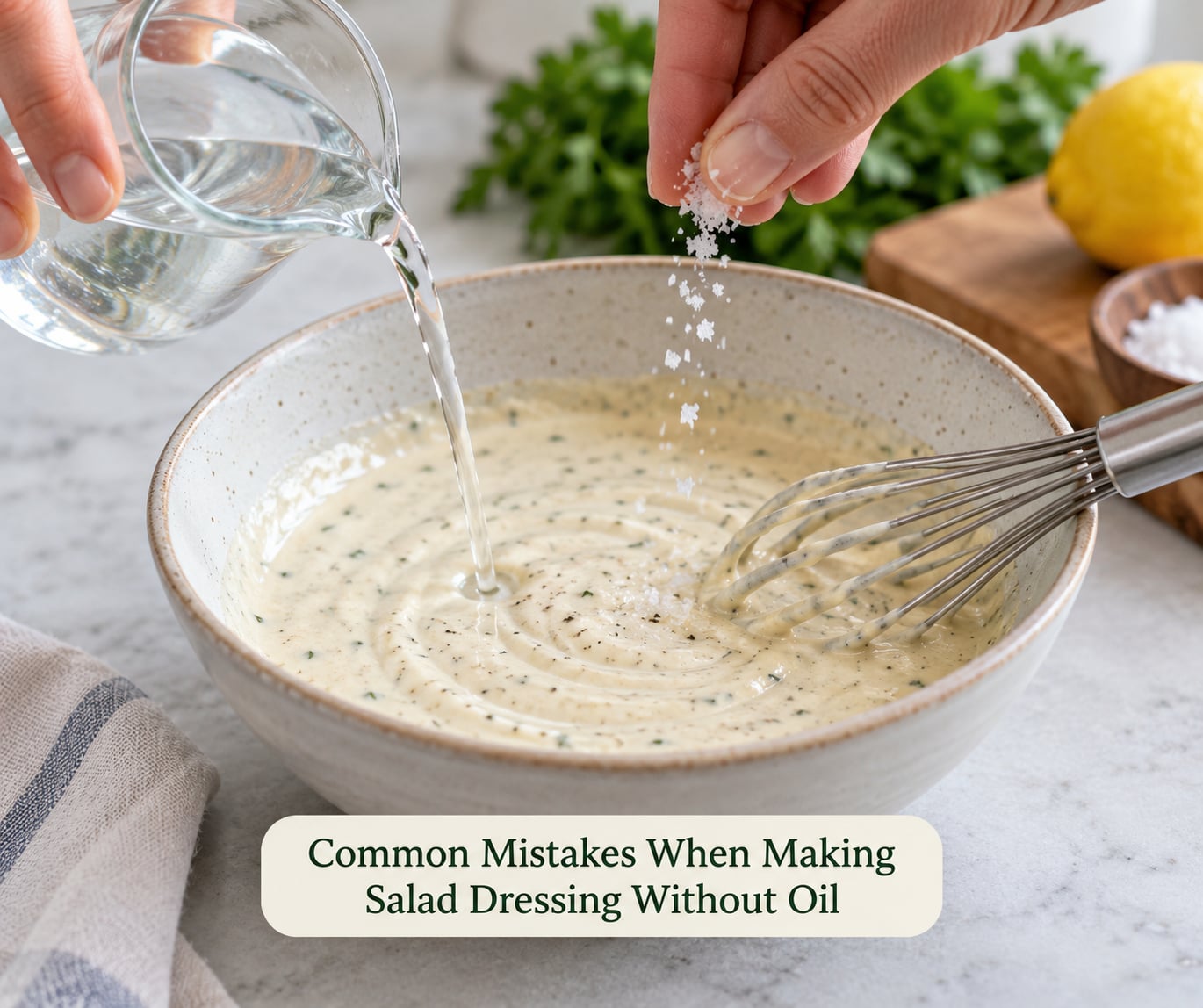
The dressing is watery and settles at the bottom. You skipped the emulsifier or did not shake long enough. Add another tablespoon of mustard or aquafaba, seal the jar, and shake for a full 30 seconds. Thin dressings are the most common problem with this kind of recipe and the easiest to rescue.
It tastes flat or dull. That is usually salt, not acid. Add 1/4 teaspoon salt, stir, taste, then add another pinch. If it still tastes flat after two rounds of salt, a teaspoon of miso paste will do what plain seasoning cannot.
It tastes too sharp or harsh. Add sweetener in small increments rather than reaching for more liquid, since more liquid also dilutes. Half a teaspoon of maple, date syrup, or sorghum at a time, tasting as you go.
It is clumpy or grainy. With tahini, it needs longer whisking and more water than you think. With nutritional yeast, graininess means you used too much for the liquid volume, or it sat too long, so blend it in rather than whisking.
It is thicker than salad dressing should be. Add water one teaspoon at a time and whisk until it ribbons off the spoon. Thick dressings can always be loosened; thin ones cannot be rebuilt.
The mustard itself contains oil. This is the trap that catches people, and it is worth checking before you start. Plenty of bottled Dijon, honey mustard, and Thousand Island dressings list vegetable or soybean oil in the ingredient panel, which defeats the whole exercise. Read the label and pick a mustard with a short ingredient list, or grind your own from mustard seed, vinegar, water, and salt.
| If you are out of | Use instead | Watch for |
|---|---|---|
| Dijon mustard | Yellow mustard, or 1 teaspoon horseradish with a splash of vinegar | Yellow mustard is milder, so reduce the salt |
| Maple syrup | Date syrup, sorghum syrup, agave nectar, or a pinch of sugar | Agave is about as sweet as sugar, so use less |
| Lemon juice | Lime juice, rice vinegar, or verjus | Rice vinegar is softer and less sharp |
| Any vinegar | Extra lemon juice plus a teaspoon of miso | Miso carries depth that lemon cannot |
| Tahini or cashews | White beans, silken tofu, or thick water | Beans give more body, tofu more smoothness |
| Aquafaba | Cold water plus an extra tablespoon of mustard | The result is thinner, not creamier |
Practical habits that make this easier. Measure with tablespoons instead of pouring, since these recipes are all about ratios. Shake rather than whisk whenever you can; it is faster and emulsifies better. Salt twice as much as feels comfortable at the start of mixing, then taste at the end. Keep the base dressing plain and add fresh herbs, seeds, or grated vegetables just before serving. And to scale up for meal prep, the 3-2-1 formula multiplies cleanly, so make it in a full cup of vinegar, a half cup of mustard, and a quarter cup of syrup.
Frequently Asked Questions
What is the best substitute for oil in salad dressing?
There is no single best one, because oil does two jobs in a vinaigrette: it suspends the flavor and it clings to the leaves. For a thin dressing, mustard is the substitute. For a creamy one, use tahini, blended cashews, silken tofu, or white beans. Whatever you pick, pair it with enough acid, a pinch of salt, and a small sweetener to keep it from tasting sharp.
How can I make salad dressing creamy without oil?
Blend or whisk in something with real body. Tahini loosened with water and lemon makes a garlic ranch in under a minute, and soaked cashews blended with a splash of water give the smoothest, most Caesar-like result. Silken tofu blended with lemon and tamari is neutral and dairy-free. The trick is adding liquid slowly, since every one of these seizes up before it loosens.
Can I use yogurt or silken tofu instead of oil?
Yes, and both work better than most people expect. Plain Greek yogurt gives a tangy, thick ranch-style dressing and needs only lemon, garlic powder, and salt. Silken tofu is the vegan option, blending smooth in about a minute and taking on whatever flavor you add. Neither needs sugar for body, so taste for salt and acid before you sweeten either one.
How long does homemade oil-free dressing last?
Refrigerated in a sealed jar, a vinegar-based oil-free dressing keeps about a week, and the soy- and nut-based creamy versions are best within three to four days. Give the jar a smell before using it, and discard anything that looks off. Because there is no oil to inhibit bacteria, do not leave these dressings sitting out at room temperature for more than a couple of hours.
Why is my dressing separating or becoming watery?
Two different problems share this symptom. Separation means the emulsion broke, so add a tablespoon of mustard or aquafaba and shake hard for 30 seconds. Wateriness means you never built body, so whisk in tahini, nutritional yeast, or blended white beans a spoonful at a time. Add liquid a teaspoon at a time as well, since loosening is easy and thickening is not.
Can I make salad dressing without oil ahead of time?
Yes, and it is one of the better reasons to make your own. Store the base in a jar in the fridge for up to a week, then add anything fresh per serving: chopped herbs, grated garlic, seeds, or cracked pepper. If it thickens while stored, loosen it with water or lemon juice and shake. Leave out ingredients that turn bitter or mushy, such as fresh herbs and garlic.
Conclusion
Start with the lemon juice and vinegar method the first time, because it teaches you the ratio that the rest of the recipes are built on: acid, mustard, a little sweetener, salt. Once that tastes balanced, move to tahini for creamy dressings and aquafaba when you want something light.
Then taste before you adjust, and adjust in small steps. A pinch of salt, a splash of water, half a teaspoon of maple syrup. That is genuinely all you need to make salad dressing without oil, and none of it requires equipment beyond a jar, a whisk, or a blender you already own.