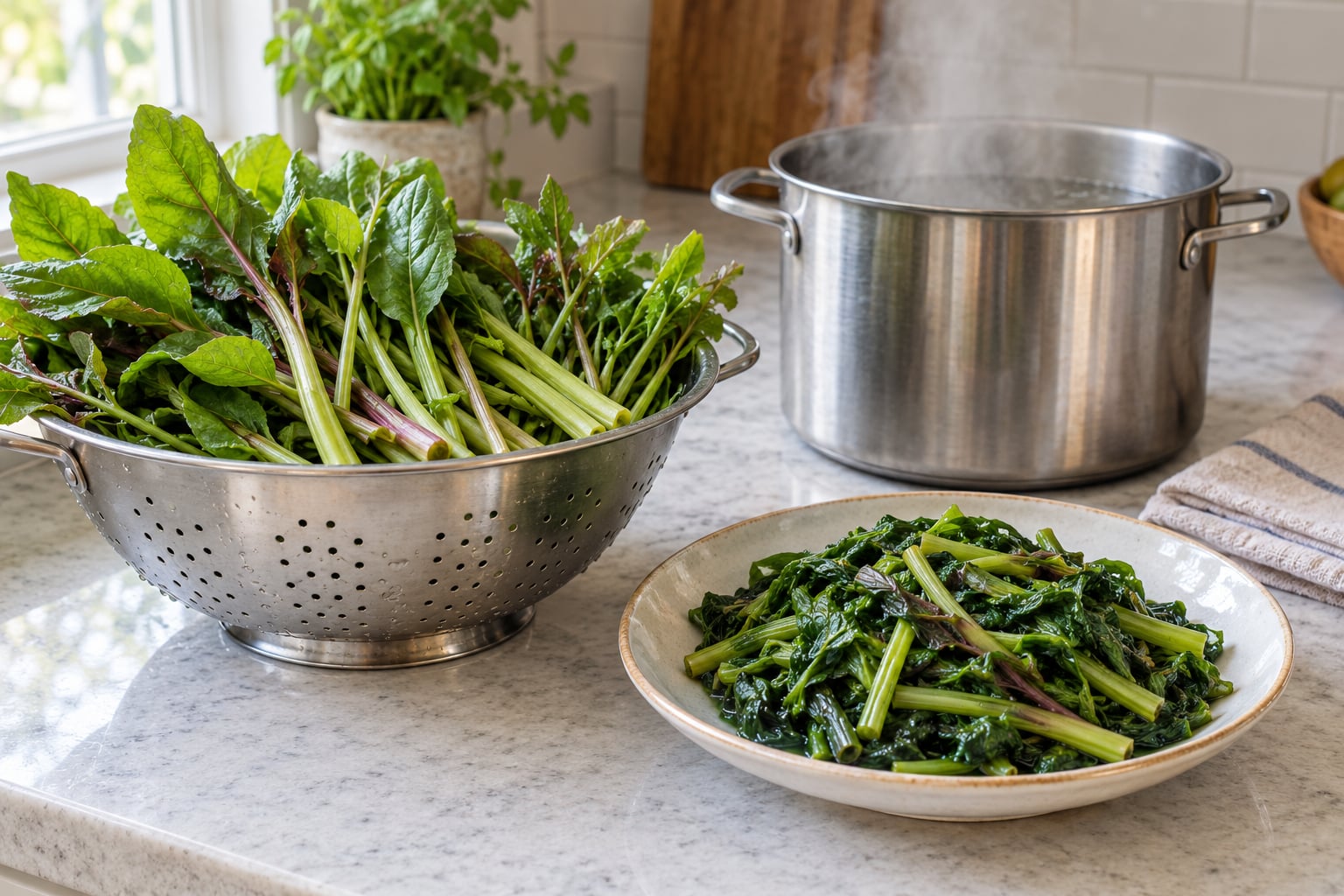
To cook poke sallet safely, boil young spring shoots of American pokeweed in two to three separate changes of fresh water, dump the water after every boil, and never eat the plant raw. Only tender shoots under six or seven inches belong in the pot. The root, the seeds and the berries never do.
Poke sallet is a spring dish that has anchored Appalachian tables for generations, and the cooking method is not complicated. What trips people up is the word salad in the name, and the fact that the safe version is unfamiliar to anyone who never grew up eating it.
Read this before you start. Cooking reduces the risk in pokeweed. It does not make an unidentified plant safe, and no cooking method turns the root or the berries into food. If you cannot name the plant with certainty, stop there. Extension services and poison control both advise against experimenting.
Throughout this guide, the method comes from cooks who have prepared it every spring for decades, and it reflects the strongest overlap in that advice rather than the most permissive version of it.
Table of Contents
- What You Need
- The ingredient
- The equipment
- Step-by-Step: How to Cook Poke Sallet Safely
- 1. Use a Trusted Source, Not a Wild Guess
- 2. Remove Stems and Inspect the Leaves
- 3. Boil the Leaves in Several Changes of Water
- 4. Drain, Chop, and Check the Texture
- 5. Cool and Store or Serve
- Common Mistakes
- Tasting a raw leaf to check it
- Believing one boil is enough
- Saving the water
- Crowding the pot
- Using older stalks because they are bigger
- Starting from an unverified bag of greens
- Expecting leftover pot likker
- Assuming cooking solves an identification problem
- Frequently Asked Questions
- Is pokeweed safe to eat raw?
- How many times should you boil poke sallet?
- What happens if someone eats pokeweed?
- Can you eat pokeweed berries, even cooked?
- What should you do if you touch pokeweed with cuts on your hands?
- How long can you keep cooked poke sallet?
- Conclusion
What You Need
You need a verified ingredient and a plain pot. Nothing here requires special equipment, and there is no shortcut that replaces the water changes.
The ingredient
Pokeweed, Phytolacca americana, bought from a grower who names the plant and the harvest, or from a market vendor you trust. The shoots should be under six or seven inches tall, still soft, with stems that have not started turning red or magenta.
Do not identify and dig pokeweed on your own to feed this method. Identification mistakes with look-alikes are the reason experienced foragers work with a mentor or a local extension office, and a cook with a strong case of food poisoning is not a reasonable trade for a pot of greens.
If you have seen the plant in the wild, a few traits separate American pokeweed from the things most often mistaken for it. Pokeweed grows as a single smooth, unbranched stalk with alternating oval leaves, and older stems turn deep magenta or purple. Inkweed (Phytolacca octandra) is a close relative in the same family that is not the species behind the traditional dish, and poke milkweed is an entirely different plant with a milky sap and a completely different preparation. Both get picked by beginners.
None of that is a substitute for being told by someone who knows. Identification photos, county extension agents and experienced growers are all better than a field guide matched against a phone screen.
The equipment
- A large stockpot with a lid, big enough that the shoots move freely in the water
- A colander for draining, plus a second pot or bowl for the discarded water
- A sharp knife and a cutting board
- Tongs or a slotted spoon so you are not reaching into cooling boil water
- A timer, because the whole method depends on minutes rather than color
- Cool running water for washing, and paper towels or a clean towel for drying
- Gloves if you have any open cuts on your hands
Step-by-Step: How to Cook Poke Sallet Safely
Most of the work is in discarding water you would rather keep. Plan for three boilings even if a recipe you read says two, and give yourself about an hour from washing to serving.
1. Use a Trusted Source, Not a Wild Guess
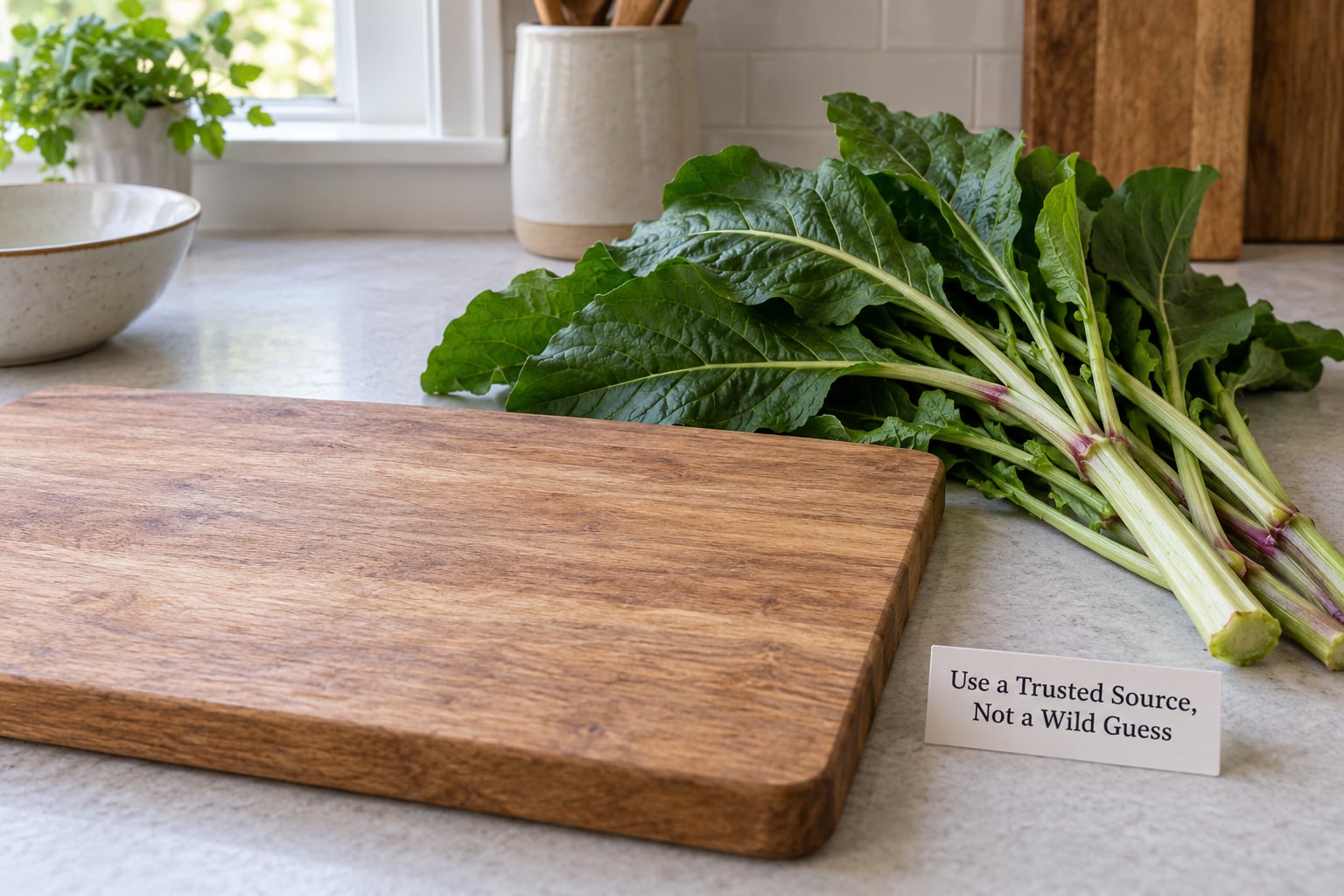
Start with material somebody else has vouched for. A grower who tells you the species, a market stall that has been selling the same greens for years, or a family member with fifty springs of practice behind them all qualify.
If you do harvest, the habit that matters most is cutting above the soil line with a clean knife rather than pulling the plant. Pulling tears the crown and brings root material up with the shoot, and root is the most dangerous part of the plant.
2. Remove Stems and Inspect the Leaves
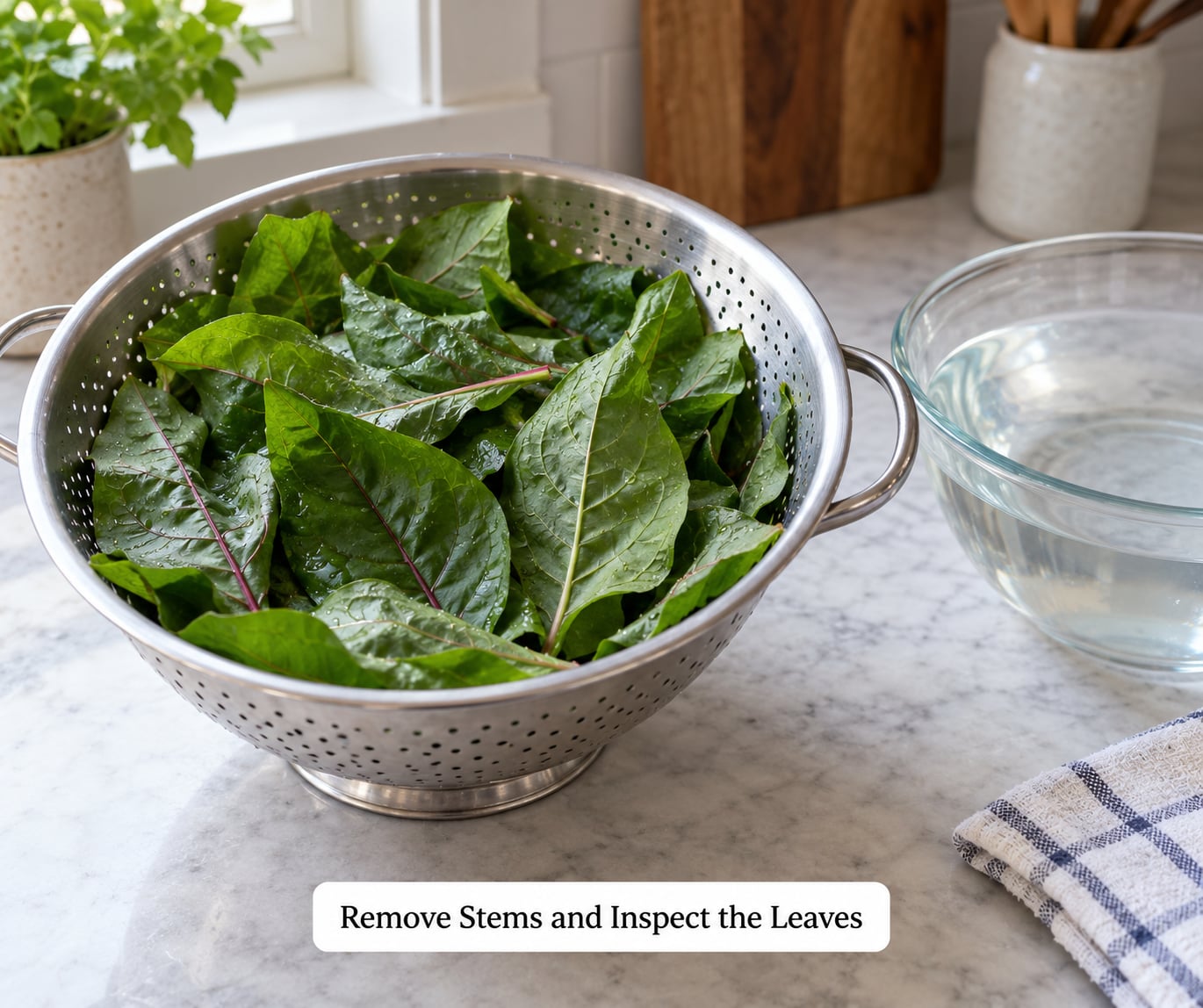
Wash the shoots in several bowls of cool water, lifting the leaves out and dumping each bowl rather than rinsing the pile in place. Dirt hides in the folds of a young leaf, and a colander full of grit ends up in your finished dish.
Pull the tough stems out of the leaf clusters. On shoots this small the stems are usually soft enough to eat, but any fibrous or woody piece gets discarded.
Inspect every leaf and throw away anything damaged, discolored, slimy or unfamiliar. This is the moment to be paranoid rather than generous. Do not taste anything raw at any point in this process, because tasting is exactly how people learn the hard way.
3. Boil the Leaves in Several Changes of Water
Bring a pot of unsalted water to a full rolling boil, add the leaves, and boil them for ten minutes. Lift them out, discard that water completely, and start over with fresh water. That is one change. Repeat for the second and third boil.
The reason for the ritual is that pokeweed carries irritant compounds that are water-soluble. Boiling draws them out into the water, and the water leaving the pot takes them with it. Saving the liquid and using it as pot likker, which older recipes sometimes did, undoes the whole point.
Here is how the common methods compare.
| Method | Water changes | Minutes per boil | Flavor and texture | Commonly recommended by |
|---|---|---|---|---|
| Simple double boil | 2 | 10 minutes each | Slightly stronger green, sometimes a faint bitterness | Most introductory foraging guides |
| Triple boil | 3 | 10 minutes each | Milder, creamier, closer to cooked spinach | Appalachian and Ozark cooks, and the safest-leaning sources |
| Parboil then cook | 1 brief parboil, then a full boil | 1 minute parboil, then 15 minutes | Best texture of the three, closest to asparagus | Foragers who measure by feel rather than by water changes |
For a first batch, use the triple boil. Thirty minutes of simmering is not a burden once, and it buys you margin on the part of the process that cannot be undone later.
Cooked poke sallet should taste creamy and faintly green, closer to spinach with an asparagus note than to a raw salad. If it still tastes sharp, bitter or soapy, it needs another change of water and another boil.
Keep one thing in mind while you stir. Softer texture and milder flavor mean compounds are leaving the leaf. They are not a certificate. Taste is not a safety test for this plant, and a batch that tastes fine is not proof that it is fine for you.
4. Drain, Chop, and Check the Texture
Drain the greens in the colander and let them sit for a few minutes so the last hot water runs off. Then chop them roughly with a sharp knife, cutting across the leaves rather than trying to follow the veins.
Test with a fork. It should slide into a chopped piece with no resistance, and the leaf should collapse when you press it with the back of the spoon.
If the pieces still have a firm, rubbery core, put them back in the pot for another boiling in fresh water rather than hoping they soften on the plate.
5. Cool and Store or Serve
Spread the cooked greens on a clean towel or a sheet pan and cool them quickly. Do not leave them sitting in the warm water you just drained, and do not put a deep pile of hot greens into a closed container, because that traps steam and speeds spoilage.
Cooked poke sallet keeps three to four days in the refrigerator, tightly covered at or below 40°F. Reheat only what you plan to eat, and heat it through to a full simmer before serving.
For longer storage, blanch the cooked greens briefly in boiling water, drain, cool and freeze them in a sealed container or bag, label it with the date, and boil for a full fifteen minutes after thawing. Cooked poke freezes well, and cooks who keep it through the winter routinely re-boil it rather than serving it straight from the freezer.
Serve it the way most Appalachian kitchens do: a spoonful of bacon drippings over the top, fried eggs alongside, or a simple dressing of vinegar, oil, salt and black pepper. Ramps in early spring, a pinch of pepper flakes, or a fried slice of cured pork all work. The greens are mild, so they need fat and acid more than they need salt.
Cooked poke is not a health food in the sense people sometimes mean. It is a legitimately nutritious green, comparable to spinach or mustard greens in what it offers, and it also carries more of the plant’s irritant compounds than most garden vegetables do. Serving it alongside something richer, the way the tradition does, keeps a modest portion the default.
Two household cautions are worth stating plainly. Serve poke sallet to children only in a fully boiled preparation you prepared yourself, and keep the boiled greens and the discarded water where a curious kid or a dog cannot reach them, because both are tempting to something that has no business eating them.
Common Mistakes
Almost every story about poke sallet going wrong traces back to one of these. The forum threads on this plant fill up with genuine disagreement, including people who describe eating it with no boiling at all, so it is worth saying that the disagreement exists rather than pretending everyone agrees.
Tasting a raw leaf to check it
The single most dangerous habit, and the reason for the plant’s name. Sallet means greens in Middle English, so poke sallet sounds like a salad, and people assume salad is eaten raw. Never taste pokeweed in any form before it has been boiled, and never taste a plant you are not certain you have identified.
Believing one boil is enough
Forum cooks argue endlessly about two boils versus three, and some describe a single long boil. For a beginner, three ten-minute boilings with the water discarded each time is the version that leaves the most room for error. Shortcuts here are the kind that only pay off when nothing goes wrong.
Saving the water
Do not drink it, do not use it for soup, do not cook rice in it. Every batch of water you drain carries the compounds you just pulled out of the leaves. Pour it down the drain and let it go.
Crowding the pot
If the leaves cannot move freely in the water, they cook unevenly, and the center of a packed clump can stay undercooked while the outside turns to mush. Cook in batches instead of doubling down.
Using older stalks because they are bigger
Shoots over six or seven inches, or stems that have begun turning red or magenta, are past the window that long-time cooks rely on. If you have a large plant and want to use the stalks, the traditional approach is to peel off the papery outer skin and fry the stalks like okra, which is a separate preparation from cooking the leaves.
Starting from an unverified bag of greens
Pokeweed sold as a cooking green is not always sold as a forageable wild plant, and mislabeled material does happen. Buy from a source that names what is in the bag, and if the labeling is vague or missing, find another seller.
Expecting leftover pot likker
Some older Appalachian recipes serve the greens over the water they were boiled in, or the broth from cooking cured pork with them. That broth is a separate pot of water made fresh afterward, not the cooking water from the third boil. Anyone who pours the third-boil liquid over a plate has undone three boilings in one motion.
Assuming cooking solves an identification problem
Boiling removes a large share of what is in a correctly identified shoot. It does nothing at all for a plant you guessed at, and a wrong identification is the failure mode with the worst possible outcome. When in doubt about the species, the pot is the last place to find out.
Frequently Asked Questions
Is pokeweed safe to eat raw?
No. Raw pokeweed carries irritant compounds that attack the stomach lining and can cause severe nausea, vomiting, cramping and diarrhea. There are accounts of people eating it raw without immediate symptoms, which is exactly what makes it dangerous, since delayed illness is common. Treat any raw pokeweed consumption as a poisoning concern and call Poison Control at 1-800-222-1222 rather than waiting to see what develops.
How many times should you boil poke sallet?
Three changes of water is the safe choice for a first batch. Boil the leaves for about ten minutes, drain them completely, discard the water, and repeat with fresh water until you have done it three times. Some experienced cooks stop at two, and some use a one-minute parboil followed by a fifteen-minute boil. A milder taste means more boiling is needed, not that you have gone too far.
What happens if someone eats pokeweed?
Symptoms usually start within a few hours and include intense nausea, vomiting, watery diarrhea, abdominal cramping, weakness and sometimes dizziness or confusion. Symptoms are often delayed, so someone who ate a raw leaf and feels fine at first can still become ill later. Do not wait it out. Call Poison Control at 1-800-222-1222 or go to an emergency department, and bring a sample or photo of the plant if you have one.
Can you eat pokeweed berries, even cooked?
No. The berries and seeds are among the most toxic parts of the plant, and no home cooking method makes them safe. Unlike the leaves, they are not processed by boiling in changes of water, and there is no traditional preparation that uses them as food. Pokeberry ink is a separate historical use, but ink is not food. If berries or seeds end up in a bowl of greens, discard the whole batch.
What should you do if you touch pokeweed with cuts on your hands?
Wash your hands and any exposed cuts with soap and cool running water right away, and cover the cut with a clean bandage. Pokeweed sap contains irritants that can upset open skin. Gloves are the simple answer if you already have cuts, and washing hands and forearms after handling cuts down the odds regardless. Touching the plant is not the emergency that eating it is, but it deserves more attention than rinsing off and moving on.
How long can you keep cooked poke sallet?
Refrigerated at or below 40°F and covered, cooked poke sallet keeps three to four days. Reheat only the portion you are eating, and bring it to a full simmer. For longer storage, blanch the cooked greens, cool, freeze in a sealed container and label it with the date, then boil for a full fifteen minutes after thawing rather than warming it gently. Discard anything that smells off or sits out past two hours.
Conclusion
The safest first move is not a technique. It is the ingredient: get young pokeweed shoots from someone you trust, keep them under six or seven inches, and if the identity of what you are holding is in doubt, do not put it in a pot.
From there, how to cook poke sallet safely is a repeatable, unremarkable process. Wash, trim, boil ten minutes, discard the water, and do it three times. Then serve it with bacon drippings and eggs and get on with your spring.