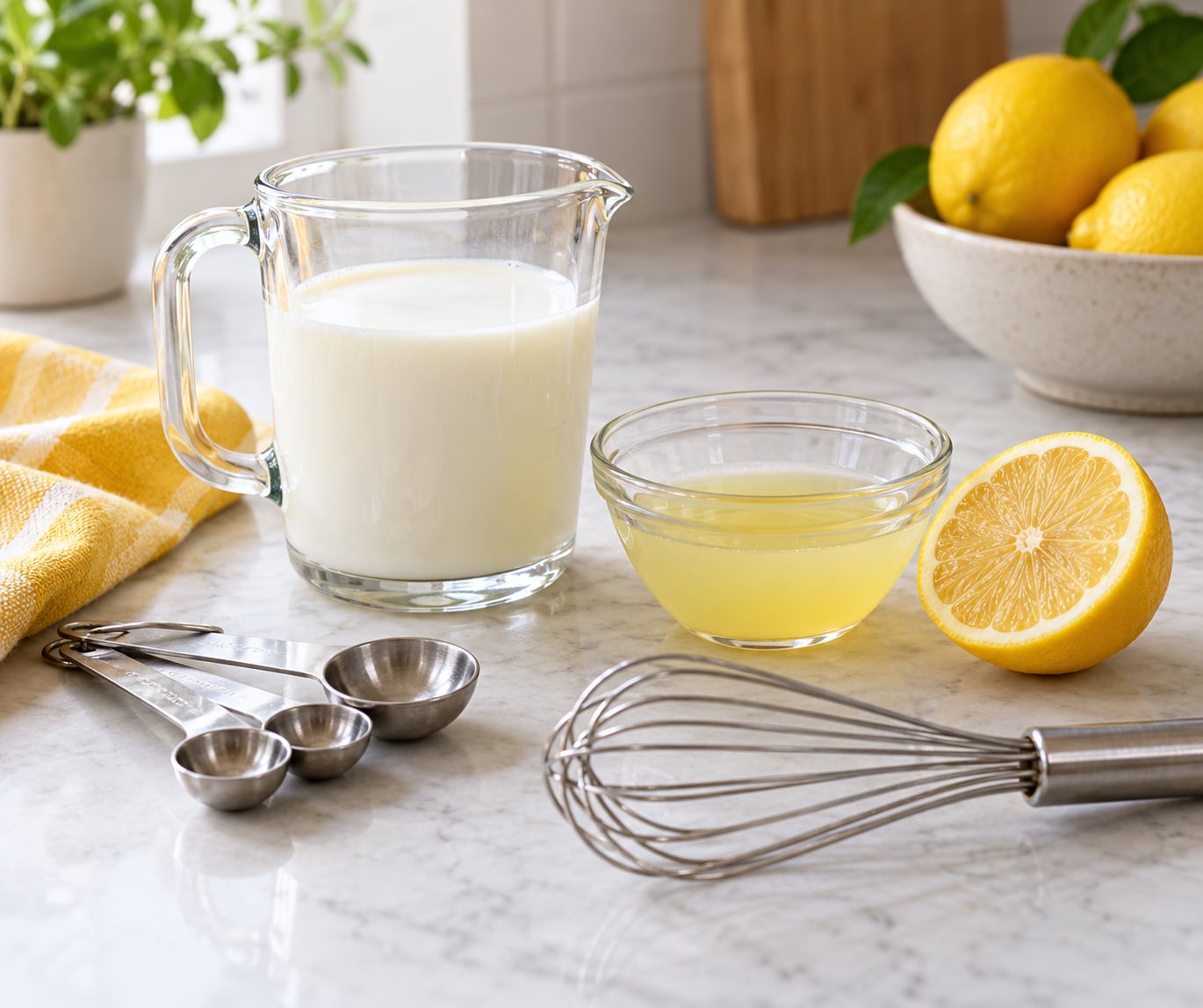
To make a buttermilk substitute for baking, stir 1 tablespoon of fresh lemon juice or distilled white vinegar into 1 cup of milk and let it stand at room temperature for 5 to 10 minutes, until it thickens slightly and looks lightly curdled. Use it wherever the recipe called for buttermilk, and use it within about an hour.
That is the entire trick. Two ingredients, one measuring spoon, and a short wait, and you have the sour, acidic milk that biscuit and pancake batter is asking for. I keep lemon juice and a bottle of distilled white vinegar on the shelf for exactly this reason, because buttermilk is the one ingredient a recipe can casually demand at eight in the morning.
There is a little more to it than the ratio, though. The acid in the substitute is what reacts with the baking soda in the dough, what tenderizes the gluten, and what gives a layer cake its faint tang. Get the amount wrong and you can taste it. Get it right and nobody will.
Table of Contents
- What You Need
- Step-by-Step: How to Make Buttermilk Substitute for Baking
- Step 1: Choose the Substitute That Matches Your Recipe
- Step 2: Combine the Milk and Acid for the Right Ratio
- Step 3: Add Baking Powder Only When the Recipe Needs Extra Lift
- Step 4: Make a Cultured, Dairy-Free Substitute
- Step 5: Use the Substitute in Your Baked Recipe
- Common Mistakes
- Frequently Asked Questions
- What is the best substitute for buttermilk in baking?
- How much vinegar or lemon juice should I add to milk for buttermilk?
- Can I use buttermilk substitute in biscuits, pancakes, and cakes?
- Does milk and vinegar make the same texture as buttermilk?
- Can I make buttermilk substitute ahead of time?
- Is baking powder necessary when making a buttermilk substitute?
- Conclusion: Start With the Recipe’s Needs
What You Need
For the standard dairy version, you need a cup of milk and an acid. Whole milk gives you the richest result, and it is what most traditional recipes assume, but 2% works fine and is what I usually reach for. Low-fat milk also works. Skim milk will curdle, and the crumb will be slightly tighter, which nobody will notice in a pancake but might in a delicate cake.
For the acid, use fresh lemon juice, distilled white vinegar, or apple cider vinegar. Distilled white vinegar is the neutral choice at a standard 5% acidity, and it is the one I reach for when I do not want the batter to taste faintly lemony. Lemon juice is slightly milder and rounder, and it works beautifully in cornbread and biscuits. Apple cider vinegar carries its own fruitiness, so bakers who use it tend to go heavier, around 2 tablespoons per cup.
Two more options cover cases where acid is not what you want. A tub of plain yogurt or sour cream thinned with milk gives you something closer to real buttermilk in thickness and taste, with no rest time at all. Cream of tartar delivers the sourness with a rounder, less sharp flavor than vinegar, and it is the mildest of the three acids.
A few tools matter more than they sound. You need measuring spoons, a glass measuring cup or small bowl you can leave sitting undisturbed, and a timer, because the difference between five minutes and forty-five is the difference between a good pancake and a curdled mess.
Before you mix anything, read the recipe for four things. How much buttermilk does it call for? Does it use baking soda, baking powder, or both? Is the finished dish baked, or is it a dressing, custard or no-bake dessert? And is the recipe already seasoned with salt and other acids? Those four answers decide which method you use and how much of it.
Step-by-Step: How to Make Buttermilk Substitute for Baking
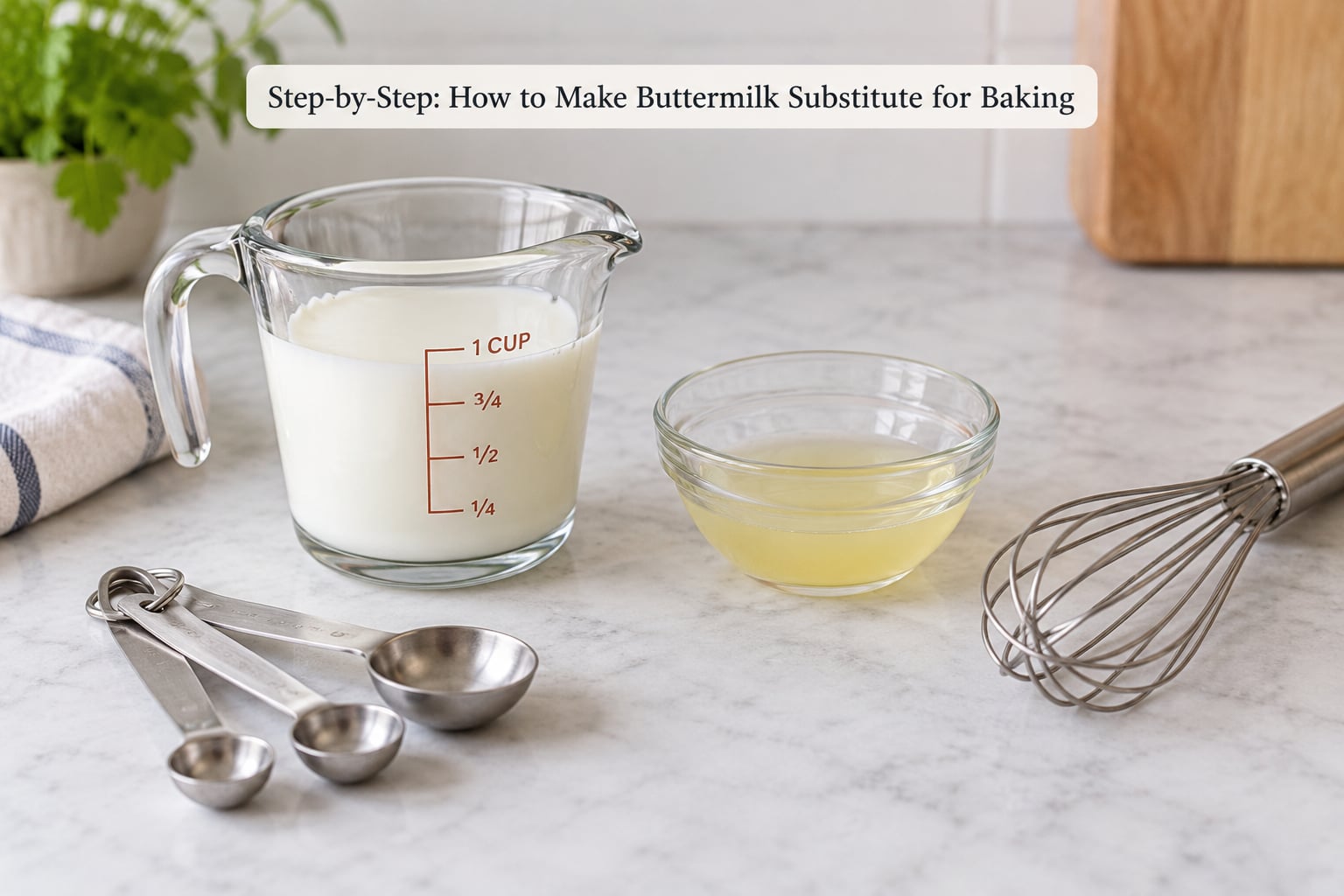
The core method takes three steps and about ten minutes:
- Measure 1 tablespoon of lemon juice or distilled white vinegar into a small bowl or the bottom of a measuring cup.
- Pour in milk until the total volume reaches the amount of buttermilk your recipe calls for, and stir once or twice.
- Leave it undisturbed at room temperature for 5 to 10 minutes, until the surface looks slightly thickened with fine curds, then stir again and use it.
Step 1: Choose the Substitute That Matches Your Recipe
Milk plus lemon juice or white vinegar is the right answer for nearly every recipe that calls for buttermilk. It is what you want for biscuits and scones, pancakes and waffles, cornbread, muffins, quick breads, cupcakes, and most layer cakes. Those recipes lean on the acid for lift and tenderness, and the acid is exactly what you are adding.
Reach for the yogurt blend instead when the recipe is more about flavor than structure. A buttermilk pound cake, a creamy quick bread, or anything where you would taste the tang in a plain cake comes out closer to the real thing with 3/4 cup plain yogurt or sour cream thinned with 1/4 cup milk. No rest time, no acid measurement, and a thicker result.
Cream of tartar is the middle option: 1 1/2 to 1 3/4 teaspoons per cup of milk, rested the same way. Use it when you want the sourness and the tender crumb but not the sharp edge that comes with vinegar or lemon.
Step 2: Combine the Milk and Acid for the Right Ratio
One tablespoon of acid per cup of milk is the standard ratio, and it is what most recipe developers settled on after testing. You will also see 1 1/2 teaspoons recommended in older sources, and both numbers are defensible: the smaller amount is gentler and better in a cake where you do not want noticeable tang, while the full tablespoon gives biscuits and cornbread the lift and edge they are built around.
The difference between those two figures is not a mistake to be corrected but a dial you set based on the recipe. My rule is 1 tablespoon for anything savory or biscuit-based, and 1 1/2 teaspoons for a sweet cake that already carries vanilla, citrus zest or almond extract.
Scale it from there. Some small confusion about whether “1 1/2 cups” means one and a half cups or one cup plus half again is the single most common reason a substitution goes wrong.
| Buttermilk in the recipe | Milk | Lemon juice or white vinegar | Cream of tartar |
|---|---|---|---|
| 1/2 cup | 1/2 cup | 1 1/2 teaspoons | 3/4 teaspoon |
| 1 cup | 1 cup | 1 tablespoon | 1 1/2 teaspoons |
| 1 1/2 cups | 1 1/2 cups | 1 1/2 tablespoons | 2 1/4 teaspoons |
| 2 cups | 2 cups | 2 tablespoons | 3 teaspoons |
| 3 cups | 3 cups | 3 tablespoons | 4 1/2 teaspoons |
| 1 quart | 4 cups | 4 tablespoons | 2 tablespoons |
Stir the acid into the milk rather than pouring milk into the acid, and let the cup sit somewhere you will not bump it. The curdling is gentle and slow, and shaking or stirring it while it thickens slows it down.
How do you know it worked? You are not looking for cottage cheese curds. You are looking for a milk that has gone from glossy and thin to just slightly thickened, with fine grainy flecks and a thin layer of whey-looking liquid at the bottom of the cup. It will look a little like low-fat milk that has sat out too long. That is the cue, and if it does not happen within ten minutes, use it anyway.
Step 3: Add Baking Powder Only When the Recipe Needs Extra Lift
Most recipes that call for buttermilk also call for baking soda, and the acid you just added is what makes the soda work. That reaction produces the carbon dioxide gas that lifts the batter in the oven, and it happens because the dough is acidic enough to set it off. Skip the acid and the soda sits there inert, and your biscuits come out dense and cakey.
The same reasoning tells you when extra leavener is a mistake. There is an old trick of adding a teaspoon of baking powder to a milk and vinegar substitute in cake recipes that list no leavening at all, and it does add a small amount of lift. If your recipe gives a precise amount of baking soda or baking powder, do not add to it. You will flatten the flavor, and in a cake or quick bread you will usually end up with a dry crumb.
Beyond lift, the acid is doing quieter work. It partially coagulates the milk proteins during mixing and baking, which is a large part of why buttermilk cakes and biscuits have a finer, more tender crumb than the same recipe made with plain milk.
Step 4: Make a Cultured, Dairy-Free Substitute
For plant milk, the honest answer is that curdling reliability varies a lot by base. Unsweetened soy milk is the most dependable, because its protein content is close enough to dairy that acid will thicken it the same way. Oat milk works reasonably. Almond milk is the one that frustrates people most, because it is thin and low in protein, and it often will not thicken no matter how much acid you add.
The practical workaround for nut and seed milks is to stop expecting curdling and lean on the flavor and leavening instead. Use 1 tablespoon of lemon juice or vinegar per cup of unsweetened plant milk, let it sit five minutes, and then add 1/2 teaspoon of baking powder per cup to supply the lift that real curdling would have provided.
Treat it as a same-session ingredient. Mix it, use it in the batter, and keep the rest out of the fridge. A soured plant milk separates faster than a soured dairy one and does not recover, so unlike the yogurt blend, there is nothing to be gained by making it early.
If you want a substitute closer to cultured buttermilk in thickness, the blend route works with plant yogurt too: 3/4 cup unsweetened plain soy yogurt loosened with 1/4 cup water or plant milk. It is thicker, milder and holds for the length of a baking session.
Step 5: Use the Substitute in Your Baked Recipe
Use the substitute exactly as you would have used the buttermilk, and treat it as a liquid. Pour it in with the other wet ingredients, or add it right after the dry ones when you are creaming butter and sugar, and stir just until combined. Over-mixing is the mistake here; the acid starts working on the flour as soon as it is wet, and a batter that sits and gets beaten turns gummy.
The adjustments are small. If your recipe is short on liquid, cut the milk by the same amount you are adding as acid so the total stays where the recipe intended. If you are doubling a biscuit recipe, double the acid too. And keep the salt exactly as the recipe writes it, because an unsoured milk version usually needs a pinch more rather than less.
Beyond baking, the same substitute works for a fried chicken brine, which is where people need a quart rather than a cup: 4 tablespoons of acid to 4 cups of milk, rested ten minutes before the chicken goes in. It works for a buttermilk pancake batter, a cornbread batter, and a creamy soup you are thickening. It does not work well for dressings, where raw vinegar will be tasted straight out of the jar, or for uncooked custards and no-bake desserts, where the thinner substitute shows.
One more option exists if you want the real thing. You can ferment milk into genuine cultured buttermilk over 24 to 48 hours with a live buttermilk culture, kept warm, and the result is thicker and more complex than anything you can sour in ten minutes. Churning butter from heavy cream gets you there too, because the cultured liquid remaining in the churn is real buttermilk.
Common Mistakes
The milk did not visibly curdle. Nothing is broken. Some milk curdles visibly and some barely does, and the difference is fat and protein, not your technique. Use the mixture as soon as the ten minutes are up. Pushing it further by leaving it on the counter only makes it sharper, and dairy left out longer than two hours is a food safety problem, not a baking one.
Too much acid went in. If the finished bake tastes sharp or vinegary, you doubled the tablespoon or used tablespoons where teaspoons were called for. Once it is baked you cannot fix it, so the fix is prevention: measure with the spoon that says tablespoon, and scale the acid with the milk rather than guessing.
The substitute came out too thin for the recipe. That happens most in no-bake bars, cheesecake-style desserts and custards, where the thickness of the dairy is structural. Use the yogurt blend instead of the acid version, and reduce the added liquid slightly so the total volume still matches.
You used sweetened or flavored milk. Vanilla yogurt and vanilla plant milk are common, and both will sweeten a bake that is supposed to taste tangy. Use plain, unsweetened versions every time.
You added extra baking powder or swapped soda for powder. The recipe’s leavening is already tuned for the acid the recipe assumes. Add to it only if the recipe lists no leavening at all, and never swap one for the other in a soda-leavened batter, since the soda needs the acid to activate and the powder is already self-activated.
You made the substitute in advance. It is not a keep-well ingredient. Mixed, it keeps turning more sour and more separated, and refrigerating it does not pause that. Measure the acid into the bottom of the container ahead if you like, then add the milk when the oven is preheated.
You used it where buttermilk cannot be imitated. Salad dressings, cold custards, no-bake cheesecakes and anything served uncooked will show the difference in both taste and body. Buy a carton for those, or make real cultured buttermilk ahead.
Frequently Asked Questions
What is the best substitute for buttermilk in baking?
Milk plus a little acid is the best substitute for most baking recipes. Add 1 tablespoon of fresh lemon juice or distilled white vinegar to 1 cup of milk, wait 5 to 10 minutes until it looks lightly curdled, and use it wherever the recipe called for buttermilk. Biscuits, pancakes, cakes, muffins, quick breads and cornbread all take it well.
How much vinegar or lemon juice should I add to milk for buttermilk?
One tablespoon per cup of milk is the standard ratio, which is 3 teaspoons. You will also see 1 1/2 teaspoons recommended, and that gentler amount suits cakes where you want less tang. Biscuits, scones and cornbread can take the full tablespoon. Measure rather than eyeball, and always add the acid to the milk.
Can I use buttermilk substitute in biscuits, pancakes, and cakes?
Yes, and those three are where it earns its keep. The acid reacts with the baking soda in biscuit and pancake batter for extra lift, and in layer cakes and cupcakes it tenderizes the crumb and adds a faint tang. Biscuits turn lighter, pancakes get a tender crumb, and the lemon or vinegar rarely comes through in the finished bake.
Does milk and vinegar make the same texture as buttermilk?
Not quite. Real cultured buttermilk is thicker and more gently sour because it is a 24 to 48 hour bacterial ferment rather than a ten-minute acid treatment. A milk and vinegar substitute is thinner and sharper. In cakes, biscuits and pancakes the difference mostly disappears in the oven, but it shows in creamy custards and no-bake desserts.
Can I make buttermilk substitute ahead of time?
Make it right before you bake. A soured milk keeps curdling after you mix it, so it can separate and turn sharper within about an hour, and refrigerating it does not stop that. If you need to prep ahead, measure the acid into the bottom of the container and pour the milk in when the oven is preheated and you are ready.
Is baking powder necessary when making a buttermilk substitute?
No, and adding it to most recipes will throw them off. The acid you add is what activates the baking soda or powder already in the recipe. The one exception is adding a teaspoon of baking powder to a milk and vinegar substitute in a cake recipe that lists no leavening at all. If the recipe gives a precise amount, leave it alone.
Conclusion: Start With the Recipe’s Needs
Read the recipe first. Note how much buttermilk it wants and whether it leavens with baking soda, then measure 1 tablespoon of lemon juice or distilled white vinegar per cup of milk, rest it 5 to 10 minutes until it looks lightly curdled, and get it into the bowl. That covers biscuits, pancakes, cakes, muffins, quick breads and cornbread, which is nearly everything that asks for buttermilk in the first place. When a recipe needs the tang without the heat of acid, or when you are baking without dairy, go with the yogurt blend or the plant milk version instead. Updated for 2026, and tested enough times that I no longer check a recipe for buttermilk before I start.