Here is how to make refrigerator pickles without canning: slice the vegetables, pack them into jars, pour a hot vinegar brine over them, and refrigerate for 24 to 72 hours. There is no water bath, no pressure canning, and no heat processing. Quick pickles, fridge pickles and refrigerator pickles are the same method under three names.
This is the method I grew up with in an Appalachian kitchen, where nobody owned a canner and a mason jar of dill pickles always came from someone else’s garden. The whole batch takes about 20 minutes of hands-on work, and most of the waiting happens in the refrigerator while you do something else.
The one rule that never bends: refrigerator pickles stay in the refrigerator from the moment the brine hits them until the last pickle is eaten. Treat them like any other refrigerated pickle you buy fresh.
Table of Contents
- What You Need to Make Refrigerator Pickles Without Canning
- Step-by-Step
- Step 1: Choose and Slice the Vegetables for Quick Pickles
- Step 2: Salt the Vegetables If Needed
- Step 3: Make the Vinegar Brine
- Step 4: Pack the Jars and Pour the Brine
- Step 5: Cool and Refrigerate the Pickles
- Step 6: Check the Texture, Flavor, and Storage Life
- Common Mistakes and How to Fix Them
- Frequently Asked Questions
- Can I use any vinegar for refrigerator pickles?
- Why did my refrigerator pickles turn cloudy?
- Do refrigerator pickles need pickling salt?
- Can I reuse the brine or vegetables for a second batch?
- Can I add different vegetables to the same jar?
- Conclusion
What You Need to Make Refrigerator Pickles Without Canning
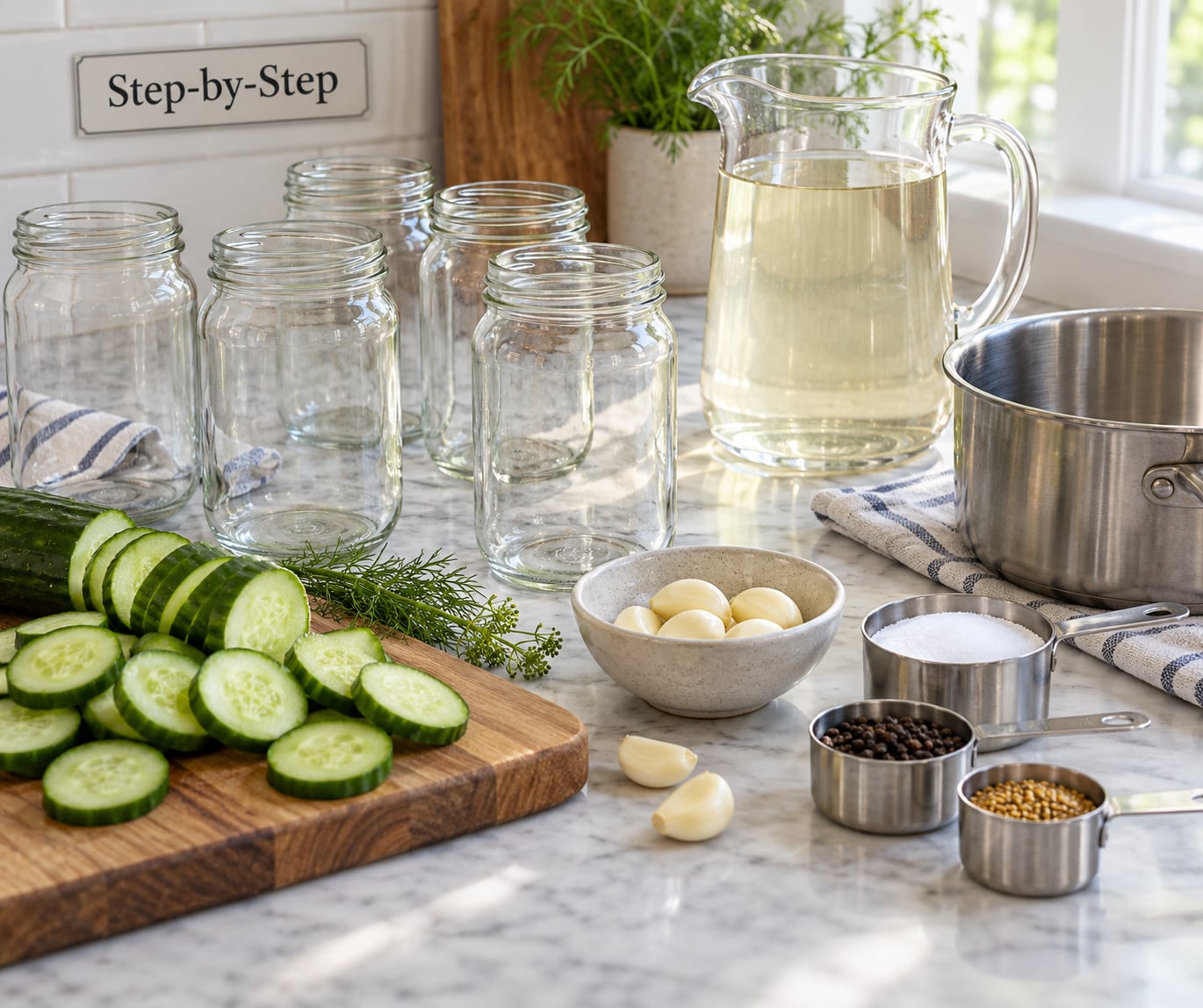
You need one saucepan, a measuring cup, and clean glass jars. Any plain mason jar or jelly jar works, including ones you already have from jam. Wash the jars in hot soapy water and rinse them. You do not need to sterilize them, and you do not need new lids that have never been used.
For one quart jar of pickles, gather the vegetables and spices:
- 4 cups pickling cucumbers, washed and sliced into spears or coins
- 4 to 6 garlic cloves, lightly crushed
- 2 tablespoons fresh dill flower heads, or 1 tablespoon dill seed
- 1 tablespoon whole black peppercorns
- 2 teaspoons mustard seed, for the old-fashioned Southern version
- 1 to 2 teaspoons pickling salt or kosher salt
Then the brine. Equal parts vinegar and water is the classic base, and it is the version I make most often.
| Brine ingredient | Amount per quart jar | What it does |
|---|---|---|
| White distilled vinegar, 5 percent acidity | 1 cup | Lowers the pH so the pickles taste sour and stay safe under refrigeration |
| Distilled water | 1 cup | Softens the sharpness of the vinegar so the flavor is round instead of sharp |
| Granulated sugar | 6 tablespoons | Balances the acid and carries the spice flavor |
| Pickling or kosher salt | 2 tablespoons | Draws water out of the vegetable cells and firms them for crunch |
Distilled water keeps the brine clear. Tap water works fine and tastes nearly identical, but hard water can make the liquid look slightly hazy.
Pickling cucumbers are small and thin-skinned, about 4 to 5 inches long. Regular slicing cucumbers are larger and have a waxy skin, so they end up crunchier but less flavorful. Either works. Peel them if the skin is thick, and always cut off the blossom end, which carries most of the enzymes that soften a pickle.
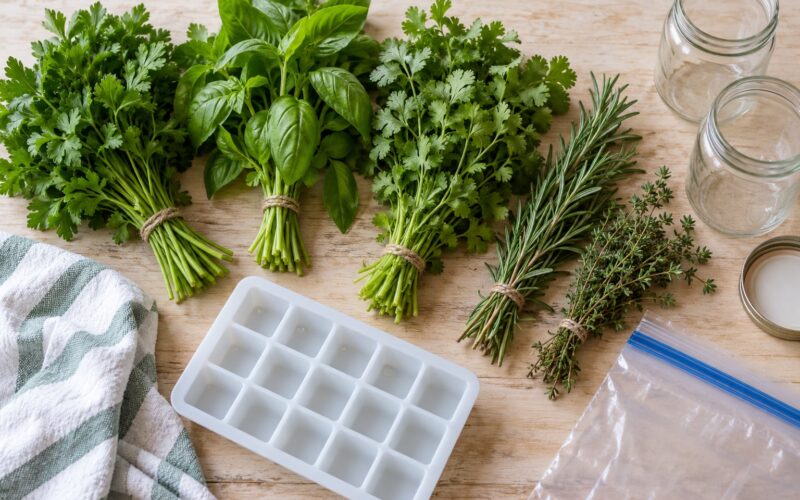
If your dill supply ran out, dill seed works, as does a spoonful of peppercorns or a strip of fresh rosemary. Recipes on r/homestead and r/Pickles regularly get made with whatever herbs were on hand.
Step-by-Step
Step 1: Choose and Slice the Vegetables for Quick Pickles
Wash the cucumbers and cut them into pieces of roughly the same size. Uniform pieces matter more than the shape you choose, because the brine has to reach the inside of every piece at the same rate. Spears about an inch thick, coins a quarter-inch thick, all fine.
Match the cut size to the vegetable. Carrots and radishes want thin slices or coins because they are dense and take a while to season. Cucumbers can go thicker, and green beans or asparagus can stay whole.
The visible cue: a bowl of roughly even pieces with a few ragged ones trimmed down to match. Size variation is the most common reason a jar ends up half-bright and half-bland.
Step 2: Salt the Vegetables If Needed
Watery vegetables benefit from a salt pre-treatment. Weigh 1/2 teaspoon of salt per cup of cucumbers, cabbage, onion, or green tomatoes, toss the vegetables with it, and let them sit in a colander over a bowl for 1 to 2 hours. Weigh them afterward and you will see how much water pulled out.
Drain and rinse them lightly before packing, or skip the rinse if you want a bolder salt hit. Skip this step entirely for peppers, green beans, carrots, and cauliflower, which do not need it.
The visible cue: the vegetables look slightly softer and shinier and a cloudy puddle sits in the bowl underneath. That puddle is the moisture that would have gone into your brine and turned it cloudy.
The most common mistake here is over-salting. The salt you add in this step plus the salt in the brine plus the salt left on the vegetables from rinsing can push a batch into inedible territory. Measure, do not eyeball, and taste one raw piece after draining.
Step 3: Make the Vinegar Brine
Combine 1 cup vinegar and 1 cup water in a saucepan. Add 6 tablespoons sugar and 2 tablespoons salt, then warm over medium heat, stirring, just until the sugar and salt dissolve and the liquid reaches a simmer. That is under a minute of cooking.
You do not have to boil the brine. Cold brine is safe for refrigerator pickling because the pickles never leave the refrigerator, and many cooks use a straight no-heat brine. Hot brine dissolves the sugar and salt faster and drives it deeper into the vegetable, which means better flavor in 24 hours instead of three days.
| Hot brine | No-heat brine |
|---|---|
| Dissolves salt and sugar fully | Needs stirring and time at room temperature |
| Seasons the vegetables within 24 hours | Takes 48 to 72 hours |
| Softens cucumber skins slightly | Leaves cucumbers a bit crisper |
| Best when you want dill pickles tomorrow | Best for thicker cuts and mixed vegetables |
The visible cue: a clear solution with no sugar crystals sitting on the bottom of the pan. If you see any, keep stirring until they disappear.
Step 4: Pack the Jars and Pour the Brine
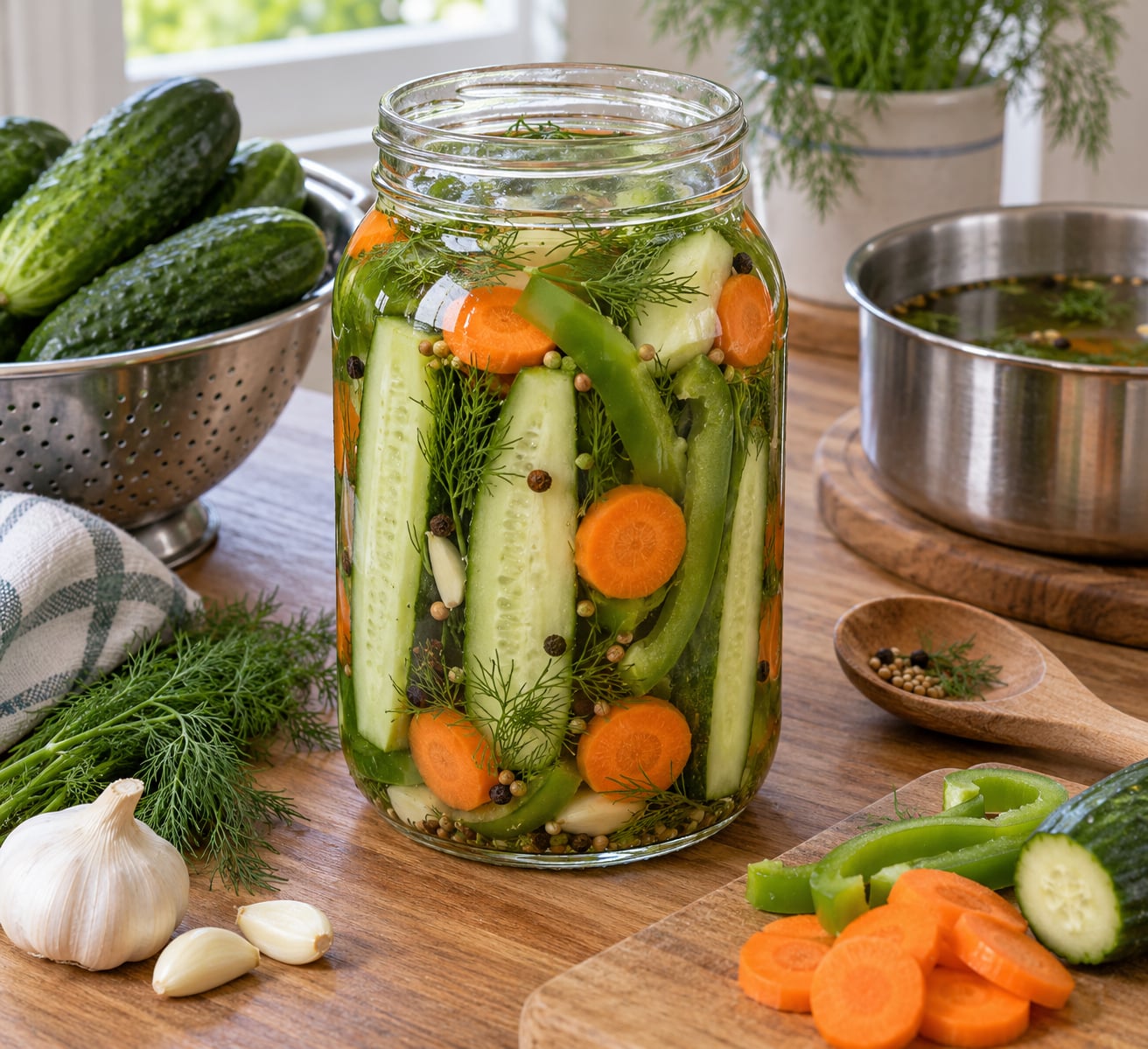
Put the garlic, dill, peppercorns, and mustard seed in the bottom of the jar, then pack the cucumbers on top and press them down gently. Pack tight enough that the pieces stay put, but not so tight that the brine cannot reach every gap.
Leave about 1/2 inch of headspace at the top. The vegetables release liquid as they sit in the brine, and a jar filled to the rim will overflow in the refrigerator.
Pour the hot brine over the vegetables until everything is covered, including the pieces at the top of the jar. Tap the jar firmly on the counter a few times, or run a butter knife down the inside edge, to knock out air pockets. Wipe the rim clean with a damp towel before the lid goes on.
Use a two-piece canning lid if you have one, or any screw lid that fits. Screw it on snug. You are not creating a vacuum seal, and you are not heat processing anything, so leave the lid tight rather than finger-tight.
The visible cue: clear liquid with no trapped air gaps along the sides, vegetables sitting below the brine line, and a clean jar rim before the lid goes on.
A jar with a zip-top bag inside instead of a lid also works, and a glass weight or a small plate pressed down on top keeps everything under the liquid. Anything sitting above the brine line turns cloudy and off-colored, and exposed vegetable is where mold starts.
Step 5: Cool and Refrigerate the Pickles
Let the jars stand on the counter until they stop steaming, usually 30 to 60 minutes depending on how hot the brine was. Then put them in the refrigerator at 40°F or below, straight onto a shelf where nothing heavy sits on top of the lids.
Cooling slowly with the lid on keeps the liquid moving as it cools. Once cold, the liquid stops absorbing, and the vegetables settle into the brine instead of floating in a pocket of air.
To serve, use clean tongs or a fork and put only what you plan to eat on a plate. Never dip a spoon back in and return it to the jar. That single habit is the biggest reason homemade refrigerator pickles go bad early.
The visible cue: the brine has gone from warm to room temperature to cold, and the jar has moved from counter to refrigerator within about an hour. Do not leave the jars out overnight, even in a cool kitchen.
Step 6: Check the Texture, Flavor, and Storage Life
Taste one piece at the 24-hour mark. It should still taste mostly like cucumber with a bright edge. By 48 hours it is a pickle. By 72 hours the flavor has soaked all the way through, and most cooks say the batch keeps improving for the first week.
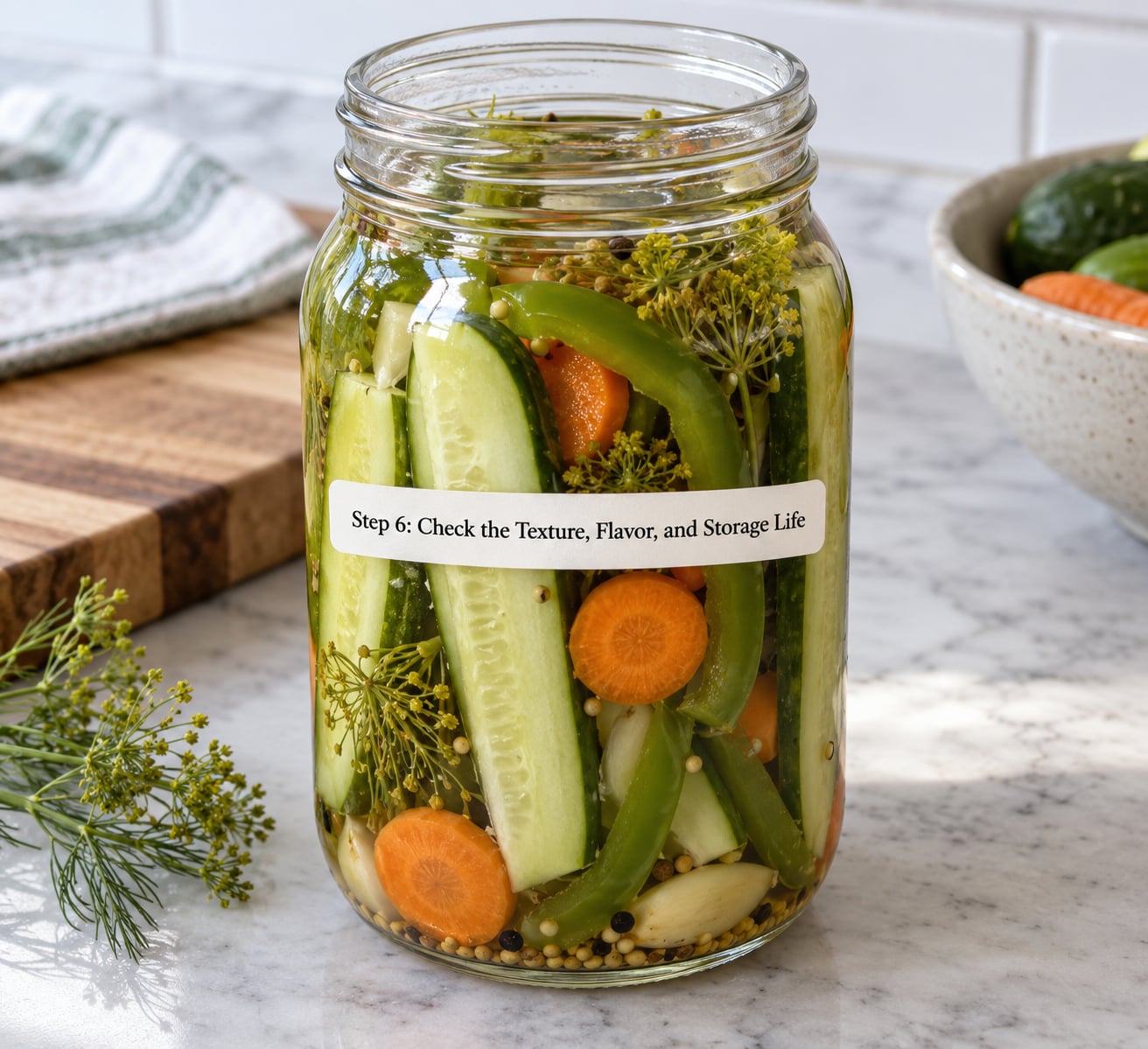
Suggested brining times, from first taste to full flavor:
- Cucumbers, spears or coins: 24 to 48 hours
- Carrots, radishes, onions, thin-sliced: 48 hours
- Green beans, asparagus, cauliflower, bell peppers: 48 to 72 hours
- Cabbage, green tomatoes, thicker squash chunks: 72 hours to a week
For crunch, pack a few washed grape leaves or a spoonful of loose tea leaves in the jar. The tannins react with the cucumber skin and help it stay firm, and this is the trick old cooks used before tannin leaves were sold as a pickle-making product. Very hot brine, tight packing, and a refrigerator at 40°F or below do the rest.
Refrigerator pickles keep in the refrigerator for 2 to 4 weeks. Eat them within that window, and always with a clean fork or tongs. They are not shelf stable and never will be, because nothing in the process killed the organisms that canning destroys.
Common Mistakes and How to Fix Them
Most failed refrigerator pickle batches come down to one of six things. Each one has a fix you can use on the next batch, and several can be corrected on the batch you already have.
Cloudy brine. A cloudy or milky liquid is almost always harmless. It comes from dissolved salts and vegetable cell walls mixing, and it usually clears as the batch ages. Kettle limescale makes it worse, so use distilled water if you have it. The exception is a brine that is fizzy or has a bad smell, which means fermentation got ahead of you and the batch should be discarded.
Mushy pickles. Over-salting the vegetables, using boiling brine, or letting the jars sit warm on the counter for days all soften cucumber skins. Cut back on the salt soak, pour brine that has simmered and then cooled for a minute, and refrigerate within the hour. Adding grape leaves or a teaspoon of calcium chloride dissolved in cold water helps firm the texture for the next batch.
Veggies floating and turning dark at the top. Anything above the brine oxidizes and can grow mold. Push the pieces down, add a small plate or glass weight on top, or pour in a little extra brine if there is room. Better still, use smaller jars so the produce is packed deeper and has less room to rise.
Too salty or not salty enough. Table salt, kosher salt and pickling salt all work, and since you are not canning you do not need special pickling salt. If a batch is too salty, add a couple of raw grape leaves, a few slices of raw carrot, or a spoonful of cider vinegar, then let it sit in the refrigerator overnight before tasting again.
Bland pickles after two days. Usually the brine never reached the middle of the jar. Fill the jar to the top, make sure no headspace gap hid behind the vegetables, and give it another 24 hours. Adding a tablespoon of salt or a splash of vinegar to the cold brine and letting it sit also works.
Signs to toss the whole batch. Mold on the surface or on the vegetables, a fizzy or swollen jar lid, and a sour or fermented smell all mean something grew that should not be there. Do not taste to test it. Toss it, clean the jars, and start again with the same salt math and a shorter counter cool.
For serving, refrigerator pickles are good on sandwiches, in grain bowls, chopped over taco night, added to a cheese board, or pulled straight from the jar with a fork. They also make a quick pickle brine for a second batch: after the first jar is mostly eaten, top it up with fresh vinegar, a tablespoon of sugar, and a few new cucumbers.
The old-fashioned Southern and Appalachian version swaps in cider vinegar and brown sugar for the white vinegar and white sugar, adds a heavier hand of mustard seed, and uses whole spices instead of dried herbs. Same method, same refrigerator, different pantry shelf. Plenty of cooks also leave out dill entirely and lean on mustard seed and peppercorns, which is a perfectly good pickle.
Frequently Asked Questions
Can I use any vinegar for refrigerator pickles?
White distilled vinegar at 5 percent acidity is the most reliable choice because it is neutral and cheap. Apple cider vinegar works well and adds fruitiness, rice vinegar is milder and slightly sweeter, and red or white wine vinegar gives a lighter flavor. Avoid anything below 5 percent acidity and skip balsamic, which is dark, sugary and will muddy the brine.
Why did my refrigerator pickles turn cloudy?
A slightly cloudy or milky brine is normal and almost never means spoilage. It comes from salt, released vegetable juices and spices mixing in the liquid, and it often clears as the pickles age. Hard tap water speeds it up, so distilled water gives you a clearer jar. Only a fizzy brine, a swollen lid or a bad smell means the batch should be discarded.
Do refrigerator pickles need pickling salt?
No. Since you are not processing these in a water bath, table salt and kosher salt both work fine, and pickling salt is not required. If a batch turns out salty, the more common cause is the salt pre-treatment on the vegetables rather than the salt in the brine. Measure the brine salt by volume and skip soaking the cucumbers if you are sensitive to salt.
Can I reuse the brine or vegetables for a second batch?
You can pour leftover brine into a fresh jar of vegetables and refrigerate it. It carries plenty of pickling flavor, so add about half as much sugar and salt as you would for a new batch, since the brine is already seasoned. Old cucumber pieces have gone soft and watery, so eat those straight from the jar rather than trying to re-pickle them.
Can I add different vegetables to the same jar?
Yes, and mixed jars are common in quick pickling. Cut everything to a similar size so it seasons at the same rate, and keep in mind that different vegetables reach their peak at different times. Cucumbers can be slightly softer after 72 hours while cauliflower is still firm, so if you want every bite identical, pack separate jars instead of layering them.
Conclusion
Start by measuring the brine: equal parts 5 percent vinegar and distilled water, 6 tablespoons of sugar and 2 tablespoons of salt for a full quart jar. Pack the vegetables with about 1/2 inch of headspace, pour the hot brine until everything is covered, and get the jars into the refrigerator within the hour. Then wait 24 to 48 hours before you open one and taste.