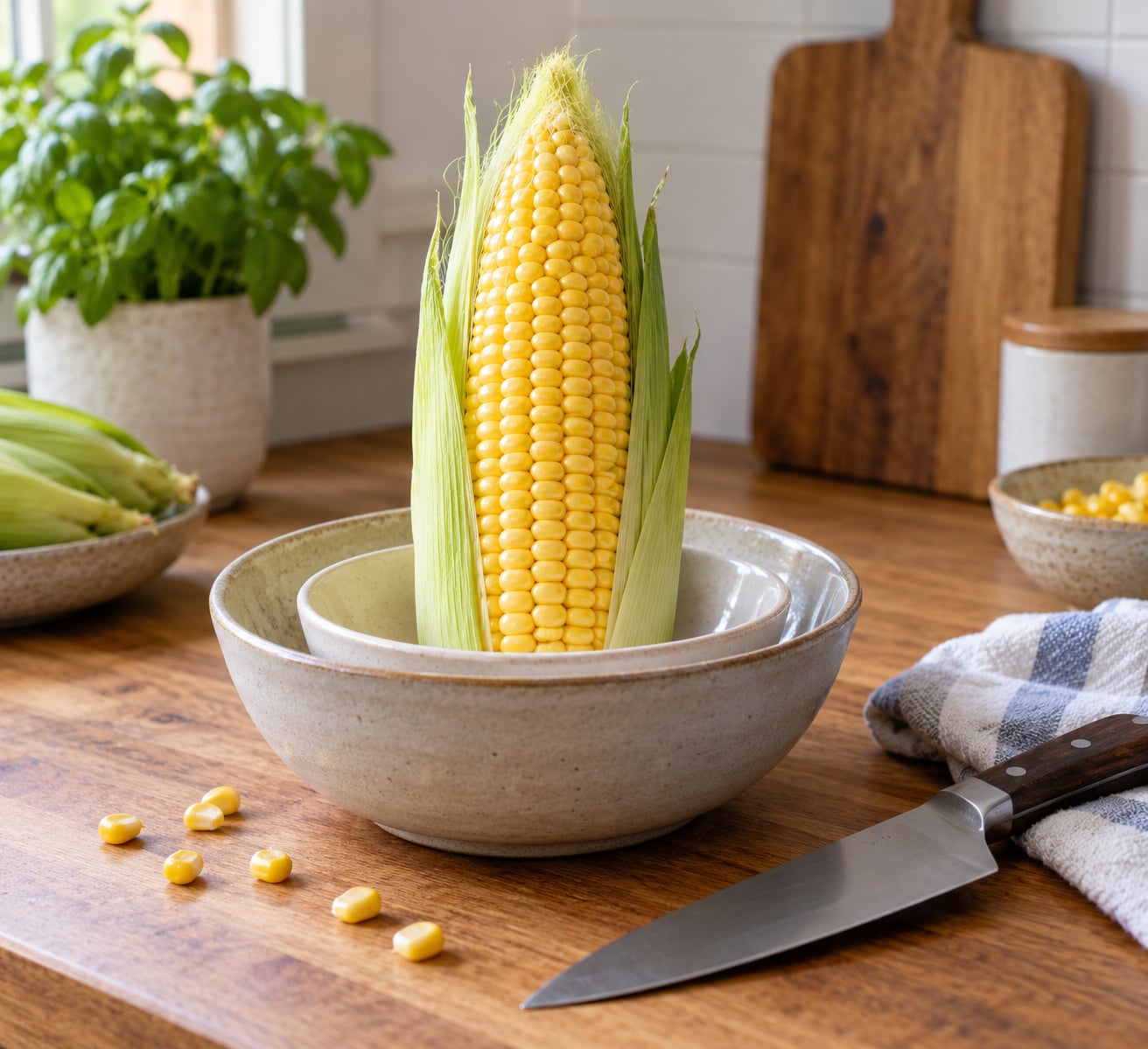
To cut corn off the cob cleanly, stand the ear in something that holds it steady and catches every kernel, then slice shallow strokes from the top down with a sharp knife until you reach the cob’s core. Set up takes about a minute, and the whole job runs five minutes per ear. Updated for 2026.
The reason people avoid fresh corn isn’t the flavor, it’s the mess. Kernels bounce off the board, roll under the stove, and you find them there three days later while sweeping. The sticky cob juice underneath makes it worse.
I’ve shucked enough summer corn to know the fix is boring and reliable: give the cob somewhere to stand and somewhere to land. Everything else is detail.
Table of Contents
- What You Need
- Step-by-Step: How to Cut Corn Off the Cob Cleanly
- Prepare the Corn Cob
- Hold the Cob Steady
- Slice the Kernels from Top to Bottom
- Use the Cob’s Curve to Your Advantage
- Common Mistakes and How to Fix Them
- Tips for Cleaner, Faster Corn Removal
- Frequently Asked Questions
- Is it easier to cut corn off the cob raw or cooked?
- Should you cut corn in half before or after boiling?
- Can you remove corn kernels without using a knife?
- How do I stop the cob from slipping while I cut?
- How many cups of kernels do you get from one ear of corn?
- Conclusion
What You Need
A sharp knife is the only real requirement. A serrated knife grips each kernel and stops the blade skating sideways, which is why growers reach for one. A straight chef’s knife works fine if it’s honed, and it gives you a cleaner, shallower first cut.
Everything else exists to stop the cob rolling and to catch what comes off:
- A sheet pan or rimmed baking sheet — the catch surface. A damp kitchen towel or paper towels spread over it turns the pan into a blanket you lift and tip into a bowl.
- Two bowls, one smaller than the other. Invert the small bowl in the big one, set the cob on the dome, and the kernels fall straight into the bowl underneath.
- A tube or angel food cake pan — the tip drops into the center hole and the stem becomes a handle.
- A bundt pan — the hole is a snug fit for one end of the cob and it splatters less than an open sheet pan.
- A damp paper towel for gripping. A wet cob on a wet board is how people cut fingers.
- A corn cob holder or silicone non-slip mat if you do a lot of ears. One ear at a time, same technique.
Here is how the stabilizers compare, because the right one depends on how many ears you’re doing.
- Bowl in bowl (two bowls) — the lowest mess of anything here. Best for one or two ears and minimal washing up.
- Sheet pan and towel (rimmed pan, damp towel) — low mess, some juice soaks into the towel. Best for three or more ears and blanching batches.
- Tube pan (angel food cake pan) — moderate mess, juice collects in the base. Best for steady hands and a cob you want to turn as you work.
- Bundt pan — low mess. Best for ends that don’t sit flat in a bowl.
- Stripper tool (corn cob stripper) — low mess and no knife contact. Best for kids helping, sore hands, or a large harvest.
Step-by-Step: How to Cut Corn Off the Cob Cleanly
Prepare the Corn Cob
Pull the husk and silk off under cool water, then dry the ear completely. A wet cob is a slippery cob, and the silk that stays behind ends up in your kernels later while you pick through a bowl.
Check the tip and the base, where kernels tend to stay attached. Trim nothing else; cutting the ends off flat just gives you more flat surface to grip. You are done when the cob is dry, de-silked, and standing on its own flat end.
Hold the Cob Steady
Put your catch surface down first, then set the cob on it. A damp towel on a sheet pan is the version I’d teach first. Invert a small bowl inside a larger bowl if you want zero scatter.
Grip the top of the cob with your non-cutting hand, fingers curled back and out of the blade’s path. Cut on the side facing away from your body, not the side facing you. If you’re using a tube or bundt pan, drop the tip into the hole and hold the stem like a handle — you give up a few kernels at the tip and get much safer fingertips.
A damp towel under the cob and the kernels end up on fabric you can lift and funnel into a bowl. I use that when I’m doing more than two or three ears.
Slice the Kernels from Top to Bottom
Start at the top of the cob just below the stem end. Cut down the rows in one continuous stroke, blade angled slightly toward the cob so the tip skims the surface rather than punching into it.
Take off the whole kernel but not the tough translucent root underneath. Cut too deep and you gouge the cob, waste part of the kernel, and leave a ragged surface that looks like nothing happened. Move to the next row, repeat, and go all the way around.
Use the Cob’s Curve to Your Advantage
A cob is round, so a straight top-to-bottom pass only handles the face in front of you. Rotate it a quarter turn after every few rows and keep going around.
The last third of the cob narrows and the kernels sit at a steeper angle. Tilt the ear toward you and cut down the slope rather than straight across it. Most people stop too early and leave a stubborn fringe, then pick it out by hand ear after ear.
Common Mistakes and How to Fix Them
- The cob rolls. Wet cob, wet board. Dry the ear first, then add a damp towel or a non-slip mat underneath.
- Kernels tear and juice runs. The blade is dull or you’re pressing too hard. Sharpen the knife and let the edge do the work.
- The knife slides sideways. Use a serrated knife. The teeth catch the tops of the kernels and stop the blade skating.
- You cut into the cob. Angle the tip out and follow the curve. The core underneath is tough and will dull your knife fast if you keep hitting it.
- Strips of kernel are left on the cob. Those are on the curve near the ends. Rotate the cob and cut downhill instead of straight down.
- Sticky milky puddle on the board. Nothing stops it entirely. Working over a towel or pan means you wipe one thing instead of the whole board.
- Cob slips and punctures a fingertip. Put the tip in a pan hole and cut with the stem as a handle, or hand the job to a corn cob stripper.
One more warning, because it comes up constantly on cooking forums: cooked corn cobs are a real choking and digestive hazard for dogs, and a stripped bare cob is the dangerous part. Toss it in the bin instead of the walk.
Tips for Cleaner, Faster Corn Removal
Pick ears that feel heavy for their size with kernels that push tight against the husk. Loose, dented kernels cut ragged and come off in strips.
Sharpen your knife before the first ear, not between the third and fourth. A dull blade is the single biggest cause of torn kernels and milky juice.
Plan roughly a third of a cup of kernels per average ear. Two good ears cover most fritter or pudding recipes, and that number helps when you are scaling for a crowd.
For a harvest batch, cut both ends off the ears, blanch them about three minutes, cool in the sink, then de-kernel with the large flat side down. Blanched corn cuts noticeably faster and the kernels hold their shape going into the freezer. Freeze in single-cup bags with the air pushed out.
And skip the standalone husking chore if you hate it: microwaving the whole ear with the husk still on for four or five minutes steams the silk loose enough to strip off in one pull.
Frequently Asked Questions
Is it easier to cut corn off the cob raw or cooked?
Cooked, especially blanched rather than boiled soft. Heat softens the kernel’s attachment so the blade slides through with less pressure and fewer torn pieces. Raw corn cuts fine with a sharp knife, but it takes more force and sprays more juice. Most cooks who de-kernel for salads or pudding blanch the ears first, cool them, then cut.
Should you cut corn in half before or after boiling?
After, if you need to. Cutting a raw ear in half before cooking exposes the kernels to water and dries them out faster than you want. The usual order is shuck, cut in half crosswise, then boil, which keeps the cob together enough to handle and still lets the ears fit in the pot. Only cut before if you are blanching for freezing.
Can you remove corn kernels without using a knife?
Yes, and a corn cob stripper is genuinely better at it. You press the ear down onto the curved metal edge and drag it down in one motion, which takes about five seconds per ear and keeps every finger clear of any blade. For kids learning in the kitchen, or for a harvest where your hands are already tired, it is the tool I would buy first.
How do I stop the cob from slipping while I cut?
Dry the ear, then give it something to grip. A damp paper towel on a cutting board or a silicone non-slip mat adds friction, and an inverted small bowl inside a larger bowl holds the cob upright so it cannot roll at all. Never try to cut raw corn off a wet board, which is where most of the cut-finger stories come from.
How many cups of kernels do you get from one ear of corn?
About a third of a cup from a standard ear, and closer to half a cup from a long, well-filled one. That is the number to plan with when you are scaling a corn salad, corn pudding, or a batch of fritters. Very large ears from a summer garden can push past half a cup, so measure the first two before you commit to a recipe that calls for four cups.
Conclusion
Start with the easiest side of a fresh ear and work down in shallow strokes with a sharp knife, holding the cob in a bowl or on a damp towel so it cannot roll. Two moves do almost all the work: stabilize the cob, then stop cutting when you hit the core.
Once the technique clicks, cutting corn off the cob cleanly takes about five minutes an ear and leaves you with a bowl of whole kernels instead of a floor sweep.