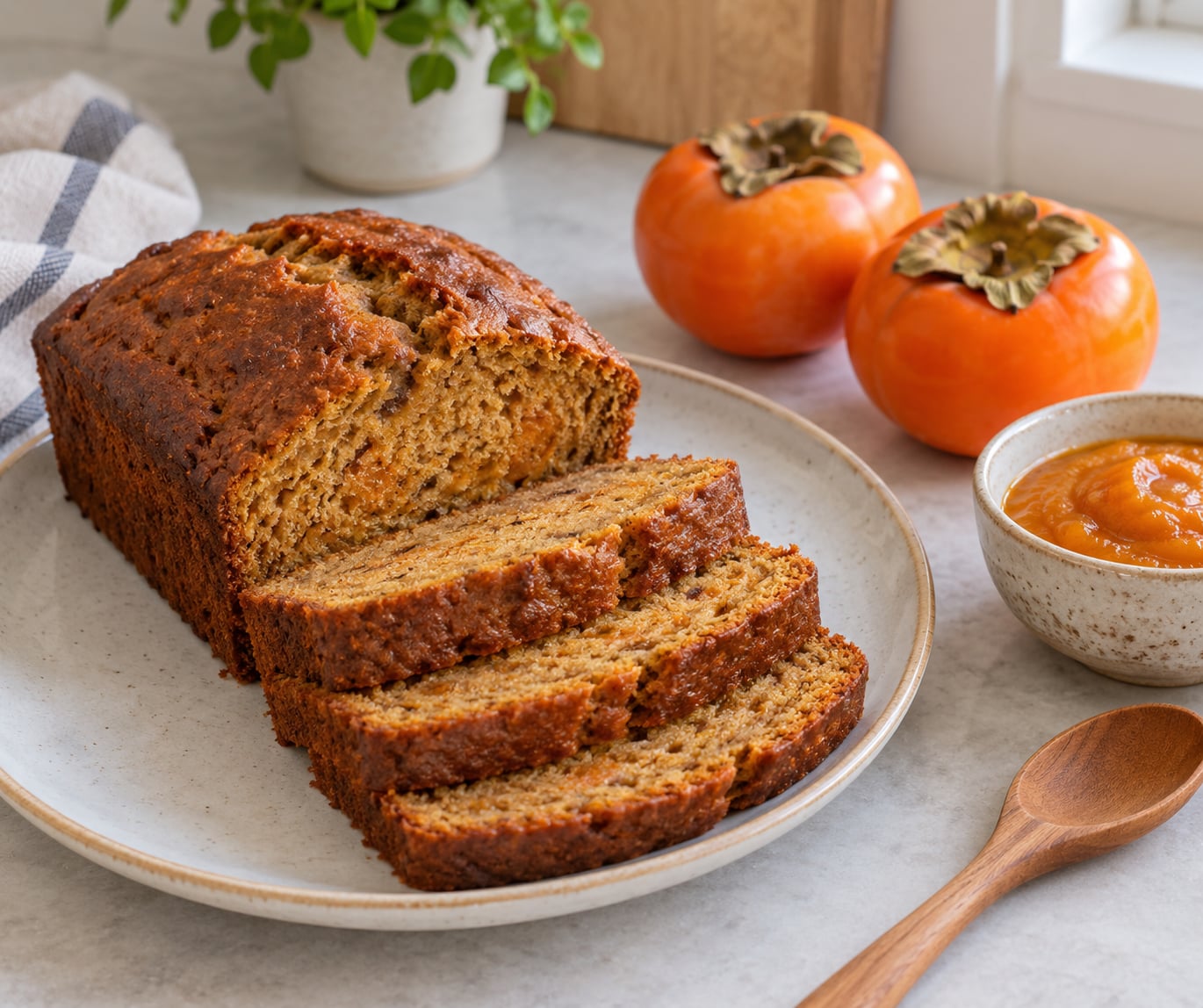
Persimmons work in baking because ripe fruit pulp brings moisture, natural sweetness, and a spiced flavor that sits somewhere between pumpkin and banana. Almost every bake that uses them starts with a Hachiya persimmon run through a blender until it turns to jelly. That puree can stand in for butter, eggs, and part of your sugar, which is exactly how to use persimmons in baking without wrecking the texture you were going for.
The fruit has a short fall window, and it ripens faster than most people can eat it, so plenty of bakers meet persimmons for the first time as a surprise box of very soft fruit. Good news: soft is the goal. A mushy persimmon is a baking persimmon.
Here is what you need, the forms the fruit comes in, and how each one behaves in a batter.
Table of Contents
- What You Need to Use Persimmons in Baking
- Step-by-Step
- 1. How to Use Persimmons in Baking: Choose the Right Form
- 2. Prepare the Fruit
- 3. Add Persimmons to Quick Breads
- 4. Fold Persimmons into Cookies and Bars
- 5. Use Persimmons in Cakes and Cupcakes
- 6. Bake With Dried or Concentrated Persimmon
- 7. Know When Not to Add Persimmons
- Common Mistakes
- Frequently Asked Questions
- Can I use persimmons instead of eggs in baking?
- Which type of persimmon is best for baking?
- Do I need to peel persimmons before using them?
- How much persimmon puree should I add to a cake or bread recipe?
- Can frozen persimmon puree be used in baking?
- Why does my persimmon bread taste too sweet?
What You Need to Use Persimmons in Baking
Two varieties cover almost all home baking, and they behave completely differently in the oven.
- Hachiya (also called Sharon or kaki) is the soft, jelly-like, astringent one. It has to be fully ripe before you touch it, because its tannins turn your mouth chalky while the pulp is firm. Once it collapses under your thumb it purees smooth and is the standard choice for bread, muffins, cakes, and pudding.
- Fuyu is the squat, flat, tomato-shaped one. It is not astringent, so you can eat it firm, and it holds its shape when sliced. It is decorative by nature, which makes it a good topper for a tart or an upside-down cake.
| Variety | Astringent? | Usable when | Best baking use | How to prep |
|---|---|---|---|---|
| Hachiya | Yes, until fully soft | Feels like a filled water balloon, no firm core | Quick bread, muffins, cakes, pudding, cookies | Scoop out the pulp, seeds out, blend or mash smooth |
| Fuyu | No | Firm is fine | Decorative slices, upside-down cake, tart topping | Peel, slice thin, layer or fan on top |
| Mast Charge | Yes, in the flesh | Fully soft, like a Hachiya | Anywhere pulp is used, same as Hachiya | Same as Hachiya |
For supplies you need almost nothing special: a blender or food processor, a spoon to scrape the pulp from the skin, and a fine mesh strainer if you want a silkier texture. A rubber spatula, a loaf pan, and a wire cooling rack round out the kit. Baking soda matters more than you would expect, because it thickens persimmon pulp into a gel that binds like a mashed banana.
Skip the strainer if you like flecks of fruit in the crumb, which most people do.
Step-by-Step
1. How to Use Persimmons in Baking: Choose the Right Form
Pick the form based on how much water you can afford in the batter, and the answer changes every bake.
- Fresh puree is wet, sweet, and binding. It is the default for quick breads, muffins, and cakes, and about three medium fruits give you roughly a cup.
- Chopped flesh is drier than puree and adds texture. Dice it small and fold it in late so it stays distinct in cookies and bars.
- Dried pieces are chewy and intensely sweet. They need hot water to rehydrate, and they are a poor swap for fresh fruit at the same weight.
- Concentrate is the same idea as dried fruit in liquid form. It is a few times stronger, so a recipe using it needs far less of it and less added sugar.
2. Prepare the Fruit
A Hachiya is ready when it feels heavy for its size and gives under gentle pressure like a filled water balloon. Squeeze the stem cap area and the skin should dimple. If it resists your thumb or has a hard core, it is not ready, and baking it will not fix the astringency. That problem comes from tannins binding to proteins in your mouth, and only the ripening process removes them.
Halve the fruit, scoop out the pulp with a spoon, and discard the seeds and the thin skin. Work over a bowl, since a very ripe Hachiya has almost no structural left in it. Blend the pulp for about a minute until it turns glossy and completely smooth.
One warning worth knowing before you start mixing: persimmon puree thickens and glazes over as it sits. If it looks like a solid amber gel in your bowl ten minutes later, break it up with a fork and stir it back to a spoonable consistency before it goes into the batter.
3. Add Persimmons to Quick Breads
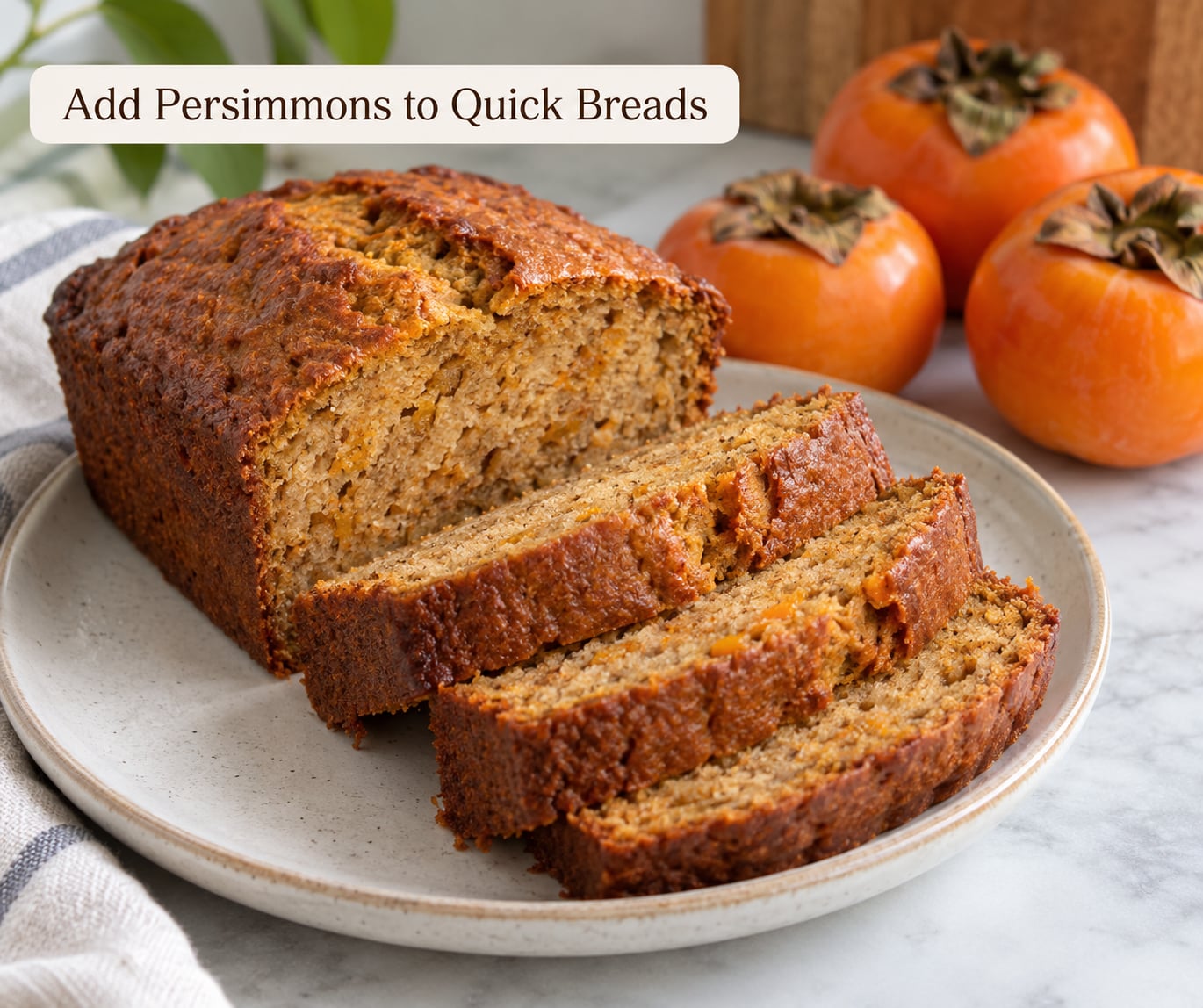
Quick bread is the easiest place to start, because the batter is forgiving and persimmon behaves like mashed banana. Replace about one-third to one-half of the liquid in a banana bread or pumpkin bread formula with puree.
A good starting ratio is one cup of puree for two cups of all-purpose flour, then cut the sugar by a quarter cup, since the fruit brings its own. Whisk the puree with a teaspoon of baking soda and let it stand five minutes before it meets the flour, because the soda thickens the puree and gives the loaf its binding.
Get the ratios right and this is how to use persimmons in baking without a heavy, wet loaf, which is the version that shows up in bread forums over and over. If your loaf still feels tacky when a skewer comes out clean, it may need ten more minutes, not another cup of flour.
4. Fold Persimmons into Cookies and Bars
Soft persimmon pulp works well in oatmeal cookies and blondies, where its moisture keeps the centers chewy. It also works in a standard chocolate chip cookie, though you should expect a softer, cakier cookie that spreads more than the bakery-style version.
Chop the fruit into pieces a shade smaller than you think, since persimmons shrink and smear while baking. Add no more than half a cup per two cups of flour, and cut your sugar by a third of a cup per cup of puree.
Chilling the dough for thirty minutes before it hits the sheet pan is the fix for sticky cookies. Persimmon has real water in it, and cold fat and sugar keep the spread under control. For blondies and fruit bars, stir the puree into the wet ingredients rather than folding it in at the end, so it distributes before the batter sets.
5. Use Persimmons in Cakes and Cupcakes
Puree belongs in cake batter when you want a moist, tender crumb, and it works best in oil-based cakes rather than butter-based ones. Butter cakes need creaming for structure, and a cup of puree will not help if the fat has not been properly aerated first.
For a layer cake, swap about a third of the liquid and reduce the sugar by roughly a quarter cup per cup of puree. The fruit sweetens as it bakes, so what tastes flat in the raw batter will not taste flat out of the oven.
Chunked Fuyu is the move for decoration. Peel it, slice it thin, fan the slices over the top of a cake just before it bakes, or layer it between frosting and cake for a textural change.
Persimmon sugar means the edges brown fast, so tent the top loosely with foil after twenty minutes if you are using a dark pan.
6. Bake With Dried or Concentrated Persimmon
Dried persimmon is chewy rather than moist, so it does not do the job of fresh pulp in a loaf. Cover a quarter cup of dried pieces with a quarter cup of just-boiled water, wait fifteen minutes, and drain. Then fold them into cookies or oatmeal bars where chew is what you want.
Concentrate is useful for flavor without the water, which makes it a reasonable option for cookies, glazes, and swirls. Because it is several times stronger than fresh fruit, use a third of the amount the recipe calls for in puree, and reduce the added sugar by half.
Neither dried fruit nor concentrate is a one-for-one swap for fresh persimmon. Substituting equal weight changes both the water content and the texture of the bake.
7. Know When Not to Add Persimmons
Some bakes fight persimmon rather than welcome it. Delicate pastries like croissant dough, laminated puff pastry, and éclairs do badly with the moisture, because the fruit softens a structure that depends on staying crisp and dry.
Very dry crackers and biscotti also suffer, since persimmon reverses the point of the bake. For yeasted doughs, the sugar and water in puree feeds the yeast more than you probably want and pushes the loaf toward sweet, and it can weigh down the crumb.
Leave persimmons out of anything where the color is the point. The deep orange flesh stains a pale batter, and in a lemon or matcha recipe the tint reads as a mistake.
Common Mistakes
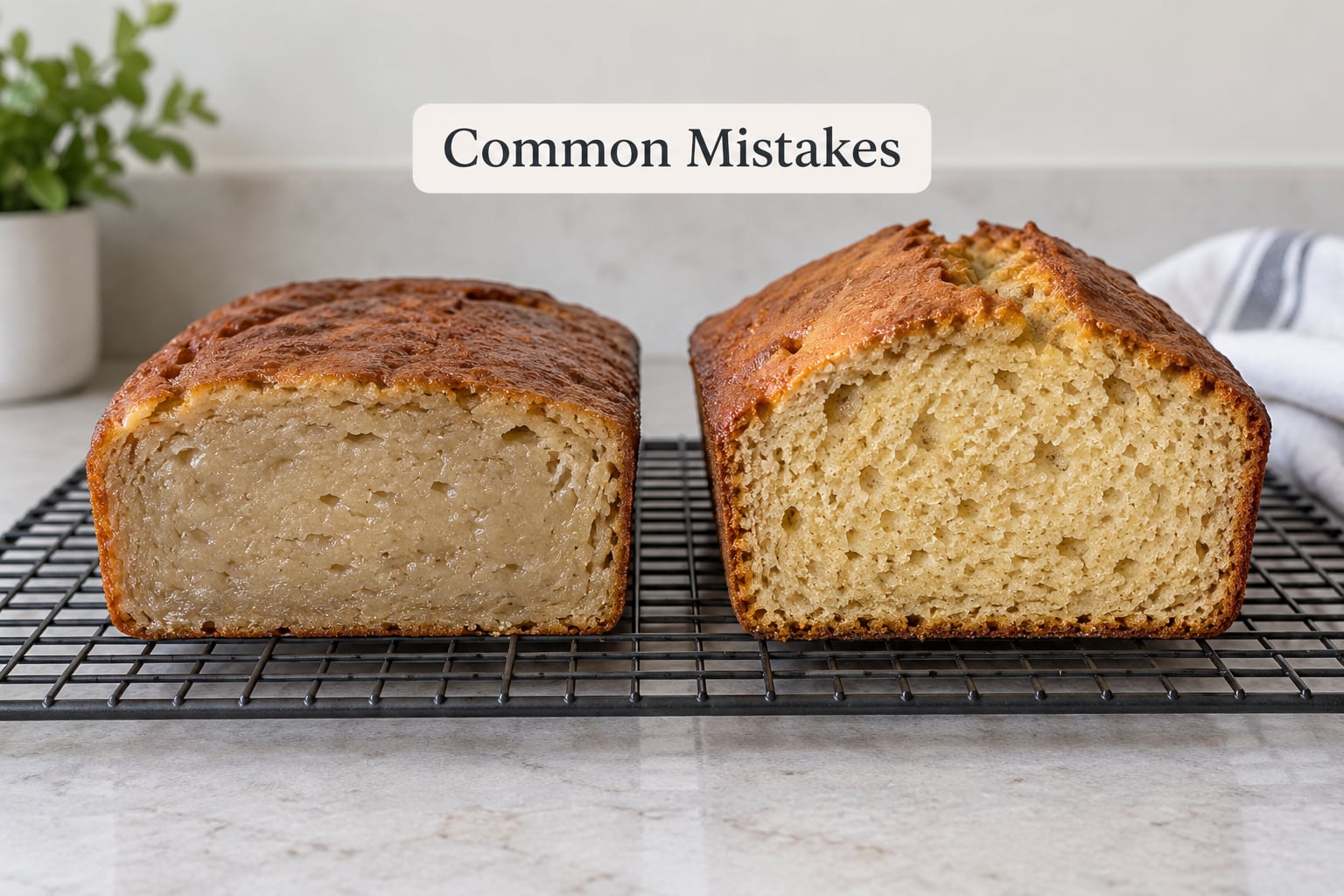
Most persimmon bake failures trace back to one ingredient doing three jobs at once: moisture, sugar, and binder. Here is what each problem looks like and what actually fixes it.
| What went wrong | Why it happened | The fix |
|---|---|---|
| Batter looked runny | Puree added without the baking soda rest, or more puree than the flour can absorb | Stir in a teaspoon of baking soda and rest five minutes, or add flour a tablespoon at a time |
| Gummy or dense crumb | Too much puree for the flour, or the loaf came out underbaked | Cut puree by a quarter next time, extend the bake five minutes, and cool the loaf fully before cutting |
| Too sweet | Recipe sugar left untouched on top of the fruit’s own sugar | Reduce sugar by a quarter cup for every cup of puree |
| Hard, over-browned edges | Persimmon sugar caramelizes sooner than plain batter | Tent with foil after twenty minutes, or lower the oven by 25°F |
| Seeds in the crumb | Pulp was scraped rather than blended and strained | Push the pulp through a fine mesh strainer, or strain after blending |
| Tough skin pieces | Fuyu was folded in with the peel still on | Peel Fuyu every time, or use it only as a topping |
| Stringy puree | Fruit was barely ripe and the fibers had not broken down | Blend a full minute longer and strain; under-ripe fruit will not smooth out |
| Sticky cookie dough | Fresh puree adds water that the recipe did not plan for | Chill thirty minutes, cut the sugar, and add a tablespoon of flour |
| Astringent taste | Fruit was still firm, or a Fuyu-like variety was mistaken for pulp | Wait until the fruit fully collapses; heat does not remove tannins |
One more that has nothing to do with the recipe: do not cut the loaf the moment it leaves the oven. Starches are still setting, and a warm slice reads as gummy even when the crumb is fine. Give it two hours on a rack. Too many bakers blame the fruit for what is really a knife held too soon.
Warm spices are the easiest way to sharpen a persimmon bake. Cinnamon, nutmeg, cloves, ginger, allspice, and Chinese five-spice all work, and a teaspoon of any of them per cup of puree is plenty.
Frequently Asked Questions
Can I use persimmons instead of eggs in baking?
Yes. One large egg binds roughly half a cup of persimmon puree, so pureed persimmon works as an egg replacer in quick breads, muffins, and rustic cakes. Use the puree plus a tablespoon of ground flaxseed or chia for extra binding in muffins and bars. It will not replace the structure an egg gives a layer cake or meringue, so keep eggs for those.
Which type of persimmon is best for baking?
Hachiya for almost everything. Once fully ripe its jelly-like pulp purees smooth and behaves like mashed banana, adding moisture and binding to quick breads, muffins, and cakes. Fuyu is the better choice only when you want visible slices, such as a tart or upside-down cake topping. Mast Charge works the same way as Hachiya.
Do I need to peel persimmons before using them?
Yes, for Hachiya. Scoop the pulp out of the skin with a spoon, discard the seeds and skin, then blend only the flesh. Fuyu must be peeled with a knife before it goes into a batter, since its skin stays firm through baking. The one exception is a strainer: push the blended pulp through fine mesh and the skins and fibers leave behind.
How much persimmon puree should I add to a cake or bread recipe?
Start with one cup of puree for every two cups of all-purpose flour, which is roughly three medium fruits. That replaces about a third of the liquid in a typical quick bread. Reduce the sugar by about a quarter cup per cup of puree, and rest the puree with a teaspoon of baking soda for five minutes before mixing so it thickens into a binder.
Can frozen persimmon puree be used in baking?
Yes, and it is the easiest way to use up a glut. Freeze puree in measured portions in ice cube trays or small freezer bags, press out the air, and keep it for six months. Thaw it in the refrigerator overnight rather than on the counter, then stir it well, because thawed puree separates slightly. Use it straight from thawed in breads, muffins, and cookies.
Why does my persimmon bread taste too sweet?
Persimmon pulp brings its own sugar to the batter, and most recipes add full sugar on top of it. Reduce the recipe sugar by about a quarter cup for every cup of puree, and let the batter sit a few minutes so you can taste the fruit’s own sweetness before committing. Very ripe fruit has noticeably more sugar than barely ripe fruit, so ripeness changes the result too.
If you are new to persimmons, start with a quick bread and a fully soft Hachiya. Blend the pulp, rest it with baking soda, cut the sugar by a quarter cup, and cool the loaf for two hours before you cut it. That single bake teaches you everything about how to use persimmons in baking, and the next one takes ten minutes less guesswork.