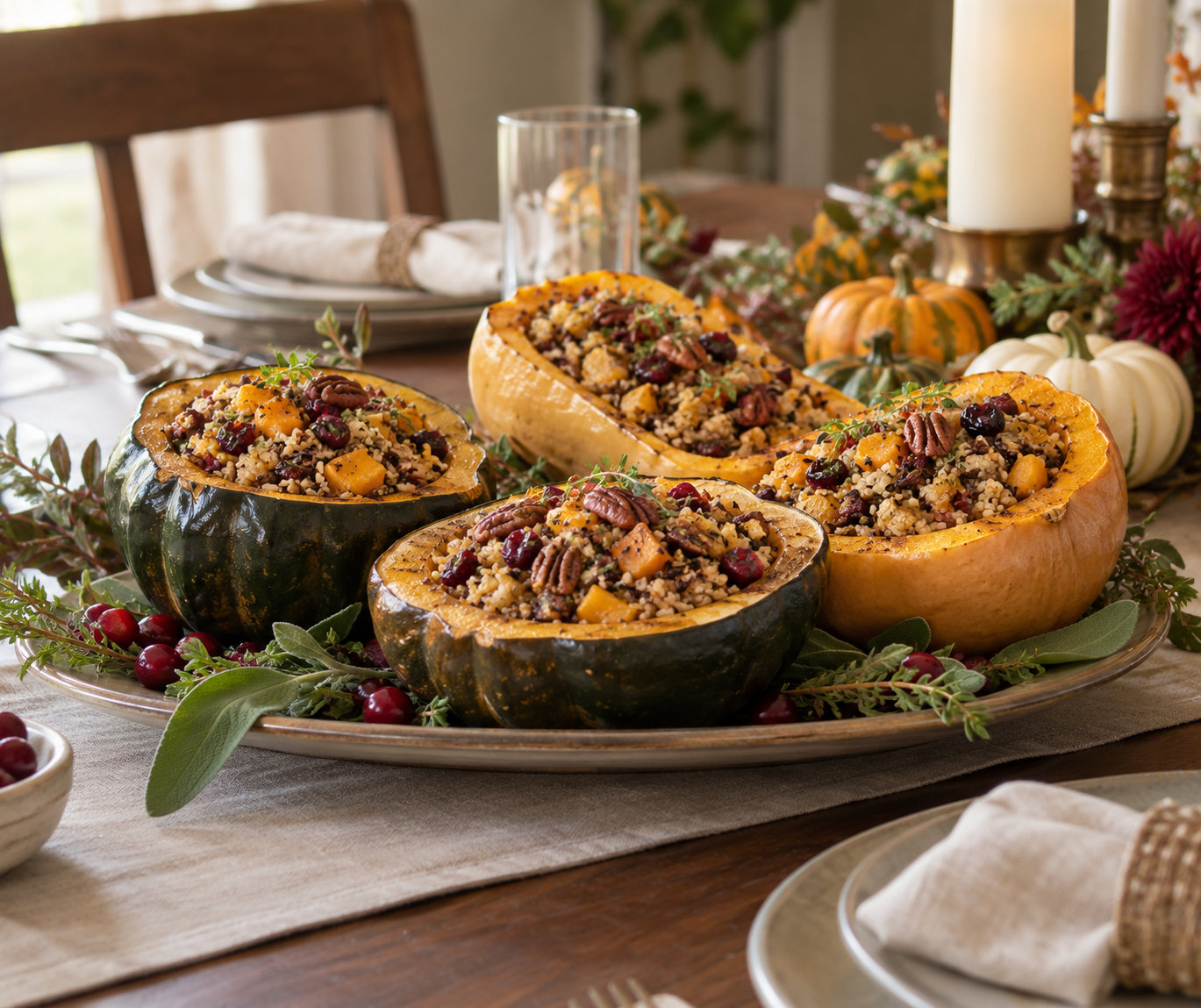
To make stuffed squash for a holiday centerpiece, par-roast the shells cut side down at 400F, cook a grain filling until it is barely moist, then return the packed halves to a 375F oven for 15 to 20 minutes. That two-stage bake is the whole trick: it concentrates the squash flesh and keeps the filling from steeping in released moisture. From cutting board to table you are looking at roughly 90 minutes, most of which the oven handles while you finish the rest of dinner.
What you get in exchange is a dish that stays where you put it. A stuffed squash holds its shape for the length of a holiday meal, feeds a table that includes vegetarians and gluten-free guests, and looks finished the moment it leaves the oven. Squash is also an honest one-vegetable centerpiece: it carries beta-carotene, potassium and a surprising amount of fiber, which matters when the rest of the table is pie and casseroles.
A note before we start. Everything below works with delicata, acorn, butternut or kabocha, and the filling is savory and plant-based, so nobody at the table has to negotiate a slice. If you need a sweeter route, there is a fruit-and-nut variation in the filling section that swaps the grain for apples, dried cherries and pecans.
Table of Contents
- What You Need
- Choosing the squash
- The filling
- Equipment
- Seasoning
- Step-by-Step
- Choose and Prepare the Squash
- Build the Savory Filling
- Fill and Roast the Squash
- Finish and Serve the Centerpiece
- Common Mistakes
- Frequently Asked Questions
- What can you stuff a squash with?
- How do you prevent soggy stuffed squash?
- Which squash is best for stuffing?
- What is the best cheese for stuffed acorn squash?
- Can I stuff squash ahead of time?
- How long does stuffed squash keep?
- Conclusion
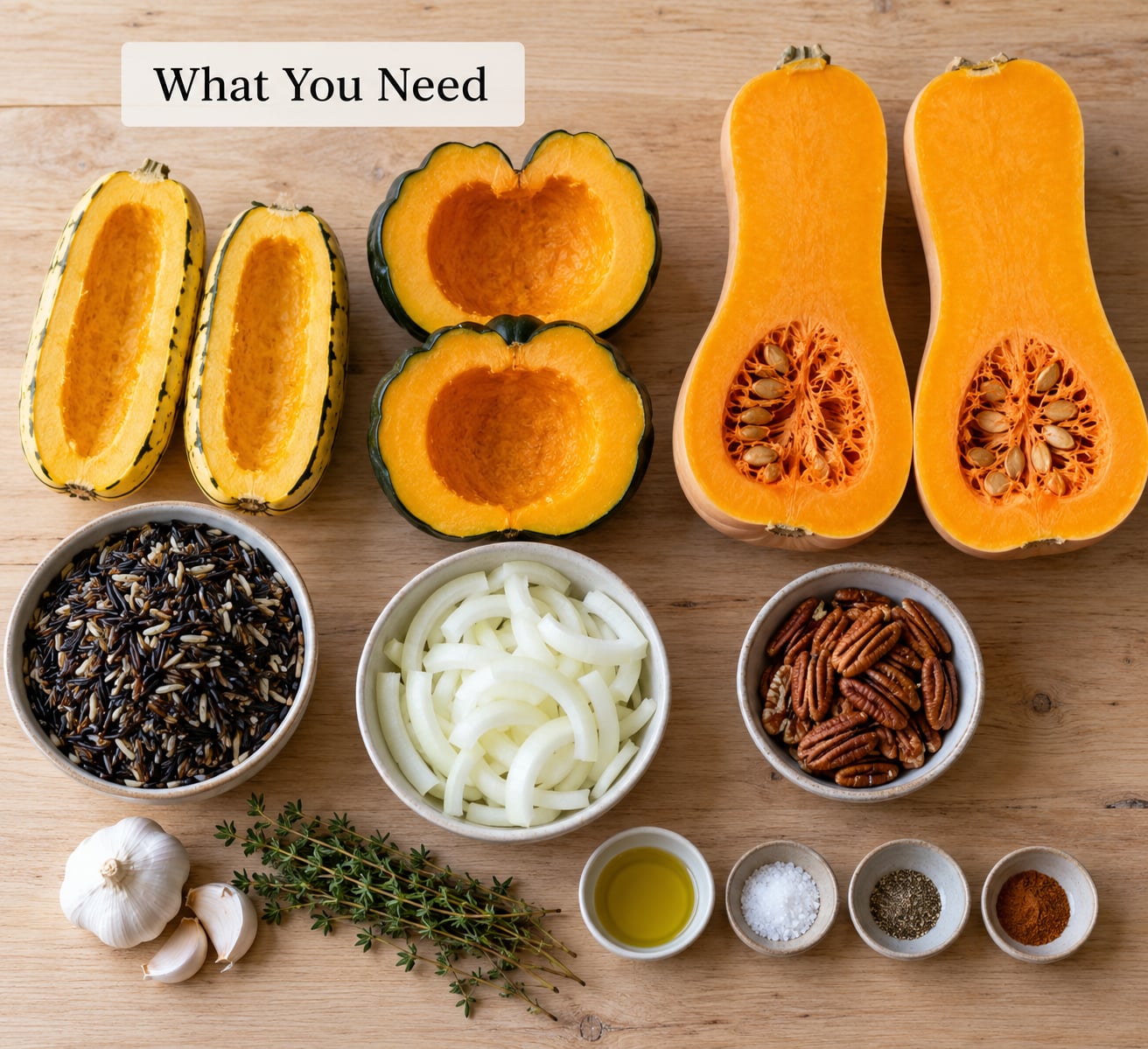
What You Need
Choosing the squash
Pick the squash by how it sits, not only by flavor. A centerpiece needs a flat base so it does not tip when the platter hits the table, and enough cavity to hold a real serving of filling. Delicata is the easiest for a first attempt, acorn gives you the most cavities per pound, butternut feeds more people, and kabocha is the one that looks the most dramatic once the edges caramelize.
| Squash | Typical size | Sits flat | Par-roast at 400F | Best filling |
|---|---|---|---|---|
| Delicata | 1 to 1.5 lb, 2 halves | Yes | 15 to 20 min | Quinoa, sausage, or wild rice |
| Acorn | 1 to 2 lb, 2 halves | Yes, with a trimmed base | 20 to 25 min | Brown rice, lentils, dried cranberries |
| Butternut | 2 to 3 lb, 2 halves | Yes, the natural base is flat | 25 to 30 min | Wild rice, sage, Gruyere or goat cheese |
| Kabocha | 1.5 to 3 lb | Usually, check the base | 25 to 30 min | Farro, mushrooms, nutritional yeast |
Those times assume a whole halved squash, cut side down, on a hot sheet pan. Smaller squash cooks faster, and nobody wants a tough centerpiece, so check early rather than trusting the clock alone.
The filling
The savory filling used here starts with wild rice because it holds its bite and soaks up the squash juices without turning to mush. Quinoa, farro, barley or millet all work in its place. Around the grain you want a small onion, a couple of garlic cloves, a handful of toasted pecans, and something green such as fresh thyme, sage or parsley.
You are looking at about three cups of cooked filling for two large halves, which reads as a main course for six to eight people when the rest of the meal is smaller dishes. Make it four and it becomes a side for ten or twelve. If you want it to anchor the table on its own, cook the filling in a double batch and bring the extra to the table in a small covered dish.
Equipment
A heavy sheet pan is the important piece, because a pale thin pan is why squash steams instead of roasting. A wide skillet for the filling, a small pot for the grain, a sharp knife, and a paring knife for the seeds are all you need beyond that. An instant-read thermometer is genuinely useful, though a fork works.
Seasoning
Salt and pepper, smoked sea salt, a little nutmeg or cinnamon, and something with acid. Squash is sweet and mellow, so it needs a counterweight, and that counterweight is usually a squeeze of lemon, a splash of cider vinegar, or a drizzle of apple cider reduction. A pinch of chili flakes does the same job for people who like heat.
Step-by-Step
Choose and Prepare the Squash
Cutting a winter squash is the one genuinely awkward moment in this recipe, and a stable setup handles it. Set the squash stem side down on a damp towel, roll it onto its side, and cut straight through the stem end with a firm chef’s knife. The stem end is firmer than the blossom end, so starting there gives you a flat, stable half rather than a wedge that rolls.
Once it is halved, scoop out the seeds and stringy membrane with a sturdy spoon. Save the seeds if you want to roast them separately; a small bowl of salted, roasted seeds next to the platter is a nice touch and they crisp in about 8 minutes at 350F. Pat the cavities dry with a paper towel, which helps the cut surfaces sear instead of weeping.
If the squash will not sit flat, shave a thin slice off the blossom end until it rocks very little. That one minute of trimming is what prevents a tipped, collapsed centerpiece.
Rub the cut faces with olive oil, season both the flesh and the cavity with salt and pepper, and set them cut side down on the hot lined sheet pan. The oil and the hot pan are what give you caramelized edges instead of pale, wet flesh.
Build the Savory Filling
Cook the grain first, in salted water, until tender but still chewy, then drain it well. Wild rice wants about 25 minutes once it has come to a boil; quinoa is done in about 15. While it cooks, warm a splash of butter or olive oil in a skillet over medium heat and soften a diced small onion for 5 to 6 minutes, then add two minced garlic cloves and a chopped celery stalk for the last minute.
Add a cup of chopped pecans to the dry pan and toast them until they smell nutty, about 3 minutes, then tip them into a bowl. Keeping the nuts out of the oil is what keeps them crisp in the finished dish.
Now fold everything together: the drained grain, the sautéed aromatics, the toasted nuts, a handful of chopped fresh thyme or sage, and a small pour of apple cider or broth. Season with salt, pepper and a pinch of nutmeg or cinnamon. Stop while the mixture is still slightly moist. If it looks dry, a splash more cider; if it looks heavy, a spoonful more grain.
The sweet version skips the grain entirely. Soften the onion the same way, then fold in diced tart apple, dried cherries or raisins, pecans, a pinch of cinnamon, and enough apple cider to bind it. That mixture is better in a smaller, sweeter squash such as acorn or delicata than in a large butternut.
Fill and Roast the Squash
Pull the par-roasted shells from the oven once the edges have colored and the flesh gives to a fork at the thickest point. This is the step most recipes skip and the reason so many stuffed squash recipes come out wet, because the squash keeps releasing water during the second bake and the filling sits in it.
Pack the filling loosely into the cavities. Loose is the operative word; a firmly packed cavity compresses the grain, and the compressed grain steams. Leave about a half inch of headroom so the filling does not spill back out in the oven, and scrape any stray grains off the rim of the pan before it goes back in.
Cover the shells loosely with foil and return them to a 375F oven for 15 minutes to heat the filling through, then uncover for 10 to 15 minutes so the top browns and the edges of the squash caramelize. Test with a fork: it should slide into the thickest part of the flesh with no resistance at all, and the squash at the base should reach about 190F on a thermometer. If you filled the shells fully tender in the par-roast, check at the 10 minute mark instead, because the filling will dry out if it keeps baking.
For a holiday dinner with several other dishes, the order of operations matters more than the recipe. Par-roast the shells and cook the filling the day before, refrigerate both, then assemble and do the second bake on the day, about 40 minutes before you sit down. The shells can go in with the bird if the bird runs long, and an air fryer at 200C for about 25 minutes, flipped at 12, handles the par-roast while the oven is occupied.
Finish and Serve the Centerpiece
Rest the filled halves for 5 minutes so the filling sets slightly and the squash does not fall apart when you move it. Then scatter fresh herbs over the top, something with a little height, such as torn parsley, thyme leaves, or pomegranate seeds for color, and add a final drizzle of olive oil or cider reduction.
Arrange the halves on a large platter or a wooden board, not a serving dish with a rim, so the caramelized edges are visible from the side. If you cut a lid from the top of the squash, roast that piece alongside the shells and lean it beside the stuffed half at the table; it looks deliberate and it catches the steam.
For a buffet, cut each half into three or four wedges once it has rested, and keep them on a warm platter until you are ready to serve. An unstuffed squash holds heat and moisture better than a cut one, so if you expect more than half an hour of buffet time, hold the halves whole and slice at the table. Keep anything sitting out longer than two hours in the fridge for the next day.
Common Mistakes
The filling is watery. The cause is almost always under-par-roasting or over-filling. Roast the shells cut side down until the edges color, then pack the filling loosely with headroom. If you have already got a soggy tray, fish the filling out with a slotted spoon, spread it on a sheet pan, and put it back in the oven for 8 minutes; it recovers surprisingly well.
The whole thing tastes bland. Squash is not a strongly flavored vegetable, so it needs salt, acid, and a fat. Season the shells before the first roast rather than only at the end, and finish with cider vinegar, a squeeze of lemon, or apple cider reduction.
The squash is still firm at the table. Size and cut are usually to blame, not the oven. Give butternut and kabocha the full 30 minutes par-roast, and test before you fill rather than at the end, because a half that was not tender when you filled it cannot be rescued by 15 more minutes with a hot filling in it.
The edges scorch before the center cooks. The pan or the squash is too large for the heat. Use a dark pan at 400F for the par-roast rather than a light-colored pan at 425F, and if your squash is a large kabocha, nest the halves snugly so the sides lean against each other.
The filling spills out in the oven. Too full, or a rim set at an angle. Trim a flat base, leave headroom, and keep a rim of squash meat around the filling. A little spillage on the pan is not a disaster, and the pan juices are good for serving.
You started too late. The shells par-roast for 20 to 30 minutes, so an hour before dinner is already tight. Roast the shells and cook the grain the day before, and the day-of work drops to filling, baking, and garnishing.
Frequently Asked Questions
What can you stuff a squash with?
Almost any cooked grain or legume filling works, and the rule is that it should be seasoned and slightly moist. Wild rice, quinoa, farro, millet, lentils and chickpeas all hold their texture. Sweet fillings of diced apple, dried cherries or raisins with pecans and cinnamon suit acorn and delicata. Ground sausage, ham or a mushroom and nutritional yeast mixture are savory options. Avoid raw rice or raw breadcrumbs, which will not cook through in the second bake.
How do you prevent soggy stuffed squash?
Par-roast the hollowed shells cut side down at 400F for 20 to 30 minutes before any filling goes in. That drives off surface moisture and caramelizes the cut edges, so the flesh releases less water during the second bake. Pack the filling loosely with about a half inch of headroom rather than mounding it, and pat the cavities dry after deseeding. A pre-microwaved shell in a microwave-safe plate works as a shortcut for smaller squash.
Which squash is best for stuffing?
Delicata is the easiest for a first time cook because the thin skin is edible and the halves cook in about 35 minutes total. Acorn gives the most cavity per pound and holds a sweet fruit-nut filling well. Butternut is the most forgiving for feeding a crowd, since one large squash yields two generous halves. Kabocha has the richest, chestnut-like flavor and caramelizes beautifully, but the skin is not edible.
What is the best cheese for stuffed acorn squash?
Gruyere melts well and browns on top, which is what you want from the second uncovered bake. Goat cheese is a good second choice, added in crumbles during the last five minutes so it softens without drying out. Fontina gives a milder, creamier melt, and Parmesan or pecorino is more useful as a finishing sprinkle than as the main cheese. For a dairy-free table, nutritional yeast or a lemon-tahini sauce works in the same slot.
Can I stuff squash ahead of time?
Yes, and it is the reason this dish suits a holiday hosting schedule. Par-roast the shells and cook the grain up to two days ahead, refrigerate them separately, and assemble the day of. Bake the filled squash for 15 to 20 minutes at 375F until the filling is steaming hot in the center, about 165F. You can also stuff the shells raw in advance and keep them covered in the fridge, but the par-roast is still worth doing fresh.
How long does stuffed squash keep?
Refrigerated leftovers keep about 3 to 4 days in a covered container. Reheat a half in the oven at 350F for 20 minutes, uncovered, so the shell does not go soft, or in a microwave for 3 to 4 minutes on a microwave-safe plate. Extra filling keeps the same 3 to 4 days and is good folded into soup, used as a stuffing for roasted vegetables, or frozen in a flat bag for up to three months.
Conclusion
Start with the shells, not the filling. Get them par-roasted at 400F until the edges color, because that single step decides whether your stuffed squash comes out savory or soggy. Then cook a wild rice filling that is seasoned, moist and loosely packed, and give the filled halves 15 to 20 minutes at 375F.
Do the shells and the grain the day before, assemble on the day, and you will have a warm, colorful centerpiece standing on the platter when everyone sits down, with enough time left in the kitchen to do the rest of dinner. That is the version worth repeating every year.