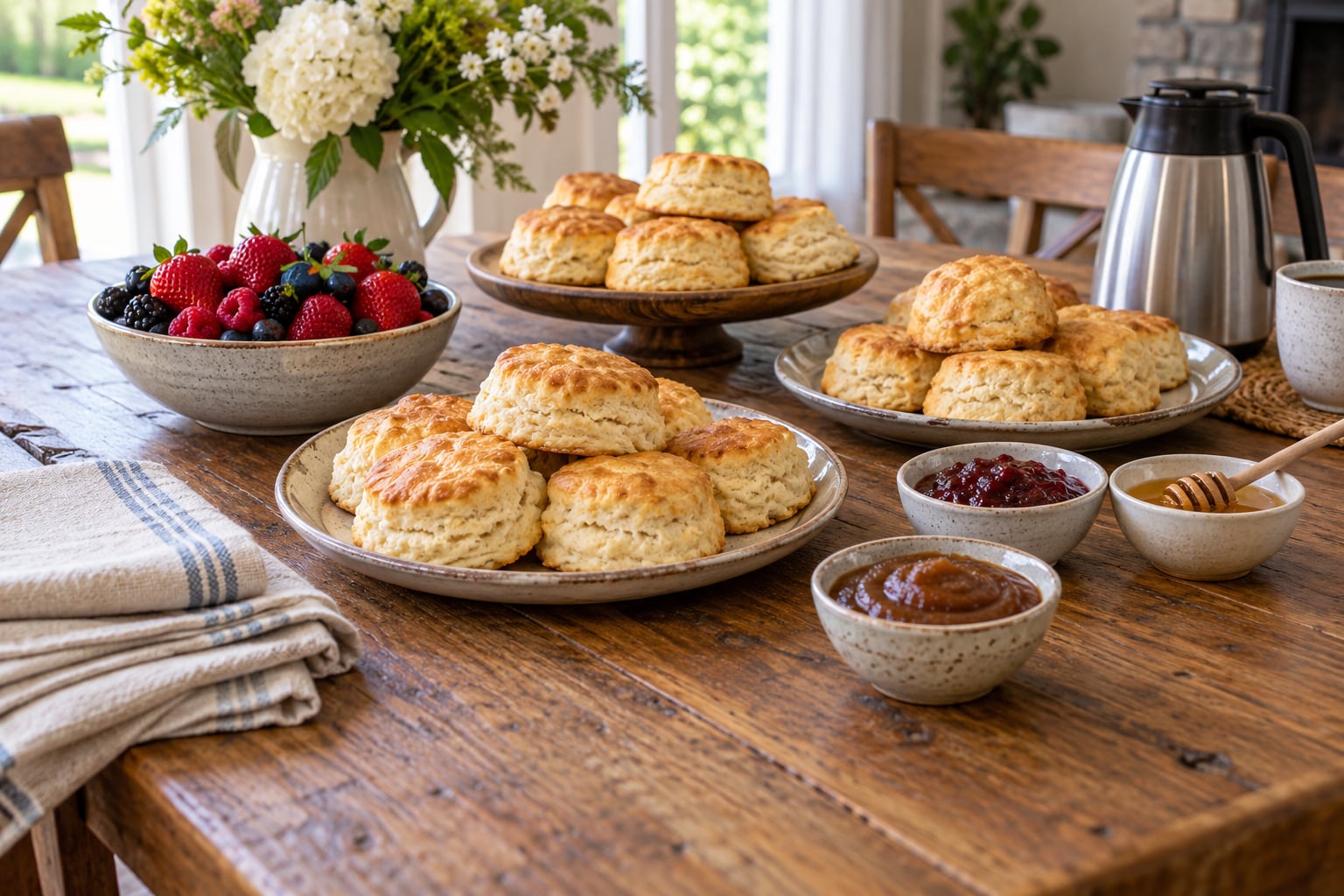
A biscuit bar is a build-your-own brunch station: a platter of warm Southern-style buttermilk biscuits ringed by butter, apple butter, honey, preserves, gravies and toppings, so guests stack their own. Learning how to set up a biscuit bar for brunch takes about two hours of hands-on work, and most of it happens the night before.
Plan on three to four biscuits per guest for a seated brunch, or two if people are grazing. And be clear about what you searched for: this is a savory Southern spread, not the dessert bar that turns up under the same phrase.
A bar is the easiest way I know to feed twenty to fifty people without plating a single meal. The food holds for the length of a two-hour brunch, everyone eats what they actually want, and you spend the morning pouring coffee instead of carving. That is why it keeps showing up at baby showers, holiday mornings and wedding brunches for traveling guests.
Table of Contents
- What You Need to Build a Biscuit Bar
- Servingware
- Utensils and Labels
- Food
- How Much to Buy by Guest Count
- How to Set Up a Biscuit Bar for Brunch: Step by Step
- How to set up a biscuit bar for brunch without overcrowding the table
- Choose the biscuit lineup
- Plan the toppings and condiments
- Prepare the food in the right order
- Arrange and label the bar
- How to bake tall, flaky biscuits for the bar
- Common Mistakes to Avoid
- Frequently Asked Questions
- How many biscuits should I bake per person for a brunch?
- Can I make biscuit bar items the night before?
- How do you keep biscuits warm for a two-hour brunch?
- How do you handle gluten-free and vegan guests at a biscuit bar?
- What are some good ideas for a biscuit bar menu?
- Is gravy better in a slow cooker or a chafing dish at a brunch bar?
- Conclusion
What You Need to Build a Biscuit Bar
You need far less than a bagel bar does. Biscuits do not need toasting, they hold their texture for hours, and the toppings are mostly things you already keep in the pantry.
Servingware
- Two platters or wide baskets, one for sweet biscuits and one for savory
- Eight to twelve small bowls or ramekins for butter, preserves and condiments
- One deeper bowl with a ladle for gravy
- A wire cooling rack if you plan to hold biscuits warm
- Clean kitchen towels or parchment to line the biscuit baskets
Utensils and Labels
- Tongs for the biscuits, so nobody squeezes them
- A separate butter knife or small spoon for every spread, including the butter
- A slotted spoon for fruit, a ladle for gravy
- Plates and forks at one end of the table, napkins at the far end
- Small kraft cards and a marker pen, or wooden table markers
Food
- Biscuits: three to four per guest, plus four spare
- Butter, plus a vegan block for anyone who needs it
- Apple butter, peach or fig preserves, sorghum or local honey
- One gravy, either white cream gravy or white sausage gravy
- One protein: country ham, fried chicken, or pimento cheese for a meatless bar
- Fresh fruit, sliced greens, and something pickled like ramps or green tomato
How Much to Buy by Guest Count
Scaling is the part people get wrong. Most hosts underestimate the sweet spread and overestimate the biscuits.
| Guests | Biscuits | Butter | Preserves and honey | Gravy | Protein |
|---|---|---|---|---|---|
| 10 | 36 | 1 stick | Two 8 oz jars | 1 quart | 1 lb |
| 20 | 70 | 2 sticks | Three 8 oz jars | 2 quarts | 2 to 3 lb |
| 30 | 110 | 3 sticks | Four 8 oz jars | 3 quarts | 4 lb |
| 50 | 185 | 5 sticks | Six 8 oz jars | 1 gallon | 7 lb |
Biscuit math works out to about three and a half per person with a small buffer, and gravy runs roughly a quarter pint per guest if it is one of several options rather than the main event.
How to Set Up a Biscuit Bar for Brunch: Step by Step
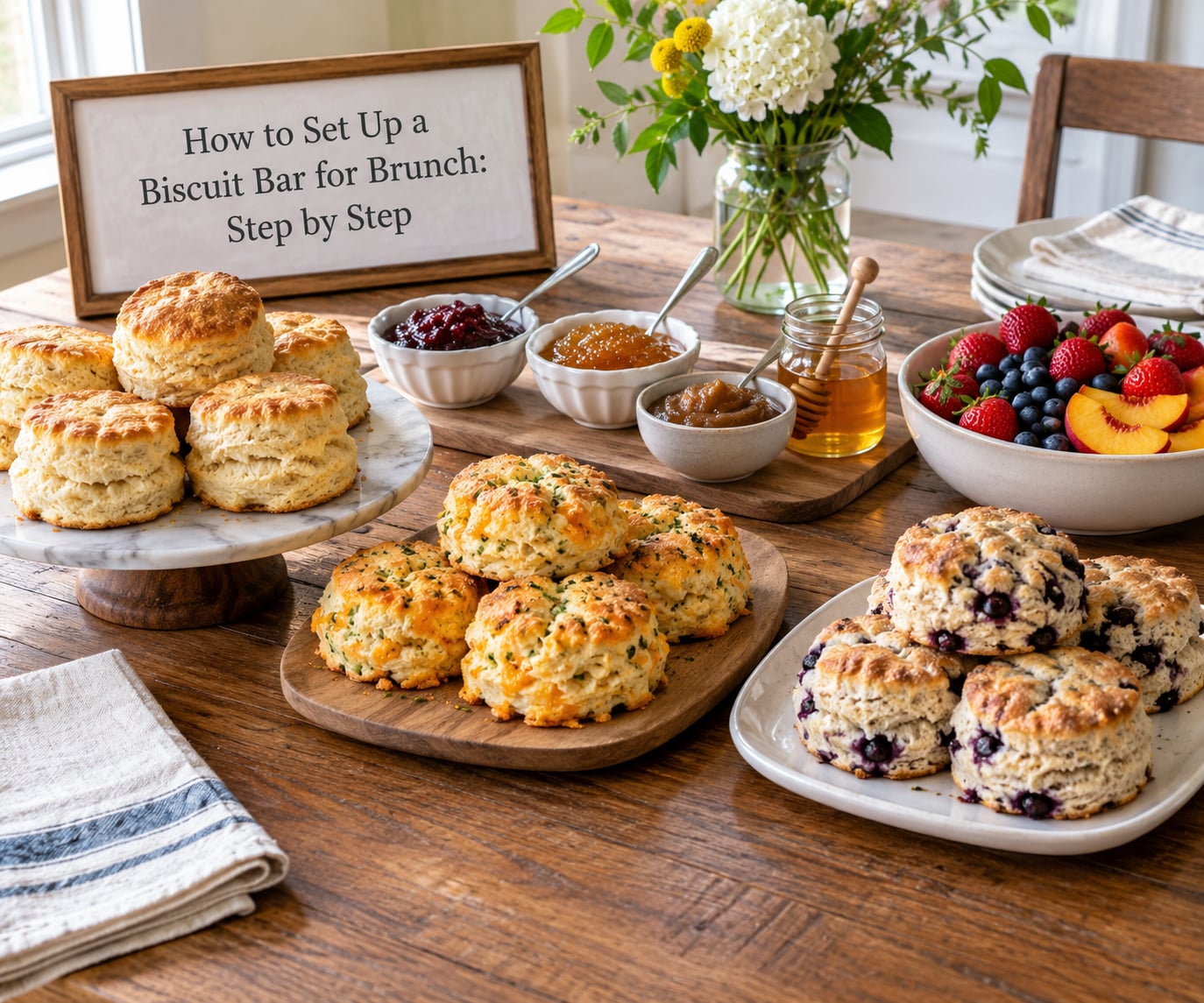
Set up a biscuit bar in six steps: bake or buy the biscuits, clear and zone your table, put out the plates, lay down biscuits, spoon up the spreads and toppings in build order, then label everything and add the drinks.
How to set up a biscuit bar for brunch without overcrowding the table
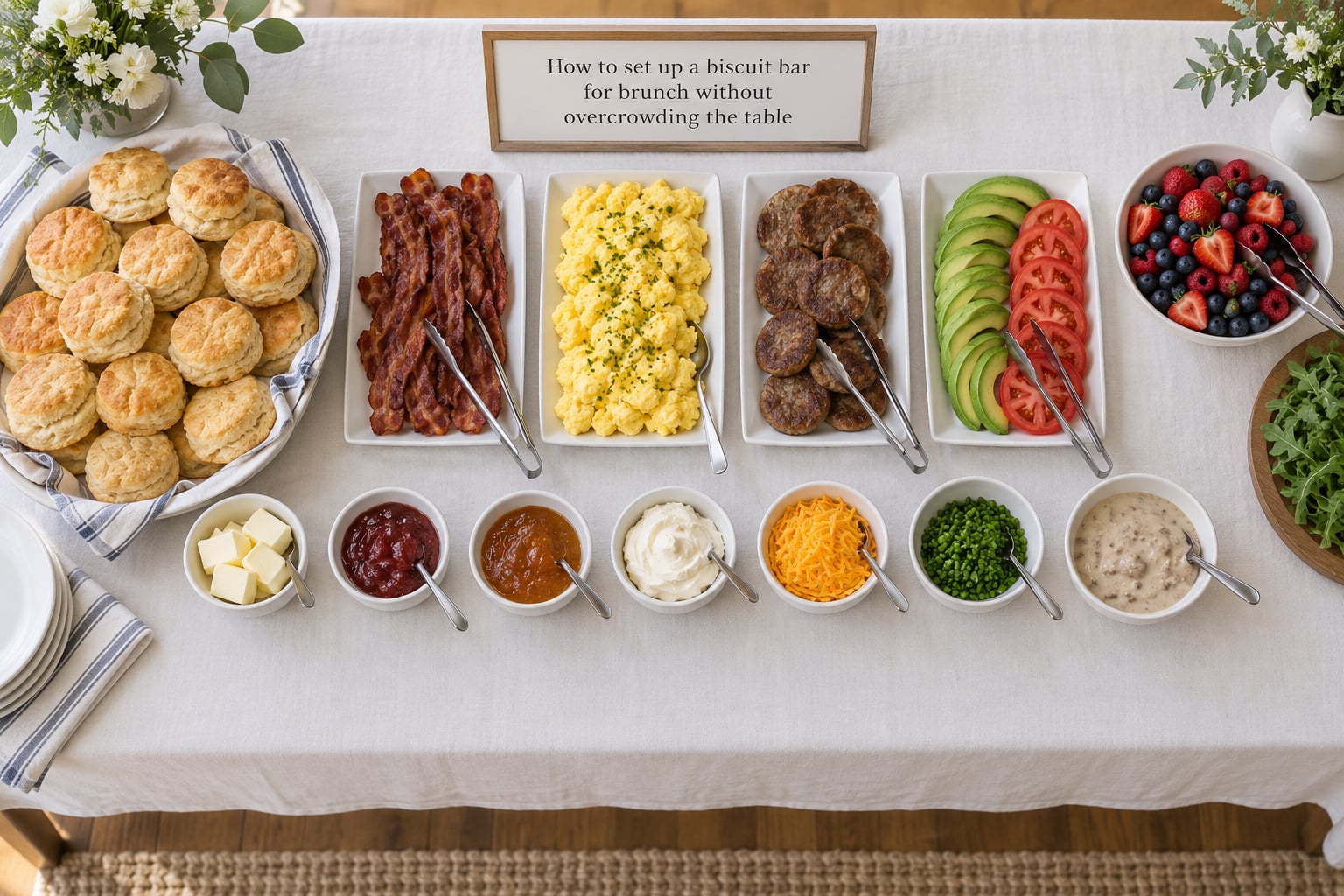
Crowding is the failure mode that ruins a bar, because a jammed line turns generous food into a traffic jam. Divide the surface into four zones: biscuits in the middle, sweet spreads on one side, savory protein on the other, fruit and pickles at the far end.
Leave an open lane along the front edge for plates and utensils, and give yourself about 18 inches of table edge per guest. At thirty guests or more, run the bar on two sides of the room instead of one long stretch, and put the gravy at its own small station so the main line never stops.
Choose the biscuit lineup
Three varieties is the sweet spot, split about sixty percent classic, twenty-five percent savory, fifteen percent gluten-free. Classic buttermilk biscuits are the base; a cheddar and scallion or black pepper biscuit gives the savory station something to stand on; a gluten-free biscuit means the gluten-free guest is not left with butter on a plate.
Keep the savory biscuits on a separate platter so nobody builds a jam sandwich by accident. If you are short on time, buy the sweet biscuits and bake only the savory batch, which is usually the one people remember.
Plan the toppings and condiments
Keep the menu manageable: two sweet spreads, one savory sauce, one protein, and produce. For sweet, that means butter, apple butter, and one preserve plus honey or sorghum. For savory, choose one gravy and one protein, then add sliced fruit, greens, and something pickled.
Regional toppings make a bar feel like nobody else’s. Local honey, peach or fig preserves, apple butter in autumn, and pickled ramps or green tomato in spring do more work than another jar of something generic.
If you serve meat, hold it hot at 140F or above. Cold egg salad, cream cheese dips and cut fruit should sit on ice and go out no more than two hours before serving. Cook poultry to 165F and ground meat to 160F before it ever reaches the bar.
Prepare the food in the right order
The night before, make the biscuits and freeze them unbaked, portion the butter, wash and dry the fruit, set out every bowl, and measure your seasonings into small dishes.
Two hours before, pull the frozen biscuits onto parchment-lined sheet pans and put them straight in the fridge so they thaw slowly. Bake them while you set the table. If you baked them fresh, warm them at 350F for six to eight minutes rather than letting them sit out and go stale.
Thirty minutes before guests arrive, arrange the biscuits, spoon the spreads into bowls, slice the protein and fruit, and put the gravy on its lowest heat. Keep a second tray of biscuits in the kitchen so you can refill without stopping what you are doing.
Arrange and label the bar
Build in order, from the guest toward the wall: plates and forks, then biscuits, then spreads, then proteins and produce, then garnishes and sauces, with napkins last at the far end. That order means everyone picks up a plate and moves one direction instead of reaching back and forth across your table.
Put a small label in front of every bowl, and use a separate plate for each condiment so nobody double-dips. A covered basket of extra biscuits tucked behind the bar solves the refill problem without anyone having to ask you.
How to bake tall, flaky biscuits for the bar
Biscuit height comes from cold fat and barely any handling. Freeze the butter, work the dough cold, fold it in thirds like a letter three times, and stop. Press the cutter straight down without twisting, or you seal the layers shut and lose the rise.
Bake at 475F for twelve to fifteen minutes on a hot sheet pan. The high heat sets the outside fast, which is what pushes the layers up. A small pinch of cream of tartar with the baking powder keeps the biscuits tall because the acid stops reacting too early.
Common Mistakes to Avoid
Most biscuit bar problems come from one of six predictable mistakes, and all of them are fixable before guests arrive.
- Baking too many kinds of biscuits. Four varieties means a slower line and a quieter platter. Three is plenty.
- Serving every topping at once. Put out half the items at the start and bring the rest out after twenty minutes. It keeps the table readable and the food fresh.
- Skipping dietary labels. Mark the gluten-free platter and the vegan butter plainly. A guest guessing at a jam is a guest who does not eat.
- Cutting toppings too early. Fruit browns, greens wilt and pickles go dull in the bowl. Prep them the night before, cut them the morning of.
- Overcrowding the table. One main item plus a tight lane beats everything crammed on. Spread across two surfaces instead.
- Running out of biscuits. Bake a dozen extra. Extra biscuits get eaten; an empty platter ends the bar.
Two more details that take ten minutes and save the morning: warm your serving dishes before the biscuits come out, and keep a stack of clean towels nearby for sticky hands. Gravy thickens as it sits, so stir it every fifteen minutes or hold it above 140F.
Frequently Asked Questions
How many biscuits should I bake per person for a brunch?
Plan on three to four biscuits per guest for a seated brunch, and two per guest if people are grazing and there is other food on the table. For twenty guests that works out to about seventy biscuits, which covers a spread with both sweet and savory toppings. Add four spare so you are not baking at the end of the service.
Can I make biscuit bar items the night before?
Yes, most of the bar is made ahead. Freeze unbaked biscuits the night before and thaw them in the refrigerator, then bake fresh. Wash and dry fruit, portion butter, set out bowls and mix seasonings a night ahead. Cut fruit, slice protein and cook gravy the morning of so nothing sits and wilts.
How do you keep biscuits warm for a two-hour brunch?
Bake them just before guests arrive and hold them in a 200F oven on a wire cooling rack with a loose foil tent over the top. Never stack biscuits while they warm, since trapped steam makes the bottoms soggy. Avoid a slow cooker or crockpot, which steams them soft instead of keeping them flaky.
How do you handle gluten-free and vegan guests at a biscuit bar?
Put out a dedicated gluten-free biscuit platter, kept separate from the regular flour biscuits, and label it clearly. For dairy-free guests, offer a vegan butter block and a vegan honey or sorghum, since butter is the one item nearly every biscuit needs. Ask about allergies when you invite, not on the morning of.
What are some good ideas for a biscuit bar menu?
A workable menu is three biscuits, two sweet spreads and one protein. Try classic buttermilk, cheddar scallion, and a gluten-free biscuit, with butter, apple butter, peach preserves, and local honey on the sweet side. On the savory side, add white gravy, sliced country ham or fried chicken, greens, and pickled ramps.
Is gravy better in a slow cooker or a chafing dish at a brunch bar?
A chafing dish or a low slow cooker both work, and both are fine for holding temperature. The trick is heat: keep the gravy above 140F and stir it every fifteen minutes, since it thickens as it sits and scorches at the bottom if the heat is too high. Keep it at its own station so the main line keeps moving.
Conclusion
Start by writing down your guest count and buying biscuits for three and a half per person. If you are still deciding how to set up a biscuit bar for brunch from scratch, everything after that is zones, bowls and labels, and the night before does most of the work for you.