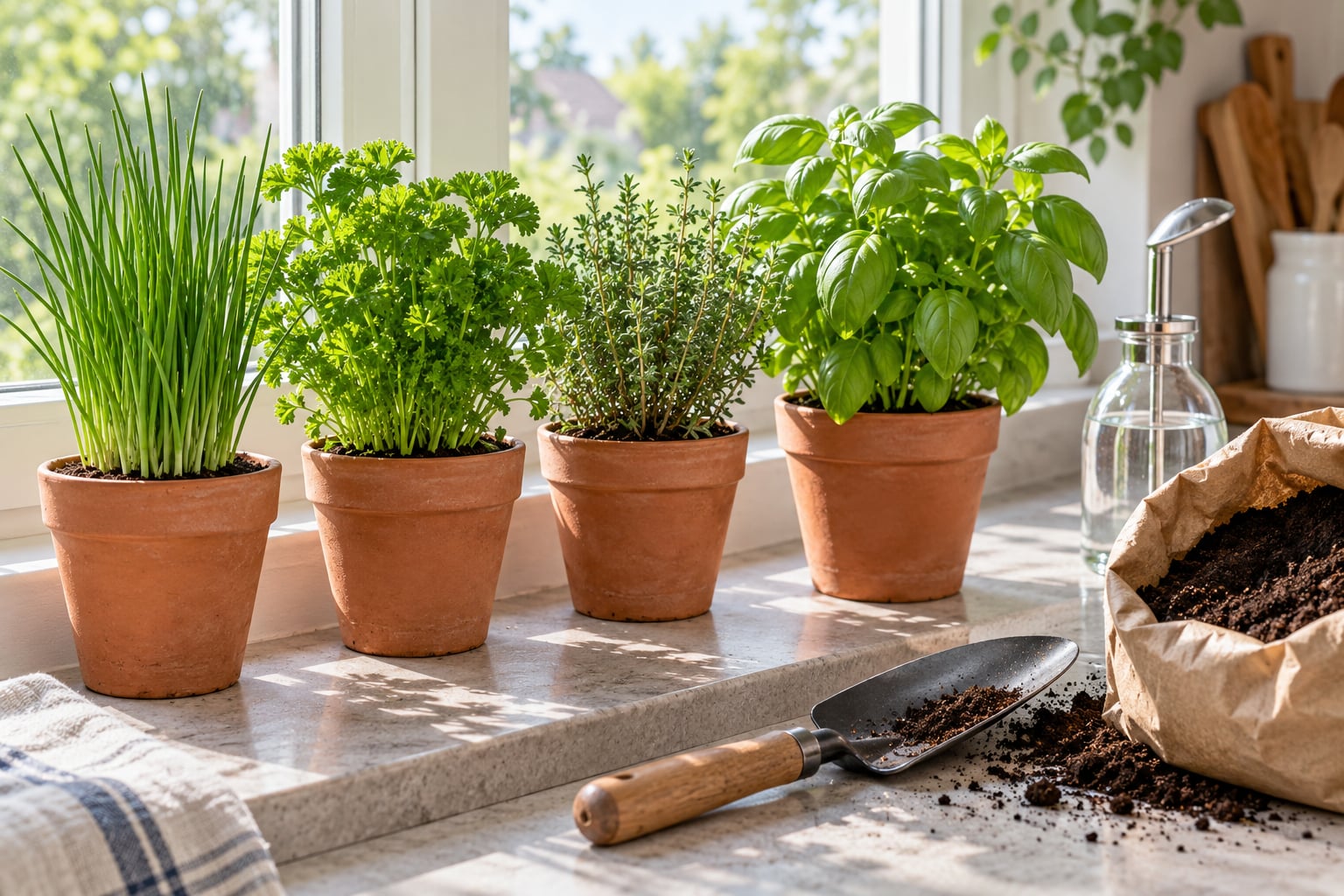
To grow herbs on a windowsill successfully, give them three things: 4 to 6 hours of direct sun, a pot with a drainage hole filled with loose potting mix, and water only when the top inch of soil feels dry. Start with chives, parsley, thyme, or basil, and you can keep a small herb garden alive in a single window all year.
That is genuinely all a windowsill herb garden asks of you. No yard, no raised bed, no special soil. A sunny sill, a handful of small pots, and a habit of poking at the soil before you pour anything into it.
I keep a windowsill garden mostly for chives, parsley, and cilantro, because those three cover eggs, soups, and beans without me thinking about it. Basil gets its own pot by the south window. My first attempt failed for the boring reason most people fail: I watered on a schedule instead of checking, and two plants went yellow within a month.
Here is the whole process, step by step, along with the mistakes worth skipping in the first place.
Table of Contents
- What You Need
- How to Grow Herbs on a Windowsill: Step-by-Step
- How to Grow Herbs on a Windowsill: Choose the Right Herbs
- How to Grow Herbs on a Windowsill: Choose Containers and Soil
- How to Grow Herbs on a Windowsill: Plant Without Overcrowding
- How to Grow Herbs on a Windowsill: Give the Right Light
- How to Grow Herbs on a Windowsill: Water Correctly
- How to Grow Herbs on a Windowsill: Harvest for Cooking
- Common Mistakes
- Frequently Asked Questions
- How much sunlight do herbs need on a windowsill?
- How often should I water herbs growing on a windowsill?
- What is the best container for growing herbs indoors?
- Can I grow herbs on a windowsill without direct sunlight?
- How long do herbs grown indoors on a windowsill last?
- Should I use potting soil or regular garden soil for windowsill herbs?
- Conclusion
What You Need
The supply list for a windowsill herb garden is short. Everything you need fits in one drawer or one shelf, and most of it comes in a single trip to a garden center.
- Containers with drainage holes in the base. Aim for 4 to 6 inches deep and 6 inches wide for most herbs, one plant per pot.
- Saucers or drip trays to catch the runoff from every watering.
- Quality potting mix, not garden soil from the yard. Potting mix is formulated to stay airy and to hold moisture without compacting.
- Perlite, pumice, or small pebbles to loosen the mix if it packs down.
- A narrow-spout watering bottle or small can so you can water the soil without blasting the leaves flat.
- Plant labels or masking tape and a pen, because parsley and cilantro look nearly identical when young.
- Optional: a small LED grow light, a bottle of diluted houseplant fertilizer, and a hand trowel or fork for repotting.
For beginners, I would skip the seed trays entirely and buy nursery starter plants. Basil grown from seed needs 3 to 4 weeks before the first usable harvest, and most people lose interest before it happens.
Chives, parsley, mint, and thyme are the most forgiving herbs on a windowsill. Gardeners posting on r/gardening and r/IndoorGarden keep naming chives, parsley, and mint as the ones that survive apartment life, and I would add thyme because it forgives a missed watering better than anything else.
How to Grow Herbs on a Windowsill: Step-by-Step
Six steps cover the entire process: pick the right herbs, pick the right pot and soil, plant without crowding, position for the light you actually have, water on a check rather than a calendar, and harvest in a way that keeps the plant producing.
How to Grow Herbs on a Windowsill: Choose the Right Herbs
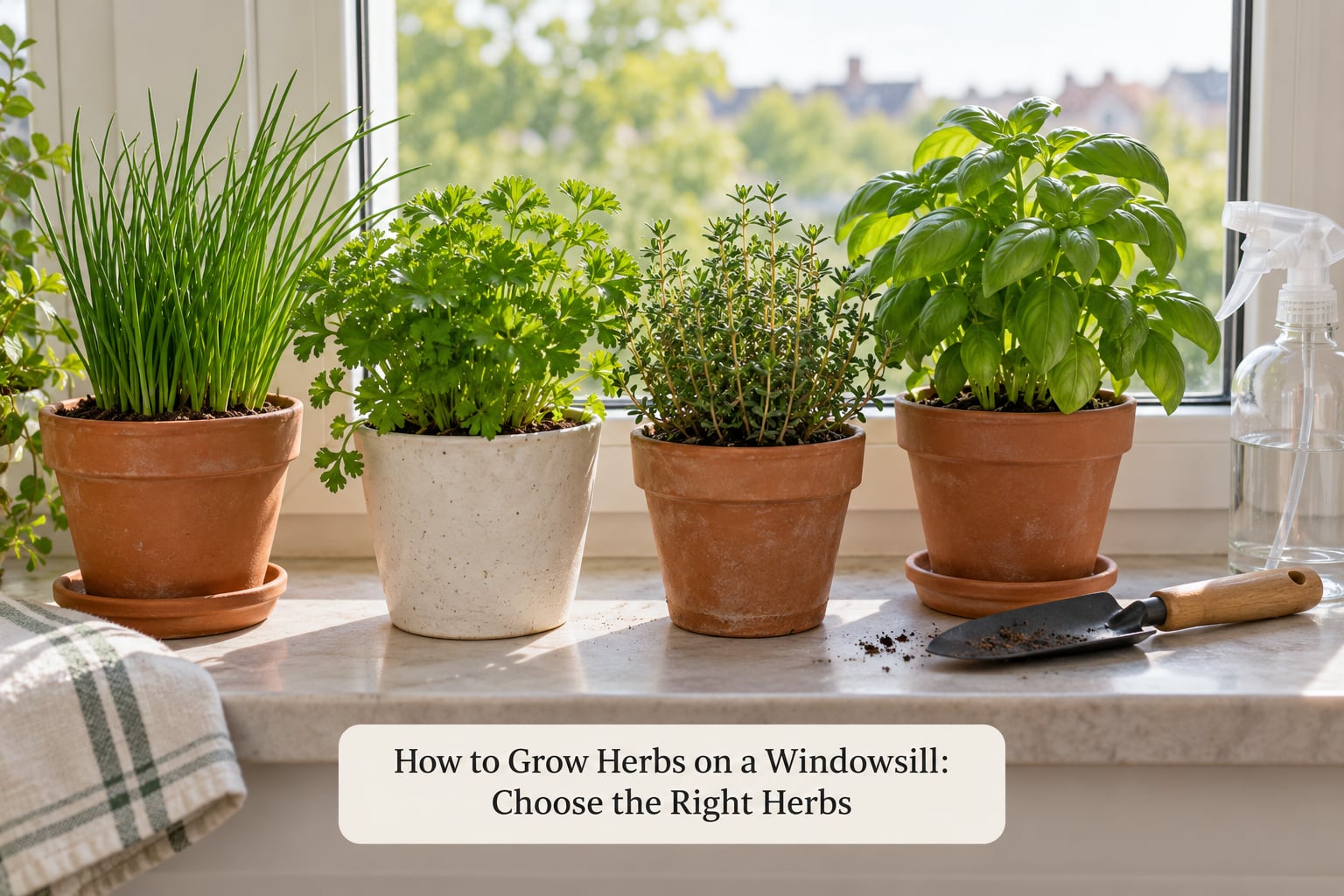
Chives, parsley, cilantro, mint, thyme, and basil cover most home cooking, and all six will grow indoors. They are not interchangeable, though. Mint wants its own pot and more water than the rest. Thyme and other Mediterranean herbs want to dry out between drinks and will rot in soggy soil. Cilantro bolts in heat and turns bitter, which makes it a poor windowsill companion in a warm kitchen.
Parsley, cilantro, and chives are cool-season herbs. They do their best near a window that is bright without baking, and they hold up fine through winter. Basil and mint are warm-loving and sulk in a cold draft.
Start with three plants. Three pots is enough to prove the setup works, easy to water, and small enough that a windowsill of 24 inches can hold them. Add more once you know how often your particular sill dries out, which is different in every kitchen.
| Herb | Light | Water | Days to first harvest from seed | Kitchen use |
|---|---|---|---|---|
| Chives | 4 to 6 hours of sun | Keep evenly moist | 14 to 21 | Eggs, potatoes, chive butter |
| Parsley | 4 to 6 hours of sun | Moist, never soggy | 21 to 30 | Stock, sauces, parsley rice |
| Cilantro | 4 to 6 hours of sun | Even moisture | 10 to 14, then bolts | Salsa, beans, curry |
| Mint | Bright light, some sun | Wetter than most herbs | Start from a plant | Tea, lamb, mint jelly |
| Thyme | 6 hours of sun | Let dry between waterings | 21 to 28 | Roasts, beans, cornbread |
| Basil | 6 or more hours of sun | Moist, water often | 21 to 28 | Pesto, tomatoes, sauces |
| Oregano | 6 hours of sun | Dry between waterings | 25 to 35 | Pizza, pasta, chili |
| Sage | 6 hours of sun | Dry between waterings | Slow, often started as a plant | Stuffing, biscuits, beans |
The day-to-harvest numbers are approximate and depend on temperature, light, and variety. Sage and rosemary grow slowly enough that most people buy a nursery plant rather than start from seed.
How to Grow Herbs on a Windowsill: Choose Containers and Soil
Pick pots with holes in the bottom. A container without drainage has no second chance, and a pot that sits in a saucer full of water will rot the roots from below no matter how careful you are.
Depth matters more than width. A 6-inch-deep pot holds enough root mass to keep a chive or a basil plant alive through a dry week. Rosemary and thyme want at least 6 inches because their root systems run deep, while a shallow 3-inch pot suits a single windowsill tray of mixed salad greens and nothing else.
Fill with potting mix, not soil from your yard. Garden soil compacts indoors and does not drain the way a soilless mix does. If you want extra airflow, mix in a handful of perlite or pumice. You can put a shallow layer of pebbles at the base for stability, but do not pack them so tightly that they seal the hole.
Decorating a cachepot or a wooden trough works fine as long as the inner pot still drains. Many people use any container and drill drainage holes themselves.
How to Grow Herbs on a Windowsill: Plant Without Overcrowding
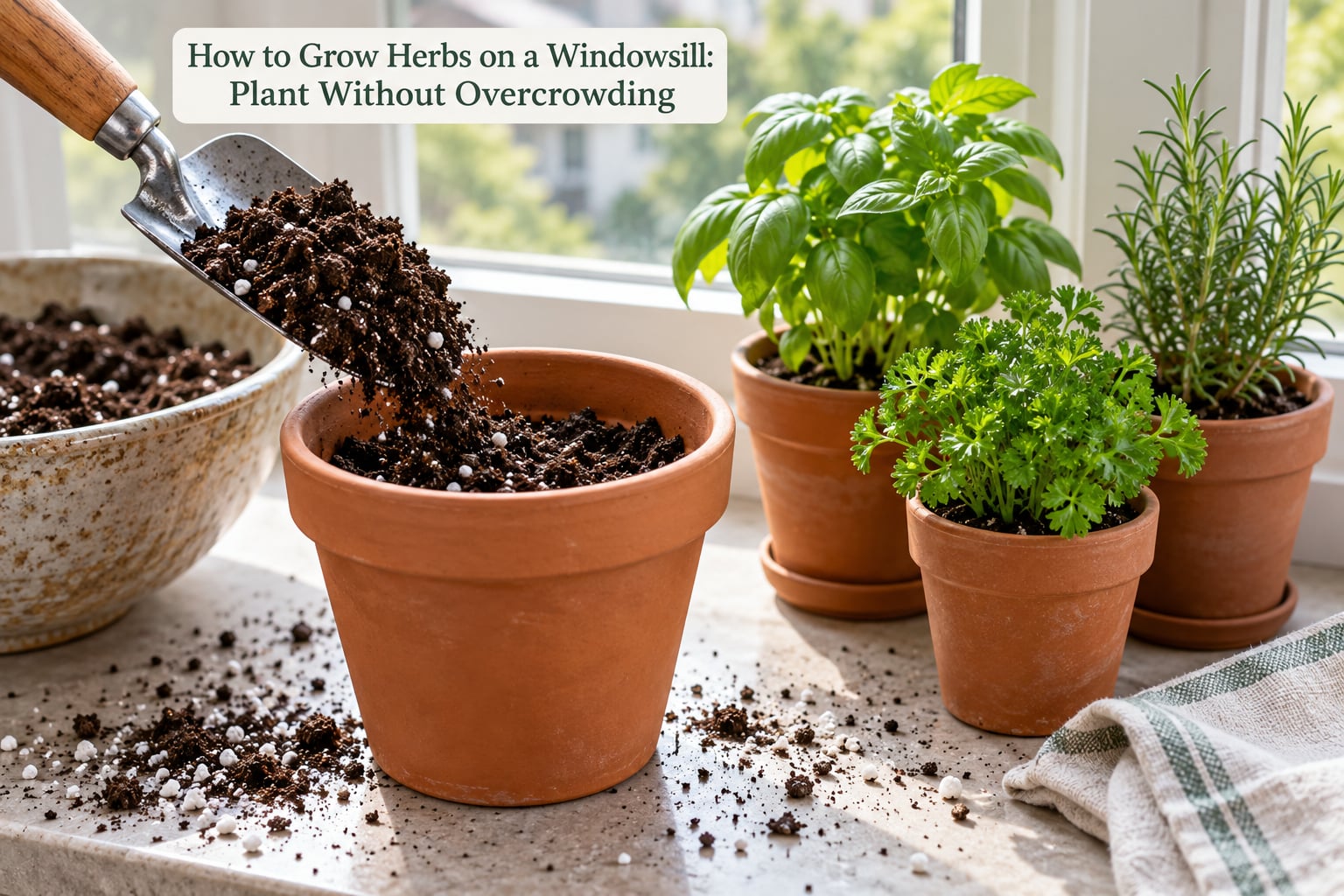
Crowding is the mistake that quietly ruins most windowsills. Roots compete for water, air stops moving between the leaves, and one pot that gets too big has to go.
Leave 4 to 6 inches between pots so air can pass between them, and give mint a pot entirely to itself. Mint spreads by runners and will take over a shared container within a month. That rule is the one people are told about most often and still ignore.
To plant a starter, set the pot on a saucer and fill it about two-thirds with mix. Ease the plant out of its nursery pot, tease the roots apart a little, and set the root ball so the top of it sits level with the rim. Anything deeper and the stem can rot; anything higher and the root ball dries out fast.
Backfill around the sides, press the soil down gently with your fingertips, and water until water runs out of the base. That first watering settles the soil around the roots, so skip it only if you are planting dry seed. Label the pot the same day, not when you can no longer remember which one was which.
How to Grow Herbs on a Windowsill: Give the Right Light
Most herbs want 4 to 6 hours of direct sunlight, and basil and the Mediterranean herbs prefer closer to six. Check your window rather than assuming. Watch the sill for a few minutes on a clear morning and note where the shadow of the window frame falls.
South and southwest windows give the most light. East and west windows work for parsley, chives, and mint. A north-facing window gets bright indirect light most of the day, which is enough for chives and parsley but thin for basil, which will stretch and go pale.
Turn your pots a quarter turn every week. Plants lean hard toward the glass and end up lopsided otherwise, and rotating even that little is often the difference between a bushy plant and one long stem reaching for the window.
When the window falls short, a grow light fixes it. A small full-spectrum LED in the 20 to 40 watt range, hung 12 to 16 inches above the foliage and left on 12 to 14 hours a day, delivers enough light for most herbs. Put it on a timer so the schedule stays consistent. People worry that the tiny light in a countertop garden kit is too weak, and most of those lights are indeed weak, so a separate lamp is the better investment.
How to Grow Herbs on a Windowsill: Water Correctly
Do not water on a schedule. Water on a test. Push a finger about an inch into the soil and if it feels dry all the way down, water; if it is cool and damp, wait another day. This is the single habit that separates a windowsill garden that lasts from one that ends in root rot.
When you do water, pour slowly and evenly until water runs out of the drainage hole, then empty the saucer after a few minutes. Standing water in the tray puts the root ball back into the soggy conditions you just drained it of.
The frequency changes with the season and the pot. A 4-inch pot on a warm south sill in July may need water twice a week. The same pot in a cool room in January may go a week between drinks. Smaller pots dry out faster, so judge each pot on its own rather than on the group.
Signs of overwatering are yellow leaves, a soft stem near the soil, and a sour smell. Signs of underwatering are crisp brown leaf edges, a wilted plant that perks up within an hour of a drink, and soil that has pulled away from the pot wall. Yellowing plus wet soil means too much water. Yellowing plus bone-dry soil means the opposite, which trips people up more than it should.
How to Grow Herbs on a Windowsill: Harvest for Cooking
Harvesting correctly is what turns a windowsill plant into a cut-and-come-again plant. Cut above a leaf node, where the leaf joins the stem, and new growth starts from that point. Cutting just below the top leaves leaves you with a bare stem and nothing to regrow from.
Take from the outside in. Choose the outermost and oldest stems, cut them at the base of the plant, and leave the center growth untouched. Never strip the lower stems bare, because those are the ones holding the plant up. And never remove more than about a third of a plant in a single sitting.
For basil and mint, pinch the tip just above a pair of leaves. That single pinch is what turns one basil stem into a bushy plant with six.
Harvest often and in small amounts, and always before the plant flowers. Once basil or cilantro bolts, the leaves turn bitter and cooking with them is a waste. Cut cilantro hard and often, and resow, because the window closes quickly on that one.
Common Mistakes
Nearly every windowsill herb failure comes down to one of six things. The symptom usually tells you which one before the plant dies.
| Symptom | Likely cause | Fix |
|---|---|---|
| Yellow leaves, soft stem | Overwatering or no drainage | Stop watering, check for a blocked hole, repot in dry mix |
| Long pale stems, wide leaf spacing | Not enough light | Move to a brighter sill or add a grow light 12 inches up |
| Sprouted, then stopped growing | Light or root room ran out | Thin seedlings, repot, and lengthen the light hours |
| Crisp brown leaf edges | Underwatering or dry indoor air | Water more often and group pots near a bowl of water |
| Plants wilting daily, recovering by evening | Heat from the glass or a hot radiator | Move the pots back from the window edge |
| Sticky leaves, tiny white insects | Aphids, whiteflies, or mealybugs | Wipe with soapy water and rinse weekly until clear |
| Roots circling the base, growth stalled | Root-bound pot | Move up one pot size and refresh the mix |
| One herb swallowing the pot | Mint or another spreader | Divide it into its own container |
Poor drainage is the mistake I would rank first. Water has to have somewhere to go, and a pot without a hole has nowhere. If you have used the same saucer for months without emptying it, that is your problem.
Insufficient light comes second, and it is the one people underestimate. A window that feels bright to you may deliver two hours of direct sun. Herbs stretch toward the light, weaken at the base, and eventually collapse. A cheap grow light fixes a weak window better than any other purchase.
Dry indoor air shows up in winter, when heating air takes the moisture out of a room and the crisp leaf edges appear on chives and parsley first. Grouping pots together, standing them near a bowl of water, or just moving them a foot back from the cold glass all help. Leave a few inches between the leaves and the pane, because night temperatures next to the glass drop well below what herbs like.
The last trap is the grocery store cup of herbs. Those plants often come in containers with no drainage and roots that have already circled the pot twice. They usually fade within a few weeks, and the fix is repotting them immediately into a real pot with a hole.
Frequently Asked Questions
How much sunlight do herbs need on a windowsill?
Most culinary herbs want 4 to 6 hours of direct sunlight a day, and basil, thyme, rosemary, and oregano prefer closer to six. South and southwest windows deliver the most. East and west windows suit parsley, chives, and mint. North-facing windows give bright indirect light, enough for chives and parsley but usually not for basil, which will stretch and pale without a grow light.
How often should I water herbs growing on a windowsill?
Check the soil instead of following a schedule. Push a finger about an inch down and water only when it feels dry all the way through. Pour slowly until water runs out of the drainage hole, then empty the saucer. Small pots on a warm sunny sill in summer may need water twice a week, while the same pot in a cool room in winter may go a week between drinks.
What is the best container for growing herbs indoors?
Any container with a drainage hole in the base, 6 inches wide and 4 to 6 inches deep, set on a saucer. One plant per pot gives each root system room and keeps air moving between the leaves. Skip cachepots and decorative pots with no hole, or drill them yourself. Thyme, rosemary, and sage want the deepest pots, while mint needs its own container because it spreads.
Can I grow herbs on a windowsill without direct sunlight?
Yes, for the tolerant herbs, with a caveat. Chives, parsley, and mint will manage on bright indirect light from a north or east window, though they grow slower and stay more compact. Basil, rosemary, thyme, and oregano need direct sun or a grow light to stay productive. A 20 to 40 watt full-spectrum LED set 12 to 16 inches above the foliage on a 12 to 14 hour timer makes almost any window work.
How long do herbs grown indoors on a windowsill last?
Most well-drained pots last a full season or longer, and perennial herbs like thyme, chives, mint, and rosemary can keep going for years if you divide and repot them annually. Annuals such as basil and cilantro are finished in one run and need reseeding. Replace the potting mix every spring, and divide a root-bound pot into two when you see roots circling the base.
Should I use potting soil or regular garden soil for windowsill herbs?
Use potting mix. Garden soil from a yard compacts inside a container, holds water too long, and can bring in weeds and pests. Potting mix is soilless and formulated to stay porous while still retaining enough moisture for roots. If your mix packs down within a few weeks, loosen it with a handful of perlite or pumice, and refresh it entirely each spring.
Conclusion
Four things decide whether your windowsill herb garden works: the brightest sill you have, a pot with a real drainage hole, three easy herbs to start with, and a finger test before every watering.
Start small and let the setup prove itself through a season before you add more pots. Once you know how quickly that particular sill dries out, expanding takes an afternoon.