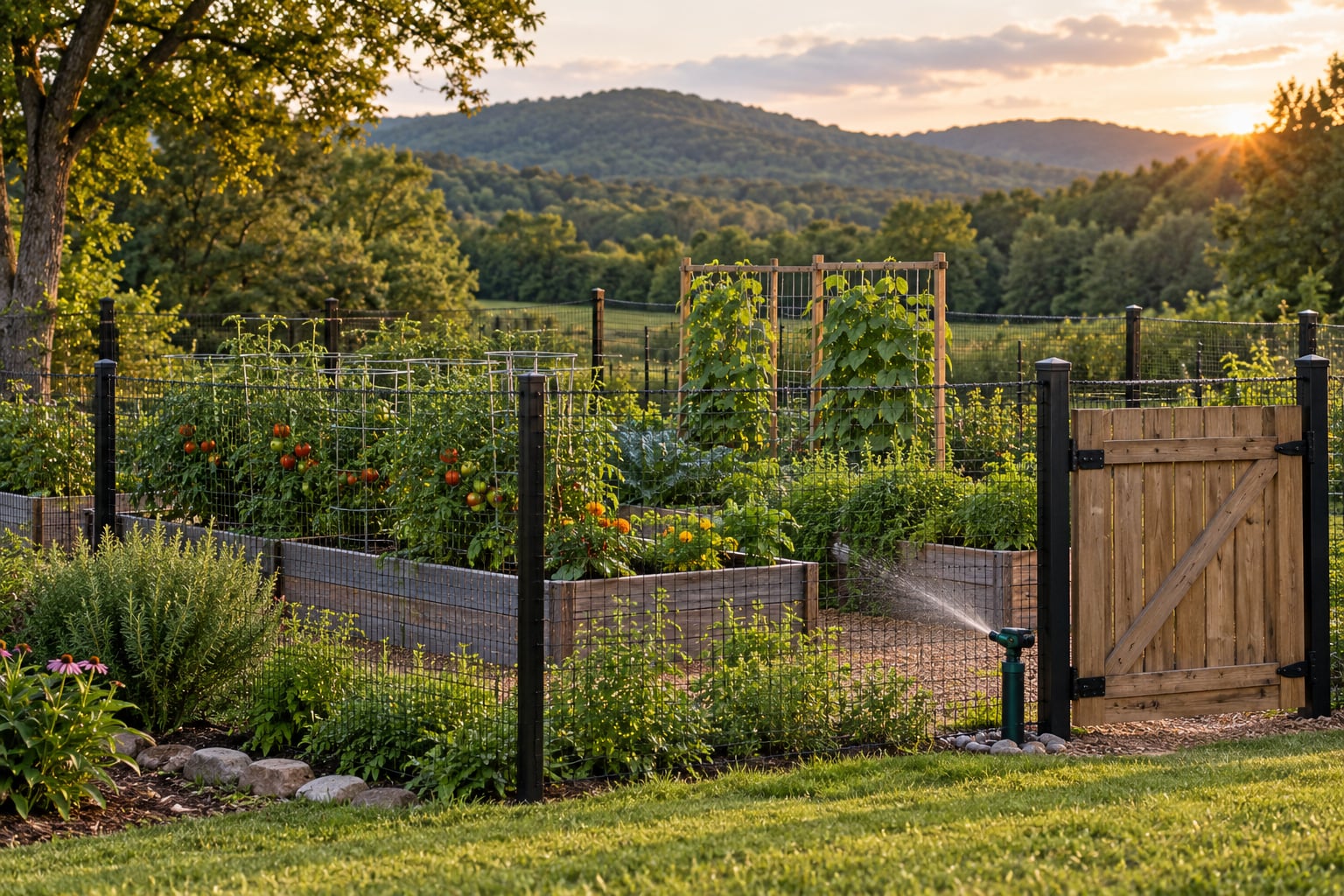
Deer are deterred most reliably by a physical barrier they cannot see through or easily jump, and the height most extension services recommend is 8 feet of mesh or netting, or about 6 feet of solid panel where deer have no room to build a running jump. Everything else you add — sprinklers, repellents, deer-resistant plants — is a backup that buys you time when the barrier gets a hole in it. That is the short answer to how to keep deer out of a vegetable garden: get the barrier right first, then layer the rest around it.
One deer will eat somewhere between 6 and 10 pounds of vegetation a day, and once a family finds a productive garden they come back nightly and bring others. A single bad night can take a season of tomatoes, beans and squash. I grew up in Appalachia where every garden plot had a fence around it for that reason, and the fence was never decorative.
The trouble is that most attempts fail for boring, fixable reasons: a fence too short, a gate left open, netting that sagged onto the ground by August, or a gallon of repellent that lost its punch in a week. Here is the way through it, in order.
Table of Contents
- What You Need to Keep Deer Out of a Vegetable Garden
- Step-by-Step: Protect the Garden in Layers
- 1. Inspect the Garden and Deer Activity Before You Buy Anything
- 2. Choose a Fence That Blocks Deer
- 3. Add a Second Layer of Protection for How to Keep Deer Out of a Vegetable Garden After Dark
- 4. Remove Attractants and Improve the Perimeter
- 5. Check, Adjust, and Maintain the Setup
- Common Mistakes
- Frequently Asked Questions
- What is the minimum fence height for keeping deer out of a vegetable garden?
- Will deer netting protect vegetables if it is only about 4 feet high?
- What is the safest deer deterrent for homes with children or dogs?
- How long do deer-repellent sprays or scent deterrents usually work?
- Can I use motion-activated sprinklers around edible crops?
- How can I protect a vegetable garden without installing a fence?
- Conclusion
What You Need to Keep Deer Out of a Vegetable Garden
Before you buy anything, work through this list. Most people discover halfway through a fence build that they are missing the one fastener type their ground requires.
- A tape measure and a sketch of your plot. Measure the actual perimeter, not the square footage. A 20 by 30 foot garden has 100 feet of edge, and corners cost extra.
- The barrier itself: 8-foot black polypropylene mesh, 6-foot solid panel, woven wire, or electric polywire. For raised beds under about 250 square feet, netting on a hoop frame does the same job over a far shorter run.
- Posts and fasteners: 6- to 8-foot steel T-posts or treated 1x2s, plus U-staples, cable ties, or landscape pins for pinning netting to the ground.
- One active deterrent: a motion-activated sprinkler, a solar path light, or a wind spinner. Pick one you can hear or see from the house so you know it is working.
- Repellents, if you use them: a putrescent egg product and a capsaicin product, so you can alternate rather than rely on a single scent.
- Deer-resistant planting stock for the border: rosemary, sage, lavender, thyme and ornamental alliums.
- A simple monitoring method: a notebook, a cheap trail camera, or both. You cannot fix a breach you do not know about.
If you rent, belong to an HOA, or have a very small budget, say so now and plan for the netting and deterrent route in Step 3 instead of a full perimeter fence.
Step-by-Step: Protect the Garden in Layers
1. Inspect the Garden and Deer Activity Before You Buy Anything
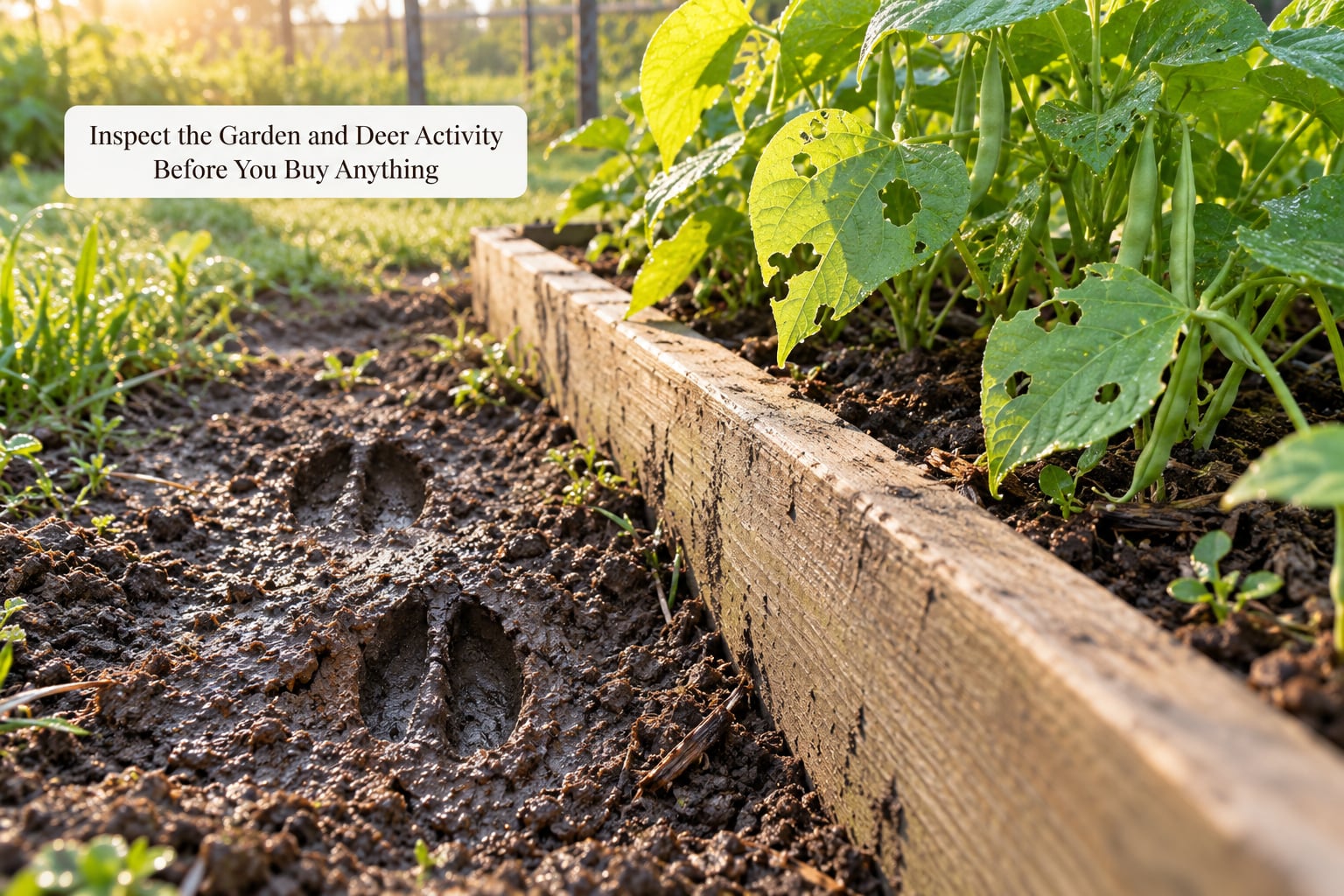
Check your beds at dawn and dusk, when deer feed and move. You are looking for two things: what they ate, and how they got in.
Browse damage has a signature. Deer tear leaves ragged and strip the tender tips off shoots, which is different from rabbits, which clip cleanly at ground level. Look for a browse line — a rough height of stripped new growth between about 2 and 5 feet — and for the cloven hoof prints that look like a split heart, often easiest to find in soft ground after rain. Pellets in a corner bed confirm residence rather than a passing visit.
Then trace the routes. Walk the boundary and note every gap: a leaning panel, an open gate, netting lying on the ground, a hedge or brush pile where the ground is soft. Those are your real perimeter problems, and a deer will exploit them over any stretch of perfect fence.
Keep a three-column record — date, bed or fence location, what you found. Three or four weeks of notes turns guesswork into a plan.
2. Choose a Fence That Blocks Deer
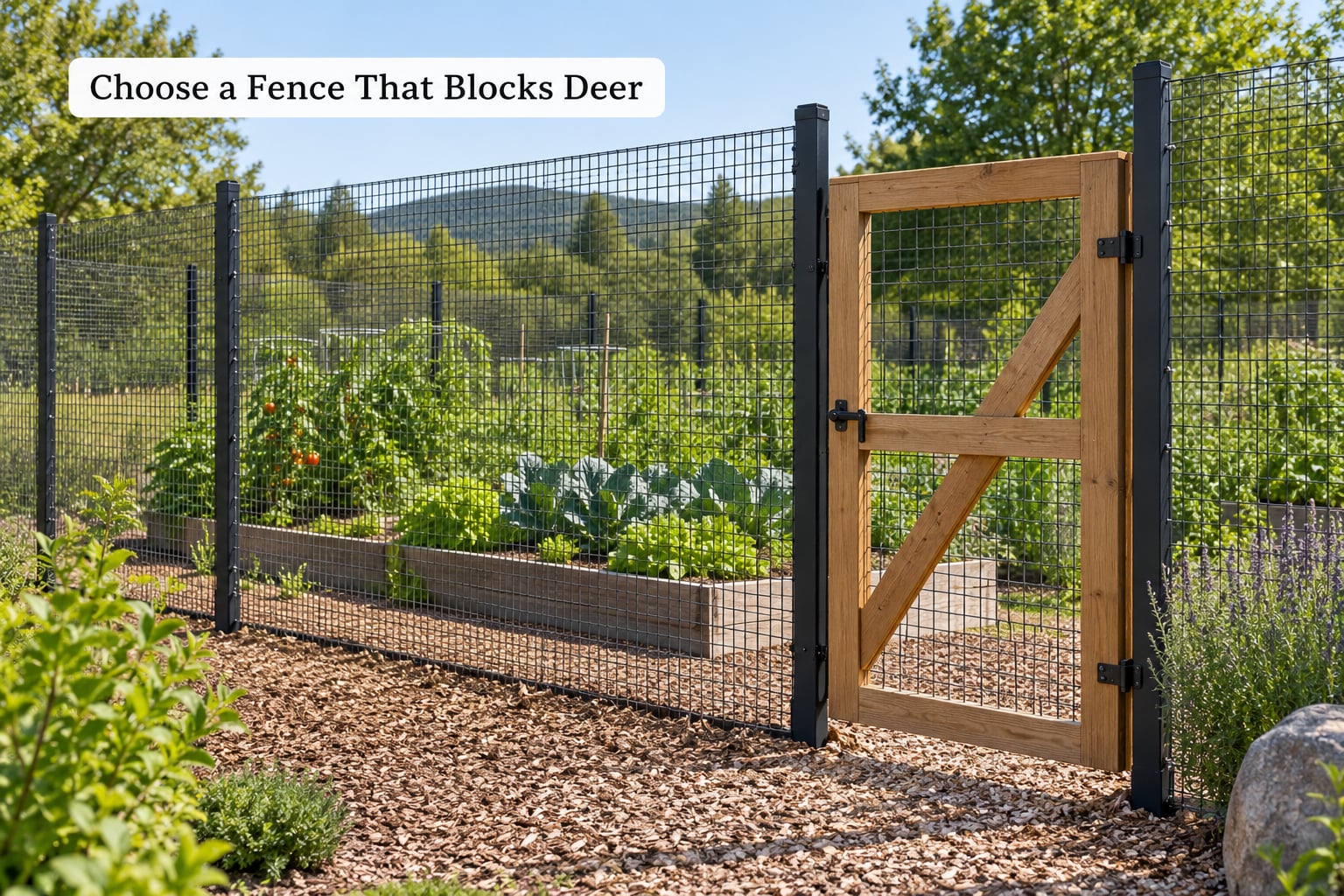
Height is the whole game. A white-tailed deer can clear a vertical jump of roughly 8 feet under good conditions and much more with a running start and a landing target, which is why 8 feet is the number extension services repeat. A 4-foot garden fence looks generous next to a bed of lettuce and gets jumped routinely once deer learn the route.
| Barrier | Effective height | Visibility | Best for |
|---|---|---|---|
| Black polypropylene mesh | 7 to 8 ft | Nearly invisible | Most vegetable gardens, long term |
| Solid panel fence | 6 ft | Opaque | Suburban yards with high pressure |
| Woven wire or chain link | 6 to 7 ft | Open grid | Existing fences, larger plots |
| Electric polywire on posts | 30 in to 48 in | Nearly invisible | Short-term pressure, low budget |
| Netting on hoop frames | 3 to 4 ft overhead | Invisible from a distance | Raised beds under 250 sq ft |
| Two fences, 3 to 5 ft apart | 4 ft each | Varies | Covering a long run for less height |
Two practical notes. First, tension matters more than most people expect: a slack fence or a sagging net loses its effectiveness because deer can push through a shape rather than a wall. Second, run the bottom of any mesh to the ground and pin it every few feet, because a low gap under a fence is a highway. For electric polywire, the well-documented training trick is to bait the wire with peanut butter on a cloth so deer test it and learn the shock association. Electric fencing carries real cautions — keep it clearly marked and away from where children play.
The double fence is the underrated option. Two 4-foot fences set 3 to 5 feet apart make the landing zone unpredictable, and many gardeners report good results for less material than one 8-foot run.
3. Add a Second Layer of Protection for How to Keep Deer Out of a Vegetable Garden After Dark
The barrier is the defense; the second layer is what happens when a deer finds the gap. Overlap covers are the simplest version: hoop frames or PVC bent over each bed, covered in bird netting or floating row cover and pinned at the base. It is unglamorous and it works on a small garden better than any spray.
Motion-activated sprinklers are the best-known backup. Most cover a 35- to 100-foot arc, and a sharp startle on a wet bed teaches a deer to associate that corner with a bad outcome. Position two of them so their arcs overlap, and test them monthly, since dead batteries are the single most common reason people think the method failed.
Repellents belong in the second layer too, and they work best rotated. Alternate a putrescent egg product with a capsaicin product every three to four weeks rather than reapplying the same one. USDA Wildlife Research Center work found that applying repellent to leaf surfaces, rather than painting a perimeter fence, does more to change browsing behavior. Keep anything you spray off edible crops, and follow the label.
Two things people underrate. A dog that is loose and outside at dawn and dusk is a genuine deterrent; a dog shut in a kennel is not. And if your whole street has vegetables, coordinate with your neighbors — community-wide fencing and repellent use takes pressure off every garden at once, which no single-property trick can do.
4. Remove Attractants and Improve the Perimeter
Your garden may be the reason deer are standing in your neighbor’s yard at all. Fallen fruit, compost piles, dog food left out, spilled birdseed, fresh manure and harvested produce piled by the fence all read as a buffet.
Move compost away from the plot, rake up windfall fruit the same day, sweep seed spills, and keep harvested vegetables indoors. Plant a border of strongly aromatic herbs and flowers — rosemary, sage, lavender, thyme, ornamental alliums — around the outer edge. Gardeners consistently describe these as a supplement, not a solution; deer eat around a border far more often than they avoid the whole garden.
5. Check, Adjust, and Maintain the Setup
A deer fence is a maintenance item, not an install-and-forget purchase. Walk the perimeter weekly: re-clip netting that has pulled loose, replace bent staples, pull vegetation off the mesh, and log any new breach.
Seasonal pressure sets the pace. Fawning in late spring and the rut in fall are the worst windows, with does and yearlings working new ground hard. Winter brings browsing pressure on trees and shrubs when the vegetables are gone, so protect young fruit trees and berry bushes with mesh sleeves rather than letting the fence go slack for the season.
Until you go a full season with no fresh browse damage, treat the garden as unprotected and keep checking.
Common Mistakes
Almost every failed deer fence I have seen comes down to one of these.
- Fencing too short. Under 6 feet of open mesh is an invitation. Fix: go to 7 to 8 feet, or add a solid panel to about 6 feet.
- Leaving the gate open. One unlocked gate undoes an entire season of fencing. Fix: add a spring or gravity latch, and check it every time you leave.
- Relying on scent deterrents alone. Castile soap shavings, coffee grounds, human hair and Irish Spring bars give most gardens a few days to a couple of weeks at best, then habituation sets in. Fix: treat them as one layer among several, and never as the barrier.
- Putting netting on the ground. A net that lies flat becomes a ramp and a highway. Fix: hoop it overhead or tension it taut and pin it continuously.
- Leaving attractants near the plot. Compost, birdseed and dropped fruit undo the work. Fix: relocate and clean up weekly.
- Installing in spring and forgetting. By late summer, clips are loose and the line has sagged. Fix: a 15-minute weekly walk.
- Hand-culling or trapping without checking the law. Deer and their handling fall under state, county and sometimes local rules. Fix: read your state wildlife agency guidance before any lethal or capture method, and prefer fencing and aversion devices.
A few habits that help: buy mesh that is rated for its height rather than the roll width, staple every 6 to 8 inches on the bottom rail, and photograph your finished perimeter from the garden side so you can compare it a month later. And be honest with yourself that nothing is completely deer-proof — the goal is a setup with enough layers that a breach costs a few bites instead of the whole bed.
Frequently Asked Questions
What is the minimum fence height for keeping deer out of a vegetable garden?
Most extension services treat 8 feet of mesh or netting as the reliable minimum for white-tailed deer, since they can jump roughly that high with a running start. A solid panel fence works at about 6 feet because deer cannot judge the landing. A 4-foot fence will only hold if you add a second fence 3 to 5 feet away or run netting overhead.
Will deer netting protect vegetables if it is only about 4 feet high?
On its own, rarely. Low netting works in two situations: stretched taut and pinned to the ground with no gap underneath, or mounted over hoop frames so it hangs above the bed and the deer cannot plant a foot on it. Nets that sit on the soil get walked over and pushed aside within days, especially once a few deer learn the route.
What is the safest deer deterrent for homes with children or dogs?
A physical barrier is the safest option, because nothing needs to be sprayed, plugged in or baited. Among active deterrents, motion-activated sprinklers are generally the least hazardous, though any device with a battery or a low-voltage charge needs to be placed where curious kids and dogs cannot reach it. Keep repellents, soaps and predator-urine products well away from edible crops and pet water bowls.
How long do deer-repellent sprays or scent deterrents usually work?
Expect days, not weeks. Most spray repellents lose much of their effect after rain or irrigation and are ignored after about a week of repeated exposure. Soaps, coffee grounds and human hair hold up for roughly two weeks at most. Reapplying every three or four days, and alternating between a putrescent egg product and a capsaicin product, works better than reapplying the same scent.
Can I use motion-activated sprinklers around edible crops?
Yes. Water is the safest active deterrent for food plots, and the spray does not leave a residue on plants. Set the unit so the arc covers the approach path rather than the bed itself, aim it away from walkways and gutters, and expect to replace batteries every few weeks. Test it monthly, because a dead battery is the most common reason people think the sprinkler failed.
How can I protect a vegetable garden without installing a fence?
You cannot keep deer out completely without a barrier, but you can reduce damage a long way. Hoop frames covered with bird netting over each bed is the strongest fence-free option, since it closes the beds instead of the yard. Add a motion sprinkler, move all attractants away, plant strongly aromatic borders, and put your most vulnerable crops — beans, lettuce, cabbage, tomatoes and berries — under cover while everything else grows unworried.
Conclusion
Start this week with the inspection: walk the perimeter at dusk, note every gap and every sign, and write it down. Then fix the single most likely entry point and put up a barrier sized to the pressure you are dealing with — 8 feet of mesh or 6 feet of solid panel for a garden that gets hit hard, hoop-frame netting over the beds if the plot is small.
Once the barrier is up, add one rotating deterrent, move the compost pile and any birdseed far away, and set a 15-minute weekly walk on the calendar. Combining a correctly sized barrier with a second layer and regular checks does more for how to keep deer out of a vegetable garden than any single product on the shelf, and it is the only approach that survives a wet August.