The whole job is one decision: bring something that was never a meat dish to begin with. A potato salad, a slaw, a chili, a sweet potato casserole or a fruit tray can go straight onto the buffet line with nobody asking a follow-up question, which is exactly how you handle how to bring a vegan dish to a family potluck without turning dinner into a debate.
Ask the host which slot is missing before you cook, travel with the dish cold or covered and hot, and put a small card on it naming the allergens. Planning takes about half an hour. The cooking depends on the dish.
Table of Contents
- What You Need
- Step-by-Step: How to Bring a Vegan Dish to a Family Potluck
- 1. Choose a Dish Everyone Can Eat
- 2. Make It Easy to Serve
- 3. Label the Ingredients Clearly
- 4. Pack It for the Trip
- 5. Reheat or Chill It Safely
- 6. Arrive Ready to Share
- Common Mistakes and Easy Fixes
- Tips for Choosing a Potluck-Friendly Vegan Dish
- Frequently Asked Questions
- Should I label my dish at a potluck?
- How much food should I bring to a potluck?
- What are the 9 most common food allergens to flag?
- How do I keep a vegan dish safe until everyone eats?
- What if a relative says they will not eat my vegan dish?
- How do I ask the host what to bring to a potluck?
- Conclusion
What You Need
Six things, and half of them cost nothing. Get these sorted before you start cooking, because the transport and labeling decisions shape which dish you pick.
- A dish in a familiar register. Something a table of mostly non-vegans already eats as comfort food. If you cannot name the meat version of it, you picked well.
- A transport vessel matched to the dish. A 9×13 casserole dish with a lid for hot bakes, a foil pan with a foil lid and a rimmed baking sheet for anything saucy, or a wide bowl with a tight-fitting lid for salads and dips.
- An insulated carrier or cooler bag and a couple of clean towels to set under the dish so nothing slides in the car.
- An index card or small tent card and a marker. One card. It does more work than the whole conversation you were dreading.
- A long-handled serving spoon or slotted fork that came from your kitchen. Never borrow one from the host’s house mid-meal.
- A temperature plan. Decide whether you are arriving hot or arriving cold and reheating, because that determines when you start cooking.
Step-by-Step: How to Bring a Vegan Dish to a Family Potluck
1. Choose a Dish Everyone Can Eat
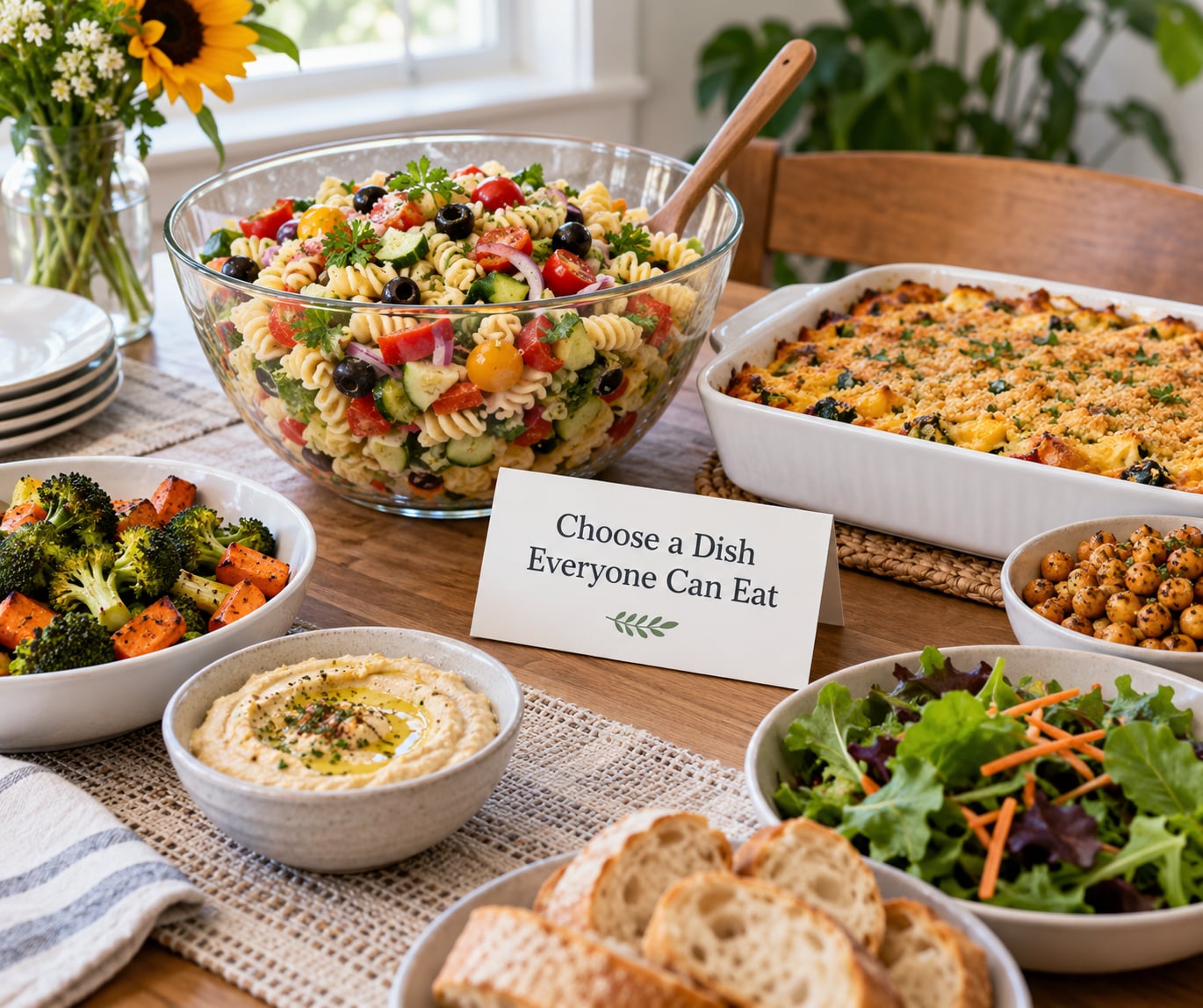
The safest choice is a dish that has no meat slot to fill. The most-upvoted answer on a long-running r/PlantBasedDiet thread asking this exact question was blunt about it: bring something very familiar that is already vegan, like a fruit salad, a tossed salad, or a simple vegetable side, rather than a vegan stand-in for something meaty.
That advice is the difference between a dish that gets eaten and a dish that gets interrogated. Skip the mock meats here even if you love them. A vegan version of a meat dish tells the table, out loud, that you are making a point, and the people most likely to argue are the ones who would have eaten a potato salad without thinking twice.
Also account for who is actually coming. If a relative has celiac disease, a nut allergy, or is avoiding soy, cross-check before you commit. Southern and Appalachian tables are already a step ahead here: beans and cornbread, slaw, potato salad, sweet potato casserole, cornbread, chili and a peach cobbler-style dessert were never meat dishes to begin with, so they carry none of the awkwardness at all.
2. Make It Easy to Serve
Pick a dish that survives a buffet line, which means self-contained and stable in one pan. A casserole needs only a spoon. A pasta salad or slaw needs a serving fork and a wide bowl. A layered dip or deviled-style appetizer needs a platter and a scoop.
Fewer last-minute steps means fewer things to forget. Dips and cold salads can be finished in your own kitchen, packed, and set out. Casseroles can be baked, cooled, covered, and reheated on arrival. Whatever you choose, cook it a day ahead if the recipe allows, since most plant-based potluck dishes are better after a night in the fridge.
3. Label the Ingredients Clearly
Yes, label it. Put a tent card or an index card taped to the dish edge, written big enough to read from the end of the table.
Write the format like this: the dish name, then Vegan, then the allergens present. Something close to Vegan Green Bean Casserole. Contains gluten (wheat) and soy. Three pieces of information and nobody has to ask you anything.
Flag what is actually in your dish rather than dumping the full nine-allergen list on every card. For plant-based cooking that usually means gluten or wheat, soy, peanuts and tree nuts, coconut, and mustard if you used a prepared dressing. If the dish is genuinely free of the big ones, say so plainly: Vegan, gluten-free, nut-free. Plenty of family tables have someone quietly skipping food they cannot eat, and a card is the only thing that tells them it is safe.
4. Pack It for the Trip
Cool the dish completely before you cover it. A lid pressed onto a hot dish traps condensation, and a warm casserole wrapped in foil arrives with a soft, soggy crust.
For a foil pan, crimp the foil over the top and set the pan inside a rimmed baking sheet so one bump in the car cannot put sauce on your upholstery. Wrap the sheet in towels and slide it onto a flat surface in the trunk or back seat, not on a sloped footwell.
Pack the serving spoon separately in a zip bag and tuck your dish labels in with it. For cold dishes, a cooler bag with an ice pack, or a frozen water bottle, buys you a long window. Chill salad dressings in their own jar and toss at the other end so nothing goes watery.
5. Reheat or Chill It Safely
Hot food should sit at 140F or hotter, and cold food at 40F or below, which is the usual USDA guidance for potluck and party service. Leave either one out longer than two hours and toss it; above 90F outside, that window shrinks to one hour.
The practical version: do not rely on a host’s oven being free when you walk in the door. Arrive with the dish already hot, or arrive with it cold and budget five minutes for a reheat.
- Casseroles and macaroni: cover loosely with foil, 350F, about 20 to 25 minutes, reheating to 165F or until steaming hot in the center. A splash of plant milk or broth keeps it from drying out.
- Sweet potato or potato casserole: cover, because uncovered edges go dry before the middle heats.
- Chili and soups: stovetop or microwave in a covered pot, stirring halfway. Loosen with a little broth if it thickened overnight.
- Slaw and potato salad: stay cold. Do not put them in the oven hoping to warm them; that only dulls the texture.
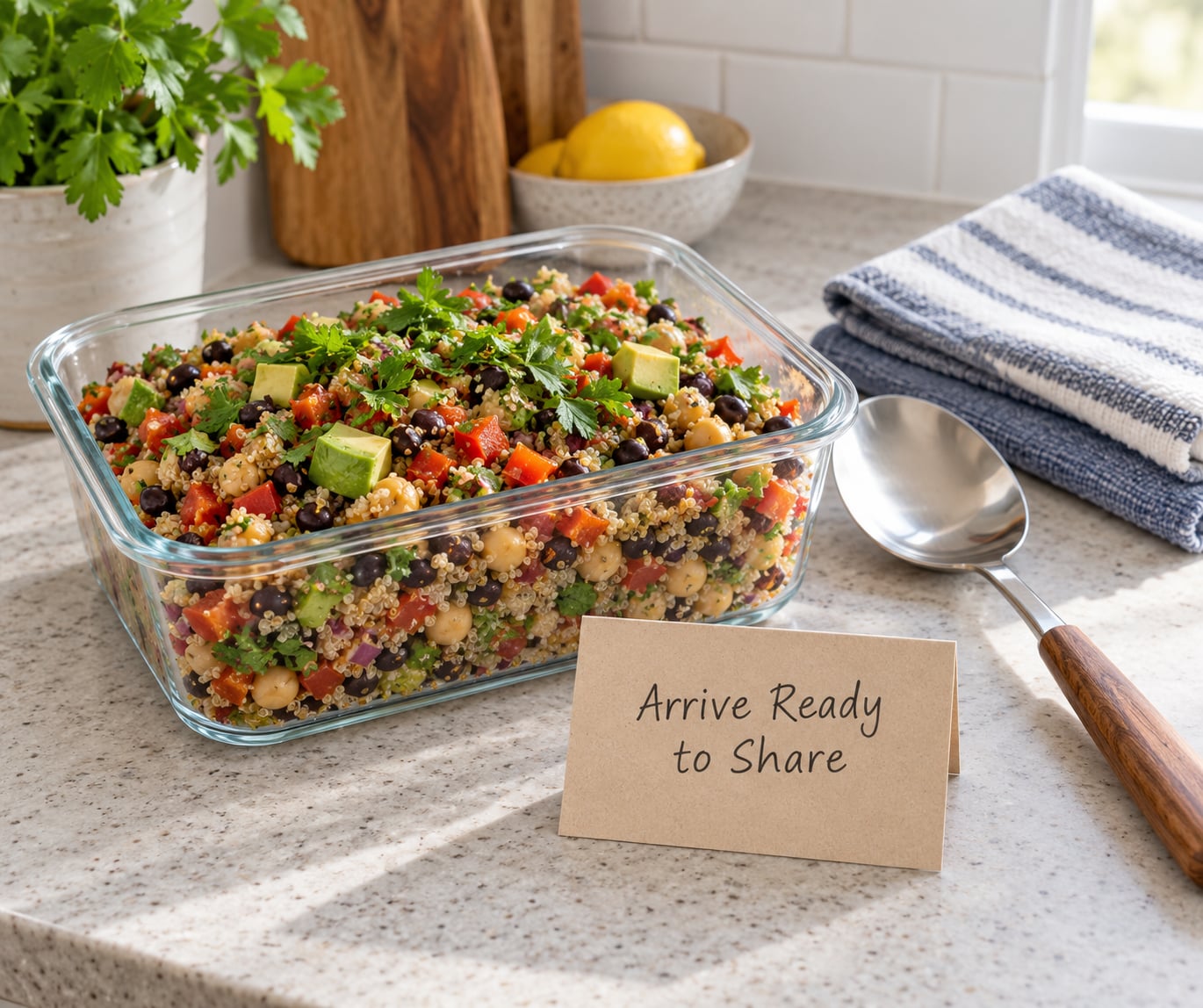
6. Arrive Ready to Share
Pull the host aside for fifteen seconds. Tell them what you brought, whether it needs reheating, and what is in it that matters for allergies. Offer to drop it anywhere on the table that helps, and ask if they want the serving spoon kept with it or returned to your bag.
Then say the quiet part out loud, once, and move on: it is vegan, and it is a good one. Do not narrate ingredients, do not explain your reasons to the table, and do not apologize. Someone who wants a plate will already be holding it.
Common Mistakes and Easy Fixes
Almost every bad potluck outcome traces back to one of these, and each has a simple correction.
- Bringing an unfamiliar dish to a conservative table. Fix: go with potato salad, slaw, fruit, or a casserole version of a dish everyone already eats. You can bring the adventurous one to a potluck with friends.
- Bringing the vegan version of a meat dish. Fix: swap it for something that never had a meat slot. This is the single most reliable rule here.
- Arriving with no label at all. Fix: one index card, three lines. It prevents the interrogation you were trying to avoid and protects anyone with an allergy.
- Transporting a hot dish in a lidded casserole. Fix: either cool and cover, or travel in a foil pan with a baking sheet under it. Condensation is what ruins the top.
- Bringing a dish that is hard to portion. Fix: choose a 9×13 pan over a bowl of loose salad, or a loaf pan you can cut cleanly. Nobody wants to ladle from the side.
- Forgetting the serving spoon. Fix: it lives in your bag until you leave. Borrowed utensils arrive dirty and never come back.
- Bringing too little or too much. Fix: plan on about half a cup of a side or a main per person, and one and a half portions per person for a main. Bring the leftovers home in a container you brought with you.
Tips for Choosing a Potluck-Friendly Vegan Dish
Once you have ruled out the mock meats, four practical questions narrow the field fast.
What slot is missing? Match the host’s request. Sweet and savory ask different things of a dish, and a well-made salad sent to a table with no sides on it is a wasted trip.
Does it hold for two hours? Soups, chili, and dips survive a buffet line. Salads wilt at the edges. Anything crisp turns soft, which is why a casserole, a potato salad, or a slaw is a safer bet than a fresh bread or a roasted vegetable tray.
Can you make it ahead? A day-old casserole is better than a rushed one. Most plant-based potluck dishes improve overnight, which means Friday-night cooking covers a Sunday table.
Can you reheat it in someone else’s kitchen? If it needs an oven, an unusual pan, or ten minutes of whisking, pick something else. Your dish should not be the reason the kitchen jams up.
Then lean on what already works. Beans and cornbread at a Sunday dinner is a tradition, not a statement. Sweet potato casserole with a pecan or oat topping belongs on every holiday table in the region and needs no defense. Slaw, potato salad, chili, cornbread, a green bean casserole, macaroni and cheese, a deviled-style chickpea appetizer, a fruit tray with a dip: each one is a potluck food first, and its plant-based credentials are simply not in dispute. Desserts work the same way. A cobbler, a fruit crisp, or a chocolate cake needs no label beyond allergens.
Plan the quantities. Six people need roughly a 9×13 pan of a side or two loaves of cornbread. Ten people need two pans or a large pot of chili. Fifteen or more means three pans, or one main plus a backup dish, because that scale is where a single casserole quietly runs out in the first ten minutes.
Frequently Asked Questions
Should I label my dish at a potluck?
Yes, and keep it short. A tent card or taped index card with the dish name, the word Vegan, and the allergens present answers every question before it gets asked. Common flags for plant-based cooking are gluten or wheat, soy, peanuts and tree nuts, and coconut. If a dish contains none of those, say so directly, because someone at the table may be avoiding them for a reason they would rather not explain.
How much food should I bring to a potluck?
For a side, plan about half a cup per person. For a main or a dessert, plan one and a half portions per person, because people eat more of the thing they came for. Six people need one 9×13 pan of a side; ten people need two; fifteen or more needs three, or a main plus a backup. Bring a container for leftovers so you are not leaving food or donating your pan.
What are the 9 most common food allergens to flag?
The nine major allergens are peanuts, tree nuts, milk, eggs, wheat, soy, fish, shellfish, and sesame. A vegan dish cannot contain milk or eggs, but it can easily contain wheat or gluten, soy sauce or tofu, nuts, coconut, and sesame in tahini or a seeded topping. Write only what is actually present, so the card stays readable. A label listing gluten-free and nut-free is more useful than one listing everything.
How do I keep a vegan dish safe until everyone eats?
USDA guidance for potluck service is to hold hot food at 140F or above and cold food at 40F or below, and to discard either one left out longer than two hours, or one hour when it is above 90F outside. In practice, that means hot dishes go straight onto a warming tray, cold dishes go back in a cooler or the fridge, and a casserole you are unsure about gets reheated to 165F before it hits the table.
What if a relative says they will not eat my vegan dish?
Let them. Pick a dish with a familiar flavor in the first place, put the label on it, and never defend it. The only thing worth saying once is that it is vegan and that there is plenty for anyone who wants it. On a mixed table, plant-based food that nobody identifies usually gets eaten quietly, and that is a better outcome than winning an argument you did not start.
How do I ask the host what to bring to a potluck?
Ask early and keep it easy to answer. Message the group or text the host directly: happy to bring something, anything you are still short on, and if nobody answers I will do a side. When you talk to the host, mention that what you are bringing is plant-based so they can factor it into the table, and offer to build your own plate from the sides if they would rather keep the menu as planned.
Conclusion
Start with the dish, not the container. Choose something that was plant-based before anyone decided eating meat was the point, text the host about the open slot, and let that dish travel cold or travel covered and hot depending on how it serves best.
Then handle the two minutes of work that make the rest easy: one card naming the allergens, and your own serving spoon in your own bag. Bringing a vegan dish to a family potluck is a recipe problem for about fifteen minutes and a logistics problem for about the same. Getting those two right in 2026 is what leaves you free to eat dinner instead of explaining dinner.