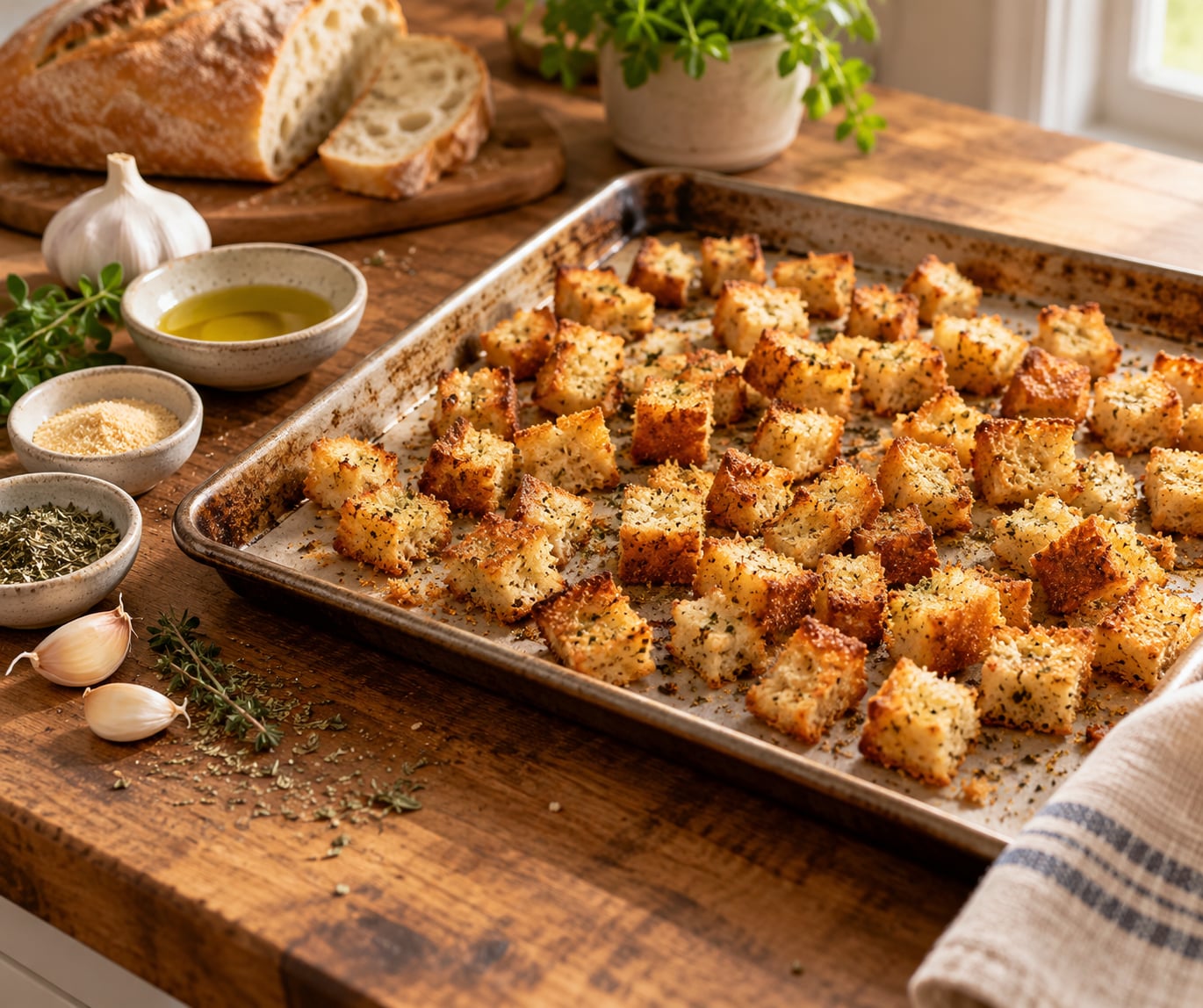
Bake croutons at 375°F for 10 to 20 minutes. Cube a day-old crusty loaf, toss the cubes with olive oil and seasoning, spread them on a rimmed baking sheet in a single layer, and toss once halfway through. From cutting board to cool crouton you are looking at about 30 minutes, most of it hands-off.
This is the method I use for salad toppers, soup garnishes, and casserole crusts, because it gives you control over two things store-bought croutons never let you set: the seasoning and how crisp the center ends up. A stale loaf that was heading for the trash turns into a batch of croutons that taste like they came from a good Italian place.
- Prep: 10 minutes
- Bake: 10 to 20 minutes at 375°F
- Total: about 30 minutes
- Yield: roughly 4 cups of croutons from a half loaf
- Best bread: sourdough, French bread, a baguette, or any crusty country loaf
Table of Contents
- What You Need
- How to make croutons in the oven starts with the right bread
- Step-by-Step: How to Make Croutons in the Oven
- Step 1: Cut the bread into even pieces
- Step 2: Season and coat the bread
- Step 3: Bake until golden and crisp
- Common Mistakes and How to Fix Them
- Frequently Asked Questions
- What’s the secret to crispy croutons?
- How long do croutons take at 350°F?
- Is it better to use butter or olive oil for croutons?
- Is it better to fry or bake croutons?
- How do you re-crisp soggy croutons?
- How do you keep homemade croutons crisp?
- Start With the Bread
What You Need
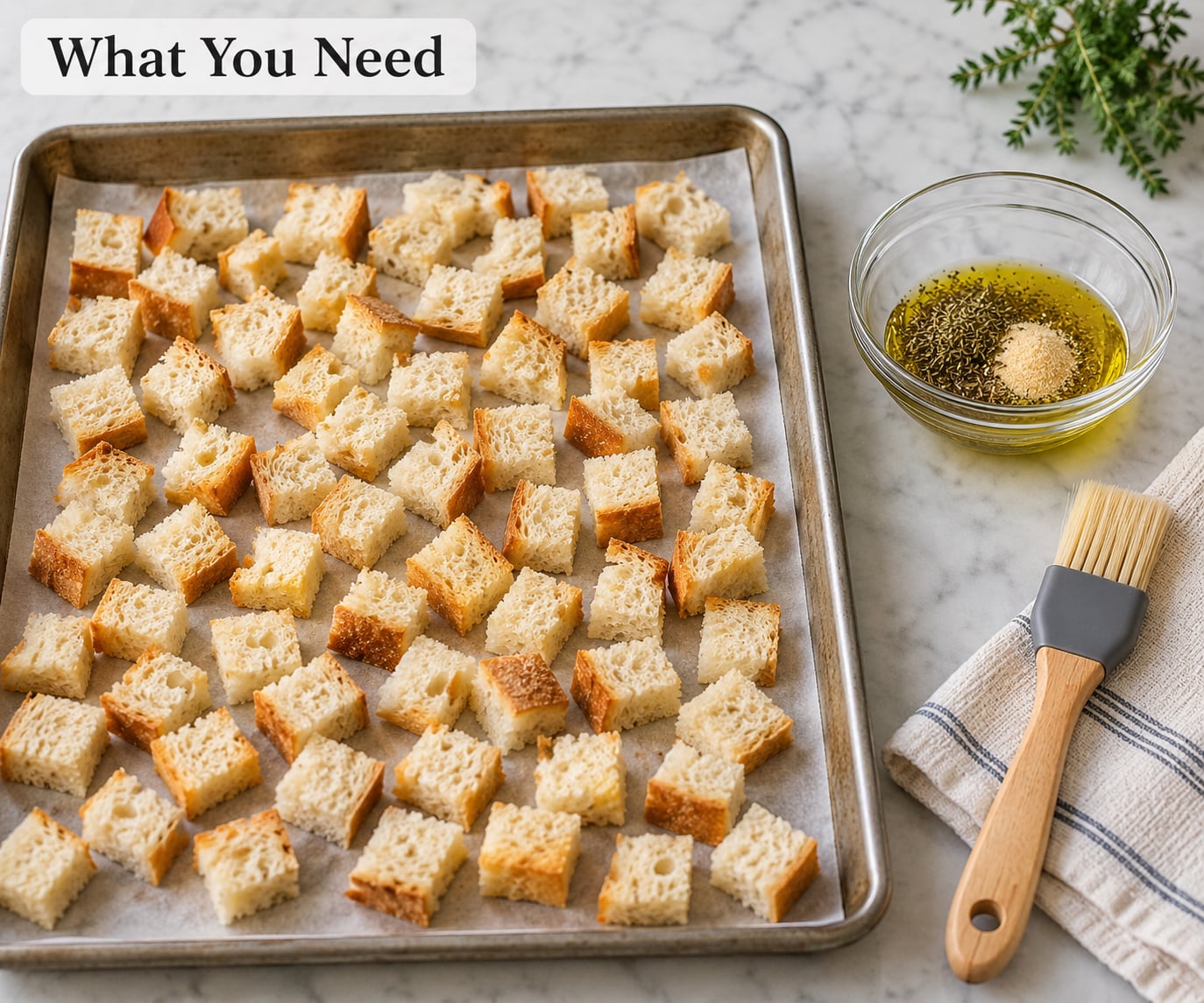
Croutons are a three-ingredient formula with a lot of variables, so the quality of what you start with matters more than any technique. Here is the short list.
- Bread: 4 to 6 cups of cubes or torn pieces, roughly 3/4 inch on a side. Day-old or day-two-old bread is ideal, and so is bread thawed from the freezer.
- Fat: 3 tablespoons olive oil for a neutral-crisp result, or 3 tablespoons melted butter for a richer, nuttier flavor.
- Seasonings: 1/2 teaspoon kosher salt or fine sea salt, 1/4 teaspoon black pepper, and 1/2 teaspoon garlic powder or Italian seasoning.
- Optional extras: 1 teaspoon za’atar, 1 teaspoon Herbes de Provence, 2 tablespoons grated Parmesan, 1/4 teaspoon red pepper flakes, or a tablespoon of chopped fresh rosemary.
- Equipment: one large rimmed baking sheet, a sheet of parchment paper or silicone mat, a large bowl, and a wide spatula.
The ratio that works almost every time is roughly 1 tablespoon of fat per cup of bread. More oil than that and the pieces fry in a puddle instead of roasting. Less than that and you get bread that dries out before it colors.
How to make croutons in the oven starts with the right bread
Stale bread is the single biggest upgrade, because a dry loaf has less moisture to give up and spends the oven time browning rather than steaming. Fresh bread can absolutely be used, though, so nothing is wasted if your loaf is still soft. Just cube it, spread it out to air for 20 to 30 minutes, or give it a few minutes in a low oven first.
Pick bread with an open crumb. Sourdough, French bread, ciabatta, a baguette, or a Pain de Campagne all give you airy croutons. Dense sandwich bread and enriched loaves like challah or pain de mie toast out faster and turn chewy in the middle, so pull those a few minutes earlier if you want the softer, chewier result some people prefer. Cooks on r/Cooking asked the same question about density years ago, and the answer was the same: open crumb, not a tight loaf.
Gluten-free bread works well, with one adjustment. GF loaves dry out and brown faster because there is less gluten structure holding water, so use the lower end of the timing window and check them at the 8-minute mark rather than waiting the full 20. Two tablespoons of olive oil also help a lot here, since fat is what replaces some of what gluten would have done.
Step-by-Step: How to Make Croutons in the Oven
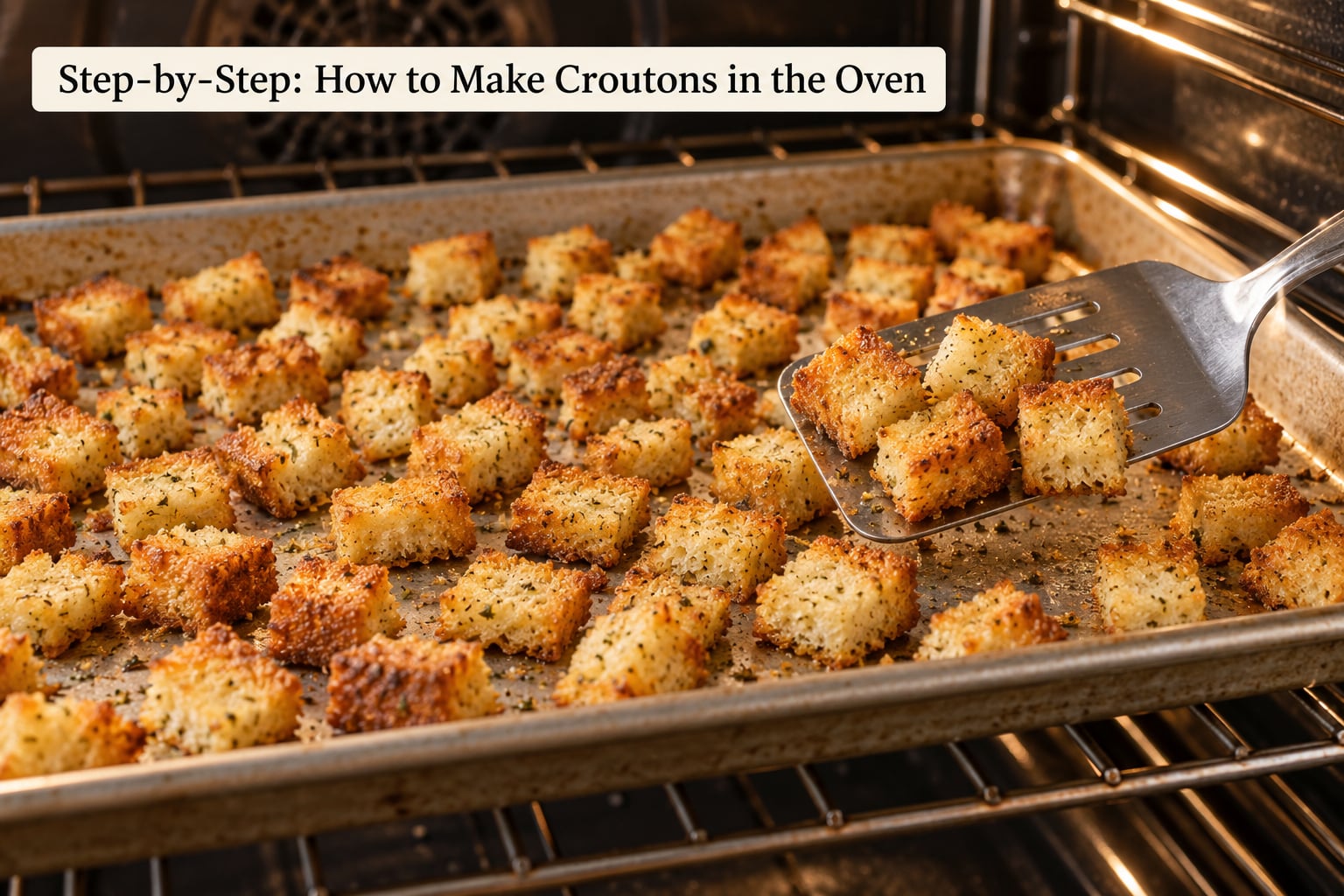
- Preheat the oven to 375°F (190°C) and put a rimmed baking sheet inside to heat up. A cold sheet slows the first minute of browning and leaves you with paler faces.
- Cut the bread into 3/4-inch cubes. Steadier cubes brown evenly and hold their shape. Torn pieces give you craggy croutons with more surface area, which means more crunch and more sauce-catching.
- Toss with the fat and seasonings. Warm the olive oil or melt the butter, pour it over the bread in the bowl, and toss with your fingers for a full minute so every face is coated. Add salt, pepper, and garlic powder, then toss again.
- Spread in a single layer. Tip the bowl onto the hot lined sheet and spread the cubes out so none of them touch. Leave an inch of empty metal between pieces. Crowding is the number one reason croutons come out chewy.
- Bake 10 to 20 minutes, tossing at the halfway mark. At the halfway point, pull the sheet out and flip the cubes with a spatula, then keep baking.
- Pull them when the outsides are golden brown and the centers still feel slightly soft. They keep crisping as they cool on the pan. Baking them to a hard crunch in the oven is how you end up with tooth-breakers on the counter.
That last point is the one most recipes skip. The King Arthur test kitchen spells it out: croutons continue to crisp as they cool, so baking until they are crunchy all the way through overshoots. You want golden outside, still slightly yielding in the middle when you pull the sheet.
Step 1: Cut the bread into even pieces
For salads, 3/4-inch cubes are the standard. Anything larger takes longer to crisp all the way and tends to burn on the corners before the center firms up. Anything smaller, around 1/2 inch, gets crisp inside and out and is the move if you are making croutons for a big batch of gazpacho where the pieces get soaked.
Slice a baguette lengthwise, lay the halves cut side down, then cut across into coins before cutting the coins into cubes. It is faster than trying to cube a round loaf in the air and gives you more even pieces. A torn heel or end piece with extra crust is fine, just put it in a minute early since crust takes longer to soften.
Step 2: Season and coat the bread
Warm the oil first. Room-temperature oil sits on the bread surface instead of soaking in, and you end up with shiny, under-seasoned pieces. Thirty seconds in a microwave or a minute in a small pan over low heat fixes that.
Toss in a large bowl rather than spooning oil over the sheet. The bowl lets you lift and turn every piece; the sheet leaves the flat faces bare. Toss for a full minute, scrape the bottom of the bowl, and toss again. That scraping step is what separates evenly coated croutons from patchy ones.
Step 3: Bake until golden and crisp
Because every oven runs a little different and every loaf holds a different amount of water, the timing table matters more than any single recipe line.
| Oven temperature | Bake time | What you get |
|---|---|---|
| 325°F (165°C) | 18 to 25 minutes | Paler, softer, chewy centers. The gentlest option for large pieces. |
| 350°F (175°C) | 15 to 20 minutes | Even, gentle browning. A safe choice for enriched and gluten-free breads. |
| 375°F (190°C) | 10 to 20 minutes | The all-around sweet spot. Crisp edges with a tender middle. |
| 400°F (205°C) | 7 to 12 minutes | Fastest and crispest, but watch it closely. Small cubes only. |
Set the sheet on a middle or lower-middle rack. Upper racks brown the tops fast while the bottoms stay pale, which is the classic burned-edges-and-chewy-center look. Keep it one layer and rotate the sheet front to back at the halfway point if your oven runs hot on one side.
You will know they are close. The smell changes around minute 8, from warm bread to something toasty, and the surface loses its wet sheen and goes matte and golden. Give one a squeeze with tongs. Still a little soft inside means pull it; hard and crackling means you went too far.
Common Mistakes and How to Fix Them
The croutons are soft and chewy. Almost always crowding. Pieces that touch trap steam and cook each other in a damp pocket instead of drying out. Two sheets, or two oven racks, will fix a batch that will not fit in a single layer. Cutting to 1/2 inch and adding one more tablespoon of oil also helps.
The edges burned while the centers stayed pale. Too much oil pooling in the bottom of the pan, or the rack too high. Toss the oil through the bread in the bowl instead of pouring it over the sheet, and move the pan down a rack. Turn the heat down 25°F for the rest of the bake if you already have color on the edges.
They are golden but hard as rocks. You baked them past done. Remember that they crisp as they cool, so pull them when the centers still give slightly. If you are catering to someone with sensitive teeth, cut the cubes smaller and stop at the first color change.
They are soggy a day later. Moisture, mostly. Cool them completely on the pan before you move them, and store them only once they are room temperature. Any warmth trapped in the container condenses, and the croutons steam themselves soft overnight. An airtight container helps; a paper bag lets them stay crisp for about a day, a sealed one for a week or two.
Browning is uneven. Cut cubes more uniform and spread them out more. Large crust-heavy chunks belong on their own sheet or come out early so they do not burn while the rest catch up.
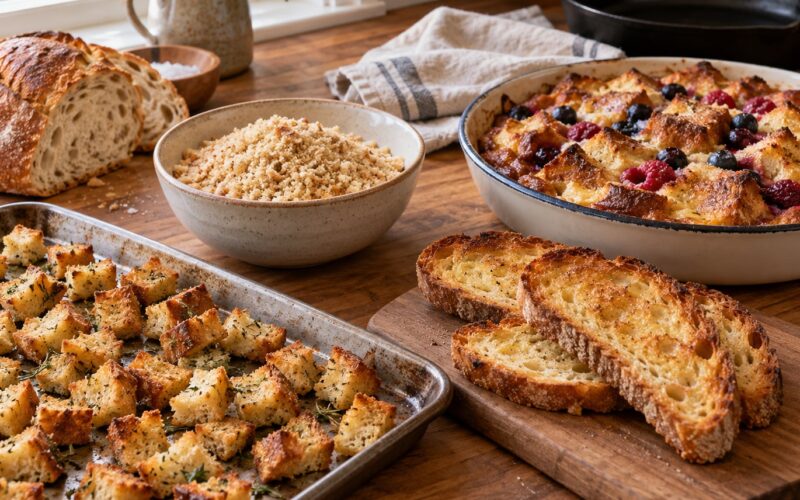
A few variations worth knowing. Garlic Parmesan croutons: add 2 tablespoons finely grated Parmesan after the oil toss and bake at 375°F, since cheese browns quickly. Za’atar and olive oil is a good middle-Eastern combination, especially over a lentil or cucumber salad. Cinnamon-sweet croutons swap the pepper for 1 teaspoon cinnamon and 2 tablespoons brown sugar, which is the version I like on a breakfast bread pudding.
For cornbread stuffing, skip bread entirely and cube day-old cornbread in the same way. Cornbread is already fairly dry and crumbly, so it needs less fat: two tablespoons of butter per 4 cups, and a slightly cooler oven at 350°F so the crumbs do not scorch before the stuffing browns.
Batch preparation works better than most recipes suggest. Croutons keep two weeks frozen in a sealed bag, well past the week or two they last at room temperature. Make a double batch on the weekend, cool it fully, freeze half, and you have salad toppings for two weeks without turning bread down. If you want crumbs rather than cubes, run the cooled pieces through a food processor or crush them with a rolling pin, and you have breadcrumbs for casseroles or a crust for baked pasta.
To bring back soft croutons, spread them on a baking sheet, mist very lightly with oil, and bake at 375°F for 5 to 7 minutes until they sound crisp again when you shake the pan. Same method for store-bought croutons that have gone cracker-flat in the bag.
A single air fryer does the same job faster for small batches: 350°F for 6 to 8 minutes, shaking the basket halfway. It browns unevenly like a toaster oven, so check more often, and keep the pieces under 1 inch so they do not hit the element.
Frequently Asked Questions
What’s the secret to crispy croutons?
Coating every surface with oil or melted butter, spacing the cubes so none of them touch, and tossing them halfway through the bake. Fat is what browns instead of drying out, and space is what lets moisture escape as steam. Pull them while the centers still feel slightly soft, since they finish crisping on the pan.
How long do croutons take at 350°F?
About 15 to 20 minutes at 350°F for 3/4-inch cubes, starting to check at 12 minutes. The lower temperature browns more gently, so it is the better choice for enriched breads like challah and for gluten-free bread, both of which dry out quickly at higher heat. Toss at the halfway mark for even color.
Is it better to use butter or olive oil for croutons?
Olive oil gives a cleaner, crisper result and a longer shelf life, often a couple of weeks in an airtight container. Melted butter adds a richer, nuttier flavor that browns beautifully, but those croutons stale faster and are usually best within a few days. A blend of the two is a good compromise for a salad topping.
Is it better to fry or bake croutons?
Baking uses less oil, leaves the crumb tender instead of dense, and is easier to scale to a big batch. Frying produces a crunchier shell but soaks the center with fat and dries the bread out faster. For a crisp outside and a tender middle, baking at 375°F wins, and an air fryer at 350°F gets close in about eight minutes.
How do you re-crisp soggy croutons?
Spread them in a single layer on a baking sheet and bake at 375°F for 5 to 7 minutes, shaking the pan halfway through. They are done when they sound crisp again when you shake the sheet. This also revives cracker-flat store-bought croutons. The basket of an air fryer does the same job in about 3 minutes.
How do you keep homemade croutons crisp?
Cool them completely on the baking sheet before storing, then move them to an airtight container. Any residual warmth creates condensation inside the container, which steams the croutons soft overnight. For longer storage, freeze them in a sealed bag for up to two weeks and let them sit at room temperature for 15 minutes before serving.
Start With the Bread
Pick up whatever loaf is closest to going stale, cube it at about 3/4 inch, toss it with roughly a tablespoon of olive oil per cup plus salt and garlic powder, and bake at 375°F for 10 to 20 minutes. Spread it out, do not crowd it, toss once, and pull it while the centers are still a touch soft. That is the whole method behind how to make croutons in the oven, and once you have it down you can swap the seasonings instead of relearning anything.