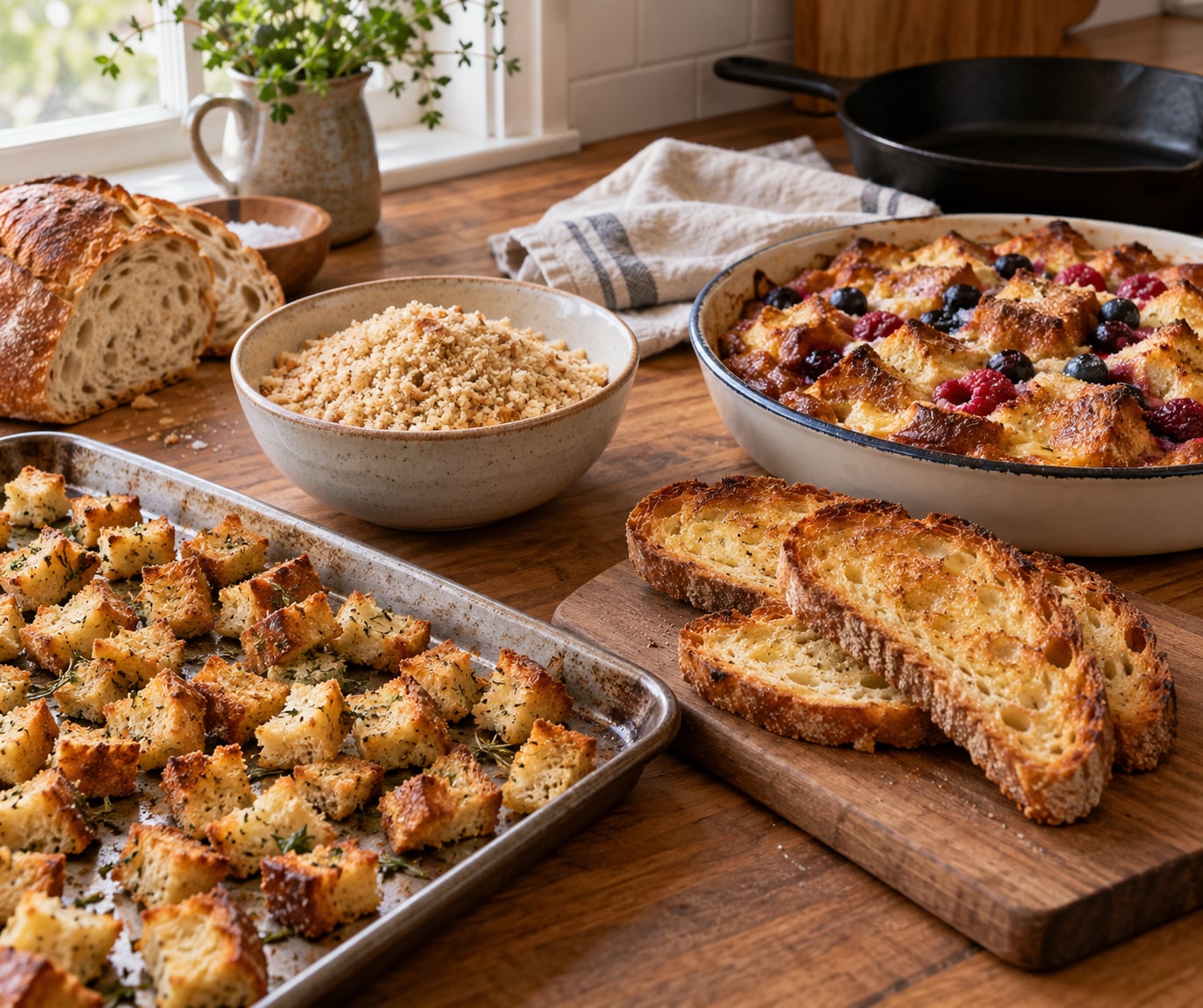
Stale bread splits into two jobs: revive it so it eats like bread again, or repurpose it into something that wants crumbs, cubes, or a soak. To revive, dampen the crust and heat it hard: 450°F for about 10 minutes, or 300°F wrapped in foil for 15 to 20. To repurpose, bake cubes at 350°F for 7 to 10 minutes, or pulse bread to crumbs and dry them at 300°F for about 15 minutes. Here are ten ways to use up stale bread, from breakfast to dessert.
Worth knowing why it happens: bread goes stale when the starch in the crumb loses water and the starch granules recrystallize into a rigid structure. The crumb dries and firms up while staying perfectly edible. That firmer crumb is exactly what you want in a meatball binder or a panzanella, because it holds its shape instead of dissolving.
In our kitchens nothing wasted is a household rule, not a slogan. Half a loaf left over on the counter gets used the same night. These ten ideas are the ones we actually reach for.
Table of Contents
- How to Use Up Stale Bread at a Glance
- 1. Make Crispy Bread Crumbs
- Dry the bread first, then blitz it
- Where crumbs do the most work
- 2. Turn Stale Bread into French Toast
- Soak time is the whole trick
- 3. Bake a Savory Bread Pudding
- Keep it moist without turning it to pudding
- 4. Make Stale Bread into Stuffing
- Wet breadcrumbs, dry center
- 5. Create Crispy Bread Bowls
- 6. Add Stale Bread to Soup or Stew
- Add bread late, stir often
- 7. Make Stale Bread Croutons
- 8. Blend Stale Bread into a Smoothie
- 9. Use Stale Bread in a Casserole
- Use crumbs as a binder, too
- 10. Bake a Bread Pudding with Fruit
- Frequently Asked Questions
- Can you eat bread that is only stale?
- How stale is too stale to use?
- What is the best way to soften stale bread before using it?
- Can stale gluten-free bread be used in these recipes?
- How should I store stale bread until I use it?
- What can I do with a very small amount of stale bread?
How to Use Up Stale Bread at a Glance
| Idea | Best for | Time | Result |
|---|---|---|---|
| 1. Crispy bread crumbs | Coating casseroles, quiche, pie crusts, vegetables | 35 min, mostly oven | Easy, crisp, freezes well |
| 2. French toast | A slow breakfast for a few | 20 min | Easy, soaks up custard |
| 3. Savory bread pudding | Dinner centerpiece, vegetarian main | 1 hr | Moderate, feeds a crowd |
| 4. Stuffing | Thanksgiving and any roast dinner | 1 hr 15 min | Moderate, holiday staple |
| 5. Bread bowls | Soup, chili, grain bowls | 30 min | Easy, editable after baking |
| 6. Soup and stew thickener | Gazpacho, ribollita, squash soup | 40 min | Easy, one pot |
| 7. Croutons | Salads, soups, snack mixes | 15 min | Easy, best on day one |
| 8. Smoothie base | A fiber and body boost | 5 min | Easy, only if bread is soft-ish |
| 9. Casserole layer | Vegetable, bean, pasta bakes | 50 min | Easy, forgiving |
| 10. Sweet bread pudding | Dessert with fruit | 45 min | Easy, forgiving |
1. Make Crispy Bread Crumbs
This is the one to do first, because crumbs are the safety net for every other idea on this list. Stale bread blitzes into crumbs better than fresh bread, which turns to paste in the food processor.
Dry the bread first, then blitz it
Bake the loaf or the loose slices at 300°F until the crumb is bone dry, about 10 to 15 minutes. Let it cool, tear it into chunks, then pulse in a food processor until you get a mix of coarse crumbs and a few finer ones. Keep pulsing and you will hit flour and then gum in a food processor, which is the one way to ruin them.
Spread the crumbs on a baking sheet and bake at 300°F for about 15 minutes, stirring twice, until they are dry to the touch and pale gold.
Where crumbs do the most work
Press them into the bottom of a quiche or a savory pie, roll eggplant or zucchini slices in them before baking, and scatter them over a vegetable casserole in the last ten minutes. They also make a decent top for a green bean or squash casserole that needs crunch.
If you are not using them within a week, freeze them in single-use portions in a freezer bag. I keep one bag of plain crumbs and one with Italian seasoning mixed in, which covers most of what I cook.
2. Turn Stale Bread into French Toast
Stale bread works well for French toast, and honestly it beats a fresh loaf because it drinks up the custard instead of leaving a soggy center. Slice the loaf thick, a full inch if you can, and let it sit out five minutes so it is not rock-hard.
Soak time is the whole trick
Beat three eggs with a cup of milk, a spoon of sugar, and vanilla for a standard four slices. Dip each slice for 20 to 30 seconds per side. Long soaking is the mistake; a slice that soaks for a full minute will fall apart in the pan.
Cook in a buttered skillet over medium heat, three to four minutes per side, until the outside is firm and the middle has lost its raw sheen. To go plant-based, use a block-style milk blended with a flax or chia egg replacer and let it sit five minutes to thicken. Keep the heat at medium-low; a hot pan scorches the egg before the middle sets.
3. Bake a Savory Bread Pudding
Think of it as a custard you eat with a fork. Cubes of stale bread go in the dish first, then eggs, stock, cheese, and whatever vegetables you have, and the whole thing bakes into a sliceable main dish.
Keep it moist without turning it to pudding
For a 9-inch square baking dish, soak about 6 cups of cubed bread with 3 eggs, 3 cups of stock or plant milk, 1 cup of grated cheese, and a chopped onion. Let it stand 20 minutes so the bread absorbs without dissolving, then add 2 cups of cooked vegetables and a handful of chopped herbs.
Bake at 350°F for 45 to 55 minutes, until the center is set and the top is browned. If you push dairy and eggs to the top and add raw chicken or sausage, cook to an internal temperature of 165°F (74°C) before serving. Let it rest 10 minutes so it holds together when you cut it.
4. Make Stale Bread into Stuffing
Cornbread dressing is the version we make every Thanksgiving, and day-old bread works because you want it drier than fresh to begin with. The trick is that stuffing goes in the pan wet and stays moist through the bake, not from the bread but from the stock and the butter.
Wet breadcrumbs, dry center
Cube the bread and let it sit uncovered for an hour so the surface dries. Melt butter in a skillet, soften diced onion and chopped celery, and stir in the bread. Add chopped apples, a cup of chicken or vegetable stock, and thyme, sage, and black pepper. Mix with your hands until every cube is damp but no liquid pools at the bottom.
Loosely fill a buttered baking dish and cover with foil for 20 minutes at 350°F. Pull the foil off and bake another 25 to 30 minutes until the top is crisp. Keep in mind a stuffed cavity must reach 165°F (74°C), so check with a thermometer rather than the color of the top.
5. Create Crispy Bread Bowls
This is the most fun one to hand to guests. You cannot really bake bread into a bowl shape from scratch, but you can make a wide, sturdy shell out of a loaf by soaking and molding it.
Mix a cup of stale bread cubes with just enough water to bind them, press into a greased oven-safe bowl or ramekin with the bottom flattened, and invert onto a lined sheet pan. Bake at 350°F for 25 to 30 minutes until the shell is dry and firm all the way through. Test the base with a knife; if it still gives, give it five more minutes.
Fill with soup, chili, curly kale with white beans, or a warm grain salad. Warn people the shell gets softer as it sits, so serve the first pass right away or hand out small bowls rather than one big one.
6. Add Stale Bread to Soup or Stew
Torn bread does two jobs in a pot: it thickens and it adds body. Ribollita, a Tuscan bread and bean stew, exists precisely because old bread went into the pot with the cannellini beans and the leftover cabbage.
Add bread late, stir often
For a soup that serves six, tear three thick slices into rough pieces and simmer them in the finished soup for the last 15 to 20 minutes. Stir often. The bread will fall apart and thicken the broth, and by the end it should be soft but still identifiable.
If you want a smooth gazpacho or a silky roasted squash soup, do the opposite: toast the bread dry at 300°F for 10 minutes, soak it in the cucumber or squash for an hour, then blend it with the liquid and strain for a smooth texture. Add bread early to a long-simmered stew only if you want it to disappear entirely, which is a different dish but still a good one.
7. Make Stale Bread Croutons
Croutons are how to use up stale bread at its cheapest: a third of a loaf makes a big bowl of them, and stale cubes are already part of the way there. Cut the loaf into cubes about the size of a sugar cube, or tear larger pieces if you want a rustic salad top.
Toss with olive oil, salt, and pepper, or with garlic powder and dried herbs for a soup crouton, or with cinnamon and brown sugar for a dessert one. Spread on a sheet pan so nothing touches, and bake at 350°F for 7 to 10 minutes, stirring at the halfway mark, until the edges are deep gold and the centers are dry.
They crisp best on the day they are baked. If you are making them ahead, cool them completely on the pan, then store airtight so they do not steam themselves soft. Two-day-old croutons are a fine sprinkle over a salad, but not a good crunch on its own.
8. Blend Stale Bread into a Smoothie
This only works when the bread is slightly firm rather than hard. If the slice bends without cracking, it blends; if it snaps, you will get sandy grit at the bottom of the glass.
Tear off a quarter of a slice with no crust, add a cup of liquid, and blend for 30 seconds. The bread disappears and adds real body plus a few grams of fiber, which helps a fruit-only smoothie actually fill you up. Apple and banana, with cinnamon and a spoon of peanut butter, is the combination we make most.
Avoid strong coffee, dark chocolate, or tomato here; the bread dulls them. And skip this one if the loaf is gluten-free bread baked with psyllium or flax, which blends in a way most people find chalky.
9. Use Stale Bread in a Casserole
A layer of bread cubes at the bottom of a baking dish catches the juices and keeps the bottom from going soggy, which is the standard problem with a vegetable or pasta casserole.
Use crumbs as a binder, too
Toast cubes at 300°F for 10 minutes, then layer a third of them in the dish under the filling. Cover the top with the rest, drizzle with a little oil, and bake at 350°F until the filling reaches 165°F (74°C) for dishes with raw poultry, or 160°F (71°C) for ground meat.
The other direction is savory bread pudding, which is item 3. Between the two, stale bread can be the floor, the roof, or the whole dish.
10. Bake a Bread Pudding with Fruit
A sweet bread pudding is the easiest dessert on this list, and stale bread is the correct texture for it. The bread needs to hold together after soaking but still drink the custard through.
For six servings, tear 6 cups of stale bread into chunks and let them sit in 3 beaten eggs, 3 cups of milk, half a cup of brown sugar, and a teaspoon of vanilla for 20 minutes. Add 3 apples diced small, a handful of raisins or dried cranberries, a teaspoon of cinnamon, and a quarter teaspoon of nutmeg.
Bake at 350°F for 40 to 45 minutes until the top is brown and the center springs back when you press it lightly. Dried persimmons or a spoon of apple butter stirred into the custard make a good fall version. Serve it warm with plain yogurt or a little cream.
Frequently Asked Questions
Can you eat bread that is only stale?
Yes. Staling is a physical change, not spoilage. The bread has lost moisture and the starch has firmed up, but there are no microorganisms involved, so it is safe as long as it is free of mold and off odors. The danger zone for bread is mold, and slices touching visible mold should be discarded rather than trimmed.
How stale is too stale to use?
Rock-hard bread is still usable, but it needs a different approach than merely firm bread. Hard slices need a longer soak in custard or a longer bake, and they are better in crumbs and croutons. If a slice is so hard you cannot dent it with a knife, skip French toast and go straight to crumbs. Firm is a problem to manage; hard is not a reason to throw food out.
What is the best way to soften stale bread before using it?
Run the loaf or slice briefly under cool water, dampening the crust without soaking the crumb, then heat it immediately. Ten seconds in the microwave wrapped in a damp paper towel also works. Just note that reviving only works one time. Once bread is baked back to soft, it will go stale again faster, so eat it that day or turn it into crumbs.
Can stale gluten-free bread be used in these recipes?
Yes, with two adjustments. Gluten-free bread dries out faster, so toast it before blending or pulsing, and expect it to crumble more when cubed. Skip the smoothie idea, since gluten-free loaves with psyllium or flax blend chalky. Crumbs, croutons, and bread bowls are the most reliable uses because they depend on browning rather than on the crumb structure.
How should I store stale bread until I use it?
Freeze it. Slice the loaf, lay the slices flat on a tray to freeze solid, then bag them and keep them in the freezer. Stale bread freezes perfectly well, and when you need it, thaw it in the pan or toast it straight from frozen. Never refrigerate bread, which speeds up staling, and do not store it in a sealed plastic bag at room temperature for more than a day or two.
What can I do with a very small amount of stale bread?
Collect the heel, the crust ends, and any torn pieces in the freezer in a bag labeled for crumbs. When the bag gets full, bake it at 300°F for 15 minutes, cool it, pulse it, and you have a batch of crumbs ready for coating vegetables or pressing into a quiche crust. Small amounts also make excellent croutons at roughly the same effort as a full loaf.
Start with the crumbs. Dry the loaf at 300°F for 10 to 15 minutes, pulse it, and you have an ingredient that will carry you through croutons, casseroles, and coatings for the next two weeks, which takes the pressure off using up everything else at once.