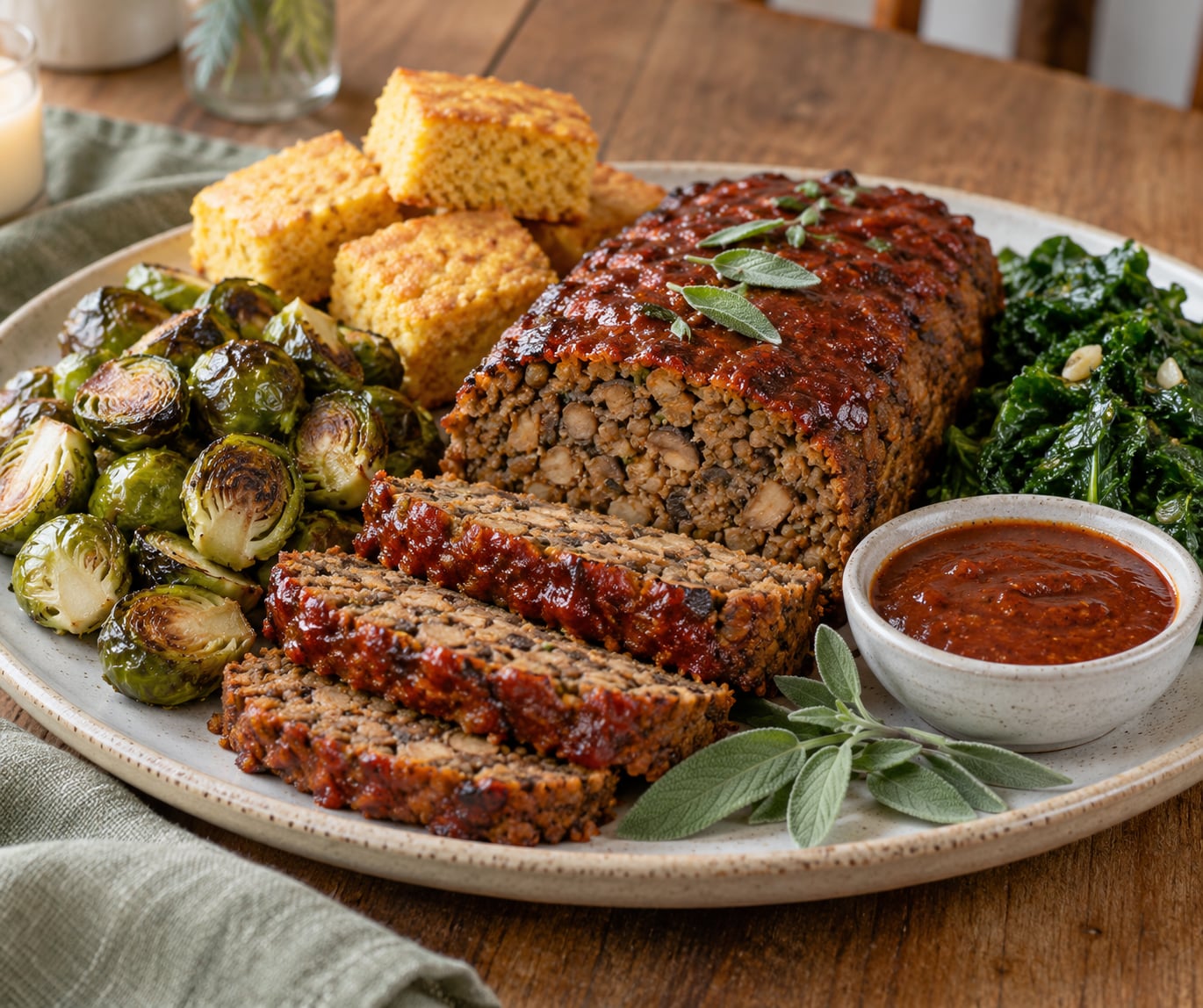
The fastest way to learn how to make a vegan main dish for the holidays is a make-ahead lentil and mushroom loaf: brown the filling in a skillet, bind it with oats, pack it firmly into a loaf pan, and brush on a tangy tomato-mustard glaze before it bakes. It feeds eight, slices cleanly, reheats well, and needs no specialty meat substitutes.
Plan on about 30 minutes of prep, 10 minutes of skillet work, and 55 to 60 minutes in the oven. Most of the work fits into the day before dinner, which matters when the oven is already booked with potatoes and a pie.
Table of Contents
- What You Need for a Lentil-Mushroom Holiday Loaf
- How to Make a Vegan Main Dish for the Holidays, Step by Step
- Prepare the Lentils and Mushroom Mixture
- Shape and Bake the Lentil Loaf
- Make the Glaze and Finish the Dish
- How to Make It Ahead and Keep It Safe
- Serve It as a Holiday Main Dish
- How Many Guests Does This Loaf Feed?
- Common Mistakes With Vegan Holiday Loaves
- Frequently Asked Questions
- What is the best vegan main dish for a holiday dinner?
- Can I make this vegan holiday loaf ahead of time?
- Is this recipe suitable for people eating gluten-free?
- How do I keep the lentil loaf from falling apart when sliced?
- How long does a vegan holiday loaf keep in the refrigerator?
- Conclusion
What You Need for a Lentil-Mushroom Holiday Loaf
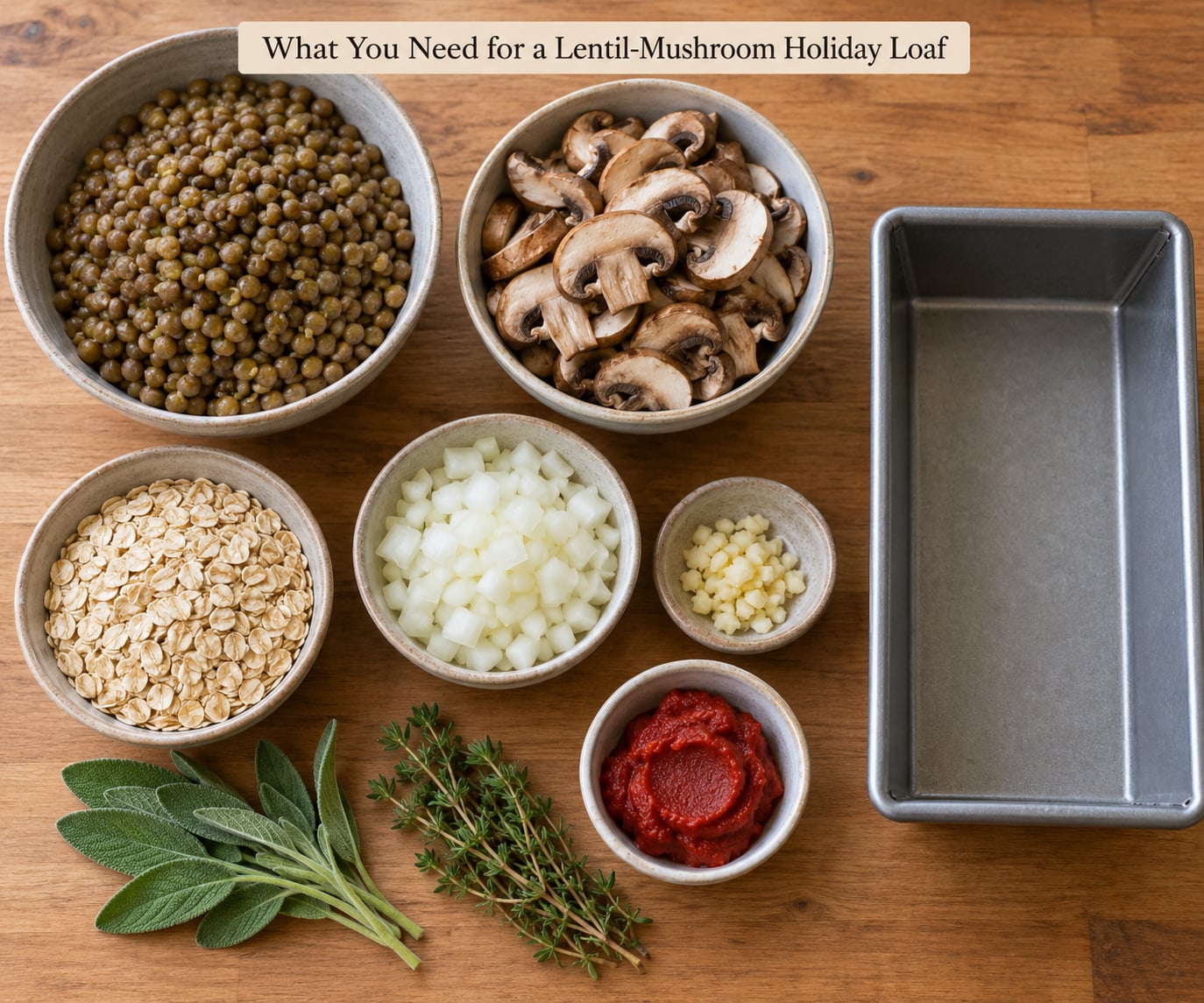
Everything comes from an ordinary grocery aisle. Lentils and mushrooms carry the weight and the savory flavor, oats and flaxseed do the binding, and the glaze supplies the tang that a roast would have supplied from its own juices.
For the filling:
- 1 cup cooked green lentils, about half a cup of dry lentils
- 8 ounces mushrooms, finely chopped (cremini, shiitake, or a mix)
- 1 cup rolled oats, blitzed to a coarse flour in a food processor
- 2 tablespoons ground flaxseed
- 1 small yellow onion, diced small
- 3 garlic cloves, minced
- 2 tablespoons tomato paste
- 1 tablespoon tamari or low-sodium soy sauce
- 2 tablespoons olive oil, plus more for the pan
- 1 teaspoon smoked paprika
- 1 teaspoon dried sage, rubbed between your fingers
- 1/2 teaspoon dried thyme
- 1 teaspoon maple syrup
- Salt and black pepper
For the glaze:
- 1/3 cup tomato paste or plain ketchup with no added sugar
- 2 tablespoons yellow mustard
- 1 tablespoon apple cider vinegar
- 1 tablespoon maple syrup
Equipment: a 9-inch loaf pan, a wide skillet or Dutch oven, a food processor or blender for the oats, and a wooden spoon you do not mind using for pressing the mixture.
Gluten-free swaps: buy oats labeled gluten-free, since regular oats are frequently milled alongside wheat. For the pan, oil a parchment sheet and lay it into the loaf pan instead of buttering and flouring.
Nut-free and soy-free swaps: the recipe contains neither to begin with. If you want a richer crust, trade the oat flour for sunflower seed meal mixed with ground flaxseed. For the tamari, use coconut aminos plus a pinch of salt.
How to Make a Vegan Main Dish for the Holidays, Step by Step
A finished loaf is a dense, brick-red-brown block that holds its shape when you lift it out of the pan. The cut face shows a moist, fine crumb studded with mushroom pieces, and a shallow score line runs across the top under a glossy glaze. Prep takes 30 minutes, baking takes about an hour, and the whole thing rests 15 minutes before slicing.
Prepare the Lentils and Mushroom Mixture
Start with the lentils. Cook half a cup of dry green lentils in 1.5 cups of water or vegetable stock until tender, about 20 minutes, then drain and let them cool for several minutes. Cooking them from scratch gives you control over the seasoning; using leftovers is fine as long as they were cooked plain and not in a salty broth.
While the lentils cook, heat 1 tablespoon of olive oil in a wide skillet over medium-high heat. Add the mushrooms in a single layer and leave them alone for 3 to 4 minutes before stirring. Mushrooms release water first, then brown; crowding the pan traps that water and you get a gray, steaming mixture instead of browned bits.
Push the mushrooms aside, add the onion and remaining tablespoon of oil, and cook 5 minutes until translucent and sweet. Stir in the garlic, tomato paste, smoked paprika, sage, and thyme, then cook 1 minute until the raw edge is gone and the pan smells savory rather than garlicky.
Combine the lentils, mushrooms, oat flour, flaxseed, maple syrup, tamari, and a generous amount of black pepper in a large bowl. Mix with your hands until nothing is loose at the bottom of the bowl, then rest the mixture 10 minutes so the oats hydrate.
How do you know the moisture is right? Squeeze a handful. It should clump and hold its shape but not ooze liquid between your fingers. If it feels sandy, add a tablespoon of water; if it feels slick, sprinkle in a couple more tablespoons of oat flour.
Shape and Bake the Lentil Loaf
Heat the oven to 375 F. Oil a 9-inch loaf pan and line the bottom with parchment, letting the ends overhang slightly so you can lift the loaf out later.
Scoop the mixture into the pan and press it down with the back of a spoon until it is level and packed solid. This is the step that decides whether the loaf holds together. Compact it in two or three passes, working from the ends toward the middle to push out air pockets.
Run a sharp knife across the top in a single long score, about a third of the way down. Brush the top with half the glaze, then set the pan in the center of the oven.
Bake for 55 to 60 minutes. You will know it is done when a skewer pushed into the center comes out clean and the internal temperature reads 165 F. The top should be deeply browned and slightly cracked along the score line.
If the crust darkens before the center sets, tent the loaf loosely with foil for the last 10 minutes. Pale edges are the more common problem, and they mean the oven was too cool or the loaf sat too far from the element.
Make the Glaze and Finish the Dish
Whisk the glaze ingredients in a small bowl right before you need them: tomato paste or ketchup, mustard, cider vinegar, and maple syrup. It should taste sharp on its own. If it tastes only sweet, add another teaspoon of vinegar.
Brush half the glaze over the scored loaf before baking. After about 30 minutes, pull the pan out, brush on the rest, and return it to the oven for the final stretch. Two thin coats bake into a lacquered, slightly caramelized crust that resists drying out.
Rest the loaf in the pan for 15 minutes once it comes out. The interior is still setting, and a loaf lifted straight off the heat can crumble down the middle. After resting, run a knife around the edges and lift it out by the parchment.
How to Make It Ahead and Keep It Safe
This is the part that makes the dish practical for a holiday. You can stop the recipe two different places, depending on how much room your schedule leaves.
Route one, cook fully a day or two ahead: bake the loaf, cool it completely, wrap it in foil or seal it in a container, and refrigerate. Reheat wrapped at 350 F for 25 to 30 minutes, or slice it and warm the slices in a dry skillet for a crisper crust. Bring the internal temperature back to 165 F before serving.
Route two, assemble raw: shape the loaf in the pan, cover it, and refrigerate for up to two days. Bake from cold with 10 extra minutes, and keep the center temperature at 165 F. Do not freeze the raw, unbaked mixture.
Refrigerated leftovers keep 3 to 4 days at or below 40 F. A fully baked, cooled loaf freezes for 2 to 3 months in foil or a freezer bag; thaw it in the refrigerator overnight rather than on the counter, then bake wrapped at 350 F until the center hits 165 F again.
Here is how each stage holds, and how you finish it later:
- Baked loaf, cooled, in the refrigerator, 3 to 4 days. Wrap it and bake at 350 F for 25 to 30 minutes, until the center reaches 165 F.
- Raw shaped loaf in the refrigerator, up to 2 days. Bake at 375 F with 10 extra minutes.
- Baked loaf, cooled, in the freezer, 2 to 3 months. Thaw in the refrigerator overnight, then bake wrapped at 350 F to 165 F.
- Cooked mushrooms and lentils in the refrigerator, 3 days. Combine, shape, and bake as usual.
Because this dish has no meat, dairy, or egg in it, it relies on cooking to 165 F rather than on a shorter time. That also makes it a safe choice for a buffet line kept over a chafing dish or a warmer, provided you hold it at 140 F or hotter and do not leave it out longer than 2 hours.
Serve It as a Holiday Main Dish
Slice with a serrated knife, one motion per slice, and cut about three-quarter-inch thick. Thick slices hold together on the platter and give you eight servings from a single 9-inch pan. Thin slices fall apart, which is the fastest way to lose the whole illusion of a roast.
Set the loaf in the center of the table on a plain platter and let people cut it themselves. A drizzle of pan juices or a spoonful of mushroom gravy over each slice buys you the thing the glaze cannot supply on its own.
Pair it with sides that carry their own weight: cast-iron cornbread stuffing with herbs, maple-roasted brussels sprouts with a squeeze of lemon, roasted squash with cider and sage, and something sharp on the table like pickled beets or a vinegar-based relish. Acid next to a rich plant-based centerpiece is what makes people take a second slice.
One rule for mixed tables: put the loaf on the main platter rather than on a side board. Vegan food that gets filed away with the salad reads as an afterthought, and the uptake problem is exactly what you are trying to avoid.
How Many Guests Does This Loaf Feed?
One 9-inch loaf pan gives you eight slices at three-quarter-inch thickness, which serves four to six people as a main with sides. For a bigger table, bake in two pans rather than one deep one, because a thicker loaf stays gummy in the middle and no amount of extra time fixes it cleanly.
A crowd of ten to twelve is better served by a different format. A stuffed butternut squash feeds eight to ten from one dish, a sheet pan of cauliflower steaks or portobello mushrooms scales to any number without changing the cook time, and a pot pie in a wide dish can be doubled by increasing the pan size instead of the depth.
Planning for four? The loaf is still the right call, and the extra slices become the next day’s lunch: thick-cut and pan-fried in a little oil, or turned into a sandwich with pickles and mustard on a roll.
Common Mistakes With Vegan Holiday Loaves
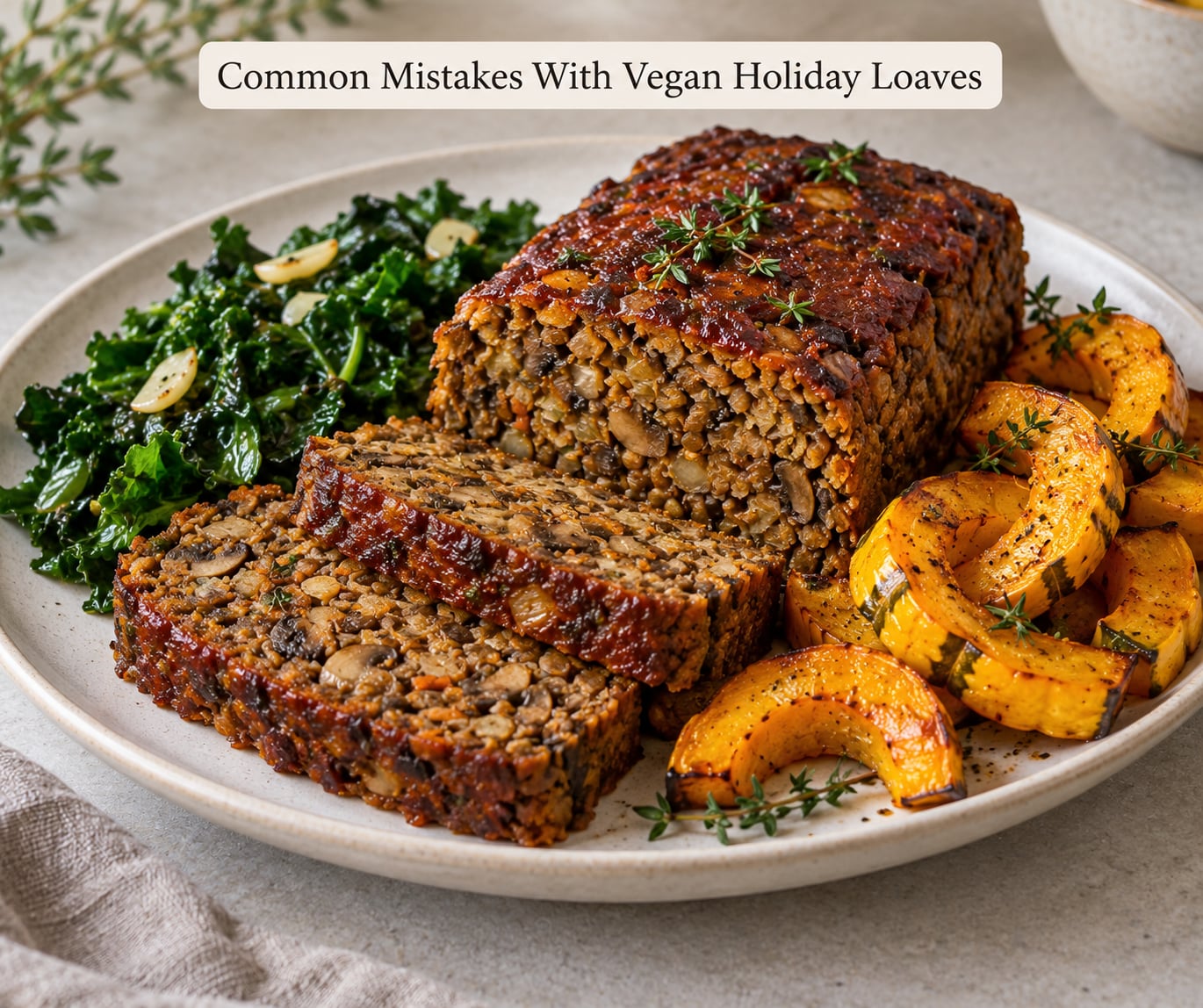
Almost every disappointing vegan centerpiece traces back to one of a handful of fixable problems. Here is what goes wrong and what to change.
The loaf crumbles when you slice it. That is almost always under-pressing. Pack the mixture into the pan harder than feels reasonable, leave it untouched while it bakes, and let it rest 15 minutes before the first cut. Adding an extra tablespoon of flaxseed or a beaten egg-free binder also helps if the crumb is too loose.
The center is dense and gummy. Dense center means under-baking or a pan that was overfilled. Bake until a skewer comes out clean and the middle reaches 165 F, and never pack more than one and a half inches of mixture into the pan.
The edges brown before the middle sets. Wrap the loaf in foil for the last 10 to 12 minutes. Home ovens run hot, and at 425 F the outside of a loaf burns long before the center catches up. 375 F is the better temperature for this shape.
Slices go wet on the platter. Drain any liquid that collects in the pan before slicing, and skip the fruit-based glaze if your sauce is already sweet. Serve in waves rather than plating the whole loaf at once, and put the loaf on a wire rack if the platter holds heat.
Everything tastes like sage. Dried sage gets more intense every hour it sits, so measure it rather than eyeballing it, and crush the leaves so they release less. Fresh thyme, a spoon of miso, and a splash of cider vinegar pull the dish back toward savory instead of green.
It reads as a health food side. Deep browning is the cure. Brown the mushrooms in one uncrowded layer, roast the loaf until the top is lacquered, and add something crisp on top such as toasted walnuts, pumpkin seeds, or caramelized onions. Texture is what convinces the skeptical guest at the table.
Cross-contamination at a gluten-free table. Use certified gluten-free oats and a parchment-lined pan, then keep the finished loaf on a separate board from any bread or gravy that has touched wheat.
One more habit worth keeping: taste the filling before it goes in the pan. If it is not quite seasoned, no amount of glaze will rescue it at the table.
Frequently Asked Questions
What is the best vegan main dish for a holiday dinner?
A hearty lentil and mushroom loaf is among the best vegan main dishes for a holiday dinner because it feeds a crowd, slices like a roast, and reheats without drying out. Stuffed butternut squash and a mushroom pot pie are strong alternatives. Whichever you choose, build it around a sturdy protein, brown it well, sauce it for moisture, and finish with something crisp.
Can I make this vegan holiday loaf ahead of time?
Yes, in two ways. Bake it a day or two ahead, cool it fully, and wrap it before refrigerating, then reheat wrapped at 350 F until the center reaches 165 F. Or shape the raw loaf in the pan, cover it, and refrigerate for up to two days, adding about 10 minutes to the bake time. Do not freeze the raw mixture.
Is this recipe suitable for people eating gluten-free?
The loaf is naturally gluten-free if you use certified gluten-free oats, since regular oats are often milled near wheat. Skip the traditional buttered and floured pan and line the loaf pan with parchment instead. Watch sauces, gravy, and broth, which frequently contain flour, and serve the loaf on a separate board from any wheat-based dishes.
How do I keep the lentil loaf from falling apart when sliced?
Press the mixture firmly into the pan so there are no air pockets, and leave the loaf alone in the oven so it can set. Rest it 15 minutes in the pan before moving it, then cut thick slices with a serrated knife using one steady motion per cut. Adding an extra tablespoon of ground flaxseed to the binder also firms the crumb.
How long does a vegan holiday loaf keep in the refrigerator?
A baked loaf kept covered at or below 40 F stays good for 3 to 4 days. A raw shaped loaf can be refrigerated for up to two days before baking, and a cooled baked loaf freezes for 2 to 3 months. Reheat to an internal temperature of 165 F, and throw the loaf away if it has sat out longer than 2 hours.
Conclusion
Start with the lentils and the mushrooms, since that skillet step is where the flavor lives. Then pick your route: bake the loaf a day ahead if your holiday schedule is crowded, or shape it in the pan the morning of and add 10 minutes to the bake time if you want it warm from the oven. Press the mixture down firmly, glaze it twice, and give it 15 minutes to rest before the first slice.