How to plan a Thanksgiving timeline for the oven comes down to one line of arithmetic: pick the time you want to sit down, subtract 30 to 45 minutes for the turkey to rest, subtract the bird’s roasting time, and you have the moment the turkey goes in. Everything else on your menu gets hung off that number in temperature bands, so one oven can carry the whole meal without anything finishing cold or at midnight.
Most Thanksgiving timing problems are not cooking problems. They are scheduling problems wearing a cooking costume. The oven is the constraint: a handful of racks, one temperature at a time, and a door that drops 20 or 30 degrees every time somebody checks on the bird.
This guide walks through the whole method, with a worked example for a 6 p.m. dinner for twelve, a temperature-band table you can copy, and a recovery plan for the morning the turkey runs late. Budget about an hour with a notebook the first time. The plan itself takes five minutes on Thursday morning.
Table of Contents
- What You Need
- How to Plan a Thanksgiving Timeline for the Oven
- Step 1: Set the Serving Time and Work Backward
- Step 2: Group Dishes by Temperature and Time
- Step 3: Build the Hour-by-Hour Schedule and Check Rack Capacity
- Step 4: Add Hold, Rest and Finish Times
- Step 5: Test the Plan Before Thursday
- Common Mistakes
- Frequently Asked Questions
- When do I put the turkey in the oven for a 6pm Thanksgiving dinner?
- How many dishes can I cook in one oven at Thanksgiving?
- Can I cook dishes that need different temperatures in the same oven?
- How do I keep mashed potatoes and casseroles hot without drying them out?
- What do I do if the turkey is running late on Thanksgiving Day?
- Why does my fan oven cook unevenly on Thanksgiving?
What You Need
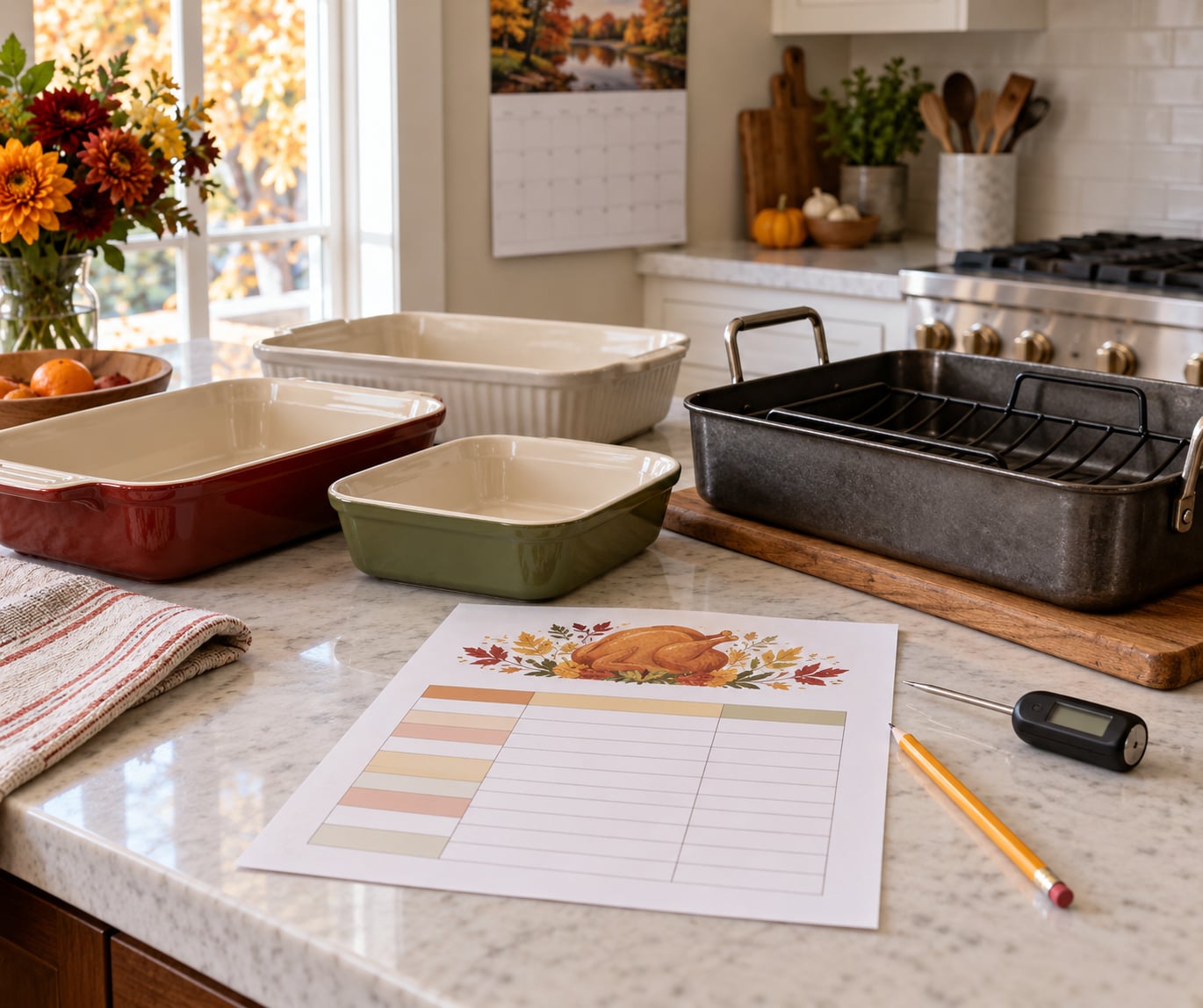
Before you assign a single dish to a rack, gather five things. Skip any of them and you are scheduling on instinct, which is how people end up carving at nine.
- A written serve time. One clock time, decided before you look at another recipe. Six p.m. is typical. An early lunch at one or two works just as well, and a 7:30 p.m. dinner is easier than six because the oven has more slack.
- Your menu with a temperature and a time for every dish. Write them on one sheet. Stuffing, sweet potato casserole, green bean casserole, brussel sprouts, squash, rolls, pie, mashed potatoes, gravy. If a recipe has no temperature, look it up now rather than at 3 p.m. Thursday.
- Your oven’s real capacity. Count the racks, know the usable spacing, and note whether it is conventional or convection. A standard 30-inch range oven gives you two or three usable rack positions with a full-size roasting pan on the bottom. A wall oven with a true second oven gives you double the space.
- A list of what comes off the oven. Make-ahead dishes, stovetop dishes, slow cooker dishes, and anything served at room temperature. Every dish you move off the oven is a slot you can hand to something that needs the heat.
- A pen and one sheet of paper. A timeline in your head fails at 4:45 when three people ask you questions at once. One sheet taped inside a cabinet door survives the whole day.
Add an instant-read thermometer to that list. The turkey math gets you close, but close is not 165 degrees, and the turkey is the only dish on the table that cannot be rescued at the last minute.
How to Plan a Thanksgiving Timeline for the Oven
Step 1: Set the Serving Time and Work Backward
Choose one time and write it at the top of the page. The serving time is the anchor everything else hangs from, and it is the one decision nobody can make for you. Guests arriving at six does not mean dinner at six; it usually means dinner at six-thirty with drinks, so build in 30 minutes of slack between arrival and carving.
Now subtract. For a standard unstuffed turkey roasted at 325F, plan about 13 minutes per pound, then add 30 to 45 minutes of rest. A 14-pound bird is roughly three hours of roasting plus 45 minutes of rest.
So a 6 p.m. serving means the turkey comes out at 4:30 p.m. and goes in at 1:30 p.m. Work backward the rest of the way too. You want sides reheated in the 45-minute rest window, rolls warmed in the last 10 minutes, and gravy finished on the stove at about 5:15. If the numbers do not leave you 30 spare minutes, move the serving time or cut a dish.
Step 2: Group Dishes by Temperature and Time
Most holiday recipes are written for a narrow range of temperatures, which is good news. Almost everything you bake lands in one of four bands, and dishes in the same band can share a bake without adjustment. This is the single move that turns one oven from a bottleneck into a workable machine, and it is the answer to the question forums ask most often: yes, you can cook a turkey at 325F and a casserole at 375F in the same oven, because 50 degrees apart is one oven setting, not two.
Home cooks who juggle a full menu have long used one rule of thumb: run the oven hot, around 400F, and let everything share. That works. So does staging by band, and staging is more forgiving. Sort your list into this shape.
| Band | Dishes that belong here | Typical time |
|---|---|---|
| 325F | Turkey, bone-in turkey breast, large prime rib | 13 minutes per pound, unstuffed |
| 350F | Stuffing, sweet potato casserole, green bean casserole, scalloped potatoes, mac and cheese, cornbread, mashed potatoes reheated covered | 45 to 75 minutes |
| 375F | Stuffing in a loaf pan, cornbread in a loaf, some pie recipes, gratin potatoes | 40 to 60 minutes |
| 400F | Brussel sprouts, roasted squash, roasted vegetables with oil, dinner rolls, mashed potatoes browned on top, reheating casseroles to brown | 15 to 45 minutes |
| 425F | Crispy skin on potatoes, roasted nuts, a final browning pass | 20 to 40 minutes |
Then sort a second way, by duration. Long bakes get the early slots, short bakes get the late ones, and nothing is scheduled to finish in the same five-minute window as anything else. Staggered finish times are what let you reheat one dish without colding another.
Step 3: Build the Hour-by-Hour Schedule and Check Rack Capacity
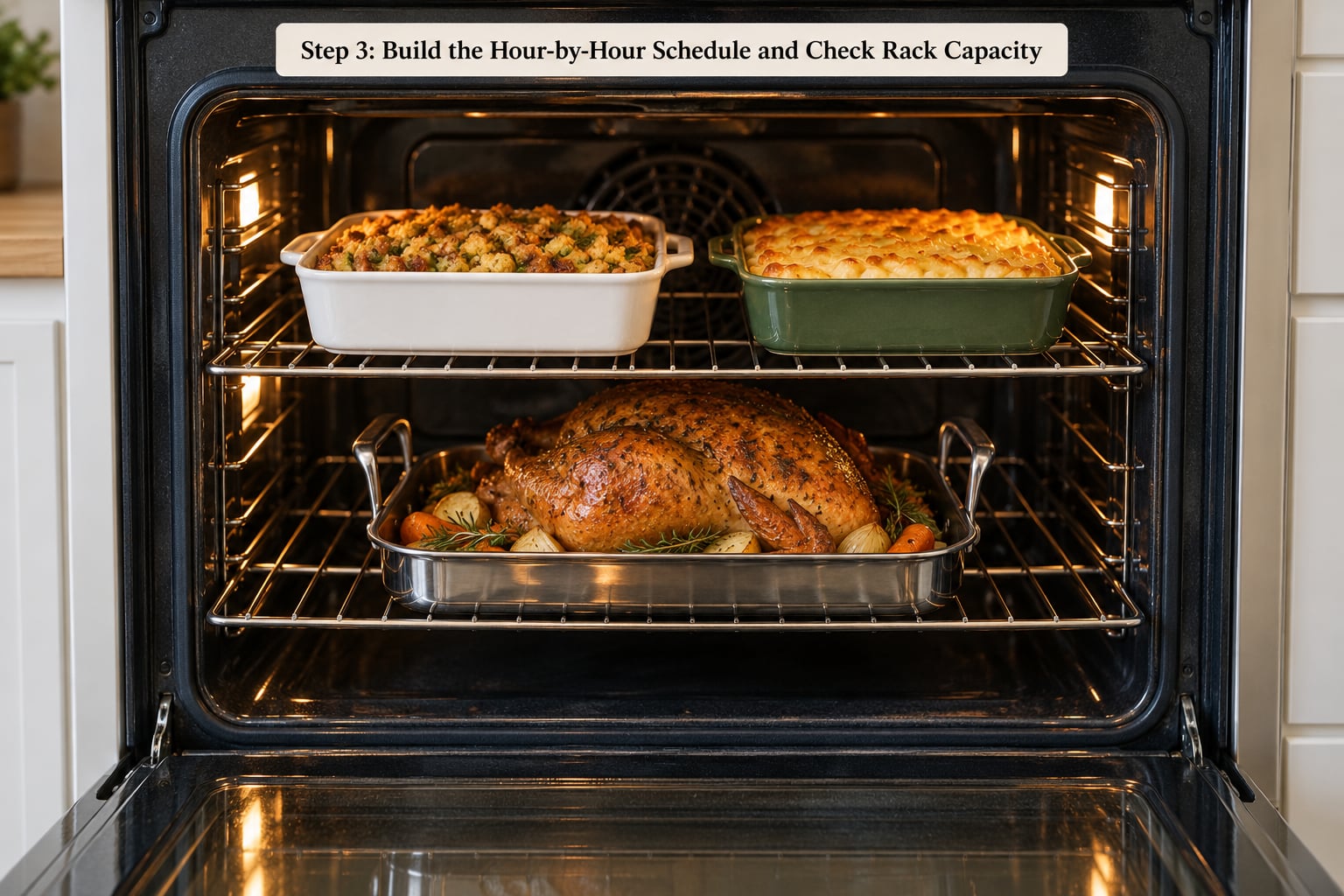
Here is a worked schedule for twelve people serving at 6 p.m. with a 14-pound turkey. The pattern matters more than the clock times: early 350F bakes, then a run of 400F vegetables, then the long turkey window, then short reheat and browning jobs layered on top of it.
| Time | Dish | Oven setting | Rack | Action |
|---|---|---|---|---|
| 7:00 a.m. | Sweet potato casserole | 350F | Center | In, uncovered, 60 to 75 min; cover and hold at 200F when done |
| 8:15 a.m. | Brussel sprouts and squash | 400F | Center | In, 35 to 45 min; hold at 200F |
| 9:00 a.m. | Green bean casserole | 350F | Center | In, 45 to 60 min; cool uncovered, refrigerate if holding over four hours |
| 10:00 a.m. | Gravy base | Stovetop | Off oven | Drippings, broth, aromatics; finish later with cornstarch |
| 11:00 a.m. | Stuffing in a separate pan | 350F | Center | In, 45 to 60 min; cool uncovered |
| 12:30 p.m. | Turkey | 325F | Bottom | Roasting pan in, about 3 hours; thermometer in the thigh |
| 2:00 p.m. | Mashed potatoes | 325F with turkey | Upper | Covered dish in with a splash of hot water and butter; 60 min |
| 3:00 p.m. | Green bean casserole and stuffing | 350F | Upper, then Center | Reheat covered, 25 to 35 min |
| 3:35 p.m. | Mashed potatoes | 400F | Center | Uncovered to brown the top, 10 to 15 min |
| 4:00 p.m. | Dinner rolls | 400F | Center | In, 8 to 10 min; foil and hold |
| 4:20 p.m. | Turkey check | 325F | Bottom | Thigh at 165F, loosen the foil tent |
| 4:30 p.m. | Turkey out | — | — | Rest on a board, tented, 45 min; start carving at 5:15 |
| 5:00 p.m. | Warming | 200F | Center | All reheated sides go in to hold; rolls last so they stay soft |
| 5:45 p.m. | Guests sit | 250F | Lower | Pies in after the plates are cleared |
Two racks is the working assumption in that table, and it is a real limit. A full roasting pan claims the bottom rack and most of the heat. The upper rack takes one 9×13 pan comfortably, two only if one of them is shallow. Count pans, not dishes: a 9×13 casserole and a loaf pan on one rack is fine; two deep casseroles is not.
Leave a finger of clearance on each side of every pan so air moves, and put the dish that needs the most heat closest to the element. Rotating pans mid-cook is allowed. Changing a dish’s cook time is not, which is why the bands exist.
Adding a dish to a hot oven stretches the cooking of what is already inside, because the metal and the food have to come back up to temperature. Keep the door shut as much as you can, and add pans at a moment in the schedule when nothing critical is mid-bake.
Step 4: Add Hold, Rest and Finish Times
A dish that finishes at 2 p.m. and sits until 6 p.m. is a problem no schedule solves by itself. Two habits handle it: put the oven at 200F as a holding cabinet, and move anything that will not tolerate four hours of waiting to the slow cooker or the stovetop.
Warm-holding sits between 200 and 250F. That is hot enough to keep food safely above the danger zone for a couple of hours and gentle enough that nothing dries out or overcooks. Reheating happens at 350F, covered, with a splash of water or stock in anything that has a starch in it. Mashed potatoes are the exception most hosts get wrong: they need butter and warm milk added before they go back in, and the top browning happens later at 400F, not during the reheat.
The turkey rest is the most useful window in the whole day. Those 30 to 45 minutes are not dead time; they are the only stretch when the oven is free of the bird and every side can be reheated at once. Time your sides to that window, not to your own sense of how long the reheating takes.
Give the turkey a foil tent if it is browning fast, and rest it on a board with a lip, because the juices run. Carryover cooking keeps pushing the internal temperature up after it leaves the oven, which is why a bird pulled at 160F is not a mistake and a bird pulled at 170F is dry.
Step 5: Test the Plan Before Thursday
Run one dry rehearsal a week ahead. Lay the sheet out and walk the schedule on paper, moving nothing. You will find the two dishes you scheduled for the same 20 minutes, the casserole with a 75-minute bake you gave 45, and the second oven’s setting that does not match the one on the sheet.
Then check the real numbers. Confirm oven capacity by measuring the clear space between racks with your roasting pan and your deepest casserole in hand. Confirm the turkey’s cook time from its own weight, not a chart for a different bird. And confirm which dishes your guests are bringing, if they are bringing any, so you are not planning oven space twice.
Add 20 to 30 minutes of slack to the plan and spend it at the front rather than the back. A slower oven, a fuller rack, or a bird that takes an extra fifteen minutes is absorbed before the serving time instead of after it.
Common Mistakes
Six failures account for nearly every ruined holiday meal. Each has a fix you can apply to the sheet in under a minute.
Cooking everything at one temperature because the oven will not change. It will, and it costs nothing but preheat time. Most home ovens need 10 to 15 minutes to come to a new temperature, so schedule the change and give it the minutes. Staging dishes in bands costs you one adjustment instead of four.
Forgetting preheat. A casserole into a cold 350F oven runs 15 to 20 minutes long and browns unevenly. Put the preheat in the schedule as its own line item with its own start time, not as an assumption. Fully preheated ovens also recover faster when you add a cold pan during the turkey’s long roast.
Overcrowding the oven. A packed oven cooks slower, browns worse, and turns the kitchen into a sauna an hour before dinner. When the racks are full, take a dish off the oven entirely. A slow cooker holds green beans, stuffing, or mashed potatoes without a slot, and a microwave finishes a small casserole in minutes while the oven is committed to the turkey.
Planning only for bake time. Bake time is a third of the actual job. Rest, carve, hold, reheat, brown, and plate are all separate blocks of time. A dish scheduled to finish at 4:00 that needs 30 minutes of reheating has to start at 3:30, and its bake had to start at 2:50.
Leaving nothing for serving. If the last dish comes out of the oven when guests are already seated, you will reheat in front of them. Stop all new bakes 30 minutes before the serving time, and let the last 30 minutes be gravy, carving, and moving food to the table.
Winging the temperature. Run a cheap oven thermometer for a week. Home ovens commonly sit 25 degrees off the dial, and knowing which direction yours errs explains most of the “my oven is broken” complaints that arrive every November.
A few more planning tips that cost nothing: assign specific dishes to specific guests, because a list beats “bring something”; make one casserole the day before purely to remove it from the oven load; and keep the slow cooker plugged in and ready, because it is the only appliance that adds heat without needing one.
Frequently Asked Questions
When do I put the turkey in the oven for a 6pm Thanksgiving dinner?
For a 6 p.m. serving, plan 45 minutes of rest and about 13 minutes per pound at 325F. A 14-pound unstuffed turkey roasts roughly three hours, so it goes in around 1:30 p.m. and comes out at 4:30, resting until 5:15 while you carve. Put the bird in earlier if you want a 30-minute cushion, and check the thigh with a thermometer rather than trusting the clock. Pull it at 165F.
How many dishes can I cook in one oven at Thanksgiving?
A standard 30-inch range oven gives you two or three usable rack positions, and a full-size roasting pan on the bottom rack takes most of the space. That leaves room for one 9×13 pan on the upper rack, or two if one is shallow. A true second oven doubles your capacity, and a toaster oven handles rolls and a small side without touching the main cavity. Count pans and leave finger-width clearance on every side for airflow.
Can I cook dishes that need different temperatures in the same oven?
Yes, as long as the difference is small. A turkey at 325F and a sweet potato casserole at 375F are 50 degrees apart, and the casserole will bake within a few extra minutes. Dishes more than 50 degrees apart are better staged in separate windows than run together. Group everything into bands, run the oven hot for short items, and adjust the long cook by checking early rather than trusting the printed time.
How do I keep mashed potatoes and casseroles hot without drying them out?
Set the oven to 200F as a holding cabinet and move finished sides in as the turkey roasts. Anything with starch in it needs a splash of warm water or stock and a tight foil cover before reheating at 350F, and mashed potatoes want cold butter and warm milk mixed in first. A slow cooker on low does the same job for mashed potatoes and green beans and frees a rack entirely. Hold for no more than two or three hours.
What do I do if the turkey is running late on Thanksgiving Day?
Stop adding things to the oven, and let the sides wait. Push the roll warming and the 400F browning pass later, keep everything else at 200F, and tell the table that dinner is 30 minutes out rather than rushing and serving cold food. A turkey still under temperature at 5 p.m. can go back in at 400F for 10 to 15 minutes to speed the finish. Gravy and sides that are already hot absorb a short delay far better than a half-done bird does.
Why does my fan oven cook unevenly on Thanksgiving?
A convection fan moves hot air fast, which means the dish nearest the fan browns first and a crowded cavity has no room for that air to circulate. Leave a finger of clearance around every pan, use the lower rack for the roasting pan, and check the back of the oven first when testing for doneness. Convection also cuts cooking times, usually by about a quarter, so check the turkey 15 to 20 minutes earlier than the printed time.
Start with the serve time and nothing else. Write down 6 p.m., subtract 45 minutes of rest, subtract three hours for the turkey, and you have your oven start time before you have looked at a single recipe. Everything after that is bands on a sheet, and the sheet is the whole difference between a calm Thursday and a 9 p.m. one.
Happy Thanksgiving from our kitchen to yours, and good luck with the oven math.