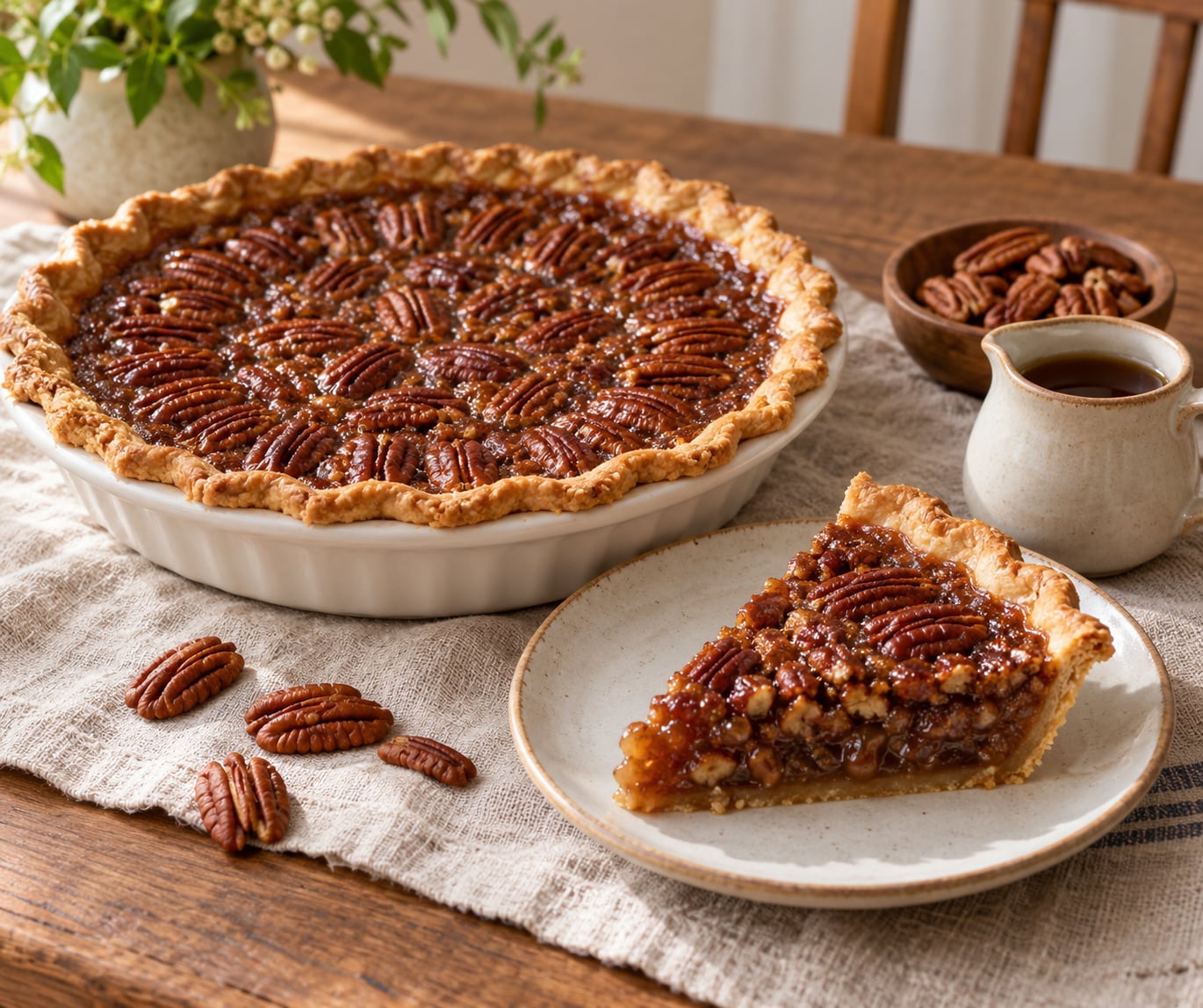
To make vegan pecan pie without corn syrup, cook brown sugar, pure maple syrup, and coconut milk with cornstarch on the stove until thick, then pour the hot filling over toasted pecans in a par-baked vegan crust. Corn syrup does two jobs in a classic pie, sweetening the filling and giving it body, so removing it means replacing the sweetness with maple syrup and the body with a starch. From prep to table it takes about 75 minutes, most of it in the oven, and it is a forgiving recipe as long as you blind bake the crust first.
I make this every November alongside a conventional pecan pie for the relatives who still want eggs, and the vegan one gets eaten first. That is not a compliment to my vegan version so much as an indictment of most supermarket holiday pies, which are heavy, overly sweet, and baked in shells that taste like cardboard.
One honest note up front: without corn syrup there is no egg protein either, so the filling has to earn its set from starch. Get that part right and you get a glossy, gooey, sliceable pie that tastes like November. Get it wrong and you get soup in a crust, which is the single most common failure reported on baking forums.
Table of Contents
- What You Need for Vegan Pecan Pie Without Corn Syrup
- The Filling
- What You Can Use Instead of Corn Syrup
- The Crust and the Tools
- Swapping the Fat
- Step-by-Step: How to Make Vegan Pecan Pie Without Corn Syrup
- 1. Blind bake the crust
- 2. Toast the pecans
- 3. Whisk the dry thickener first
- 4. Cook the filling without corn syrup
- 5. Add the vanilla and most of the pecans
- 6. Pour and arrange
- 7. Bake at 350°F for 40 to 50 minutes
- 8. Cool completely, then slice
- How to Make the Filling Without Corn Syrup
- How to Know the Pie Is Done
- Common Mistakes and How to Fix Them
- Frequently Asked Questions
- What can I use instead of corn syrup in vegan pecan pie?
- Is maple syrup a good substitute for corn syrup in pecan pie?
- Why is my vegan pecan pie filling not setting?
- Can I use a gluten-free pie crust for this recipe?
- How long does vegan pecan pie keep in the refrigerator?
- Can I make vegan pecan pie ahead of time?
- Conclusion
What You Need for Vegan Pecan Pie Without Corn Syrup
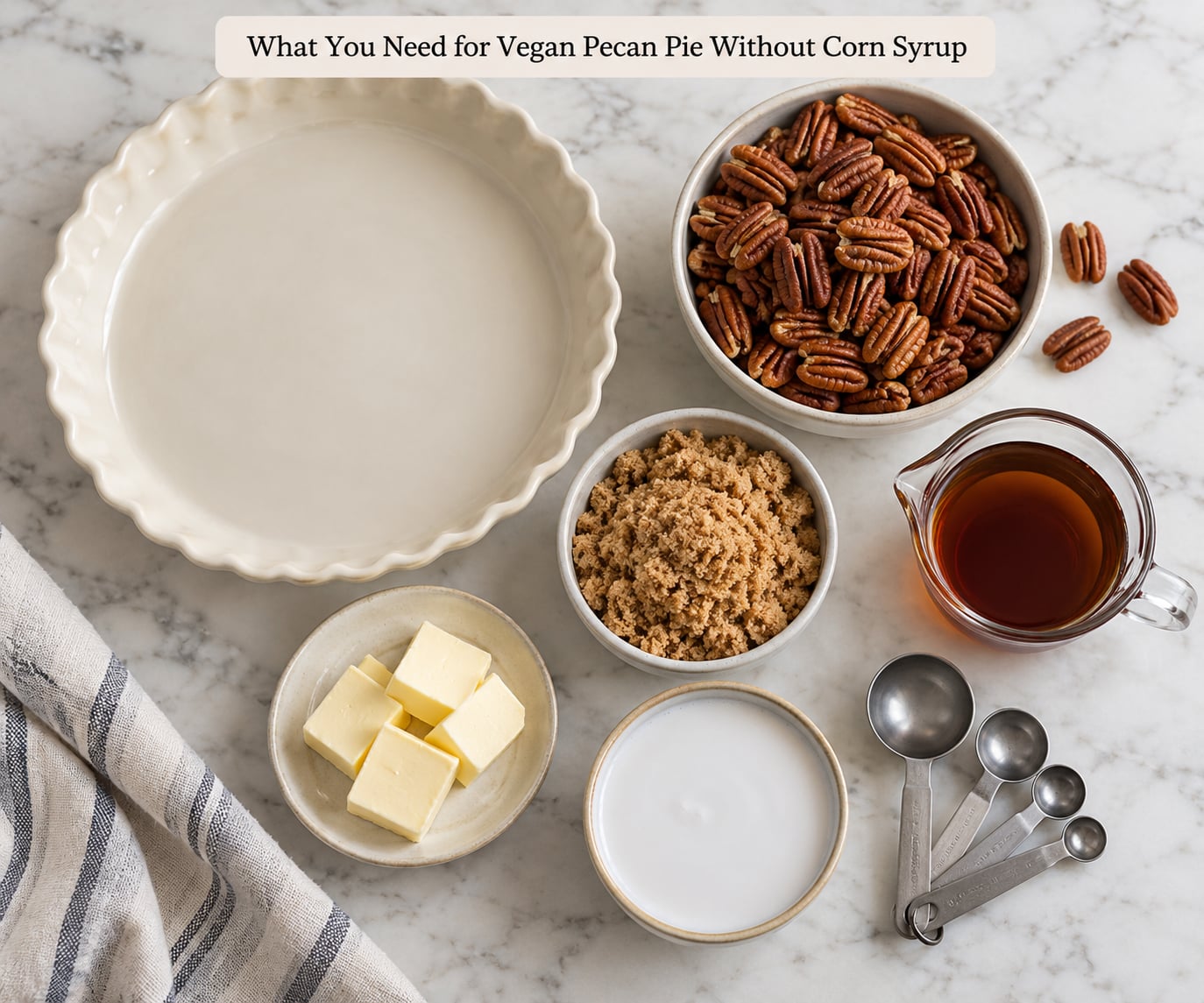
This is a 9-inch (23 cm) pie with a standard pastry crust. If you are starting from a store-bought vegan pie crust, you still need to par-bake it, because a thinner filling seeps through an unbaked bottom and pushes the crust up into the middle of the pie. That single skipped step causes most of the soggy-bottom, weeping-center disasters I get asked about.
The Filling
- 2 cups (about 220 g) pecan halves or pieces
- 6 tablespoons (85 g) vegan butter or coconut oil
- 3/4 cup (150 g) light brown sugar
- 3/4 cup (180 ml) pure maple syrup, Grade A
- 1/2 cup (120 ml) full-fat coconut milk
- 2 tablespoons (16 g) cornstarch
- 2 teaspoons vanilla extract
- 1/2 teaspoon ground cinnamon
- 1/4 teaspoon freshly grated nutmeg
- 1/2 teaspoon fine sea salt, plus flaky sea salt for the top
What You Can Use Instead of Corn Syrup
Maple syrup is the workhorse swap, and it is what this recipe uses. The table below covers the other options, with the ratio you need against the same volume of corn syrup and what each one does to the filling. Rows are ordered by how well I trust them in this particular pie.
| Swap for corn syrup | Ratio | Relative sweetness | Effect on setting |
|---|---|---|---|
| Pure maple syrup | 1:1 | About 25 percent less sweet than corn syrup | Thin, so keep the cornstarch at 2 tablespoons |
| Brown rice syrup | 1:1 | Close to neutral, slightly less sweet | Similar viscosity to maple; keep cornstarch at 2 tablespoons |
| Date syrup | 3/4 cup syrup to 1 cup corn syrup | Sweeter, with a caramel note | Very dark and staining; reduce brown sugar by a quarter cup |
| Agave nectar | Use 3/4 cup, do not reduce | Sweeter than maple | Watery; bump cornstarch to 2 1/2 tablespoons |
| Coconut sugar in place of the brown sugar | 1:1 with no added syrup | Slightly less sweet, richer flavor | Add 1 tablespoon cornstarch because it releases less moisture |
Honey works as a sweetener if you are not keeping the pie vegan, and it produces a pleasant flavor, but honey is an animal product and it makes the pie unsuitable for a vegan table. Nobody who is avoiding animal products can eat a pie made with it, however good it tastes.
The Crust and the Tools
For the crust, a refrigerated vegan pie crust is the fastest route and needs no changes beyond blind baking. A homemade shortcrust pastry made with cold vegan butter, ice water, and plain flour works just as well. A gluten-free vegan crust made with 1:1 baking flour is also fine; just blind bake it a full 5 minutes longer than a wheat crust, since gluten-free dough stays pale and crumbly longer.
A press-in crust made from crushed shortbread or graham crackers is the shortest version of all, and ginger snaps work nicely if you want the spice to carry. Watch the sugar there, because a ginger snap shell is already sweet and the filling is sweet on its own.
What you actually need on the counter: a 9-inch (23 cm) pie dish, a heavy-bottomed saucepan for stovetop cooking, a medium mixing bowl, a silicone spatula, pie weights or dried beans for blind baking, and a pastry brush. A cooling rack matters more than it sounds. A pie that cools on the hot pan bottom sets unevenly.
Swapping the Fat
Vegan butter gives the filling the closest flavor to a dairy version and browns slightly at the edges. Coconut oil works and makes the filling glossier, but it loses some of the nutty depth. A neutral oil like avocado or grapeseed is the least interesting option, though it is the one to pick if you are making the pie for someone avoiding coconut entirely.
Step-by-Step: How to Make Vegan Pecan Pie Without Corn Syrup
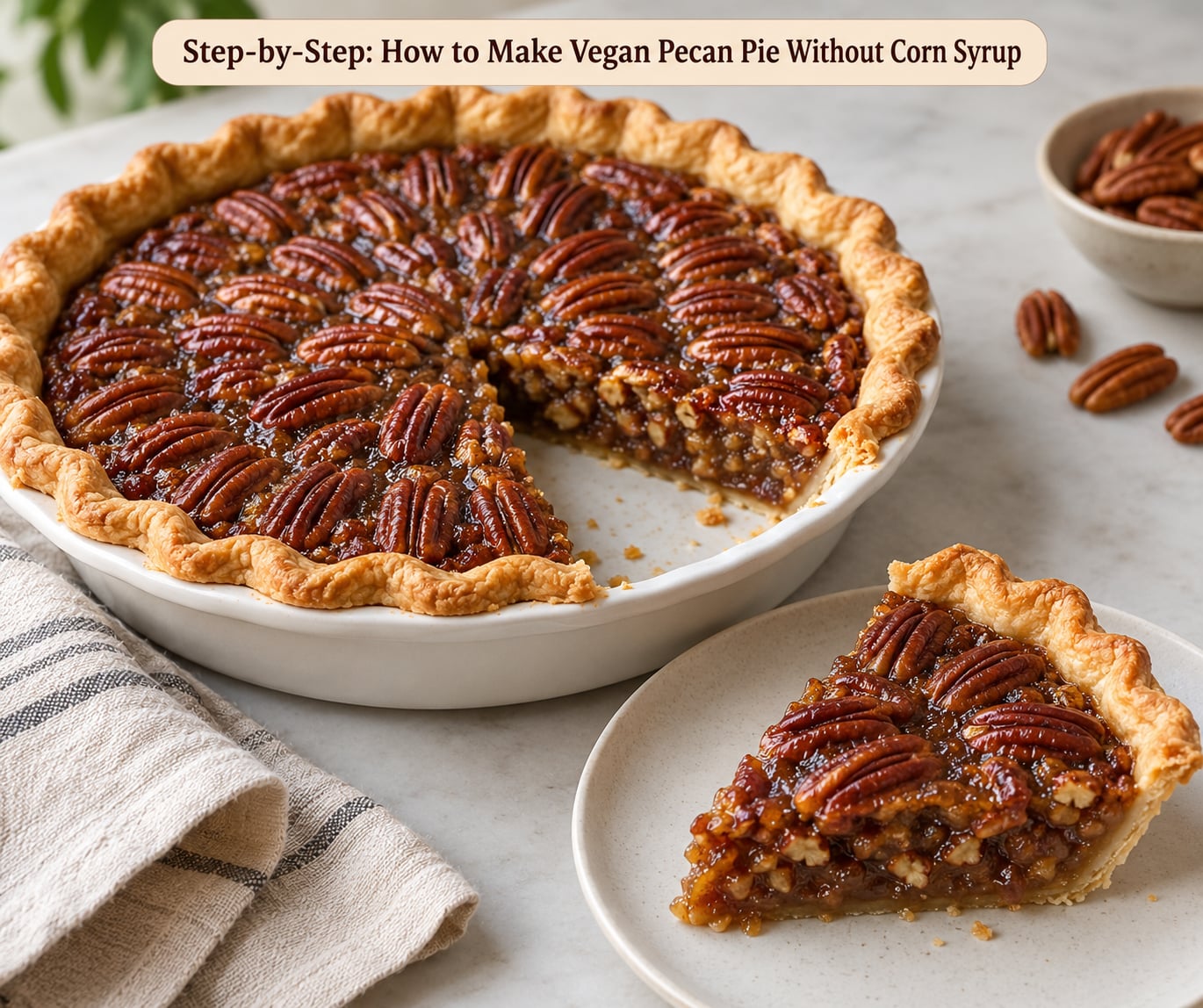
The method below cooks the filling on the stove before it ever sees the oven. That is the single biggest difference from a classic egg-based pecan pie, and it is what makes this version reliable. A stovetop filling gives you direct control over thickness and lets you taste it before committing.
1. Blind bake the crust
Heat the oven to 350°F (175°C). Press the chilled crust into the dish, prick the bottom all over with a fork, line it with parchment, and fill with pie weights. Bake 15 minutes, remove the weights and parchment, and bake 5 to 7 minutes more until the bottom looks dry and light golden.
Watch the edges. A pale rim is the part that shrinks and pulls away from the dish, so if the crust is done in the center but still white at the edge, give it three more minutes. Leave the crust in the turned-off oven while you cook the filling, so it stays warm and the filling starts setting on contact.
2. Toast the pecans
Set the oven aside and toast 2 cups of pecans in a dry skillet over medium heat for 6 to 8 minutes, shaking the pan often, until they smell nutty. Watch them closely, because pecans turn from toasted to bitter fast. Tip them onto a plate to cool.
Resist the urge to chop them. Halves and large pieces give the top its texture, and a layer of whole pieces over the finished filling looks like the pie people picture when they picture pecan pie.
3. Whisk the dry thickener first
Whisk 2 tablespoons of cornstarch with the cinnamon, nutmeg, and 1/4 teaspoon of the salt in a small bowl. Mixing the starch with the dry spices before any liquid hits it is what keeps lumps out, and lumps in a pecan filling are unfixable after baking.
4. Cook the filling without corn syrup
Melt the vegan butter in a heavy saucepan over medium-low heat. Add the brown sugar and stir until it looks wet and sandy, about 2 minutes. Slowly pour in the maple syrup and coconut milk while whisking, then add the cornstarch mixture.
Keep the heat at a bare simmer and whisk steadily for 5 to 8 minutes. You are looking for the point where the sauce turns translucent and the spatula leaves a clean line behind it that holds for a second or two before filling in. That is the set point. Taste it here, while you can still fix it, and adjust with a splash of maple syrup if it needs more sweetness.
5. Add the vanilla and most of the pecans
Kill the heat, stir in the vanilla extract, and fold in 1 1/2 cups of the toasted pecans. Save the remaining half cup for the top. The filling will look thin in the pan right now and that is correct, because it finishes setting in the oven.
6. Pour and arrange
Pour the hot filling into the par-baked crust and use the spatula to spread it to the edges. Scatter the reserved pecans over the surface in an even single layer rather than dumping them in one spot. Press each one down lightly so it sits partly submerged, which is what keeps them from floating to the surface during the bake.
7. Bake at 350°F for 40 to 50 minutes
Return the dish to the 350°F (175°C) oven and bake 40 to 50 minutes. If your crust is darkening faster than the filling, tent loosely with foil at the 30-minute mark.
8. Cool completely, then slice
Set the pie on a wire rack and cool at room temperature for at least 2 hours before cutting. A warm pecan pie needs a clean serrated knife dipped in hot water and wiped between cuts, and the first slice always comes out slightly ragged because the filling is still soft. That is normal and it settles as it cools.
How to Make the Filling Without Corn Syrup
The balance is four parts: maple syrup for sweetness, brown sugar for color and body, coconut milk for fat and richness, and cornstarch for structure. Corn syrup is roughly twice as viscous as maple syrup, which is why the vegan version needs an added thickener rather than a straight swap. Cornstarch is the most forgiving option, because it cooks to a clear, glossy glaze with no flavor of its own. Arrowroot starch works one to one with cornstarch and stays clearer, though it can feel slimy if it overcooks. Tapioca starch needs about double the volume, so use 4 tablespoons in place of 2.
If you would rather not cook the filling, blend half a block of silken tofu with the maple syrup and brown sugar until smooth, stir in the remaining ingredients, and pour it straight into the crust. The tofu sets almost identically to egg and adds no starch. Some readers prefer it, others find the texture too soft, so I would not call it identical, only close.
Watch the sweetness. Because maple syrup is about a quarter less sweet than corn syrup, this pie tastes less sugary than the classic version, which most people prefer. If you want it to land closer to a Karo pie, add 2 more tablespoons of brown sugar rather than more syrup, since extra syrup thins the filling.
How to Know the Pie Is Done
The filling is done when the surface bubbles steadily and the edges look set while the center still jiggles as one mass rather than sloshing. If it sloshes, it needs more time. If it is completely firm and pulling from the dish wall, it has gone too far and the texture will be dry and crumbly instead of gooey. Pull it at the first firm-jiggle stage and let the carry-over heat finish the job during cooling.
Set and sliceable are two different states. A pie can be set in the pan and still not hold a clean slice until it is cold, so cutting it warm is the fastest way to make people think the recipe failed. Two hours on a rack, or four hours total, gets you to sliceable. Overnight in the refrigerator makes it firm enough to travel, which is why pie bars work so well from this recipe.
Common Mistakes and How to Fix Them
Almost every bad vegan pecan pie traces back to one of five things. Here is what goes wrong, why it happens, and what to change next time.
The filling is runny and slices slump. This is the big one. Usually the cornstarch was under-measured, the filling did not reach the translucent set point on the stove, or the pie came out before the edges firmed. Fix next time: use a full 2 tablespoons of cornstarch, cook the filling 8 minutes instead of 5, and let the pie cool a full 4 hours before judging it. To rescue a finished soupy pie, chill it hard, then set it under the broiler for 2 to 3 minutes until the top bubbles and dulls.
The crust went soggy or the bottom lifted. That is an unpar-baked crust. The filling is thinner than an egg-based one and finds every hole. Blind bake with weights for the full 15 minutes, then 5 to 7 minutes dry, and never skip the second bake. Rolling the chilled dough out to an even 1/8 inch thickness also helps, because thin spots dry out and seal before the filling goes in.
The filling leaked into the oven. Same root cause, or a dish that sat over a lower rack with too much time before baking. If you cook the filling on the stove and let it sit while the oven comes back up to temperature, the filling is still warm and fluid, and a full pie dish of it is hard to move without sloshing. Pour it while hot, not while boiling.
The pecans are bitter. Either they toasted too long or they burned in the pan during the bake because they sat proud of the surface. Toast over medium-low heat, not medium, and pull them the moment they smell like toasted nuts rather than like toast. Pressing them slightly into the filling prevents the second problem.
The filling is grainy or crystallized. Unmelted brown sugar, or maple syrup that reduced too long on the stove. Melt the butter first and stir the sugar in fully before adding liquid. Some cooks add a pinch of baking soda, which softens crystallization by raising the pH, though a good stir solves it most of the time.
The slices are uneven and pull apart. Cutting on the pie, or cutting warm. Let it cool fully, use a sharp serrated knife, and wipe it clean between cuts. Clean slices also come from waiting until the day before to add the flaked salt, since it dissolves into the filling if it goes on too early.
Two habits fix most of the above. Toast the pecans separately rather than raw, and use your own crust temperature, not the recipe’s, as the signal for blind baking. Ovens run hot, and pies notice.
Frequently Asked Questions
What can I use instead of corn syrup in vegan pecan pie?
Pure maple syrup is the standard swap, used one for one. Because it is roughly half as thick as corn syrup, pair it with 2 tablespoons of cornstarch so the filling still sets. Brown rice syrup works at the same ratio, date syrup needs a smaller amount plus less brown sugar, and agave needs extra cornstarch because it is so watery.
Is maple syrup a good substitute for corn syrup in pecan pie?
Yes, and it is what most bakers use. Maple syrup gives a woodsy flavor that suits pecans better than plain corn syrup does, and it is about a quarter less sweet. The catch is viscosity: cook it with brown sugar, coconut milk, and cornstarch until the mixture turns translucent, which is where the structure comes from.
Why is my vegan pecan pie filling not setting?
Three causes cover nearly every case. The filling was under-cooked on the stove, the thickener was under-measured, or the pie was cut while hot. Maple syrup sets on starch rather than egg protein, so it needs the full 2 tablespoons of cornstarch and 5 to 8 minutes of simmering until the sauce turns translucent and coats the spatula.
Can I use a gluten-free pie crust for this recipe?
A gluten-free vegan crust works, and a 1:1 baking flour shortcrust is the most reliable option. Blind bake it 5 minutes longer than a wheat crust, since gluten-free dough stays pale and crumbly longer and needs that extra time to form a seal. Press-in graham cracker or shortbread crusts also work well and need only 10 minutes of baking.
How long does vegan pecan pie keep in the refrigerator?
Covered and stored at 40°F (4°C) or below, it keeps 4 to 5 days, and it freezes for 1 to 3 months if wrapped in foil. It firms up overnight in the fridge, so slices taken the second day cut more cleanly than those taken the same day. Bring it out of the fridge about 20 minutes before serving.
Can I make vegan pecan pie ahead of time?
Yes. Bake up to 4 days ahead and refrigerate loosely covered. You can go further: blind-baked shells freeze for a month and thaw overnight in the fridge, and the cooked filling keeps a day and reheats gently with a splash of maple syrup. Add the flaked sea salt only before serving, or it dissolves into the filling.
Conclusion
To make vegan pecan pie without corn syrup, three things matter more than anything else: par-bake the crust until the bottom is dry and golden, toast the pecans until they smell like nuts, and measure the syrup-and-starch combination properly. Maple syrup supplies the sweetness, cornstarch supplies the set, and the filling cooks on the stove until translucent before it goes anywhere near the dish.
Then give it time. Two hours on a rack for slicing, four if you want clean cuts, and a spoon of flaky sea salt right before serving. That is a fully vegan pie with a glossy, gooey filling and no Karo anywhere near it.
{ “@context”: “https://schema.org”, “@type”: “Recipe”, “name”: “How to Make Vegan Pecan Pie Without Corn Syrup”, “description”: “A vegan pecan pie made with maple syrup and cornstarch instead of corn syrup and eggs, with a par-baked crust, toasted pecans, and a glossy gooey filling.”, “recipeCuisine”: “American”, “keywords”: “vegan pecan pie, no corn syrup, eggless pecan pie, maple syrup pecan pie”, “prepTime”: “PT20M”, “cookTime”: “PT50M”, “totalTime”: “PT1H15M”, “recipeYield”: “1 9-inch pie, 8 slices”, “recipeIngredient”: [ “1 vegan 9-inch pie crust, par-baked”, “2 cups pecan halves”, “6 tablespoons vegan butter or coconut oil”, “3/4 cup light brown sugar”, “3/4 cup pure maple syrup”, “1/2 cup full-fat coconut milk”, “2 tablespoons cornstarch”, “2 teaspoons vanilla extract”, “1/2 teaspoon ground cinnamon”, “1/4 teaspoon grated nutmeg”, “1/2 teaspoon fine sea salt”, “Flaky sea salt, for finishing” ], “recipeInstructions”: [ “Heat the oven to 350 F (175 C). Blind bake the chilled crust with parchment and pie weights for 15 minutes, then remove them and bake 5 to 7 minutes more until dry and light golden.”, “Toast 2 cups of pecans in a dry skillet over medium-low heat for 6 to 8 minutes, shaking often, until fragrant. Cool on a plate.”, “Whisk 2 tablespoons cornstarch with the cinnamon, nutmeg, and 1/4 teaspoon salt.”, “Melt the vegan butter, add brown sugar and stir 2 minutes, then whisk in maple syrup, coconut milk, and the cornstarch mixture. Simmer and whisk 5 to 8 minutes until translucent and thick enough to coat a spatula.”, “Stir in the vanilla, fold in 1 1/2 cups pecans, and pour into the par-baked crust.”, “Arrange the remaining pecans on top and press them slightly into the surface.”, “Bake at 350 F (175 C) for 40 to 50 minutes until the edges are set and the center jiggles as one mass.”, “Cool on a wire rack at least 2 hours before slicing.” ], “nutrition”: { “@type”: “NutritionInformation”, “servingSize”: “1 slice”, “calories”: “380 calories” } }