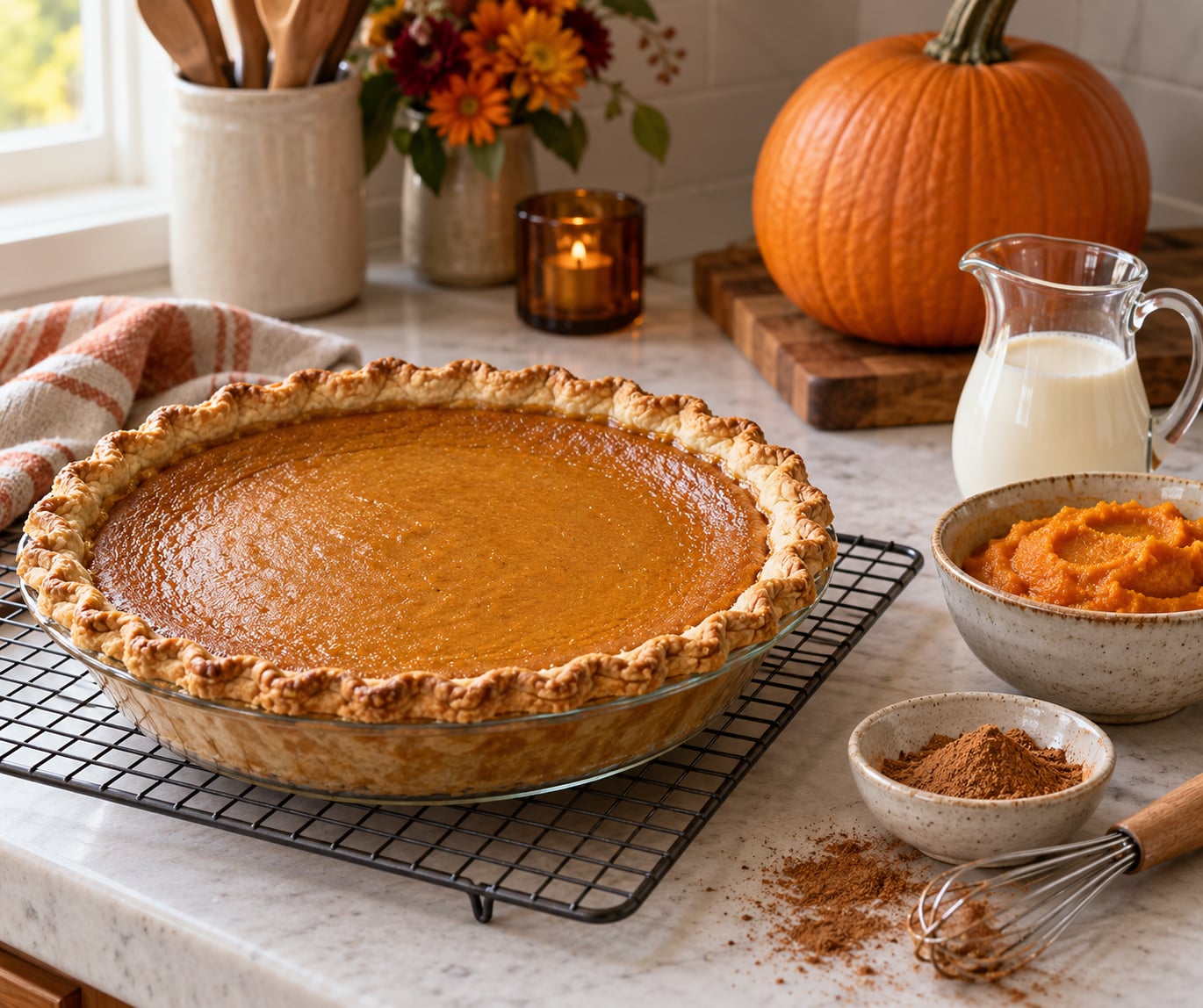
You can make pumpkin pie without condensed milk by swapping the can for plain whole milk or heavy cream, then adding the sugar the can would have supplied. A custard of 15 ounces pumpkin puree, 3/4 cup sugar, 3/4 cup heavy cream, two large eggs and warm spices bakes into a smooth, set pie in about an hour.
Two details matter more than anything else. Use pure pumpkin puree, not canned pumpkin pie filling, because pie filling arrives pre-sweetened and pre-thickened and will make your custard curdle and collapse. And expect the unbaked filling to look far thinner than a canned-milk version. That thinness is normal, and it is exactly why the eggs set so cleanly.
This is a 9-inch pie, eight slices, about 20 minutes of prep and an hour in the oven. If you have never made a custard pie before, the whole job is a whisk, a saucepan and a 9-inch plate.
Table of Contents
- What You Need
- The core filling
- What to use instead of the can
- Sweetness, separately
- Step-by-Step
- How to Make Pumpkin Pie Without Condensed Milk: Blend the Custard Base
- How to Make Pumpkin Pie Without Condensed Milk: Cook the Filling
- How to Make Pumpkin Pie Without Condensed Milk: Fill and Bake the Pie
- How to Make Pumpkin Pie Without Condensed Milk: Cool and Serve
- Common Mistakes
- Frequently Asked Questions
- What can I use instead of condensed milk in pumpkin pie?
- Can I make pumpkin pie without condensed milk using coconut milk?
- How thick should pumpkin pie filling be before it goes into the crust?
- How do I keep the top of my pumpkin pie from cracking?
- Can pumpkin pie be made ahead and refrigerated?
- Is this pumpkin pie recipe vegan and gluten-free?
- Conclusion
What You Need
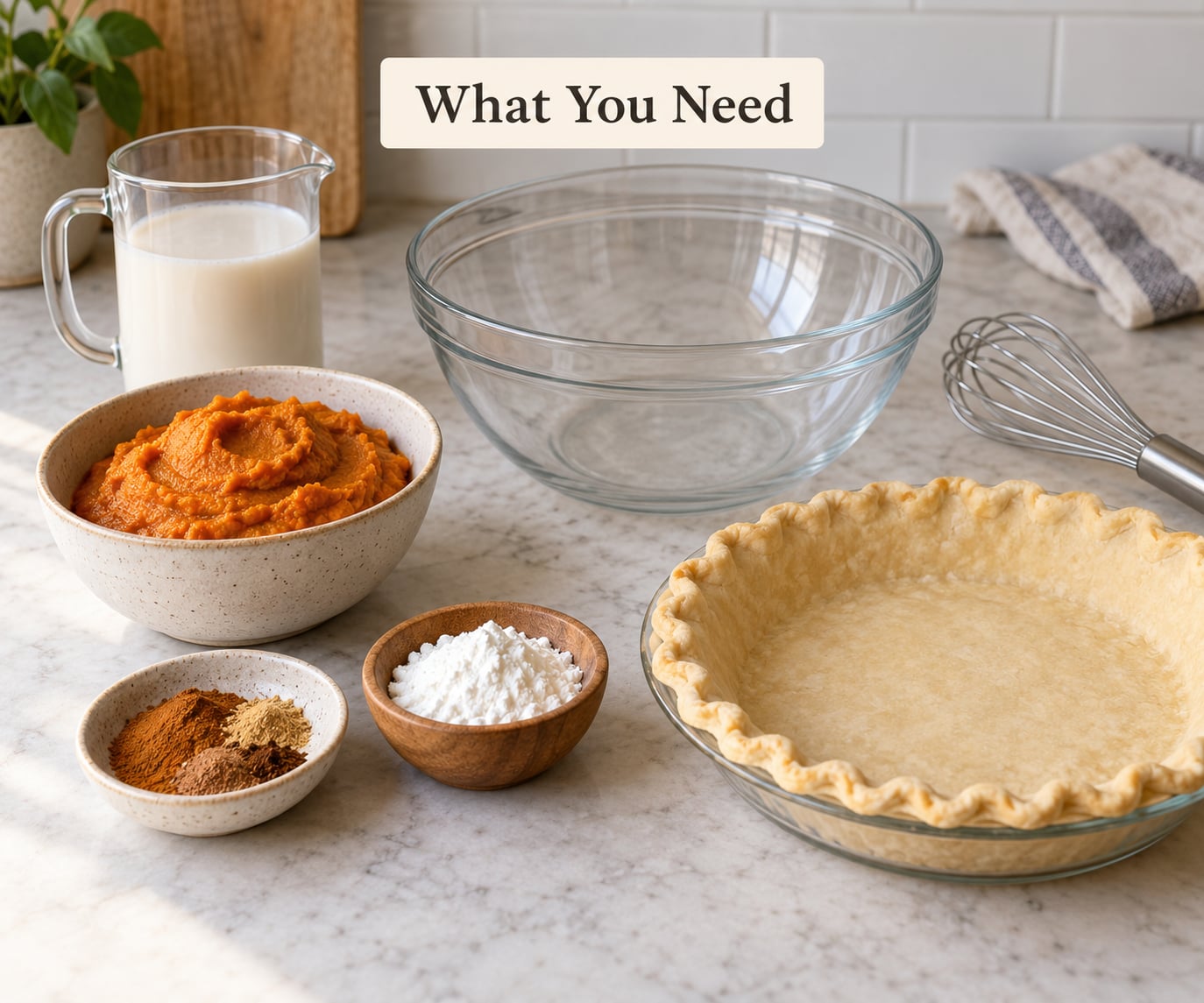
Most recipes start from a 12-ounce can of sweetened condensed milk, which is roughly 1 1/4 cups by volume. Everything below scales from that number, so you can measure once and stop worrying about ratios.
The core filling
- 15 ounces (about 2 cups, 425 g) plain pumpkin puree
- 3/4 cup (150 g) granulated sugar, plus 1/3 cup (65 g) light brown sugar for a deeper, less cloying sweetness
- 3/4 cup (180 ml) heavy cream, half-and-half or whole milk
- 2 large eggs, room temperature
- 1 to 1 1/2 teaspoons pumpkin pie spice
- 1/2 teaspoon fine salt
- 1 teaspoon vanilla extract
- 2 tablespoons cornstarch, whisked with the sugar
Cornstarch is the piece most condensed-milk recipes leave out. Condensed milk carries dissolved sugar and milk solids that give a custard body on their own. When you swap in thin cream or milk, 2 tablespoons of starch put that structure back without making the filling taste starchy.
A 9-inch pie plate, an unbaked 9-inch crust, a medium saucepan, a whisk and a rubber spatula are the whole equipment list. A wire rack for cooling matters more than people think, because a pie set on a warm counter slumps.
What to use instead of the can
This table gives the volume and the extra sugar each liquid needs per 12-ounce can of sweetened condensed milk. The sweetener column is not optional guidance, it is the part that makes the pie taste like pumpkin pie rather than like a bowl of mashed squash.
| Liquid | Amount per 12 oz can | Extra sugar to add | Resulting texture | Dairy-free |
|---|---|---|---|---|
| Heavy whipping cream | 3/4 cup (180 ml) | 3/4 cup sugar | Richest, densest set | No |
| Half-and-half | 3/4 cup (180 ml) | 3/4 cup sugar | Silky, lighter than cream | No |
| Whole milk | 3/4 cup (180 ml) to 1 cup | 3/4 to 1 cup sugar | Clean, well-set, slightly less rich | No |
| Evaporated milk | 3/4 cup (180 ml) | 1/2 cup sugar | Naturally thick, closest to the original | No |
| Buttermilk | 3/4 cup (180 ml) | 3/4 cup sugar | Tangy, softer set, add an extra egg | No |
| Coconut milk | 3/4 cup (180 ml), full-fat | 3/4 cup sugar | Very rich with a faint coconut note | Yes |
| Oat milk | 1 cup (240 ml) | 3/4 cup sugar plus an extra egg | Creamy, slightly softer set | Yes |
| Almond milk | 1 cup (240 ml) | 3/4 cup sugar plus an extra egg | Thinner, needs the extra egg | Yes |
Plant milks carry less protein and less fat, so they give a slightly softer set than dairy. The extra egg in those rows is not superstition, it is extra coagulating protein for a thinner liquid.
Sweetness, separately
If you want to go past plain white sugar, this is where to do it. Brown sugar, molasses and maple all land in the same family of flavors the condensed can was carrying, and each needs a small reduction elsewhere so the pie does not turn cloying.
| Sweetener (per 12 oz can) | Amount | Note |
|---|---|---|
| Light brown sugar | 3/4 cup (165 g) | Best all-round swap, adds a caramel note |
| Dark brown sugar | 2/3 cup (140 g) | Molasses depth, use less than you think |
| Granulated sugar | 3/4 to 1 cup (150 to 200 g) | Cleanest pumpkin flavor, less rounded |
| Maple syrup | 3/4 cup (180 ml) | Lovely with a buckwheat or oat crust |
| Unsweetened molasses | 2 tablespoons (30 ml) | On top of brown sugar, not instead of it |
Go vegan by using full-fat coconut milk, oat milk or almond milk, then add 1 tablespoon of cornstarch and about a tablespoon of aquafaba (the liquid from a can of chickpeas) for the coagulating power the egg would have supplied. For gluten-free, buy a crust made from oats or nut flour, or make a flourless crust and blind-bake it for 8 minutes before the filling goes in.
Step-by-Step
Every route to pumpkin pie without condensed milk lands in the same place: a stovetop custard that sets, an unbaked crust, 425F for 15 minutes and then 350F for 45 to 55 minutes. The high heat gets the filling hot fast so the crust cooks, and the lower heat finishes the custard without cracking the top.
How to Make Pumpkin Pie Without Condensed Milk: Blend the Custard Base
Warm the cream or milk in the saucepan over medium-low heat until you see steam on the surface, then take it off the burner. Let it sit about 5 minutes. Hot milk plus cold eggs is the fastest route to scrambled custard.
Whisk the sugar, brown sugar, cornstarch, spices and salt together in a large bowl first. Add the pumpkin puree and whisk until no dry streaks remain at the bottom. Pour in the warm liquid a little at a time, whisking constantly, then beat in the vanilla and the eggs.
At this point the batter should look like loose orange batter cream, thinner than pancake mix. Strain it through a sieve if your puree has stringy fibers, which is common with pie pumpkins.
How to Make Pumpkin Pie Without Condensed Milk: Cook the Filling
This step is optional insurance, and I use it whenever I am baking for company. Cooking the puree, sugar, spice and milk down before the eggs go in removes the water that makes pie filling weep.
Combine the puree, sugar, spices, salt and half the milk in the saucepan. Cook over medium heat, whisking often, until it steams and thickens enough that a spoon drawn through the bottom leaves a clean trail, about 5 to 7 minutes.
Pour that mixture into a bowl and press a piece of plastic wrap directly onto the surface so no skin forms. Cool it to room temperature, about 30 minutes. Whisk the remaining milk with the eggs, then whisk in the cooled pumpkin base and the cornstarch. The finished custard is thick enough to mound slowly in the bowl and is exactly what you want to see.
If you skip this step, go straight to baking with the raw batter. It works, and the pie will be a little softer in the middle.
How to Make Pumpkin Pie Without Condensed Milk: Fill and Bake the Pie
Roll the crust into a 9-inch pie plate, crimp the edges, and fill it right up to the top of the rim. Thinner batter means less volume than a canned-milk filling, but a deep-dish crust still wants the full quantity.
Bake at 425F for 15 minutes. The edges will look set and the crust will pull slightly from the plate. Cut a strip of foil about 3 inches wide, tent it over the rim and return the pie to the oven at 350F for 45 to 55 minutes, rotating the pie on the rack once if your oven runs hot at the back.
The pie is done when the center wobbles as one soft mass when you nudge the plate, not when the whole surface ripples, and the internal temperature reaches about 165F. A knife inserted 2 inches from the edge should come out clean, while a knife at the very center may still meet resistance. That difference is the jiggly center, and it is not overbaking.
How to Make Pumpkin Pie Without Condensed Milk: Cool and Serve
Cool the pie on a wire rack for at least 2 hours and ideally closer to 3 before slicing. Egg custard carries heat out of the pan as it finishes setting, so a pie cut hot is a pie cut before it is firm. Use a thin, sharp knife and wipe it between slices for clean edges.
Refrigerate at or below 40F and eat within 3 to 4 days. Custards are perishable, so the four-day window is the one to respect rather than the week a box of leftovers would allow.
Freezing works best before baking. Freeze the prepared filling in a container and let it come back to refrigerator temperature overnight before it meets the crust, or freeze an assembled unbaked pie for up to two months. A baked pie can be frozen, but the custard turns slightly grainy and the crust loses its flake, so I keep baked slices for the fridge only.
Common Mistakes
Almost every failed condensed-milk-free pie falls into one of the five rows below. The fixes are specific rather than general, because a vague instruction like add more flour makes the crust soggy later.
| Symptom | What happened | Fix |
|---|---|---|
| Watery filling pooling after slicing | Undercooked custard or watery puree | Bake until the center reaches 165F, cool the full 2 hours, and pre-cook the filling next time |
| Cracked top | Oven too hot or pie baked past the setting point | Shield the rim with foil, drop to 350F, and pull it at the jiggly stage rather than at firm |
| Soggy crust | Unbaked crust under a wet filling, no weights | Blind-bake the crust 8 to 10 minutes with pie weights before filling |
| Filling weeping through the bottom | Crust had a hole or the pie overbaked | Check the crust for cracks, and again pull at 165F rather than at browned |
| Filling baked over the rim | Too much batter for a shallow plate | Use a 9-inch deep-dish plate, or reduce the puree and liquid by a quarter cup |
| Pie tastes flat | Sugar reduced too far | Eggs need sugar to bind into a stable custard, so restore 2 to 3 tablespoons and add a pinch more spice |
If you live above about 5,000 feet, add an extra egg, raise both oven temperatures by 25F and expect to add 10 to 15 minutes to the second bake. Water boils lower up there, and the custard loses moisture faster than it sets.
A few smaller notes that improve the pie quietly. Room-temperature eggs are not a rule from nowhere, since cold eggs tighten the protein web and leave the custard slightly grainy. Vanilla goes in at the end because boiling it flattens it. And if you want a genuinely Appalachian finish, a buckwheat crust with molasses and ginger in the filling cuts the canned-milk sweetness far better than a sweet pie crust does.
Frequently Asked Questions
What can I use instead of condensed milk in pumpkin pie?
The best stand-ins are heavy cream, half-and-half, whole milk and evaporated milk, used at about 3/4 cup per 12-ounce can of condensed milk. Because the can also supplied sugar, add 3/4 to 1 cup granulated or brown sugar alongside the liquid. Coconut milk, oat milk and almond milk work too, though thinner plant milks need an extra egg and a tablespoon of cornstarch for a firm set.
Can I make pumpkin pie without condensed milk using coconut milk?
Yes, and it is one of the most reliable dairy-free swaps. Use about 3/4 cup of full-fat coconut milk per 12-ounce can, plus the same amount of sugar the condensed milk would have provided. Full-fat coconut milk sets richer than the lighter varieties and can taste faintly coconut on the finish. A pinch more cinnamon and ginger hides the note completely.
How thick should pumpkin pie filling be before it goes into the crust?
Thin is correct. Raw filling made with cream or milk should pour like loose batter and look almost runny in the bowl, and that thin custard sets firmly in the oven. If you pre-cook the pumpkin base on the stove first, thicken it until a spoon drawn across the pan leaves a clean trail with no liquid running back in, then cool it before adding the eggs.
How do I keep the top of my pumpkin pie from cracking?
Cracks come from heat that is too high for too long, not from the crust. Start at 425F for 15 minutes to set the crust, then drop to 350F for the remaining 45 to 55 minutes. Use a foil rim shield for the last 25 minutes if your oven runs hot, and pull the pie when the center still wobbles as one soft mass at about 165F.
Can pumpkin pie be made ahead and refrigerated?
Yes, and it is actually easier than a same-day pie. Bake as directed, cool completely on a rack, then refrigerate covered at or below 40F for up to 3 to 4 days. Custard pies are perishable, so that four-day window is the real limit. Let the chilled pie sit at room temperature for about 20 minutes before slicing so the texture comes back.
Is this pumpkin pie recipe vegan and gluten-free?
It is vegan once you swap in a plant milk and add a tablespoon of cornstarch plus about a tablespoon of aquafaba for setting. It is gluten-free only if your pie crust is, since the filling itself carries no gluten. Use an oat, nut or gluten-free flour crust, blind-bake it for 8 to 10 minutes with weights, and skip the flour-thickening trick, which is not compatible with a gluten-free bake.
Conclusion
Start where the whole recipe actually begins: stir together the sugar, cornstarch, spices and salt, then whisk in the puree, the warm milk and the eggs. Get that custard base smooth and seasoned before any heat touches it, and how to make pumpkin pie without condensed milk stops being a question at all.
Let the filling look thin, let the center wobble when it comes out of the oven, and give it two full hours on a rack before the first cut. Those three things are the difference between a pie that slumps and one that holds a clean slice all the way to Thanksgiving dinner.