If you want the short version: add liquid, trap the steam, and heat gently. Drizzle broth, gravy, or melted butter onto the food, cover it tightly with foil or a lid, and warm it low and slow in short bursts until the center hits 165°F. That single combination is how you reheat Thanksgiving leftovers without drying them out, whether you are working on turkey, stuffing, mash, or a whole plate of all three.
Reheated food dries out for two reasons that have nothing to do with how long you cook it. Water on and inside the food migrates to the surface and evaporates, and a microwave adds a second problem: it heats from the outside in, so the rim of your plate overcooks while the center is still cold. Covering returns escaping steam to the food, and a splash of liquid replaces what has already left. Low heat gives the heat time to travel inward before the surface burns off its moisture.
I cook a lot of holiday leftovers in a small kitchen where the oven is usually occupied by somebody else’s casserole. The skillet and steamer-basket methods below are the ones I reach for first, and they need less babysitting than the oven. Whole numbers matter more than technique here: a shallow dish, a splash of broth, a lid, and a thermometer.
Table of Contents
- What You Need
- Step-by-Step: How to Reheat Thanksgiving Leftovers Without Drying Them Out
- Reheat Turkey or Chicken Safely and Moistly
- How to Reheat Mashed Potatoes Without Drying Them Out
- Reheat Stuffing, Casseroles, and Roasted Vegetables
- Reheat Gravy, Soups, and Creamy Sides
- Reheat Pies and Crisp Toppings
- Common Mistakes That Dry Out Leftovers
- Frequently Asked Questions
- What is the best way to reheat Thanksgiving leftovers?
- How do I reheat turkey so it doesn’t turn rubbery?
- How long does it take to reheat a turkey breast in the oven?
- Can you reheat leftovers more than once?
- Is it okay to reheat food and then put it back in the fridge?
- Can you reheat leftovers straight from frozen?
What You Need
You do not need any special equipment. You need a few things that make moisture retention possible, and one tool that tells you when to stop.
- Instant-read thermometer. This is the only reliable way to know you are done. Push it into the thickest part of a turkey slice, not into the sauce.
- Microwave-safe plate with a second plate or a cover. A second plate flipped on top makes a domed lid that traps steam better than plastic wrap.
- Oven-safe baking dish, ideally with a tight-fitting lid. A 9×13 works fine. Ceramic keeps moisture in better than thin metal.
- Covered skillet or saucepan. A cast-iron skillet with a lid is the fastest path to moist leftovers, and it is what most of the people I know who gave up their microwave use instead.
- Measuring cup of liquid. Stock, pan juices, leftover gravy, milk, or water. Have it ready before the food hits the heat.
- Food-storage containers for the check. Airtight, and refrigerated at 40°F or below, which is the number the USDA uses for the cold side of this whole operation.
- Vegetable steamer basket or metal colander. Optional, but it is the best no-microwave method and the most evenly heated one.
A shallow dish matters more than any gadget. Food piled two inches deep in a bowl heats unevenly no matter which appliance you use. Spread dense leftovers like mash into a single layer and the middle stops being the problem.
Step-by-Step: How to Reheat Thanksgiving Leftovers Without Drying Them Out
Here is the short version of the whole table. Temperatures are oven or appliance set points, not internal temperatures. Every item below has to reach 165°F in the center before you serve it.
| Leftover | Best method | Temperature | Time | Add this |
|---|---|---|---|---|
| Turkey breast slices | Skillet with lid, or covered oven dish | 325°F oven / medium-low skillet | 15 to 20 minutes | 1/4 cup broth or pan juices |
| Whole turkey breast | Covered oven dish, foil tent | 325°F | 20 minutes, then check | 1/2 cup broth, loosely covered |
| Drumsticks and wings | Oven, uncovered last 5 minutes | 325°F then broil | 25 to 30 minutes | Drizzle with broth or pan juices |
| Stuffing or cornbread dressing | Covered casserole dish | 325°F | 20 to 25 minutes | 2 to 3 tablespoons broth, or butter |
| Mashed potatoes | Stovetop with lid, or microwave at 50% | Medium-low / 50% power | 5 to 8 minutes, stirring | 1/4 cup broth, milk, or reserved cooking liquid |
| Green bean casserole | Covered casserole, then uncovered | 325°F | 20 minutes covered, 5 uncovered | 2 tablespoons milk or broth |
| Gravy | Saucepan, covered | Medium-low | 5 to 10 minutes | A splash of broth if it has thickened |
| Roasted vegetables | Oven on a sheet pan | 375°F | 15 minutes | A splash of water or oil |
| Cranberry sauce | Saucepan or microwave | Medium / 50% power | 4 to 6 minutes | 1 tablespoon water |
| Pumpkin or pecan pie | Oven, uncovered | 325°F | 15 to 20 minutes | Nothing, but tent the crust if it browns |
Reheat Turkey or Chicken Safely and Moistly
Rubbery turkey is the loudest complaint I hear about reheated holiday leftovers, and it is nearly always a heat problem, not a moisture problem. Push the heat too hard and the muscle proteins contract and squeeze out what water is left. Give the heat more time and less intensity and the same turkey stays sliceable.
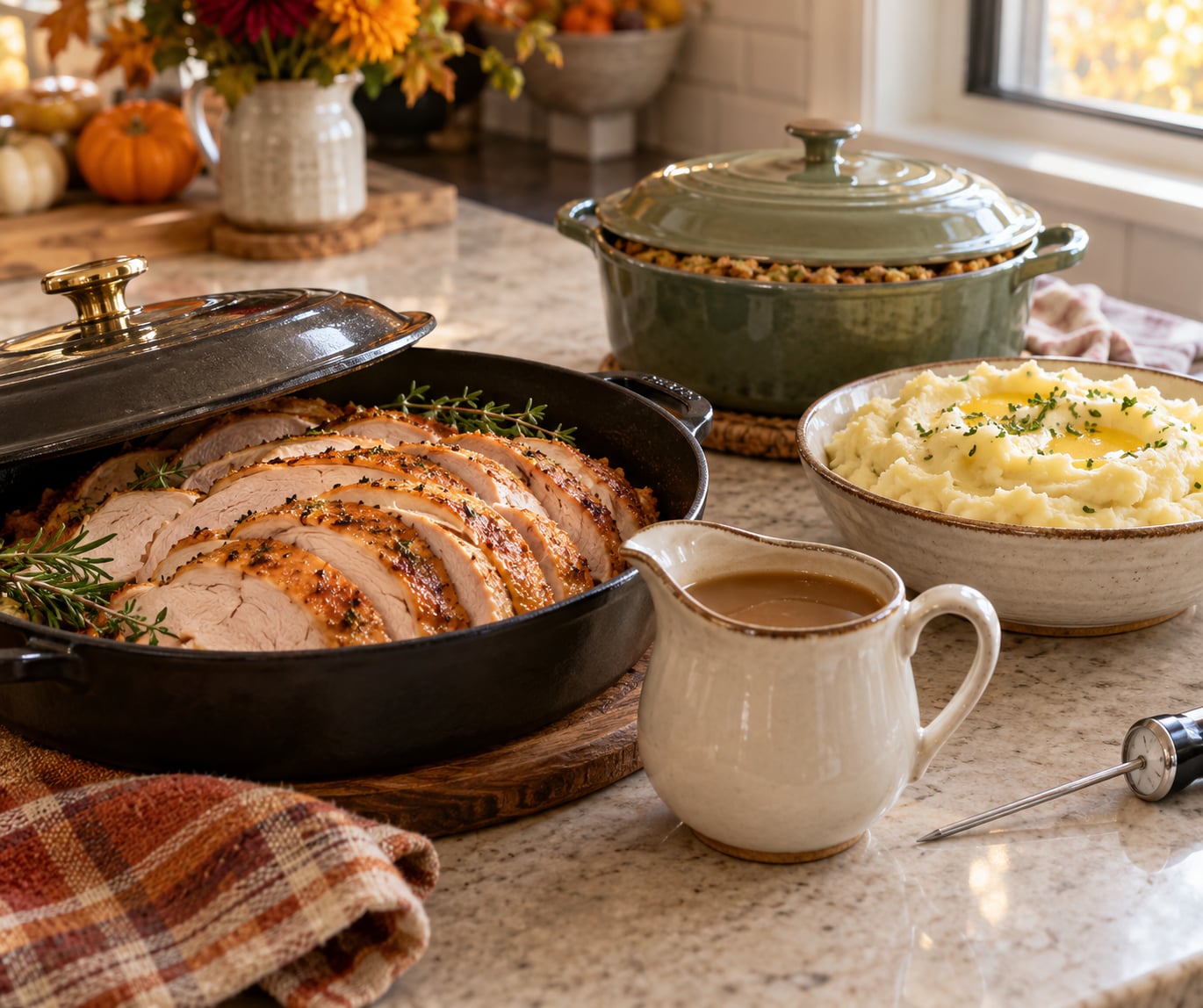
For sliced breast, warm it in a covered skillet over medium-low heat with a quarter cup of stock or the pan juices from the roasting pan. Put the lid on, give it eight minutes, turn the slices, and check the thermometer. A whole breast goes in the oven at 325°F with a half cup of broth and foil tented loosely over the top, not sealed tight, so the steam can still escape instead of pooling and steaming the skin.
Drumsticks and wings want a different finish. Roast them covered at 325°F for about 25 minutes, then take the cover off and run the broiler for four or five minutes so the skin browns. That last blast is what a microwave can never give you, and it is the difference between reheated food and food that tastes reheated.
Stop at 165°F in the thickest part. Rest the meat two minutes before slicing, because the resting time lets the juices redistribute instead of running out onto the board the moment you cut.
How to Reheat Mashed Potatoes Without Drying Them Out
Mash turns gluey from over-microwaving, and that is a starch problem on top of a moisture problem. Full power heats the outside of a pile to boiling while the middle stays cool, and those boiled starches set into a gluey shell. Low power and stirring give you time to break that up.
On the stovetop, put the mash in a saucepan with a lid over medium-low heat and add a quarter cup of broth, milk, or the liquid you saved from boiling the potatoes. Stir every minute or two, scraping the bottom, until it loosens and steams. You usually need five to eight minutes.
In the microwave, spread the mash in a shallow dish rather than a bowl, cover it, and run it at 50% power in two-minute intervals. Stir between intervals and check the center temperature, not the edges. If it is still stiff, add another splash before the next interval instead of doubling the power.
Gravy on top is the best fix of all, and it is why I warm mash and gravy in the same pan. It rehydrates the potatoes and seasons them at the same time.
Reheat Stuffing, Casseroles, and Roasted Vegetables
Stuffing dries out faster than anything else on the table because there is almost no water in it to begin with. Cover it before it goes anywhere. A foil-covered casserole dish at 325°F for 20 to 25 minutes holds steam in the middle and softens the crumb back into something close to what it was on the day you cooked it. Drizzle a little broth or melted butter over the top first, and pull the cover for the final five minutes if you want the edges to toast.
Cornbread dressing holds moisture better than a bread stuffing, but it dries out the same way, so treat it the same. A splash of stock before covering does more than anything else.
Casseroles follow the same logic with a topping twist. Heat green bean casserole covered for 20 minutes to warm the center, then uncover for five to let the onion rings or crumb topping crisp. If the sauce looks tight, add two tablespoons of milk or broth before it goes in.
Roasted vegetables reheat faster than anything else and dry out faster too. A sheet pan at 375°F for 15 minutes with a splash of water or oil on the vegetables keeps them from going leathery. Crowd the pan and they steam each other into mush, so use two pans if you have them.
To check that the center is hot throughout, slide the thermometer into the middle of the pile rather than the edge, and lift the foil for the last minute of cooking so you are not reading a trapped pocket of steam. Thick casseroles and dense stuffing need the check more than thin items like cranberry sauce do.
Reheat Gravy, Soups, and Creamy Sides
Gravy is the easiest thing on the table to fix. Put it in a saucepan over medium-low heat, stir often, and add a splash of broth only when it thickens past the consistency you want. A boiling simmer is what turns it into a gel, so keep the bubbles small.
Soups and stews follow the same path: medium-low, lid on, stir every couple of minutes, and add broth or water a splash at a time until it looks right. Leftover Brunswick stew or any thick soup-and-bean pot reheats like this almost every week in my house in November.
For creamy casseroles like green bean or macaroni and cheese, the stovetop with a lid beats the oven when you are warming one portion. Add a splash of milk if the sauce has gone tight against the dish.
Reheat Pies and Crisp Toppings
Pie wants the gentlest heat on the table. Set the oven at 325°F and warm a pumpkin, apple, pecan, or vegan pie for 15 to 20 minutes. If you are nervous about the crust, tent it loosely with foil for the first 10 minutes. What you are after is a filling that is barely warm through, not a pie that is hot, because the filling is already fully cooked.
Biscuits and rolls go in at 350°F for 6 to 8 minutes, wrapped in foil so they steam as well as bake. Cornbread and cornbread dressing do better in the oven than the microwave, since you want the cut edges to toast.
One honest limit: a microwave cannot re-crisp anything. Browning is a high-temperature chemical reaction between amino acids and sugars, and a microwave oven does not get hot enough on the food’s surface to make it happen. Anything with a crust or breading goes to a skillet with a little oil, a broiler, or an air fryer at 360 to 375°F.
Common Mistakes That Dry Out Leftovers
Reheating uncovered. Everything you add becomes steam, and uncovered, all of it leaves. Foil, a lid, or an upside-down plate, always.
Cranking the heat to save time. High heat cooks the outside of a turkey slice while the middle stays cold. The USDA recommends reheating in an oven set no lower than 325°F, and for good reason.
Running the microwave at full power. Edges hit boiling first and stay there while the center lags. Half power in one-minute intervals, with a stir and a turn between each, is slower on the clock and faster in practice.
Overcrowding one plate. A mound of leftovers is the worst possible shape for even heating. Split it across two plates or use a wider dish.
Drowning the food. More liquid than it needs turns a crisp top into a steamed one. Start with a quarter cup per pound of meat and add from there.
Skipping the center check. Food safety and good texture both depend on it. Check the middle of the thickest piece, then let it stand two minutes before reading the thermometer.
Leaving food out to reheat from room temperature. Perishable food that sits out longer than two hours should be discarded, not reheated.
Waiting for leftovers to brown. If they are reheating at 165°F with steam trapped, they should not need to brown. If they look done but taste dry, the liquid is the missing piece.
Reheating from frozen without adjusting. Frozen food needs about 50% more time, and it needs the liquid added up front because the ice melting is already pulling water out of the food.
Microwaving until a crust is soggy. Then trying to fix it in the microwave again. Move it to a skillet or the broiler from the start.
One final tip: the fastest path to moist leftovers is to reheat only what you are about to eat and leave the rest cold in the fridge. A whole batch warmed twice is drier than one warmed once, no matter how well you covered it.
Frequently Asked Questions
What is the best way to reheat Thanksgiving leftovers?
Add a little liquid, cover the food tightly, and heat it gently until the center reaches 165F. Broth, pan juices, or leftover gravy replace moisture that has already escaped, and the cover traps the steam that forms so it returns to the food. Oven at 325F for sliced meat and stuffing, skillet with a lid for portions, and half-power microwave in short intervals if that is all you have.
How do I reheat turkey so it doesn’t turn rubbery?
Rubbery turkey comes from heat that is too intense, not from a lack of liquid. Warm slices in a covered skillet over medium-low heat with a quarter cup of broth or pan juices, turning them once, and stop the moment the thermometer reads 165F in the thickest piece. Let it rest two minutes before slicing so the juices settle back into the meat instead of running onto the board.
How long does it take to reheat a turkey breast in the oven?
A sliced turkey breast takes 15 to 20 minutes in a covered dish at 325F. A whole breast needs about 20 to 25 minutes, plus time under the broiler if you want the skin browned. Add a half cup of broth or pan juices and tent the foil loosely so steam can still escape. Start checking temperature at 20 minutes, since a thermometer tells you when it is done far more reliably than the clock does.
Can you reheat leftovers more than once?
Reheating food you have already reheated is not recommended. Each warming cycle gives bacteria another chance to multiply in the danger zone, and the moisture on the surface moves further toward the point where the food is damp rather than cooked hot. If you reheat once, eat it immediately. For a second meal, reheat a fresh portion straight from the refrigerator instead of warming the whole batch twice.
Is it okay to reheat food and then put it back in the fridge?
It is safe but not ideal. Reheated food should be refrigerated within two hours, at 40F or below, in shallow airtight containers so it cools quickly. The quality suffers on the second warming because the food has been through two cycles of losing and regaining moisture, so I reheat only the portion I am about to eat and leave the rest cold in the fridge.
Can you reheat leftovers straight from frozen?
Yes, and the USDA says it is safe without thawing first. Move the container from freezer to refrigerator and let it sit overnight if you can, or set it in a shallow pan and microwave on defrost. Cooking from frozen takes about 50% longer, and for turkey or stuffing you want to add the broth or butter before it goes in, because the melting ice pulls moisture out of the food on the way.
Start with the turkey. Put it in a covered dish with a quarter cup of broth, heat it gently, and check the center at 165°F. Everything else on that plate is easier once you have the pattern down: add liquid, seal it, and go slow.