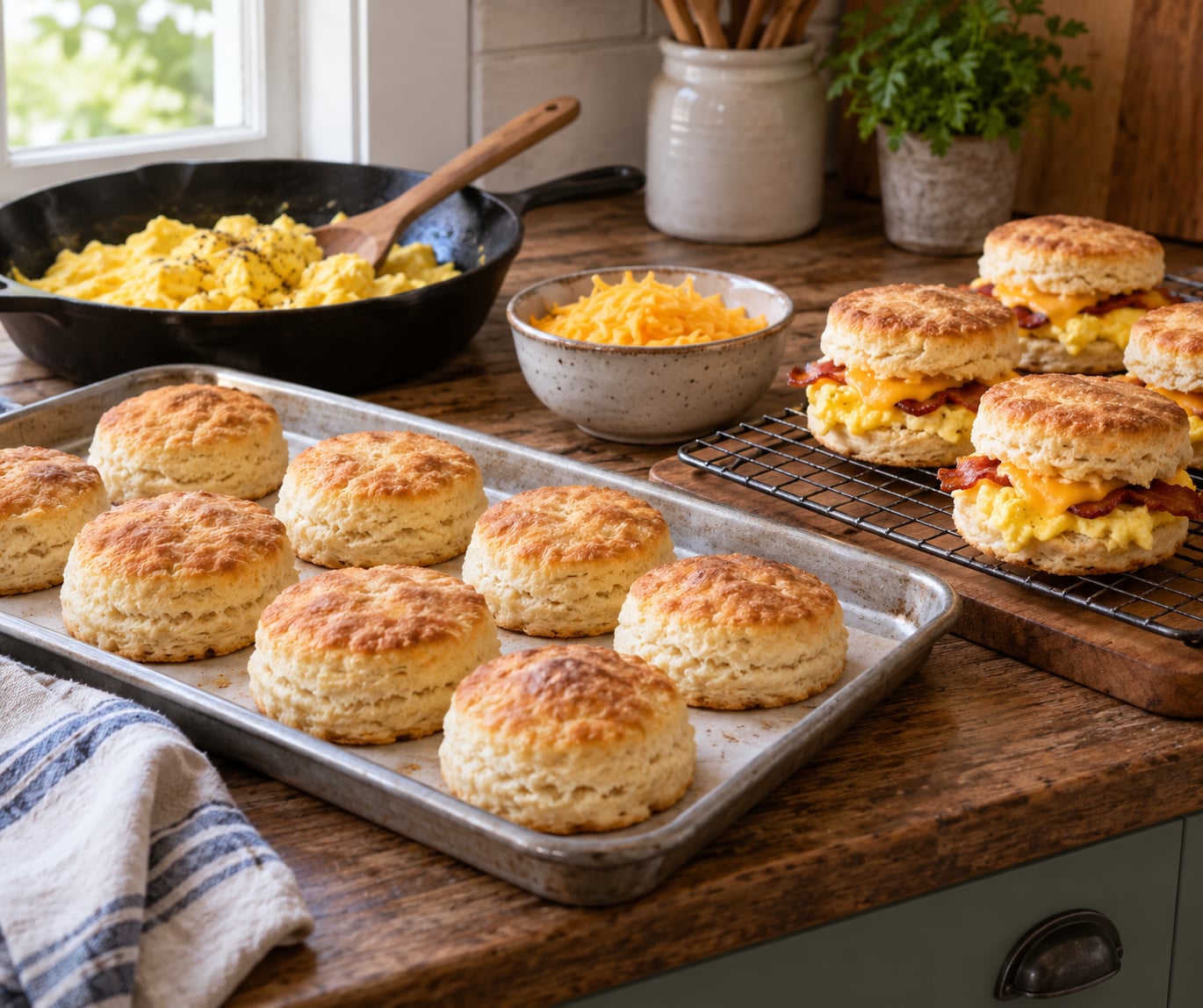
To make biscuit sandwiches for a crowd, bake a double or triple batch of large biscuit rounds, cook the filling in a skillet, then split and stack everything in the last half hour before serving. Budget 1.5 to 2 biscuits per person, so 10 guests means 15 to 20 sandwiches. The whole job runs on one rimmed sheet pan, one skillet, and a rack.
Most sandwich biscuits are baked for one person. Crowd sandwiches are built differently: the dough gets rolled thicker and cut with a 3-inch cutter so each half can stand up to a hot patty, the filling gets cooked and cooled ahead so it does not soak through the bottom, and assembly happens in waves instead of all at once.
Before you start, this is the short version of your plan:
- Biscuits per person: 1.5 to 2, cut with a 3-inch round cutter
- Hands-on time: about 45 minutes for 24 sandwiches, plus oven batches of 12
- Make-ahead window: dough 1 day in the fridge or 2 months in the freezer; baked biscuits 2 days refrigerated or 1 month frozen
- Holding window: roughly 90 minutes in a low oven at 200°F with a damp towel tucked under the pan
Table of Contents
- What You Need for Biscuit Sandwiches for a Crowd
- Equipment
- Ingredients for 10 guests (15 to 20 sandwiches)
- Step-by-Step
- Choose and prepare the fillings
- Bake and cool the biscuits evenly
- Build the biscuit sandwiches for efficient serving
- Keep, transport, and serve the sandwiches
- Common Mistakes
- Scale the recipe for your crowd
- Frequently Asked Questions
- Can I make biscuit sandwiches ahead of time for a party?
- What are the best biscuit sandwich fillings that do not get soggy?
- How many biscuit sandwiches should I make per person?
- Should I assemble biscuit sandwiches while the biscuits are still warm?
- How do I make biscuit sandwiches for a gluten-free or vegan crowd?
- How long can prepared biscuit sandwiches sit out safely?
- Conclusion
What You Need for Biscuit Sandwiches for a Crowd
The list is short because crowd biscuit sandwiches are not complicated food. They are bread, filling, and a system.
Equipment
- Two rimmed baking sheets and a roll of parchment paper
- Rolling pin and a 3-inch biscuit cutter (a clean coffee can works)
- One large skillet for the sausage and eggs, plus a second pan if you are doing sheet pan eggs
- A wire cooling rack set on a baking sheet, which becomes your holding station
- Two shallow containers for prepped filling and finished sandwiches
- A foil lid or a clean damp towel for transport
Ingredients for 10 guests (15 to 20 sandwiches)
| Item | Amount per 10 guests |
|---|---|
| All-purpose flour (or a biscuit mix) | 3 cups flour, or two 10-ounce tubes of refrigerated biscuits |
| Baking powder | 2 teaspoons |
| Baking soda | 1/2 teaspoon |
| Salt | 3/4 teaspoon |
| Cold butter or lard, cubed | 6 tablespoons |
| Buttermilk, or milk with 1 tablespoon lemon juice added | 3/4 cup |
| Breakfast sausage, raw ground pork | 1 to 1 1/4 pounds |
| Eggs | 6 large |
| Sharp cheddar, shredded | 1 1/2 cups |
| Hot sauce, honey, or butter for serving | 1/4 cup total |
That table scales cleanly. Double it for 20 guests, triple it for 30, and remember that a doubled dough should be mixed in two bowls rather than one, because hand-mixing a big batch warms the butter before it reaches the oven. For an Appalachian-style version, swap the butter for lard and bake the rounds in a preheated cast iron skillet with a little bacon drippings in the bottom.
Step-by-Step
Choose and prepare the fillings
Pick fillings that are cooked, cooled, and only slightly moist. Wet filling is the number one cause of a soggy biscuit bottom, and the fix is to drain everything well and cool it before it goes anywhere near bread.
Brown the sausage in the skillet, breaking it into patty-size pieces, then cook the eggs in the same pan so you pick up the drippings. Ground meat needs to reach 160°F; if you swap in poultry sausage or chicken, that goes to 165°F. Scrape everything onto a platter, let it lose its heat for 15 to 20 minutes, and only then add the cheese.
Plant-based paths work the same way. Plant-based sausage browns in a separate pan so the egg substitute stays clean, and sliced plant-based cheese goes on after the cooling step so it does not gum the biscuit. For gluten-free guests, bake the biscuits from a gluten-free baking mix on parchment and keep the filling naturally wheat-free, which sausage, eggs, and most cheeses already are.
Bake and cool the biscuits evenly
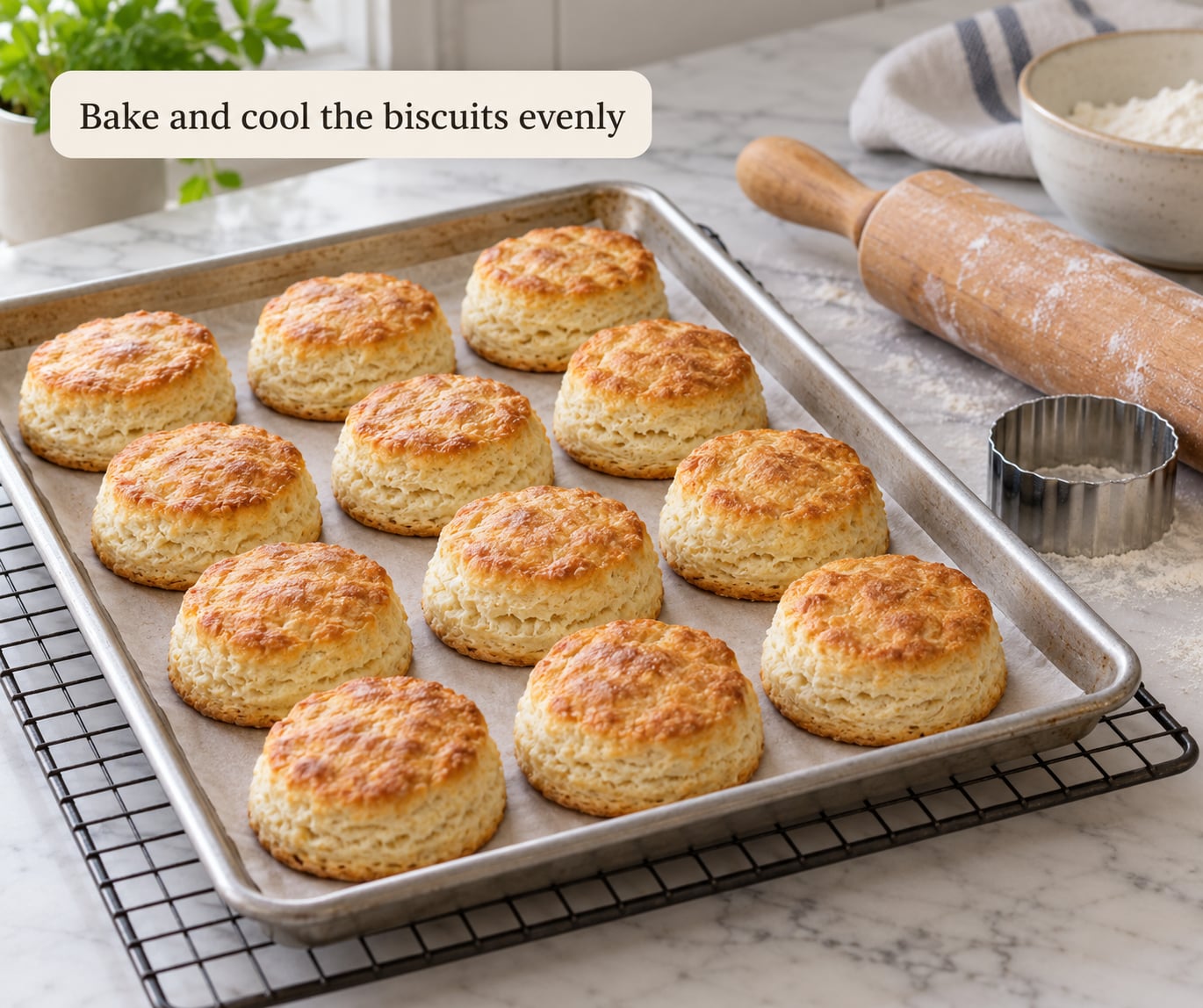
Heat the oven to 425°F with the rack in the upper third. 425°F is the right number for a large batch: 450°F browns the tops fast but leaves the middle of a thick crowd round underdone before the edges crisp.
Cut the cold butter into the flour with a pastry blender until the pieces are about the size of a pea, add the buttermilk, and stir just until it holds together. Pat the dough into a rectangle about three quarters of an inch thick, fold it in thirds, turn ninety degrees, and do that three more times. That folding is what gives you layers in a large batch.
Roll it out again and cut 3-inch rounds. Leave an inch of space between biscuits on the pan; touching rounds bake into each other’s sides and come out pale. Re-roll scraps only twice before you stop, because the third re-roll is where dough goes flat and dense.
Bake 12 to 15 minutes, swapping and rotating the pans halfway, until the tops are golden and the bottoms sound hollow when you tap one. Move the biscuits to a wire rack, not a plate, and let them cool 10 minutes. Warm biscuits tear when you split them and melt any butter you brush on.
Build the biscuit sandwiches for efficient serving
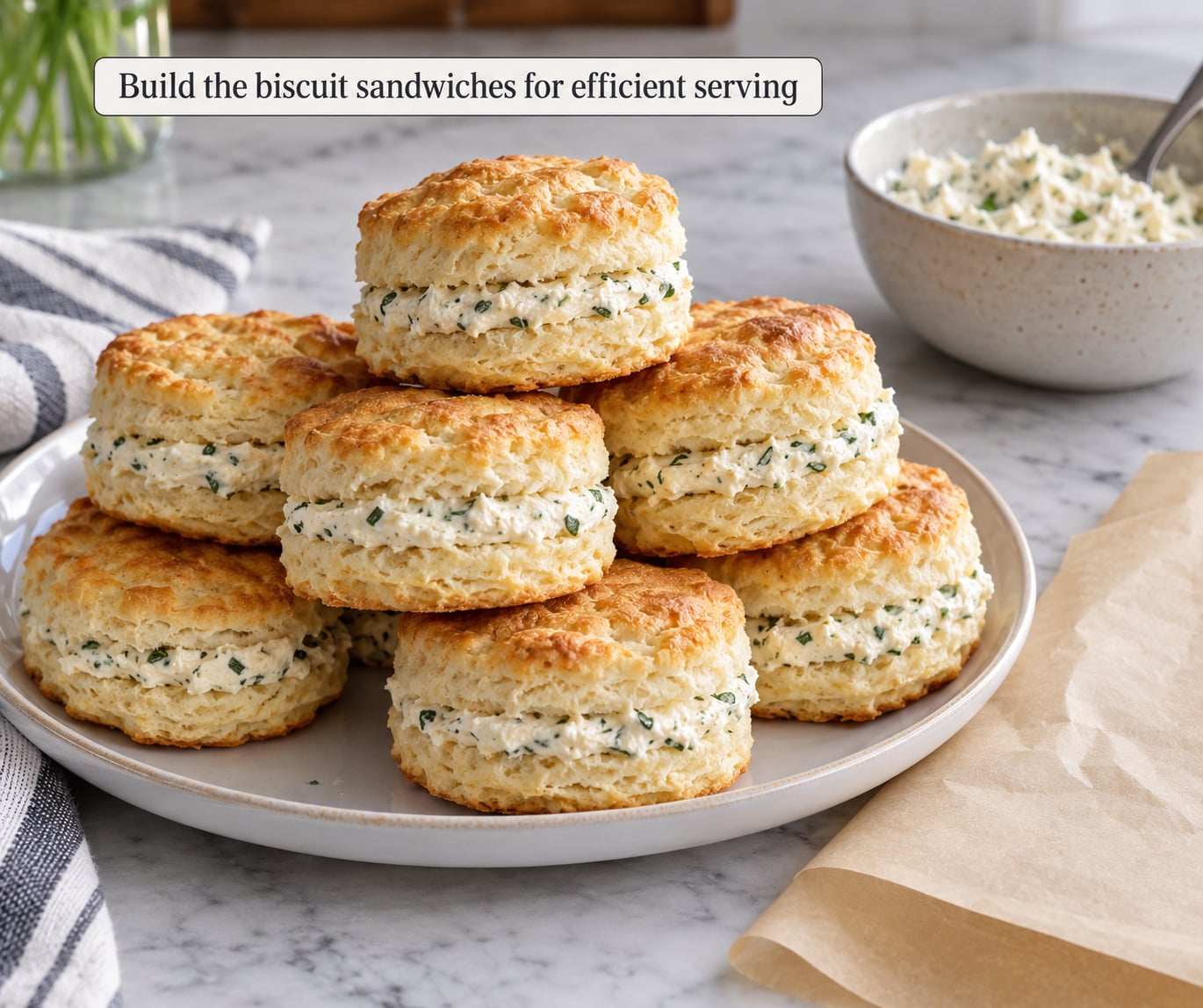
Split each biscuit with a serrated knife, turning it cut-side down as you go so the crumbs fall onto the board instead of onto your filling. Use about a third of a cup of filling per sandwich, enough to mound slightly without pushing out the sides.
Put the moist condiment where it belongs. Hot sauce and honey belong on the filling; butter goes on the cut face of the top half only. Skip mayonnaise and cold gravy on the bottom, because they steam into the biscuit and by the second wave it is a mess.
Build in batches. Fill everything, then arrange the sandwiches on a lined sheet pan in a single layer or two layers at most, seam side down. A tray of 12 goes into the low oven while you assemble the next tray, and the last sandwiches hit the platter about the time the first guests sit down.
Keep, transport, and serve the sandwiches
For a service window of about 90 minutes, set the oven to 200°F, slide the pan of sandwiches in, and tuck a clean damp towel under the rack. The towel gives back the moisture the biscuits lose, and the low heat keeps them from drying out or going rubbery.
Do not cover the tray with foil while they warm. Trapped steam softens the crust, which is the one thing people notice first about a good biscuit.
Transport works the same way. Set the sandwiches in a single layer in a shallow container, lid it, and put the container in a cooler or an insulated bag with an ice pack. Keep meat, poultry, egg, and dairy fillings out of the danger zone of 40°F to 140°F for no more than two hours, and one hour if the day is above 90°F. Plant-based fillings tolerate longer but still should not sit warm and unrefrigerated for hours.
Common Mistakes
Flat, dense biscuits. Too much handling. Mix in two bowls for large batches, re-roll scraps no more than twice, and chill the cut rounds 15 minutes before the oven. Warm dough bakes flat every time.
Uneven rounds. You cut without measuring. Roll to three quarters of an inch, use one cutter, and tap the cutter straight down instead of twisting it, which thins one side.
Soggy bottoms. Filling went on hot or wet. Cool it fully, drain it, and hold sandwiches uncovered in the low oven.
Filling sliding out on the first bite. Too much, or too loose. Cut to a third of a cup, pack it into the biscuit rather than stacking it, and press the top half down gently to settle it.
Assembling while biscuits are still hot. They tear and the butter melts out. Ten minutes on the rack, no longer.
Everything cold by the time guests eat. You assembled too early. Assembly is the last 30 minutes, not the first.
One oven, two pans, no rotation plan. Bake 12 biscuits per pan, and start the second pan the moment the first comes out. A swap at the halfway mark keeps them the same color.
Scale the recipe for your crowd
Multiply by guest count, not by intuition. The table above is the base unit, and this is how it moves.
| Guests | Biscuits to bake | Dough | Sheet pans at 425°F | Filling |
|---|---|---|---|---|
| 6 | 10 to 12 | 2 cups flour | 1 | 3/4 lb sausage, 4 eggs, 1 cup cheese |
| 10 | 15 to 20 | 3 cups flour | 2 | 1 to 1 1/4 lb sausage, 6 eggs, 1 1/2 cups cheese |
| 20 | 30 to 40 | 6 cups flour in two bowls | 3 to 4 | 2 1/2 lb sausage, 12 eggs, 3 cups cheese |
| 30 | 45 to 60 | 9 cups flour in three bowls | 4 to 5 | 3 1/2 to 4 lb sausage, 18 eggs, 4 1/2 cups cheese |
Past 24 sandwiches, stop trying to assemble everything before guests arrive. Bake and cool all the biscuits, warm the filling in two skillets at once, then run assembly in waves of 12 so a fresh tray appears every 20 minutes. If a second oven is available, bake biscuits on the lower setting while the sheet pan eggs finish on top.
The one rule for big numbers: give yourself more lead time than feels reasonable. A two-pan morning takes 90 minutes from counter to first sandwich, and three pan mornings take closer to two.
Frequently Asked Questions
Can I make biscuit sandwiches ahead of time for a party?
Bake the biscuits ahead and assemble the sandwiches the same day. Baked biscuits keep 2 days in an airtight container in the fridge or 1 month frozen, and unbaked cut dough keeps 1 day refrigerated or 2 months frozen. Cook the sausage and eggs a day ahead too, then reheat them in a skillet the morning of. Hold the assembled sandwiches in a low oven rather than making them the night before, since steam trapped overnight softens the crust.
What are the best biscuit sandwich fillings that do not get soggy?
Cooked and drained filling is the answer. Breakfast sausage, scrambled eggs, and shredded cheddar work because they carry moisture but not liquid. Sliced ham and thick tomato slices are fine if you salt the tomato and pat it dry first. Avoid mayonnaise, cold gravy, and wet salad-style fillings on the bottom half, since those turn the biscuit base soft within an hour. A thin spread on the top half only.
How many biscuit sandwiches should I make per person?
Plan 1.5 to 2 per person, which means 15 to 20 sandwiches for 10 guests and 45 to 60 for 30. Two is the safe number when the sandwiches are the whole meal. Go closer to 1.5 if you are also serving grits, fruit, and coffee, or if some sandwiches will be smaller. Buy one extra can of biscuits beyond your number, because breakage and second helpings both happen.
Should I assemble biscuit sandwiches while the biscuits are still warm?
No. Biscuits straight from the oven tear when you split them and melt any butter on the cut face, which slides out during transport. Let them cool on a wire rack for at least 10 minutes, longer if the kitchen is warm. Warm biscuits also steam the filling and soften the bottom. Once assembled, hold the sandwiches in a 200 degree oven with a damp towel underneath rather than covering them.
How do I make biscuit sandwiches for a gluten-free or vegan crowd?
For gluten-free guests, bake biscuits from a gluten-free baking mix on parchment and verify your sausage and cheese are labeled gluten-free, since many breakfast sausages contain wheat filler. For a vegan crowd, use refrigerated plant-based biscuits or a vegan mix, plant-based sausage browned in its own pan, and an egg substitute or scrambled tofu scrambled with turmeric for color. Everything else in the method stays the same, including cooling the filling before assembly.
How long can prepared biscuit sandwiches sit out safely?
Sandwiches with sausage, egg, poultry, or cheese should not sit between 40 and 140 degrees for more than two hours, and only one hour when the outdoor temperature is above 90 degrees. To hold them longer, set the pan in a 200 degree oven, or move the whole tray into a cooler with an ice pack for transport. Plant-based fillings are more forgiving, but refrigerated or pickled ingredients like cheese and condiments still need to stay cold.
Conclusion
Start with the number, not the oven. Count your guests, multiply by 1.5 to 2 for 3-inch biscuits, and mix that dough early enough that it can chill while you cook the filling. Bake the rounds at 425°F, cool them ten minutes on a rack, assemble in waves of a dozen, and hold the rest in a 200°F oven until people walk in.