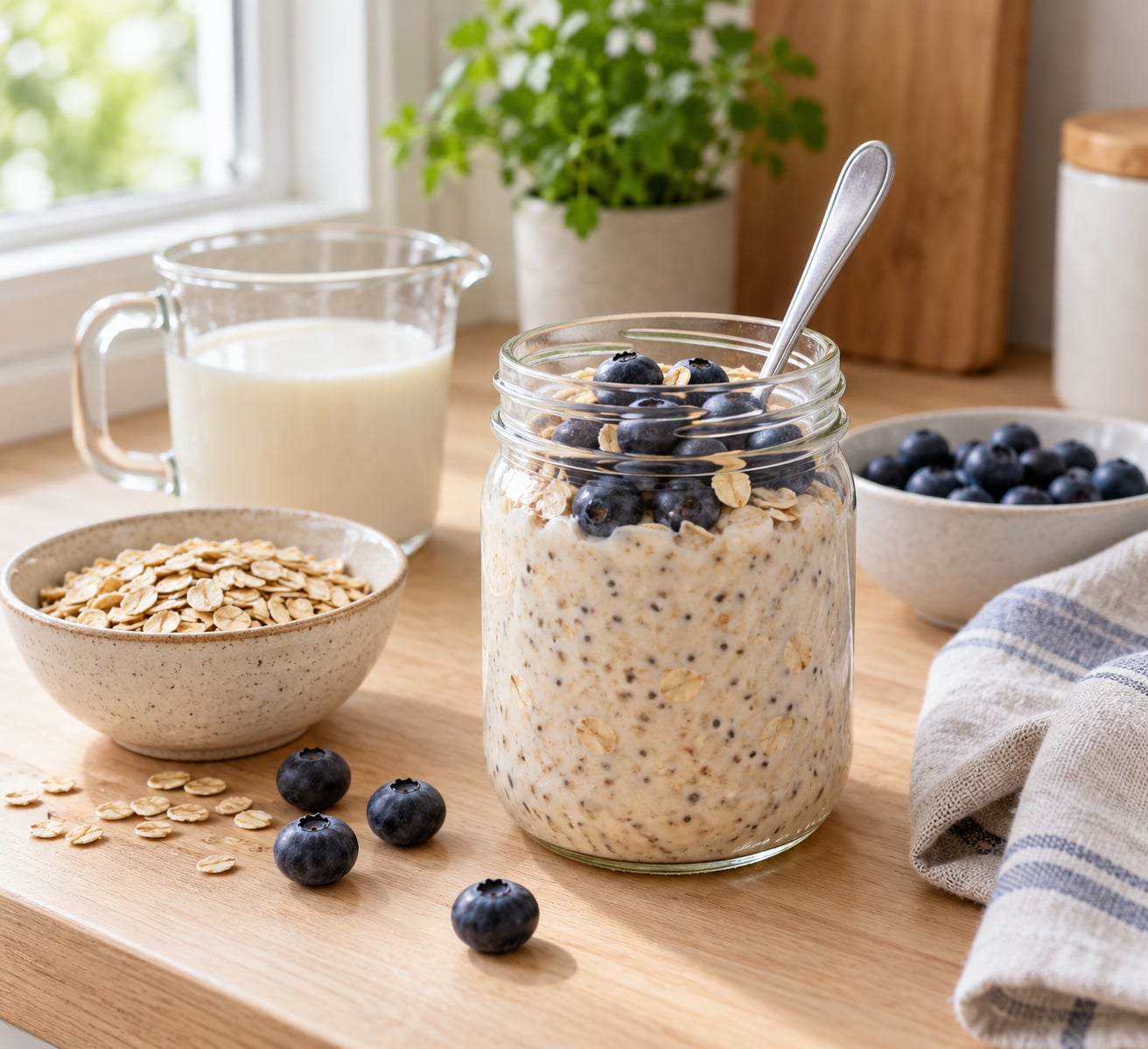
If you have been trying how to make overnight oats that are not slimy, the jar turns to glue for one mechanical reason: oats release starch and soluble fiber into more liquid than they can hold, then sit there for hours. The fix is simple. Use thick rolled oats, hold the liquid near a 1:1 ratio by volume, add a thickener, and chill covered for about eight hours. Ten minutes of assembly, no cooking at all.
Most people I know have abandoned overnight oats for one of two reasons. The jar turned into glue, or it set like wet cement and nobody could scoop it. Both failures trace back to variables you can control, mostly before the jar ever reaches the fridge.
Table of Contents
- What You Need
- Which oats to pick, in one line each
- Step-by-Step: How to Make Overnight Oats That Are Not Slimy
- Step 1: Pick oats that hold their shape
- Step 2: Use roughly a 1:1 liquid-to-oat ratio
- Step 3: Mix the liquid first, then the oats
- Step 4: Chill covered until fully set
- Step 5: Loosen overnight oats that are not slimy and flavor them last
- Common Mistakes
- Fixing a jar that is already slimy
- Frequently Asked Questions
- Is it normal for overnight oats to be slimy?
- Why are my overnight oats gooey?
- Can you make overnight oats with water instead of milk?
- How long do overnight oats need to soak?
- How do I make overnight oats thicker without cement?
- Conclusion
What You Need
The base recipe is short enough to memorize. Half a cup of oats, half a cup of liquid, a tablespoon of something thick, and a sweetener you like. Everything else is optional.
| Ingredient | Amount for one jar | What it does |
|---|---|---|
| Thick rolled oats (old-fashioned) | 1/2 cup | The base. Holds a chewy bite instead of dissolving |
| Milk, oat milk, or yogurt-thinned milk | 1/2 cup | Hydrates the oats. More than this is the number one cause of soup |
| Chia seeds | 1 tablespoon | Sets into a mild gel and stops the mixture from separating |
| Greek yogurt | 2 tablespoons | Adds protein and body without turning the jar to cement |
| Maple syrup, honey, or sorghum | 1 to 2 teaspoons | Sweetness. Less is fine since fruit adds plenty later |
| Salt | Pinch | Pulls sweetness forward so you can use less of it |
Everything except the oats is a swap. Oat milk and lactose-free milk both work, and for a vegan jar use a thick plant yogurt or bump the chia to two tablespoons. For gluten-free, buy oats labeled gluten-free rather than assuming, since regular oats are frequently milled on shared equipment.
Airtight container matters more than people expect. A mason jar with a lid, or any jar with a screw top, keeps the oats from absorbing fridge odors and stops the surface from drying into a skin. You also want a whisk or a fork, a measuring cup, and about ten minutes.
Which oats to pick, in one line each
Rolled and steel-cut oats are the only two worth using here. Instant oats turn to paste because they are steamed thin and pre-cooked, and that is the single most common mistake in overnight oats.
| Oat type | Liquid ratio that works | Result after 8 hours |
|---|---|---|
| Thick rolled (old-fashioned) | 1:1 by volume | Chewy, creamy, holds a bite. The safe default |
| Steel-cut | 1:1.5, they drink more | Nuttier and firmer, closer to cooked oatmeal. Some people switch to these specifically to escape any gummy feel |
| Quick-cooking | Not recommended | Breaks down into a smooth paste. This is where the slime comes from |
| Instant | Not recommended | Dissolves almost completely. Avoid entirely |
Step-by-Step: How to Make Overnight Oats That Are Not Slimy
Step 1: Pick oats that hold their shape
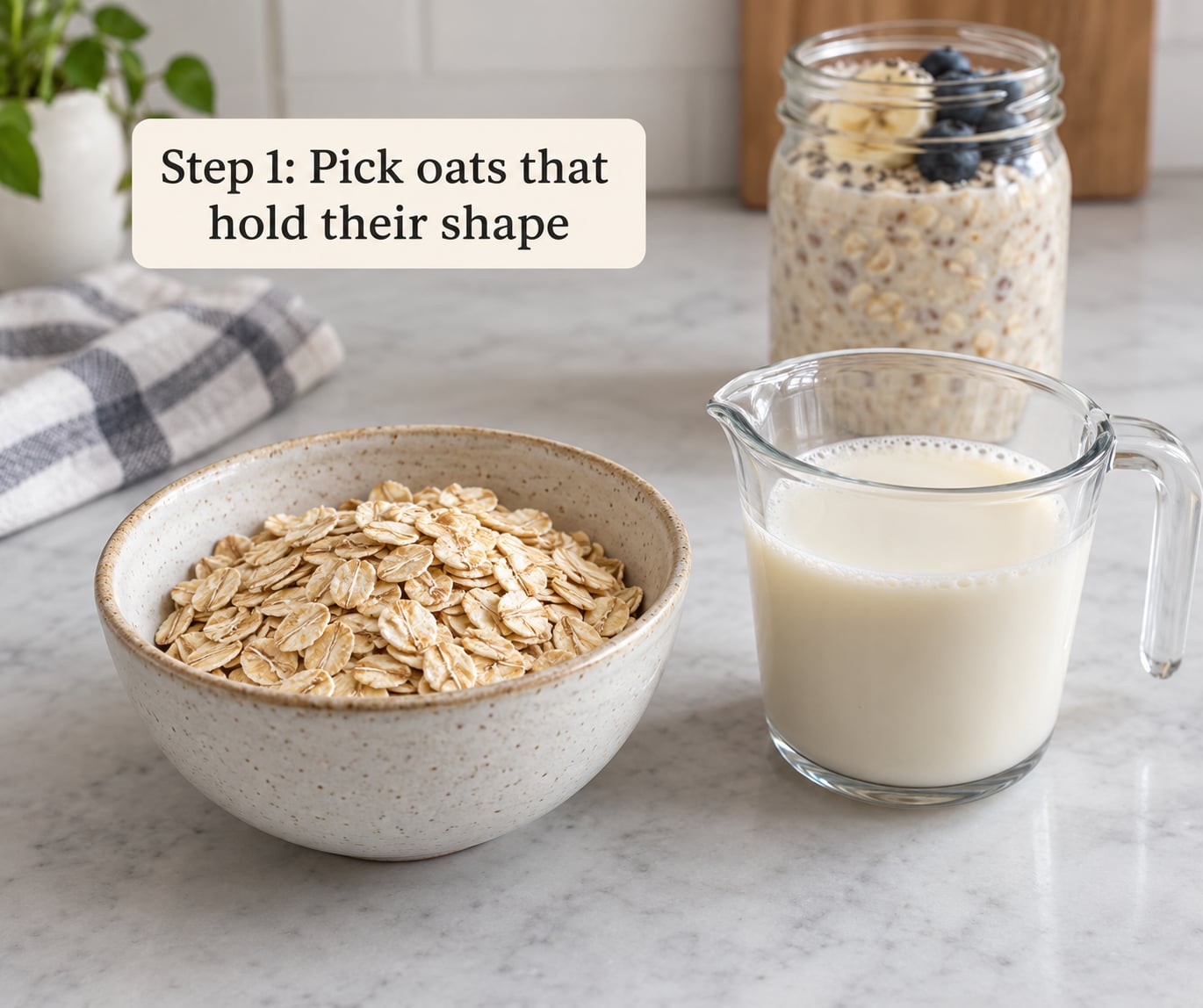
Start with thick rolled oats from the section labeled old-fashioned, not the bag that says quick. If you only have instant oats in the house, buy rolled or toast the instant ones briefly in a dry pan first, which firms them up a little.
A ten-minute toast in a 350 degree oven does two jobs. It drives off the raw, starchy taste people mistake for sliminess, and it dries the oat flakes so they hydrate more slowly through the night.
Step 2: Use roughly a 1:1 liquid-to-oat ratio
Half a cup of oats to half a cup of liquid is the starting point, and the reason so many jars turn to soup is people add until it looks right in the dry jar. It will not look right dry. Trust the number and adjust in the morning.
You will find advice online that says to add twice as much milk as oats, and other advice saying that too much milk is exactly what causes runniness. Both are describing different recipes. Twice-as-much works when chia does most of the thickening and you want something closer to a drinkable pudding. For a creamy, spoonable jar, 1:1 with a tablespoon of chia is the ratio that holds.
Steel-cut oats need closer to 1:1.5 because the pieces are denser and drink more. If you use water alone, cut the liquid slightly and add chia, because water gives a thinner gel with nothing to bind it.
Step 3: Mix the liquid first, then the oats
Whisk the chia into the liquid and let it sit two or three minutes before anything else goes in. Chia clumps when it is dumped onto dry oats and stirred in at the end, which gives you those hard little pockets nobody wants to bite into.
Then stir in the yogurt, sweetener, and salt, and only after that fold in the oats. Stir for a full thirty seconds, scraping the bottom and the sides, until nothing loose is sitting at the bottom of the jar. Unmixed oats hydrate unevenly, and the dry pockets turn pasty while the rest stays thin.
Step 4: Chill covered until fully set
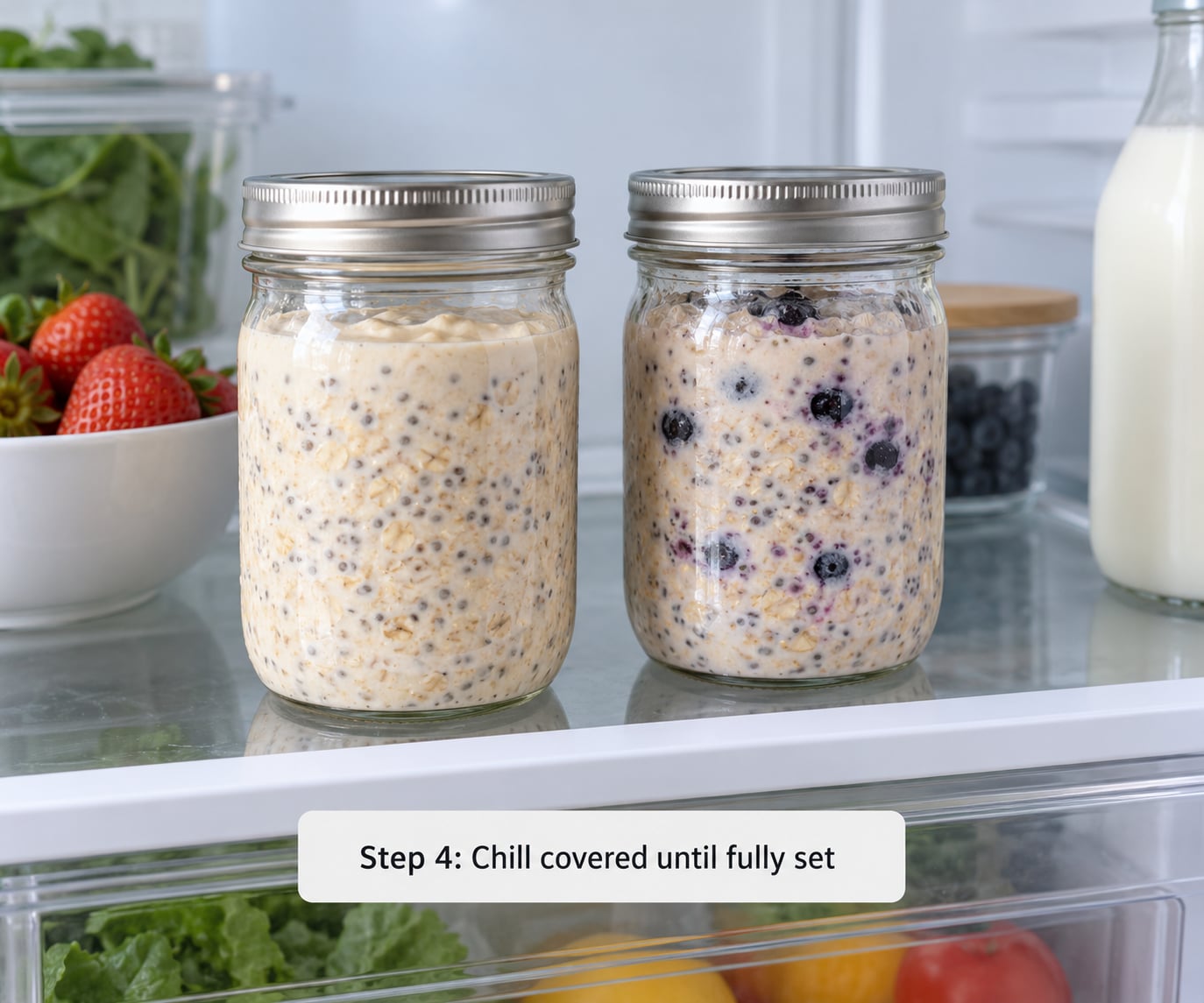
Lid it, refrigerate, and leave it for eight hours. Refrigeration is not optional here. At room temperature, starch moves faster and the mixture turns to paste well before you are ready to eat it.
You will know it is set when the surface looks matte rather than wet, and a spoon dragged across the bottom leaves a clean trail instead of cutting a wet channel. Four to six hours works if you are in a hurry, and a long soak of ten hours is fine too, as long as the jar is properly covered.
If the oats are still loose after eight hours, put them back for another two rather than stirring in milk at midnight. More liquid will only undo the set.
Step 5: Loosen overnight oats that are not slimy and flavor them last
In the morning, stir hard from the bottom. The bottom of a properly set jar is denser than the top, and that difference is normal, not a failure.
If it is tight, add liquid a tablespoon at a time and stir between each. Milk for creaminess, water if you want the oat flavor louder. If it is loose instead, stir in a spoonful of Greek yogurt or a teaspoon of chia and wait ten minutes.
Keep every wet topping for now. Fresh berries, applesauce, yogurt, and nut butter all keep releasing water into the base, which is how a good jar becomes a disappointing one by Wednesday. Add those in the morning, then finish with something dry like toasted nuts, granola, or coconut on top.
Common Mistakes
Almost every slimy jar has one of five causes. Find the symptom in the table below, then fix that row rather than rebuilding the whole recipe.
| Symptom | Cause | Fix |
|---|---|---|
| Slimy or gummy throughout | Instant or quick oats, or too little liquid | Switch to thick rolled oats and hold 1:1 by volume |
| Thin and gluey film at the bottom | Oats stirred in last, sitting unmixed | Whisk liquid first, stir 30 seconds, scrape the bottom |
| Runny or soupy | Too much liquid, or soaked 3 days | Use 1:1 next time; add a spoonful of Greek yogurt now |
| Sets like cement | Too much chia or yogurt, or not enough liquid | Stir in milk a tablespoon at a time; cap chia at 1 tablespoon |
| Fruit turned to mush | Wet toppings added before chilling | Add fruit in the morning, keep only spices and dry sweetener in the jar |
| Sour or tangy taste | Yogurt sitting overnight begins lacto-fermentation | Expected after 24 hours, not spoilage. Use less yogurt next time |
| Oats stuck to the sides | Container stored uncovered | Use a lidded jar so the oats stay hydrated |
| Crunchy, raw-tasting oats | Untoasted flakes | Toast 10 minutes at 350 degrees before soaking |
The two mistakes that catch people hardest are adding liquid by eye in an empty jar and skipping the final stir. Both feel harmless and both produce the paste people end up blaming on oats in general.
Fixing a jar that is already slimy
Not every failed batch is a write-off. Start by adding a tablespoon of Greek yogurt and stirring it through, which binds loose starch and gives you something closer to a pudding. If that is not enough, blend the jar for twenty seconds with a splash of milk. Blended oats trade their chew for a smooth, spoonable texture that some texture-sensitive eaters actively prefer, and the same technique works for people who find cooked oatmeal unappealing.
Serving it as a smoothie-style version is another way out. Thin with milk to drinkable consistency, add a banana or a spoon of apple butter, and the gluey texture becomes a feature.
Keep jars refrigerated and use them within four days for the best texture. Beyond that, oats continue softening, so the jar you make on Sunday is not the jar you eat on Friday. If the smell is sour in a sharp, alcoholic way, or there is visible fuzz, discard it regardless of how it looks.
Frequently Asked Questions
Is it normal for overnight oats to be slimy?
No. A little body is normal and desirable, but a slimy or gluey jar means the oats broke down rather than hydrated. The usual causes are quick or instant oats, more liquid than the oats can absorb, or chia clumps sitting at the bottom. Thick rolled oats at a 1:1 ratio will set creamy, not slimy.
Why are my overnight oats gooey?
Gooey texture comes from oat starch and soluble fiber dispersing into liquid that has nowhere to go. Steel-cut or thick rolled oats release starch more slowly than quick oats, which is why they stay creamy. A tablespoon of chia or two tablespoons of Greek yogurt absorbs excess liquid and firms the jar back up.
Can you make overnight oats with water instead of milk?
Yes, but the result is thinner and less creamy because water carries no protein or fat to give body. Cut the liquid slightly, use 1 to 2 tablespoons of chia, and refrigerate at least eight hours. Many people use water for the first half and top with milk in the morning.
How long do overnight oats need to soak?
Eight hours is the standard, which lines up neatly with an evening assembly and a weekday morning. Four to six hours sets a thinner jar, and ten hours is fine as long as the container is lidded. Oats keep softening after that, so a jar made on Sunday is softer by Friday. Eat within four days for the best texture.
How do I make overnight oats thicker without cement?
Add thickener before the oats, not after. Whisk one tablespoon of chia into the liquid first, let it sit a few minutes, then stir in two tablespoons of Greek yogurt and the oats. Adding powder to a finished jar creates lumps. If it is already too thick, loosen with milk a tablespoon at a time rather than dumping in a big pour.
Conclusion
Start with thick rolled oats, hold the liquid at about 1:1 by volume, mix the liquid before the oats, and chill the jar covered for eight hours. Those four decisions are how to make overnight oats that are not slimy on repeat instead of a coin flip.
Then wait until morning to loosen and flavor. Stir first, add milk a tablespoon at a time if it is tight, and keep fruit, yogurt, and nut butter out of the jar until you are about to eat. Get one jar right and the rest stop being a gamble.