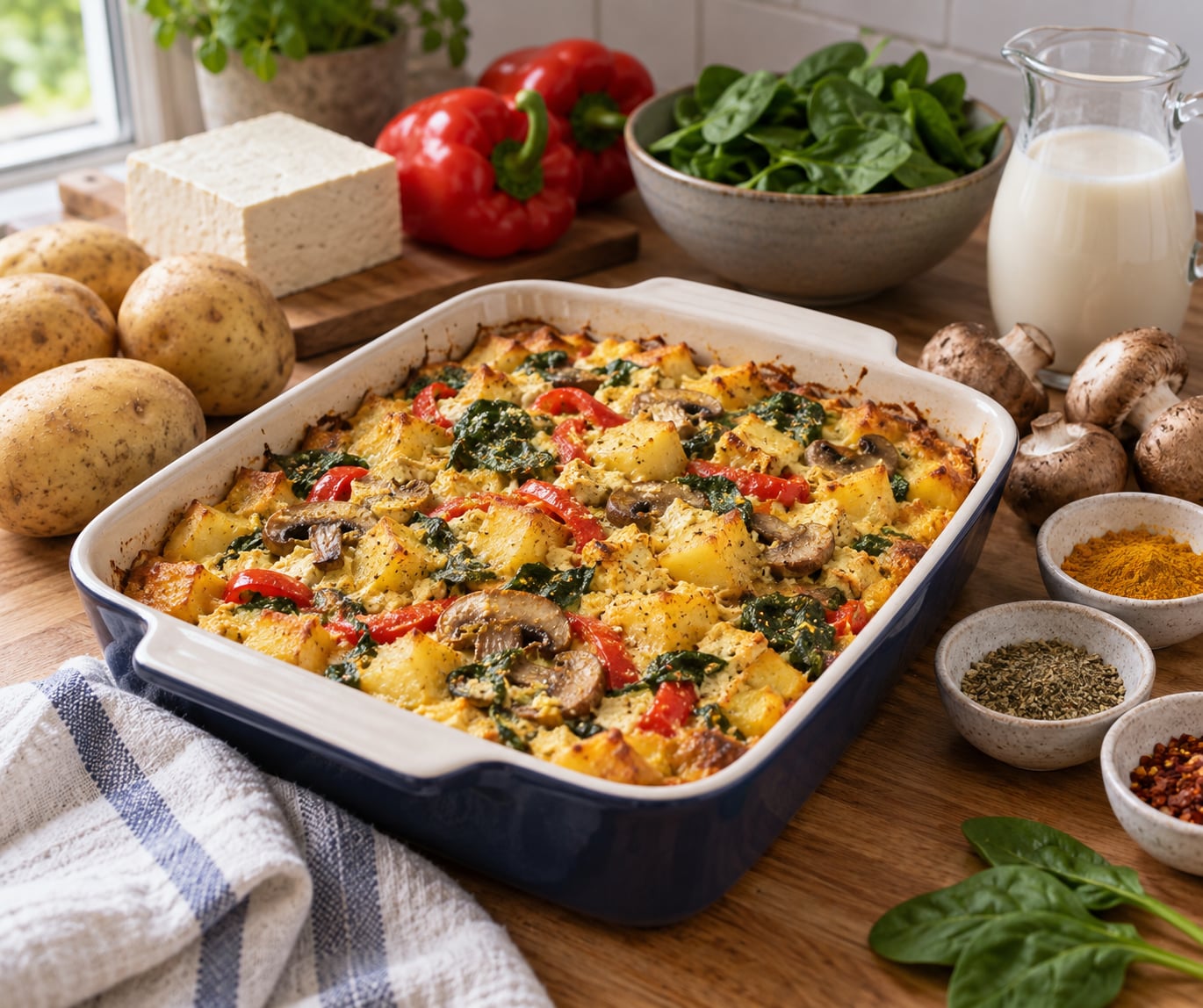
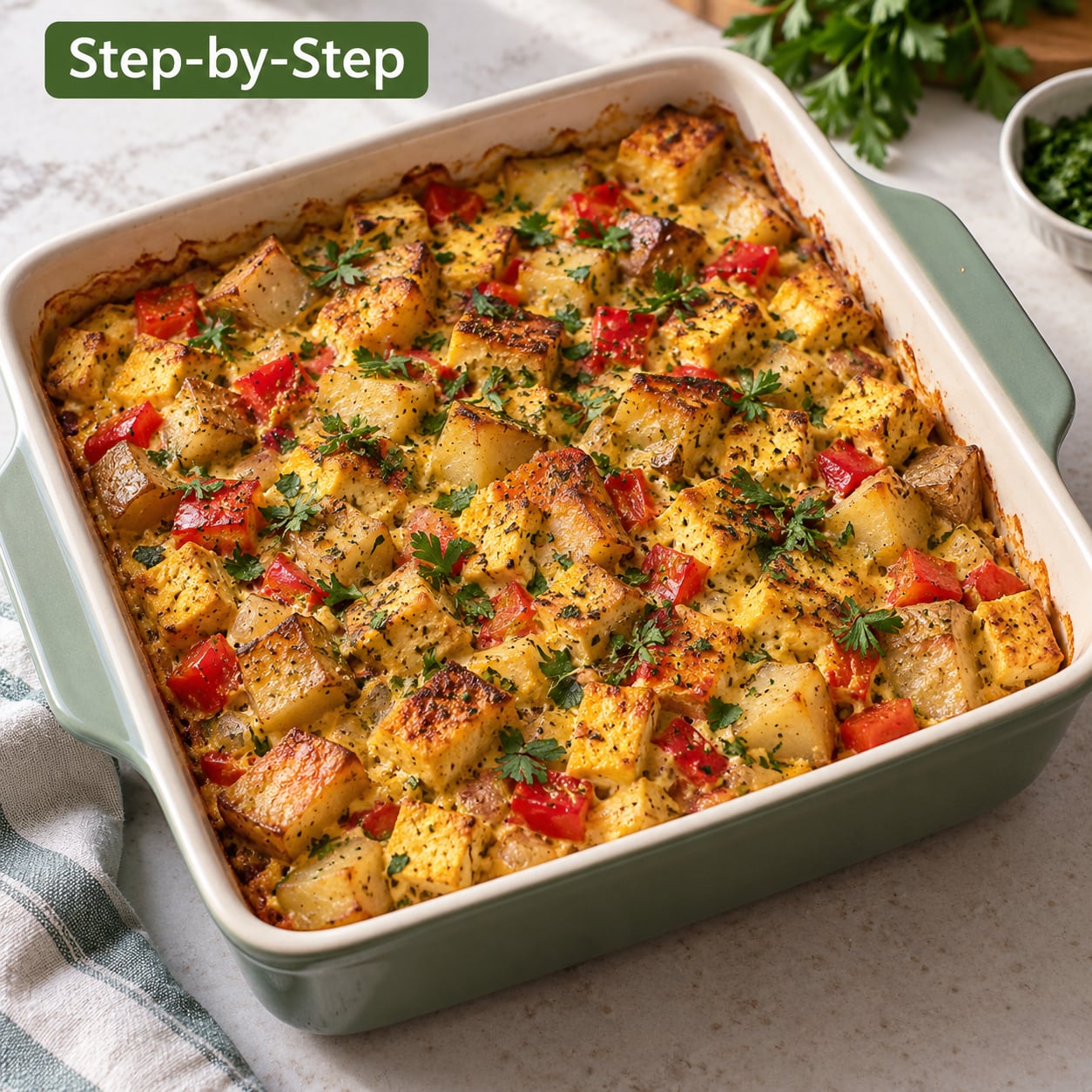
To make a vegan breakfast casserole, layer shredded potatoes or pre-roasted potato cubes in a baking dish, pour a blended tofu custard seasoned with turmeric, nutritional yeast, and black salt over the top, and bake at 375°F until the center is firm and the edges bubble. It takes about 20 minutes of prep and 45 to 55 minutes in the oven, and the whole thing feeds six to eight people from one 9×13 pan.
The part that trips people up is the filling. Egg-free custards stay runny because a blender alone is not a binder, so this recipe uses three that work together: blended tofu for body, cornstarch for structure, and yellow split mung beans for the firm set that holds up when you cut a slice. Get that right and the result slices cleanly, reheats well, and tastes savory rather than like a vegetable loaf with a sad puddle on top.
It is also the answer for anyone who eats savory food in the morning. No sweet oats, no smoothie standing at the counter pretending to be breakfast.
Table of Contents
- What You Need for a Vegan Breakfast Casserole
- Equipment
- Base layer
- Vegetables
- The vegan egg layer
- Optional add-ins
- Step-by-Step
- 1. Prepare the vegetables and tofu
- 2. Season and assemble the filling
- 3. Mix the custard-style sauce
- 4. Bake the casserole
- 5. Rest, slice, and serve
- 6. Adapt the recipe for your table
- Common Mistakes
- Frequently Asked Questions
- What can I use instead of milk in breakfast casserole?
- Can I use real potatoes for breakfast casserole?
- Do I cook a breakfast casserole covered?
- Why is my vegan egg casserole runny?
- Can I make vegan breakfast casserole ahead of time?
- What are some vegan breakfasts?
- Conclusion
What You Need for a Vegan Breakfast Casserole
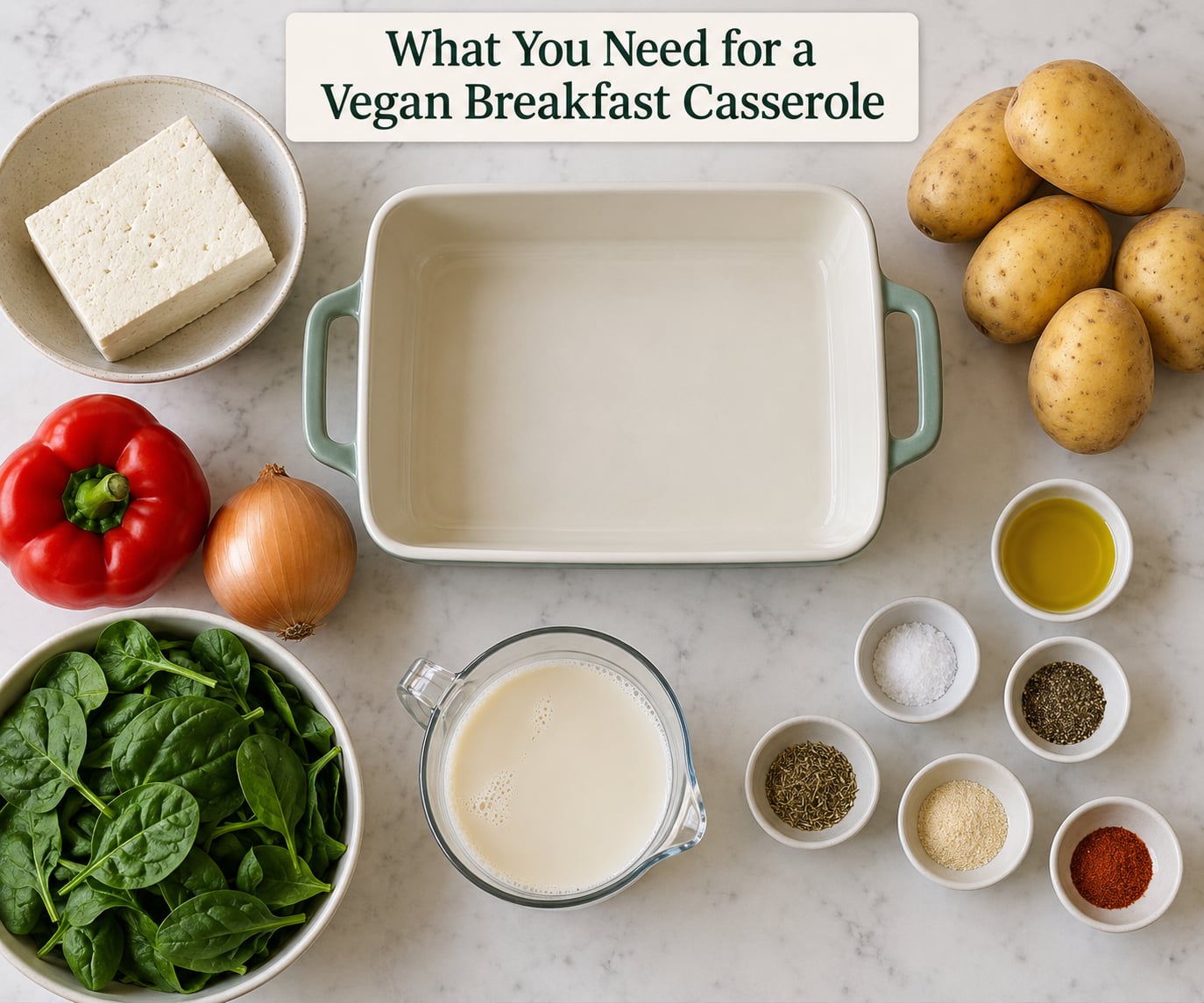
This recipe serves breakfast or brunch for six to eight, needs about 20 minutes of prep, and bakes for 45 to 55 minutes. You can assemble it fully the night before and bake it in the morning.
Equipment
- A 9×13 inch ceramic or glass baking dish, or a 10 inch cast iron skillet
- A blender, a fine grater, and either a tofu press or a heavy skillet
- A colander lined with a clean towel, if you are working with silken tofu
- An instant-read thermometer is not required here, but it is not a bad one to own for stovetop work
Base layer
- 2 pounds Yukon Gold or russet potatoes, shredded on the large holes of a box grater, or 24 ounces frozen hash browns
- 2 tablespoons olive oil, divided
- 1 teaspoon kosher salt, divided
Vegetables
- 1 yellow onion, diced
- 1 red bell pepper, diced
- 8 ounces mushrooms, sliced
- 3 cups baby spinach
- 2 cloves garlic, minced
The vegan egg layer
- 14 ounces extra-firm tofu, pressed and cubed (a 12 ounce box plus a half block works too)
- 1/2 cup dried yellow split mung beans, soaked overnight or rinsed and simmered 25 minutes until soft
- 1 cup unsweetened plant milk of your choice
- 2 tablespoons cornstarch
- 1/3 cup nutritional yeast
- 1 teaspoon turmeric
- 1 teaspoon black salt (kala namak), plus regular salt to taste
- 1 teaspoon each garlic powder, onion powder, and smoked paprika
- 1/2 teaspoon black pepper and a pinch of nutmeg
- 1 teaspoon baking powder
Optional add-ins
- Vegan breakfast sausage or tempeh bacon, cooked and crumbled
- A cup of shredded vegan cheddar or Gruyere style cheese
- Cooked black beans or chickpeas for extra protein
- Hot sauce and pickled onions for serving
Skip the nutritional yeast if the smell turns you off, which it does for a lot of people new to cooking vegan. Replace it with 2 tablespoons of white miso and a teaspoon of tamari, or use 3 tablespoons of cooked chopped mushrooms plus extra smoked paprika. You lose a little of that nutty depth but nothing structural.
Step-by-Step
1. Prepare the vegetables and tofu
Dice the onion and bell pepper and slice the mushrooms. Heat 1 tablespoon of olive oil in a skillet over medium-high heat and cook them for 6 to 8 minutes, until the onion edges turn translucent and brown and the pepper skins blister in spots. Add the garlic for the last minute.
Stir in the spinach by the handful and let it wilt down, about a minute. Season with half the salt. You are looking for browned edges and a noticeable reduction in volume, not just softened color. Veggies that only lost water give you a watery layer in the finished dish.
Now deal with the potatoes and tofu. Shred the potatoes, toss them with the remaining tablespoon of oil and salt, and spread them on a rimmed sheet pan. Roast at 425°F for 20 to 25 minutes, stirring once, until the edges brown and the shreds release from the pan without sticking. Fresh raw potatoes will not soften in a 375°F casserole, and this step is the difference between a crisp base and a mushy one. If you are using frozen hash browns, spread them on the pan, drizzle with a little oil, and roast for 15 minutes instead.
Press the tofu. Wrap the block in a towel, set it under something heavy, and leave it 20 minutes. Water you squeeze out is water that would otherwise pool in the filling and keep it from setting. Pressed tofu also crumbles more cleanly, which matters when you are folding it through the vegetables.
2. Season and assemble the filling
Crumble the pressed tofu into the skillet with the sautéed vegetables and add the optional cooked sausage, beans, or cheese. Fold everything together gently with a wooden spoon so the tofu stays in pieces instead of turning to paste.
Season now, while the mixture is still in the pan: the smoked paprika, garlic powder, onion powder, black pepper, and nutmeg go in here, along with a pinch of regular salt. Taste a small spoonful of the dry seasoning blend with a bit of the pan juices before committing. Vegan food carries less fat than a traditional egg casserole, so it needs more seasoning, not less. Most first attempts are under-seasoned by about a third.
Spread the potato layer in the bottom of the dish and spoon the tofu mixture over it, pressing it into an even layer with the back of the spoon. The filling should be about an inch and a half thick all the way across. If one corner is deeper than the rest, that corner will be wet while the opposite side dries out. Level it.
3. Mix the custard-style sauce
Cook the mung beans until soft if you did not soak them, then drain and reserve the cooking water. Add them to a blender with the plant milk, cornstarch, nutritional yeast, turmeric, black salt, and half a cup of their cooking water.
Blend on high for a full minute, scraping down the sides twice, until absolutely no lumps remain. Scrape the sides and blend another 30 seconds. Stop here and put a finger in the sauce: it should coat the finger in a thin, opaque layer, like thin cream. If it runs off like milk, add a tablespoon more cornstarch and blend again. If it is thick enough to hold a ridge, add a splash more plant milk. Getting this consistency right before it hits the oven is the single most reliable way to avoid a runny center.
Whisk the baking powder into a tablespoon of the blended sauce first, then stir it back in. Adding the powder to the whole batch later leaves you with raw-tasting pockets where the powder did not dissolve. Pour the sauce over the assembled filling and let it find the gaps, then gently push the surface flat with the back of a spoon.
4. Bake the casserole
Bake uncovered at 375°F for 45 to 55 minutes. Uncovered is the only correct answer here. Covering traps steam, and steam is what stops the top from browning and the custard from setting.
Do not trust the clock alone. Check at the 40 minute mark with a knife inserted into the center and slightly at an angle. It should come out clean or with a faint creamy film. If it emerges wet, give it another 8 to 10 minutes. Three more signals tell you it is done: the edges of the dish are bubbling when you nudge the pan, the top is set and lightly golden rather than wet-looking, and the center gives just slightly when you press the back of a spoon, then springs back. That last one is a jiggle test, and it is more honest than any timer.
If the top darkens before the center sets, tent it loosely with foil for the final 10 minutes. You are trying to protect the color, not the heat.
5. Rest, slice, and serve
Let the casserole sit in the pan for 10 to 15 minutes before cutting. This is carryover cooking, and it is what lets the loose custard finish setting into something that holds a clean edge on the plate. Slicing straight out of the oven gives you a slice that slumps into a wedge on the spatula.
Cut into six or eight squares with a straight down-and-across motion. Serve with toast, a bowl of cut fruit, hot sauce, and a scattering of chopped scallions or cilantro. In our kitchen the version people ask for is the one with pickled red onion and hot honey drizzled over the top, which is more of a Southern table habit than a breakfast one, and it works.
For leftovers, refrigerate in a covered container for up to 4 days and reheat in the oven at 350°F for 15 minutes, or in a skillet over medium heat with a splash of plant milk for 6 to 8 minutes. Reheat in the oven rather than the microwave if you can. Microwaves heat water molecules unevenly and leave the tofu rubbery and the potatoes soft, while dry oven heat keeps the crust crisp.
Freezing is the one honest limitation. A baked slice will freeze for up to a month, but the custard goes spongy and the potatoes turn watery as they defrost, and reheating does not fully fix it. If you want a freezer asset, freeze the assembled but unbaked casserole, and bake it from thawed in the oven the morning you need it.
6. Adapt the recipe for your table
A few substitutions change moisture, baking time, and texture, so swap one at a time before changing three.
- Gluten-free: This recipe already fits if you use plain tofu and plain plant milk. Buy varieties with no maltodextrin or wheat protein, and check that your hash browns and sausage are certified gluten-free, since that is where hidden gluten usually hides.
- Soy-free: Drop the tofu entirely and build the custard from 1 cup of aquafaba (the liquid from a can of chickpeas) plus 1/2 cup chickpea flour, 1 cup plant milk, and 1/4 cup more starch. Rest the batter 30 minutes before pouring so the flour hydrates. Expect a slightly lighter, cakier set rather than a soft scramble, and add 5 to 10 minutes of baking.
- Lower oil: Roast the potatoes on parchment with no added oil, using a very light spray. They crisp less and you lose some of the buttery note, but the dish still works.
- Vegetable-forward and lighter: Double the mushrooms and spinach, halve the tofu, and add a cup of cooked black beans. The beans carry protein and keep the set from going tight and dense.
- Grits base, Southern style: Replace the potatoes with 3 cups of cooked stone-ground grits, cooled slightly. Add 2 tablespoons of butter substitute or olive oil and set it in a cast iron skillet for 25 minutes at 375°F. This is the version that makes people ask what you did differently.
- Individual portions: Bake in a greased 12 cup muffin tin at 375°F for 22 to 25 minutes. Portion them the night before and freeze unbaked for a brunch you want to pop straight into a warm oven.
Common Mistakes
Almost every disappointing vegan breakfast casserole comes down to moisture, heat, or an under-seasoned filling. Here is what goes wrong and what corrects it.
| What you see | Why it happened | How to fix it |
|---|---|---|
| Filling is liquid in the center | Mung beans were firm, the sauce was thinner than cream, or the pan was too deep | Bake 10 more minutes, or return it under the broiler for 3 minutes, watching it constantly |
| Puddle of liquid under the bottom crust | Veggies were not cooked down or the dish was not rinsed after tofu | Sauté until the volume drops by half and press tofu longer; on the next batch, drain the assembled dish for 5 minutes before baking |
| Potatoes are pale and limp | Raw potatoes added directly to a 375°F casserole | Roast or parboil them at 425°F first; frozen hash browns need that 15 minute head start too |
| Tofu tastes dry and chalky | Unpressed tofu, or it was baked longer than needed | Press for 20 minutes and fold it into the sautéed veg, where it picks up moisture |
| Everything tastes flat | Vegan fillings carry far less fat than egg and dairy | Add another half teaspoon of black salt, a spoon of nutritional yeast or miso, and a hit of vinegar to lift it |
| Top browns before the middle sets | Oven running hot, or the pan is more than 2 inches deep | Move to the center rack and tent with foil for the last 10 minutes |
| Texture is dense and rubbery | Overbaked, or the blender ran too long and turned the tofu into a paste | Pull it 10 minutes earlier next time and blend in two short pulses rather than one long one |
| Top browned unevenly | Filling spread to different depths | Level it with the back of a spoon and rotate the pan halfway through |
A few habits prevent most of the above. Press the tofu every time. Cook the vegetables until they actually reduce. Bloom the spices in oil rather than stirring them into a cold pan. And rotate the dish once, at the halfway point, so the browning evens out.
For a make-ahead plan, do everything through step 3 the night before, cover the assembled dish, and refrigerate it. It holds well for 12 hours. Take it out of the fridge while the oven heats so it bakes from room temperature rather than straight from cold, which keeps the timing predictable and prevents a dense center.
If you are cooking for a holiday brunch crowd, this one scales cleanly. Two 9×13 dishes go into a standard home oven at the same time; past about sixteen servings, bake in batches so the oven stays at temperature. Cast iron goes in hot and comes out with a deeper, crustier bottom than ceramic does, which is a real difference worth knowing if you own one.
Frequently Asked Questions
What can I use instead of milk in breakfast casserole?
Unsweetened plant milk works directly: almond or oat for a neutral, creamier result, soy for more protein, and coconut for richness. Never use a sweetened variety. For a thicker, more custardy result, replace half the milk with the reserved mung bean cooking water or the liquid from a can of chickpeas.
Can I use real potatoes for breakfast casserole?
Yes, and fresh potatoes give the best texture, but they must be cooked before they go in the casserole. Shred them and roast at 425°F for 20 to 25 minutes until the edges brown, then layer them into the dish. Raw potato will not soften in a 375°F bake and will still be firm when the filling is done. Frozen hash browns need about 15 minutes in the oven for the same reason.
Do I cook a breakfast casserole covered?
Bake it uncovered. Covering traps steam, which keeps the top pale and stops the custard from setting, and that is the most common reason a vegan version comes out runny. If the top is browning faster than the center is firming, tent the dish loosely with foil for only the last 10 minutes so the heat still gets through.
Why is my vegan egg casserole runny?
Usually the binder is missing or the sauce started too thin. Confirm three things: the mung beans were soft enough to blend smooth, the cornstarch was measured rather than estimated, and your fingertip test showed the sauce coating like thin cream before pouring. A fifth cause is depth, since filling thicker than two inches in the middle sets unevenly. Extra bake time helps, but it dries the edges, so fix the ratio next time instead.
Can I make vegan breakfast casserole ahead of time?
Yes, and it is the best way to cook for a brunch crowd. Assemble through step 3, cover, and refrigerate for up to 12 hours. Take the dish out while the oven heats and bake as written, though a fridge-cold casserole needs closer to 60 minutes rather than 45. You can also freeze the assembled dish unbaked for up to a month and bake it from thawed.
What are some vegan breakfasts?
Savory options include this casserole, tofu scramble, a vegan quiche with chickpea flour, savory oats with mushrooms and greens, and a breakfast sandwich on toasted sourdough. Sweet options run to protein pancakes, coffee cake, and homemade English muffins. This casserole is the one that works as a centerpiece, since it holds a pan of eight and can sit out through a whole brunch without needing a second course.
Conclusion
Start by preheating the oven to 425°F and pressing your tofu, since those two things take the longest and everything else waits on them. Roast the potatoes until their edges brown, cook the vegetables down until they shrink, then pour in a sauce you tested on your fingertip.
Once you have that down, change what you like. Different vegetables, a grits base in cast iron, chickpeas instead of tofu, no nutritional yeast. The ratios stay the same, and the filling sets every time.