Yes, you can get enough protein on a whole food plant based diet, and you do it the same way most people eat any diet: put a real protein source in every meal instead of hoping it adds up by accident. Most adults need roughly 0.8 grams per kilogram of body weight, which works out somewhere around 55 to 90 grams a day depending on your size. Learning how to get enough protein on a plant based diet from whole foods is mostly a portion and planning problem, not a supplement problem.
The reason it feels harder than it is: whole plant foods carry fewer grams of protein per calorie than meat, dairy or eggs. A chicken breast is a concentrated protein delivery system. A bowl of beans is a concentrated protein delivery system wrapped in fiber and starch. Both work. The beans just need a bigger place on the plate and a second source alongside.
Everything below is general nutrition information. If you have kidney disease, are pregnant, are under 18, or are dealing with an unexplained symptom, talk to a registered dietitian or your doctor rather than copying a number off a website, including this one.
Table of Contents
- How to Get Enough Protein on a Plant Based Diet from Whole Foods at a Glance
- How Much Protein Do Adults Need Each Day?
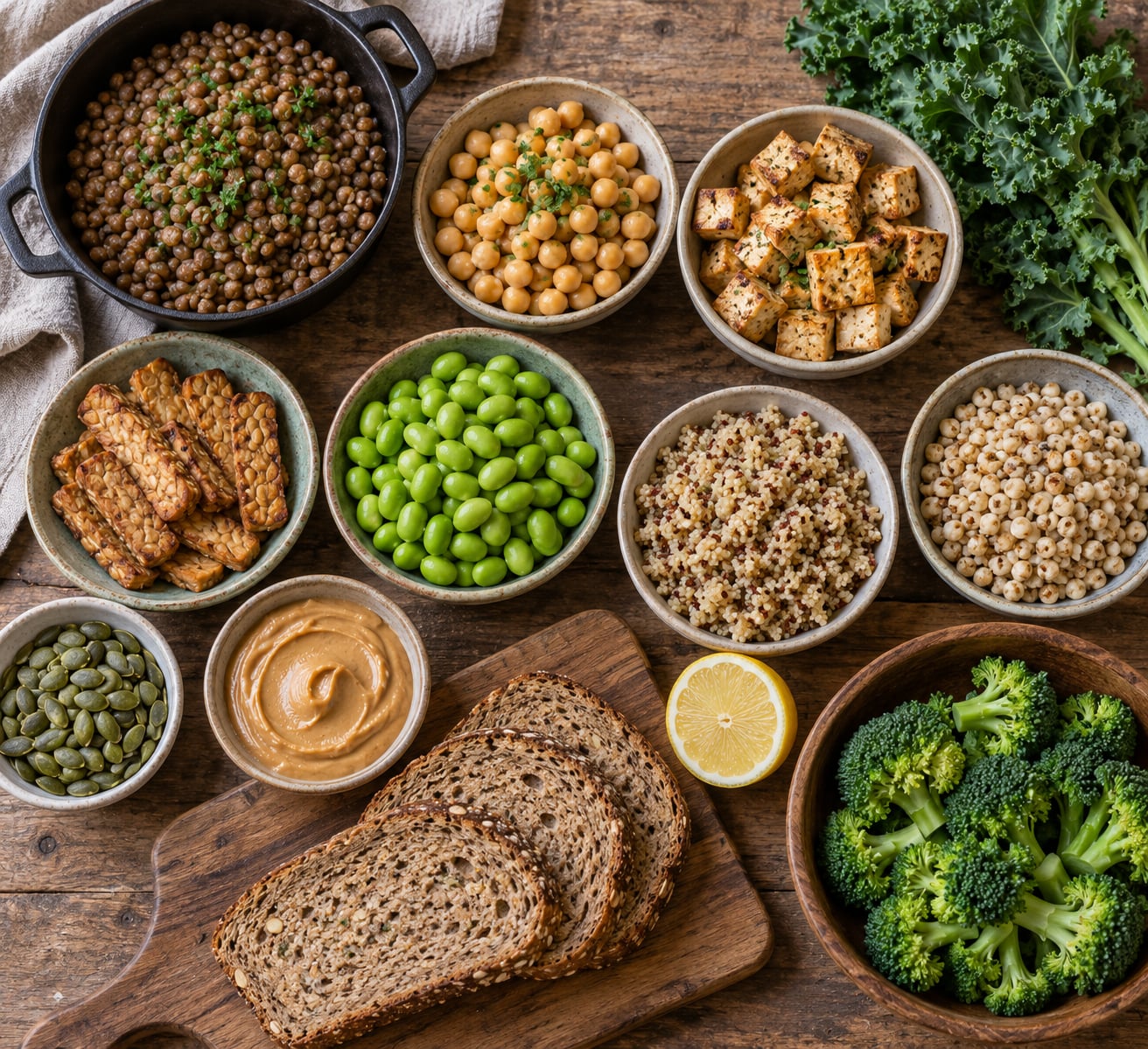
- Which Whole-Food Plant Proteins Are Most Useful?
- How Do Protein Pairings Fill the Gaps?
- How to Get Enough Protein on a Plant Based Diet at Each Meal
- What Does a Protein-First Day of Eating Look Like?
- How Can You Estimate Protein Without Reading Every Label?
- Which Everyday Mistakes Can Leave a Plant-Based Diet Short on Protein?
- How Do You Adjust for Your Needs and Preferences?
- Frequently Asked Questions
- Do I need protein powder to get enough protein on a plant-based diet?
- How much protein should I eat if I am pregnant, athletic, or over 50?
- Are plant proteins complete, and must I combine them at every meal?
- What are the best whole-food protein sources for a vegan diet?
- Can vegetables and whole grains alone provide enough protein?
- How do I know if I am getting enough protein without tracking every gram?
- Conclusion: Start With One Protein Anchor
How to Get Enough Protein on a Plant Based Diet from Whole Foods at a Glance
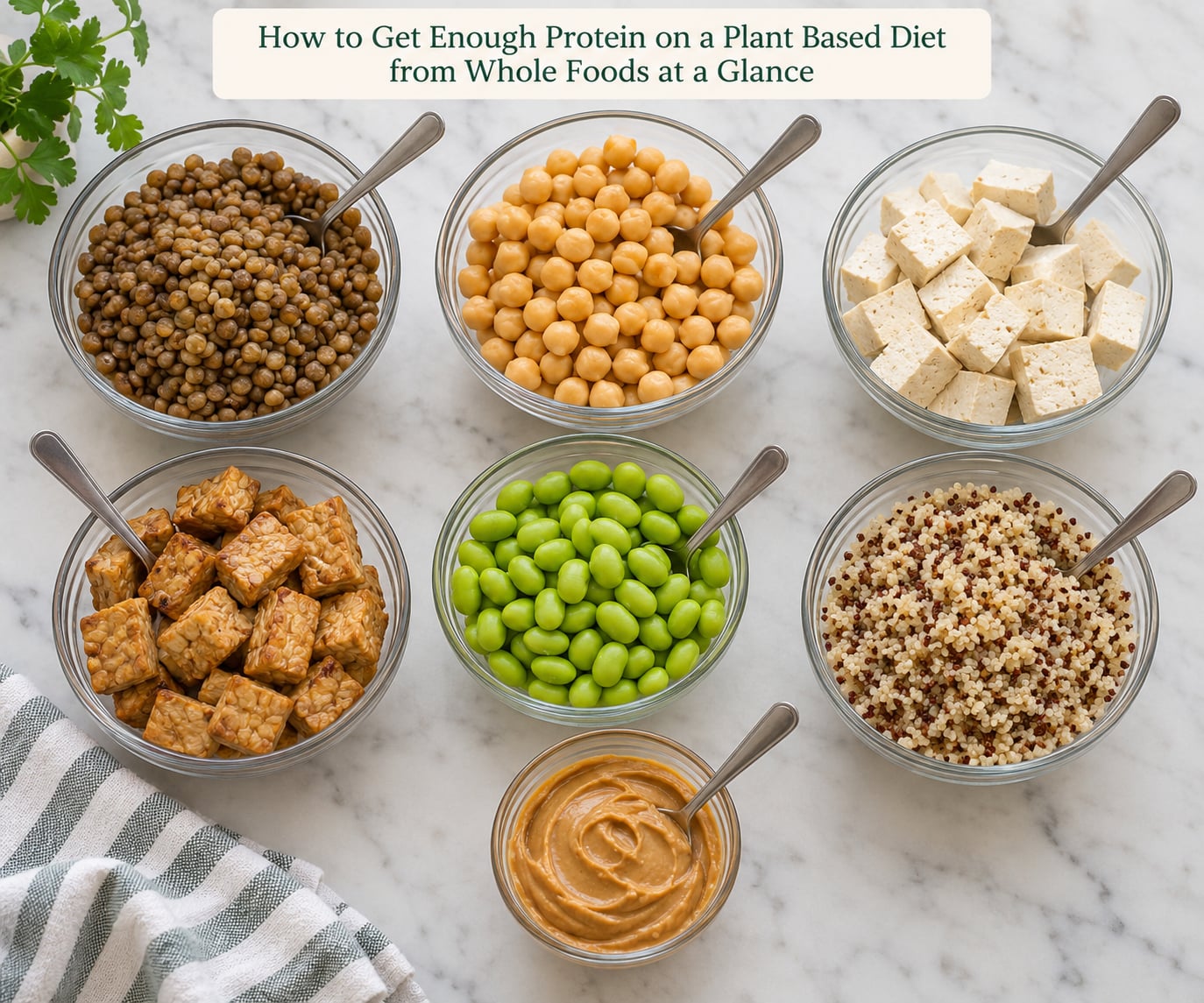
The short answer: eat one protein anchor at each of three to four meals, add a second supporting source across the day, and let legumes and soy do most of the heavy lifting. Here is what each staple actually delivers per normal portion, with the calorie number included so you can adjust if you are watching calories.
| Whole food | Typical portion | Protein | Calories | Protein per 100 calories |
|---|---|---|---|---|
| Tempeh | 100 g (about 1/3 block) | about 19 g | about 195 | about 10 g |
| Lentils, cooked | 1 cup | about 18 g | about 230 | about 8 g |
| Edamame, shelled | 1 cup | about 18 g | about 190 | about 9 g |
| Firm tofu | 150 g (about 1/2 block) | about 18 g | about 175 | about 10 g |
| Seitan | 85 g (about 3 oz) | about 20 g | about 140 | about 14 g |
| Chickpeas, cooked | 1 cup | about 15 g | about 270 | about 5 g |
| Black beans, cooked | 1 cup | about 15 g | about 240 | about 6 g |
| Pinto beans, cooked | 1 cup | about 14 g | about 250 | about 6 g |
| Extra-firm tofu, roasted | 150 g | about 24 g | about 250 | about 10 g |
| Quinoa, cooked | 1 cup | about 8 g | about 220 | about 4 g |
| Sorghum, cooked | 1 cup | about 10 g | about 260 | about 4 g |
| Whole wheat bread | 2 slices | about 8 g | about 160 | about 5 g |
| Peanut butter | 2 tbsp | about 8 g | about 190 | about 4 g |
| Hemp hearts | 3 tbsp | about 9 g | about 170 | about 5 g |
| Almonds | 1 oz (about 23) | about 6 g | about 165 | about 4 g |
| Pumpkin seeds | 1 oz | about 9 g | about 160 | about 6 g |
| Chia seeds | 2 tbsp | about 5 g | about 120 | about 4 g |
| Green peas | 1 cup | about 8 g | about 130 | about 6 g |
| Peas and rice, together | 1 cup each | about 18 g | about 440 | about 4 g |
Figures are typical values from USDA FoodData Central and label panels, and brands vary enough that you should expect a gram or two either way. The last column is the one to actually use. If you are eating fewer calories, protein per 100 calories is the number that decides between lentils and peanut butter.
How Much Protein Do Adults Need Each Day?
The general adult recommendation is 0.8 grams of protein per kilogram of body weight per day. That is the recommended dietary allowance set for a healthy, mostly sedentary adult, and it assumes a mixed diet, not a plant-only one. Athletes and older adults are usually advised to eat more.
Worked out in pounds, which is how most people actually think about it: roughly 1.8 grams per pound of body weight at the 0.8 g/kg baseline. Take some common weights and you get a very usable set of numbers.
| Body weight | 0.8 g/kg baseline | Around 1.6 g/kg | Around 2.0 g/kg |
|---|---|---|---|
| 135 lb (61 kg) | about 49 g | about 98 g | about 122 g |
| 150 lb (68 kg) | about 54 g | about 109 g | about 136 g |
| 180 lb (82 kg) | about 65 g | about 131 g | about 164 g |
| 200 lb (91 kg) | about 73 g | about 145 g | about 182 g |
| 225 lb (102 kg) | about 82 g | about 163 g | about 204 g |
Pick the column that describes your life rather than the one that sounds impressive. Someone walking for general health is fine near the first column. Someone lifting four or five days a week will usually sit closer to the middle. The higher column shows up in guidance for adults over 60, where the priority shifts toward preserving muscle and countering the drop in absorption that tends to come with age.
Pregnancy, breastfeeding, recovery from illness or surgery, and a few other situations push needs higher again. I am deliberately not putting a number on any of those here. Your doctor or a registered dietitian can give you one that accounts for what is actually going on.
Which Whole-Food Plant Proteins Are Most Useful?
Five groups carry almost all of the protein in a whole food plant based diet, and each does something different. Knowing which group you are working with tells you how to build the rest of the meal around it.
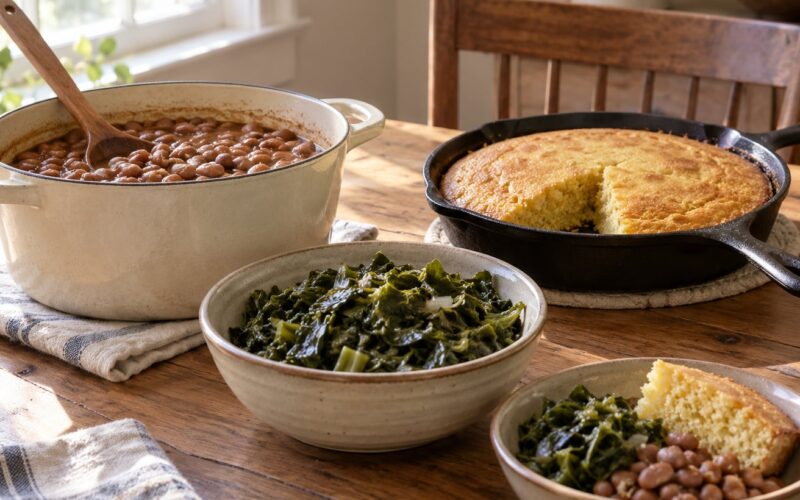
Legumes. Lentils, chickpeas, black beans and pinto beans are the backbone. A cooked cup of lentils delivers about 18 grams, and dried lentils are among the cheapest protein per gram you can buy anywhere. If you only change one habit, make a pot of them on Sunday and eat from it all week. Appalachian kitchens already lean this way: speckled butter beans and crowder peas are the regional cousins of the same idea, and both pack a cup well above 12 grams.
Soy foods. Tofu, tempeh and edamame are the only whole plant foods that are considered complete proteins on their own. Soy also carries iron, and it is the most affordable complete protein most people can buy. Firm tofu works when you want it to hold a shape, tempeh when you want a chewier, more meaty texture, edamame when you want something you can eat with your hands out of the freezer.
Whole grains and starches. Quinoa, sorghum, buckwheat, brown rice, whole wheat bread and potatoes each add 4 to 10 grams a cup. On their own they are supporting actors, not leads. Their job is to fill the plate without pushing protein out of it, which is where white rice and white pasta go wrong.
Nuts and seeds. Peanut butter, hemp hearts, pumpkin seeds, almonds, sunflower seeds and chia all contribute, and they are the easiest protein to add without cooking. They are also the densest by calories, which is why portion size matters here more than anywhere else. Two tablespoons of peanut butter is a serving. The whole jar is not.
Vegetables. Green peas, green beans, broccoli, spinach, mushrooms and asparagus all contribute a few grams. Pea protein concentrates sit at around 8 grams per cup. This group finishes the plate and covers nutrients the other groups are short on, but it will not carry a meal on its own no matter how much of it you eat.
How Do Protein Pairings Fill the Gaps?
Plant proteins are not all identical. Each one is lower than the ideal in at least one essential amino acid, usually lysine or methionine. Grains run low in lysine, legumes run low in methionine, and soy is the exception that covers both. Pairing a grain with a legume fills each other’s gap.
Here is the part most guides get wrong. You do not have to combine proteins at every single sitting. The old rule requiring rice and beans in the same bowl, within the same thirty-minute window, was never based on good evidence. Amino acids from earlier in the day remain available in your bloodstream and are used as needed. Eating beans at lunch and whole wheat bread at dinner works perfectly well.
What actually matters is variety over a day and over a week, plus a reasonable total. If you are consistently eating legumes, soy foods, whole grains, seeds and nuts, you are covering the bases without engineering anything.
How to Get Enough Protein on a Plant Based Diet at Each Meal
A repeatable formula beats a rigid meal plan, because a rigid plan falls apart the first week something is missing from the fridge. Build every meal from the same four parts: one protein anchor, one supporting source, a high-fiber carbohydrate, and vegetables or fruit to round it out.
Breakfast, the hardest one. Most people who move to plant-based eating lose roughly 10 grams of protein at breakfast without replacing it. Fill the gap deliberately. A cup of cooked lentils with toast is about 26 grams. Scrambled firm tofu on two slices of whole wheat toast lands in the same range. Soy yogurt with hemp hearts, or a chickpea flour pancake, works if tofu is not your thing.
Lunch. Anchor with a cup of beans, hummus with a generous two-inch-thick pita, or a tofu-grain bowl. Add a second source if the meal is mostly vegetables: corn and black beans, a sprinkle of pumpkin seeds on a salad, edamame in the grain bowl.
Dinner. This is where you have the most freedom. Tempeh or tofu stir-fried with quinoa, lentil and vegetable soup with whole grain bread, or chili where the beans are the main event rather than a background texture. That stays honest protein as long as the beans are a full cup, not a sprinkle.
Snacks. Pick one, not four. Roasted chickpeas, edamame, peanut butter on an apple, pumpkin seeds, or a handful of hemp hearts. A protein anchor at each of four eating occasions is what produces a daily total, and snacks are the easiest occasion to skip.
Splitting the day this way, roughly 25 to 30 grams at three or four sittings, tends to work better than one enormous protein meal and one protein-free day. It gives you a steadier stream of amino acids and it makes the total far easier to hit.
What Does a Protein-First Day of Eating Look Like?
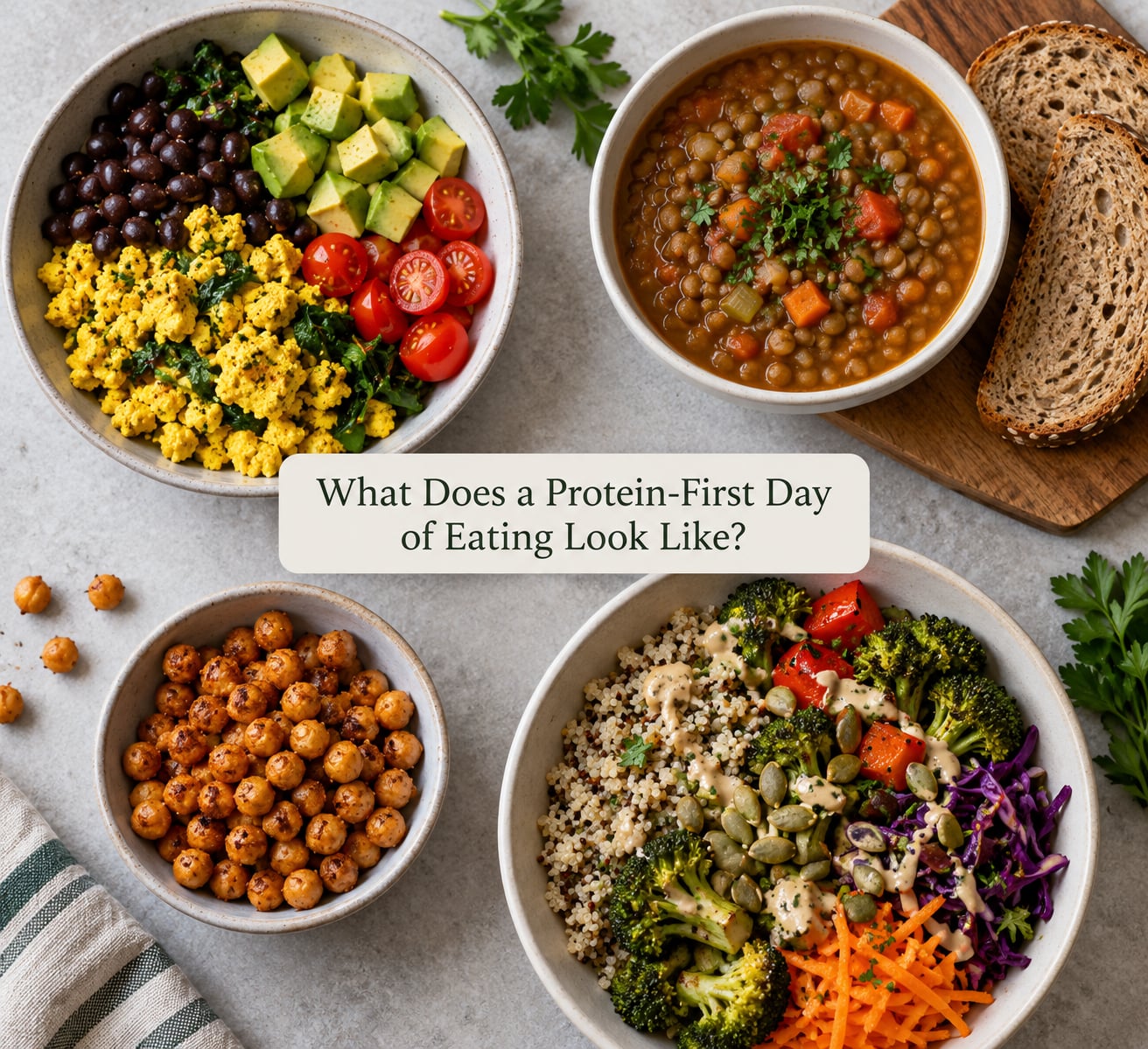
Here is one full day built entirely from whole foods, with the running total so you can see where the grams come from. This lands at about 110 grams, which clears the middle column for most adults in the weight table above.
Breakfast, about 30 g. One cup cooked lentils scrambled with cumin and nutritional yeast, plus two slices whole wheat toast and an orange. Lentils 18 g, bread 8 g, yeast 2 g, orange 1 g. The orange is not filler, because vitamin C from citrus meaningfully improves absorption of the iron in the lentils and the toast.
Morning snack, about 9 g. Three tablespoons of hemp hearts mixed into a small handful of roasted chickpeas. Hemp 9 g, chickpeas 2 g. Ten minutes of prep once, and it carries to work in a jar.
Lunch, about 32 g. A cup of black beans and a cup of quinoa with roasted squash, kale, and a lemon-tahini dressing. Black beans 15 g, quinoa 8 g, tahini 3 g, kale 2 g, squash 2 g, plus a couple grams of seeds on top. Beans and quinoa is the classic complementary pairing, and one lemon does the vitamin C work.
Afternoon snack, about 8 g. Two tablespoons of peanut butter on a banana, or a handful of edamame.
Dinner, about 31 g. Baked tempeh with a serving of sorghum and wilted greens. Tempeh 19 g, sorghum 10 g, greens 2 g.
That is about 110 grams across five eating occasions, and nothing in it came from a tub. Substitute freely: swap tempeh for extra-firm tofu, sorghum for buckwheat or brown rice, quinoa for whole wheat couscous, chickpeas for pinto beans. The structure is what matters, not the specific food. People who train hard do this and report the same 100 to 120 gram range as plenty, and it is built from rice, beans, lentils, potatoes, nuts and seeds rather than anything engineered.
How Can You Estimate Protein Without Reading Every Label?
You can get surprisingly close with a handful of anchors you memorize. Once these are in your head you rarely need a label for the plate you built yourself.
A cup of most cooked beans or lentils is 14 to 18 grams. A 150-gram portion of firm tofu is about 18. A 100-gram portion of tempeh is about 19. A cup of cooked quinoa or sorghum is 8 to 10. Two tablespoons of nut or seed butter is 7 to 8. One ounce of pumpkin seeds is about 9. Two slices of whole wheat bread is about 8. A cup of edamame is about 18.
Then apply the portion problem most people get wrong. Serving sizes on labels are frequently smaller than what actually lands on a plate. Weigh dry grains and dried beans with a kitchen scale for the first few weeks. Get comfortable with a fist of beans, a palm-sized slab of tofu, and a third of a block of tempeh, then stop measuring entirely. Most people land within a few grams after a couple of weeks of checking.
For anything mixed, blended or bought ready to eat, read the label. A soup from a deli counter has no label, so ask. Restaurant meals are the hardest case because portion sizes are unpredictable, and a bowl of chili that looks light can carry 25 grams or 8 depending on the beans and the base. When in doubt at a restaurant, choose the dish where a legume or tofu is the main ingredient rather than a garnish.
Then divide your daily target by the number of eating occasions. If you decided on 90 grams, four occasions means about 22 grams each. That number is what you aim at, and it is far easier to hit than staring at a daily total.
Which Everyday Mistakes Can Leave a Plant-Based Diet Short on Protein?
Five failures account for most of the shortfalls, and all of them are portion or habit errors rather than food-choice errors.
Treating legumes as a side dish. A spoonful of beans on a plate of rice and vegetables is a garnish. The same beans at a full cup alongside the rice is a protein anchor. Fix: measure the beans into a cup before cooking and aim for one full cup, not a ladle over the top.
Letting vegetables do the protein work. Broccoli, spinach and peppers are wonderful food that happen to contain a few grams. Fix: build every plate around a legume, soy food, seed or nut first, then add produce around it.
Skipping protein at breakfast. Toast with fruit has about 8 grams, often less. Breakfast is where most plant-based eaters lose their margin without noticing. Fix: move a protein forward from dinner to breakfast, or cook a batch of lentils specifically for weekday mornings.
Choosing bulky, low-protein grains. White rice, white pasta and large portions of potatoes fill you up fast with very little protein, so the meal ends at 10 grams even though it looks substantial. Fix: switch to quinoa, sorghum, buckwheat or brown rice in at least one meal a day, and keep the portion of any grain to about a cup.
Assuming processed substitutes are required. Store-bought plant burgers and sausages vary enormously, and some carry 5 grams while the bun around them carries 8. Fix: read the label on anything that arrives in a wrapper. Seitan, tempeh and tofu are dependable because the numbers are on the package and they do not shift between brands.
One more deserves its own note: fiber and digestion. Ramping legumes from nothing to several cups a day at once is the fastest route to gas and bloating, and people often respond by cutting back on exactly the food they need more of. Add legumes gradually, start with lentils and split peas which are gentler than larger beans, and drink water. Soaking dried beans and discarding the soaking water helps. If you are increasing legumes a lot, a registered dietitian can help you structure it so you are not trading protein for discomfort.
Iron deserves a mention too, since it travels with the protein. Plant iron is absorbed less readily than animal iron, and vitamin C is the lever. Beans with salsa, lentils with roasted peppers, tofu with broccoli and a squeeze of lemon on your beans all pair the same foods. Vitamin B12 comes almost only from animal foods, so anyone eating fully plant-based needs a reliable fortified source or a supplement, and that is a conversation to have with a professional.
How Do You Adjust for Your Needs and Preferences?
If you avoid gluten, your protein plan actually gets easier. Lentils, beans, tofu, tempeh, buckwheat, sorghum, quinoa, rice and seeds are all naturally gluten-free, and they cover most of the high-protein ground on their own. The foods you lose are the minor protein sources, wheat bread and seitan, not the anchors.
If soy is out, you lean harder on lentils, chickpeas, seitan, peanut butter and seeds, and you give a little more attention to combining across the day. Grain plus legume meals carry the load naturally. You lose the one whole plant protein that is complete on its own, which is a real but manageable gap.
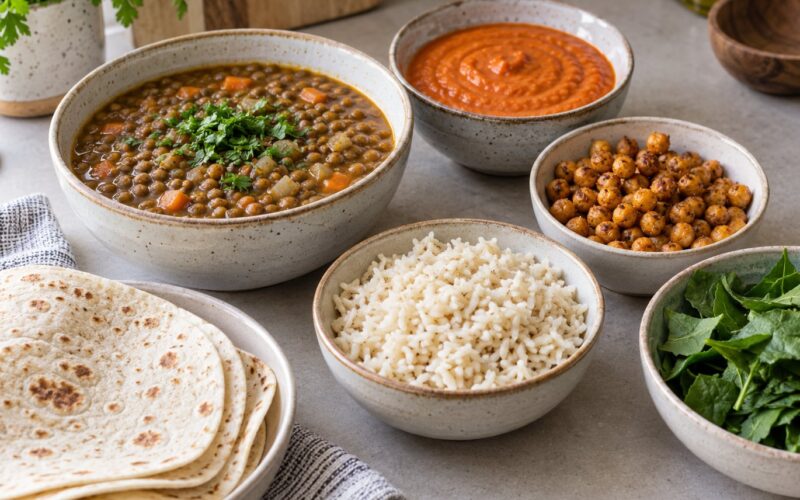
If you dislike tofu and tempeh, stop pretending. Lentil soup, bean chili, split pea soup and hummus do the same job and taste better to a lot of people, especially in cold months. Seitan and roasted chickpeas handle the quick cases.
If your week is too busy for a pot of beans every Sunday, cook a double batch on the weekend and freeze portions in containers. Or keep a shelf of dried lentils, which need no soaking and about 20 minutes, canned beans rinsed and ready, frozen edamame, and nut butter as the backup when nothing is planned at all.
If you want to eat more whole plant foods, not fewer, protein is rarely what stops you. It is seasoning, convenience and the fact that beans are boring when they are plain. Roasting them with oil and spices, building chili and soup, and putting a second pot of lentils into the rotation fixes almost all of it.
If you have kidney disease, a history of disordered eating, are pregnant or breastfeeding, or are managing a condition that changes how protein should be handled, stop reading general guides and book an appointment. A registered dietitian can set a target and a plan around your actual situation. The same goes for fatigue, hair loss, constant hunger or slow recovery that does not improve after a few weeks of eating more. Those are signals worth a lab test, not a guess from an article.
Frequently Asked Questions
Do I need protein powder to get enough protein on a plant-based diet?
No. Whole foods can carry you to any target most people need, provided each meal has a protein anchor and you eat enough total food. Powders are convenient, not necessary. On a day when you are lifting hard, short on time, or eating around 120 grams, a shake fills a gap faster than cooking lentils. For everyday eating at moderate targets, a pot of lentils, a block of tofu and a jar of peanut butter do the whole job.
How much protein should I eat if I am pregnant, athletic, or over 50?
Athletes generally aim higher, around 1.6 grams per kilogram of body weight, and older adults are often advised to eat more to protect muscle. Pregnancy and breastfeeding raise needs too, but the right figure depends on your weight, stage and medical history. None of these are good numbers to self-prescribe. Talk to your doctor or a registered dietitian, who can also help you hit the higher target with food that does not make you sick.
Are plant proteins complete, and must I combine them at every meal?
Every plant protein contains all nine essential amino acids, and soy is considered complete on its own. The rest are each slightly low in one or two, which is why variety matters. You do not need to combine foods within the same meal or a short window after it. Amino acids from earlier in the day remain available for use, so eating beans at lunch and whole grains at dinner is enough.
What are the best whole-food protein sources for a vegan diet?
The strongest anchors are lentils, chickpeas, black beans and pinto beans at about 14 to 18 grams per cooked cup, plus tofu, tempeh and edamame at similar levels. Tempeh is the most concentrated whole option at roughly 19 grams per 100 grams. Seeds and nut butters add 5 to 9 grams per small serving, and whole grains, sorghum and quinoa contribute 8 to 10 grams per cup as support.
Can vegetables and whole grains alone provide enough protein?
Not reliably on their own. Whole grains give roughly 4 grams per cup cooked, and most vegetables give 2 to 3. Eating large amounts of both can technically add up, but you would need a very high volume of food and would struggle to hit your target without feeling stuffed. Legumes and soy foods carry the protein. Vegetables and grains belong on the plate alongside them, adding fiber, vitamins and enough calories to keep you satisfied.
How do I know if I am getting enough protein without tracking every gram?
Use two checks instead of a log. First, look at your plate at each meal: does one identifiable protein source occupy a real portion, or is it a spoonful on the side? Second, notice how you feel. Steady energy, recovered from workouts, and hunger that settles within a couple of hours are decent signals. Persistent fatigue, constant hunger, hair loss or slow recovery are warning signs. If you are tracking, weigh a portion weekly rather than every meal.
Conclusion: Start With One Protein Anchor
Pick your personal range using the weight table, or get one from a registered dietitian if your situation is not straightforward, and then make one change this week: put a full portion of a protein anchor on every meal. Lentils, chickpeas, tofu or tempeh at a real portion size, not a spoonful. Keep one complementary source rotating through the day, such as a grain alongside beans or seeds on a salad, and check one label a week until your portions are right by feel. That is the whole method. Everything else on this page is detail you add as you get comfortable.