To avoid cross contamination in a shared kitchen, separate your food, tools, and storage space from everyone else’s, clean before you start, and treat anything porous or fan-blown as untouchable. The whole system runs on three habits: a defined safe zone, dedicated utensils, and a real cleaning routine between batches.
That matters more than most people expect. People with celiac disease can react to gluten at levels below 20 parts per million, which is the threshold the FDA uses for a gluten-free label, and the same shared surfaces that carry flour also carry bacteria like Salmonella and Listeria. Heat does not destroy gluten, so a pan rinsed under the tap after making bread is still a wheat pan.
Most shared-kitchen advice stops at color-coded cutting boards. That is a decent start, but the more common failures happen in less obvious places: refrigerator door handles, dish towels, condiment jars, the underside of a bench, and the air above an oven where flour hangs for a day after baking.
Table of Contents
- What You Need
- Step-by-Step
- 1. Set Up Separate Work Zones
- 2. Separate Raw, Cooked, and Allergy-Restricted Foods
- 3. Wash Hands and Clean Surfaces Before Prep
- 4. Use Dedicated Utensils and Containers
- 5. Cook and Transfer Foods Carefully
- 6. Store Prepared Foods Separately
- 7. Clean the Kitchen in the Right Order
- Common Mistakes That Cause Cross Contamination in a Shared Kitchen
- Frequently Asked Questions
- Can I use a shared cutting board for gluten-free food?
- What is the safest way to cook for someone with a food allergy?
- How should I clean a shared kitchen after cooking with allergens?
- Do I need separate utensils if I wash everything thoroughly?
- Where should I store gluten-free or allergy-sensitive food in a shared refrigerator?
- How can I prevent cross contamination when using a shared toaster or oven?
- Conclusion
What You Need
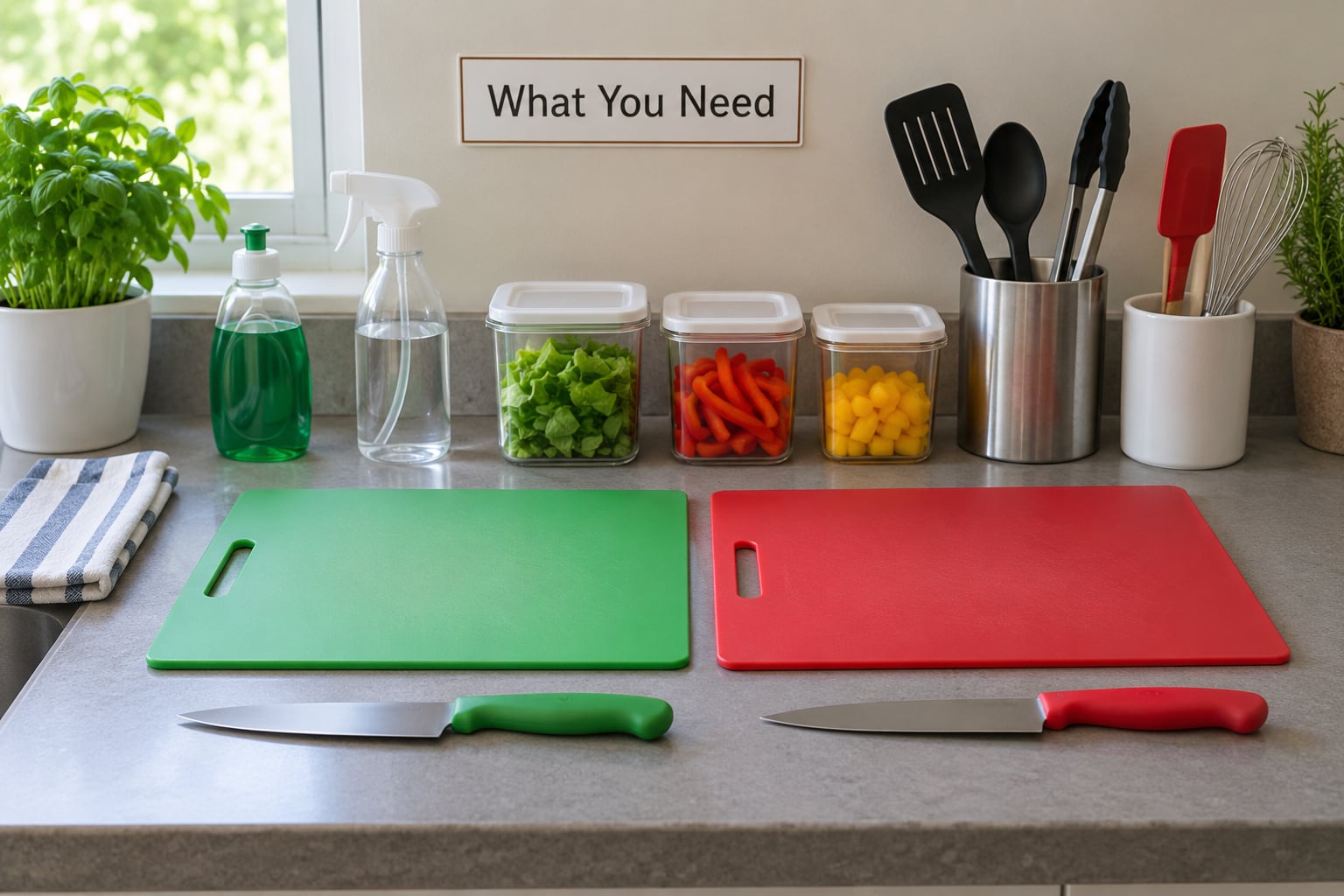
Gather this before you unpack a single ingredient. Setting up takes about ten minutes the first time and becomes automatic after that.
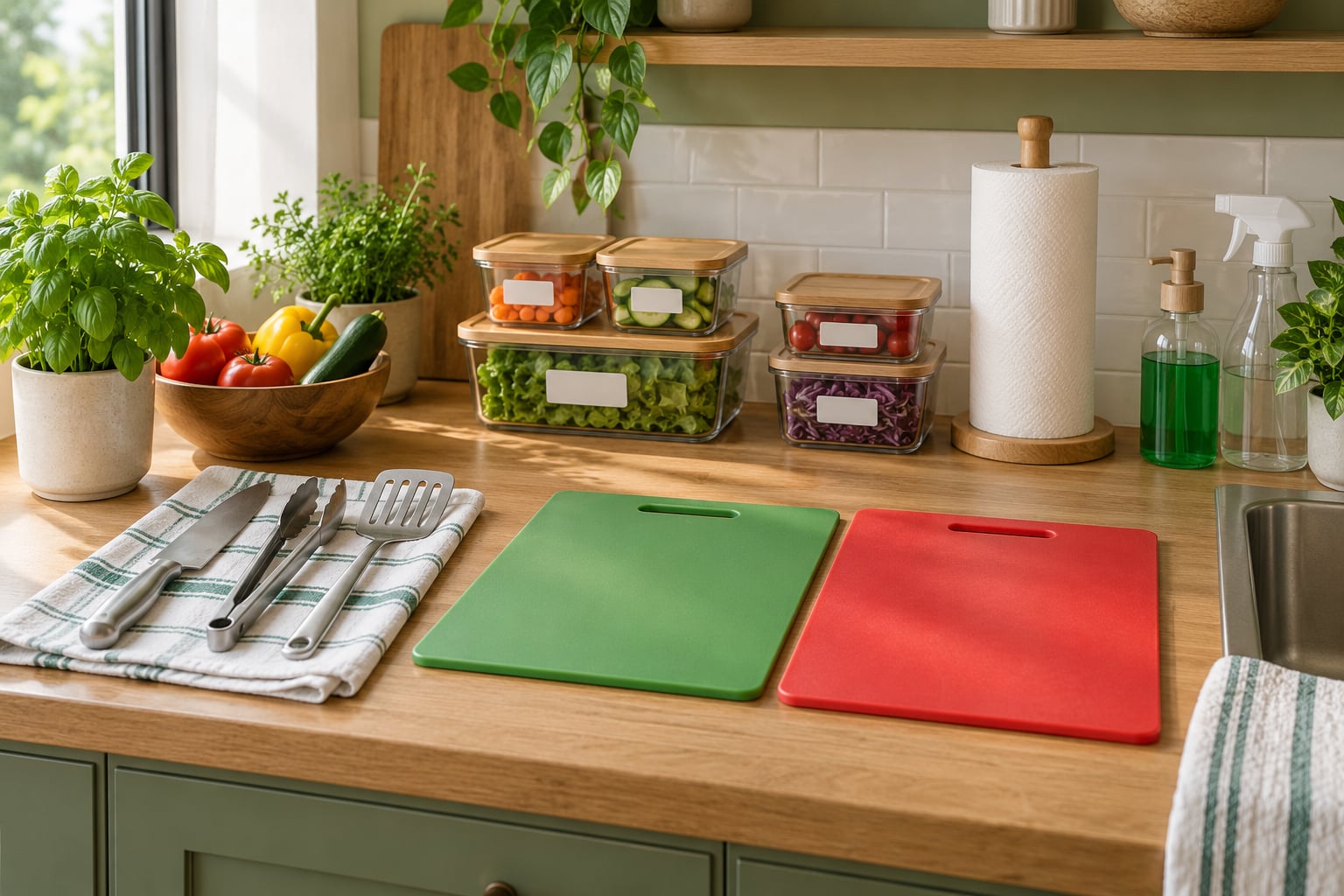
- One cutting board reserved for gluten-free or allergy-restricted food, ideally a different color from the general board
- A dedicated knife, and a spoon, tong, spatula, and can opener that never touch a gluten-containing food
- A non-porous colander or a fine mesh strainer you own outright
- Your own sponge, dish towel, and dish brush, kept in a separate bin or hung on a separate hook
- A labeled storage container with a snap lid for each category of food
- Washable labels or a permanent marker for dating and naming leftovers
- Dish soap, hot water, and either a food-safe sanitizer or a solution of one tablespoon unscented household bleach per gallon of water
- A paper towel roll and foil for lining pans, the oven rack, and the toaster tray
- A gluten test strip or swab if a reaction would genuinely disrupt your week
Pick one shelf or one end of the counter as your station and clear it completely before you begin. If your kitchen is small, a folding tray that lives in a cabinet keeps the whole system portable, which matters in a dorm or a rental where you cannot claim permanent counter space.
Step-by-Step
1. Set Up Separate Work Zones
Divide the counter into three zones and treat them as fixed territory. The safe zone holds your clean, pre-cut, gluten-free or allergen-free items. The transition zone is the only area where you chop and mix. The hazard zone is where raw meat, bread crumbs, and shared condiments live, and nothing comes back out of it.
Work out the layout before you start cooking and put a physical barrier between zones where you can: a cutting board laid flat, a strip of painter’s tape on the counter, or a tray that only travels one direction. In a shared house, name your zones out loud once. Labeled containers in one corner of the fridge do more work than a lecture, because the next person to open the door sees them without you having to say anything.
2. Separate Raw, Cooked, and Allergy-Restricted Foods
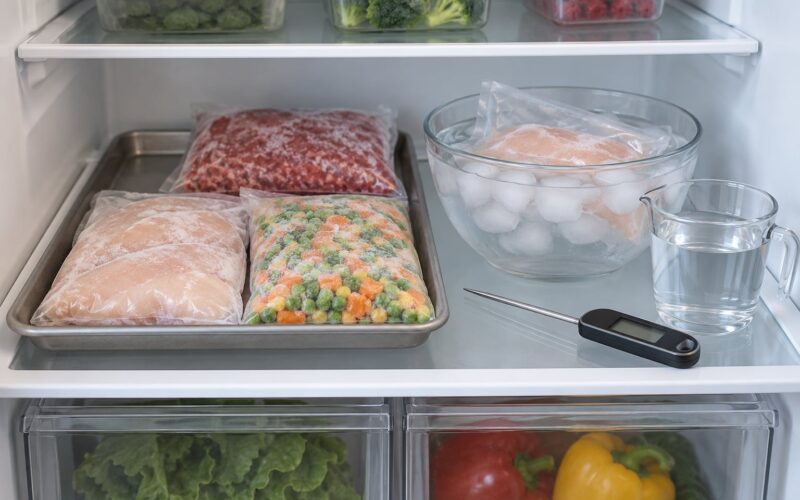
Keep the most allergy-sensitive and ready-to-eat foods away from raw meat, and keep raw meat on the lowest shelf so nothing drips downward. Never prep raw chicken on the same board you just sliced gluten-free bread on, and never let a utensil that touched raw protein go back into a finished dish.
For gluten specifically, the rule is stricter than most people expect. Separate oven racks running at the same time do not reliably prevent cross-contact, because convection fans and oven fans push air across the whole cavity. A user on r/glutenfree reported a flare-up after a cauliflower-crust pizza cooked on one rack while a frozen wheat pizza cooked on the other. Treat simultaneous baking of wheat and gluten-free items as risky, and cook them one after the other with a full clean in between.
3. Wash Hands and Clean Surfaces Before Prep
Wash for at least 20 seconds with warm soapy water, then dry with a towel you own. Flour dusts onto hands and sleeves, and those hands then touch the refrigerator handle, the cabinet knob, and the pan handle. That chain is how a clean kitchen becomes a contaminated one in about four minutes.
Before you set down your board, wipe the counter with hot soapy water, then follow with a sanitizing wipe and let it stay wet for the contact time printed on the label. Scrape loose crumbs into the bin first. A disinfectant sprayed onto a crumb-covered surface has almost nothing to work on, so pre-cleaning is not optional if you want a real result.
4. Use Dedicated Utensils and Containers
This is where a shared kitchen quietly fails people. If you cannot wash your way out of it, do not share it. Replace any wooden cutting board, wooden spoon, rolling pin, or butcher block used with wheat, because wood is porous and absorbs gluten into the grain where no amount of scrubbing reaches. Do the same for scratched plastic boards, cast iron pans, non-stick pans with deep scoring, air fryer baskets, and waffle irons.
Stainless steel and plastic are your friends. A stainless pan can be washed and sanitized until it is verifiably clean. A bamboo board cannot. When you share a toaster, use paper plates or foil barriers on the crumb tray and slots, and never butter bread in the same dish or spread the same butter that has touched a wheat crust. Condiment jars, squeeze bottles, and butter dishes are the sneakiest offenders on this whole list, because everyone dips into them with the same hands.
Stock your setup in priority order. Buy first: a dedicated cutting board, dedicated toaster slots or toaster bags, and a separate sponge and towel. Buy second: a dedicated colander, a labeled bin for the fridge, and squeeze bottles for condiments. Everything else, including a second knife and a stack of pans, can wait.
5. Cook and Transfer Foods Carefully
Prep restricted foods first, before any wheat flour hits the counter, then cover them and set them aside on a clean plate. Cook restricted items before shared items on the same stovetop, and use a fresh pot rather than reusing pasta water or oil that a wheat dish touched. Comingling cooking water, shared fryer oil, and a shared slotted spoon are all real exposure routes, not myths.
Cook to temperature, not to appearance. Poultry reaches 165°F, ground meat 160°F, and whole cuts and fish 145°F. Use your own serving spoon for your own dish, and never double-dip: put each portion on a clean plate before passing it, and no one reaches in twice.
6. Store Prepared Foods Separately
Top shelf, covered, labeled, and dated. Put restricted food above everything else so gravity works in your favor and drips never fall onto it. If a shared refrigerator gets crowded, a lidded bin is a portable shelf: it defines the boundary in a way open containers cannot.
Give leftovers a date and use them within three to four days. When reheating, bring them to 165°F and only reheat the portion you are eating, because repeated warming pushes leftovers toward the time limit faster than most people assume.
7. Clean the Kitchen in the Right Order
Use the same five-step sequence commercial kitchens use: pre-clean, wash, rinse, sanitize, air-dry. Scrape and wipe away crumbs, wash with hot soapy water, rinse with clean water, apply sanitizer and respect the wet contact time, then let everything dry on a rack or upright.
Finish with a detail pass most people skip. Wipe the refrigerator door handle, the cabinet knobs, the oven control panel, the microwave keypad, and the handle of the sink sprayer. Those are the highest-traffic surfaces in the kitchen and nobody cleans them routinely. Replace or launder your dish towel every couple of days, because a damp cloth is a carrier.
If you bake, plan for the air. Airborne flour can stay suspended and settle onto open surfaces and uncovered food for 12 to 24 hours. A convection oven, air fryer, or waffle iron fans flour outward while it runs. Let the kitchen settle, wipe the tops of cupboards and the range hood, cover your food, and run an exhaust fan or open a window for an hour.
Common Mistakes That Cause Cross Contamination in a Shared Kitchen
Most flare-ups trace back to one of six habits, and each has a simple correction.
Washing instead of separating. People assume a hot soapy wash fixes a wheat-washed board. On porous surfaces it does not. The fix is replacement, not scrubbing.
Trusting the oven fan. Separate racks at the same time is the most common misunderstanding in shared kitchens. Cook one thing at a time and clean between.
Sharing condiments and butter. A butter knife that spread jam on wheat toast goes back into the butter. Use squeeze bottles, and give restricted items their own dish with a dedicated spreader.
Cleaning after instead of before. Prepping on a surface someone used for raw chicken an hour earlier puts the whole batch at risk. Clean first, every time, even when the kitchen looks fine.
Forgetting handles and knobs. Wiping the counter but not the refrigerator handle leaves the transfer point intact. Handle the doors with a paper towel or clean them in your routine.
Cleaning but not rinsing the sponge. A sponge soaked in wheat water is a live transfer tool. Two sponges, two colors, stored separately, and replaced on a schedule.
Two habits keep the system alive. Prep restricted food first every single time, so it never becomes a decision. And keep the setup visible, since a labeled bin at eye level works better than a rule nobody remembers.
When something goes wrong, use the two-minute recovery: discard the affected food, wash and sanitize the surface and tools with a fresh sponge, air-dry everything, and tell whoever else cooks there so they do not repeat the contact. Reheated or re-served food does not undo the exposure, so throw it out rather than trying to salvage it.
Frequently Asked Questions
Can I use a shared cutting board for gluten-free food?
Only if it is non-porous and in good condition. Plastic or stainless boards can be washed, rinsed, and sanitized until testing shows clean. Wood, bamboo, bamboo-finish boards, and any plastic board with deep knife scoring hold gluten in the grooves where soap never reaches, so replace those and keep a separate board for restricted foods. Color coding helps: red for gluten, blue or green for gluten-free.
What is the safest way to cook for someone with a food allergy?
Cook the restricted food first, on a clean surface, using utensils and pans that have never held an allergen. Cover it and set it aside while you prepare everything else. Cook to a safe internal temperature: 165°F for poultry, 160°F for ground meat, and 145°F for whole cuts and fish. Serve with a dedicated spoon and keep the plate separate from shared serving dishes.
How should I clean a shared kitchen after cooking with allergens?
Work in five steps: pre-clean by scraping and wiping crumbs away, wash with hot soapy water, rinse with clean water, sanitize using a food-safe product at its labeled concentration and contact time, then air-dry. Finish with a detail pass over refrigerator handles, cabinet knobs, oven dials, and the microwave keypad. Replace the sponge or launder the dish towel afterward, since both stay contaminated.
Do I need separate utensils if I wash everything thoroughly?
For bacteria, thorough washing and sanitizing is enough. For gluten and many allergens, it depends on the material. Stainless steel, plastic, and silicone utensils can be cleaned back to clean. Wooden spoons, wooden rolling pins, porous containers, scratched non-stick pans, air fryer baskets, and waffle irons cannot, so those need to be dedicated or replaced rather than washed.
Where should I store gluten-free or allergy-sensitive food in a shared refrigerator?
On the top shelf, covered, labeled, and dated, inside a lidded bin if the shelf is crowded. Top placement stops raw meat and leaking containers from dripping onto your food, and a covered bin creates a boundary that survives someone reaching past you for the butter. Store raw meat on the bottom shelf, and keep leftovers within three to four days.
How can I prevent cross contamination when using a shared toaster or oven?
For a toaster, line the crumb tray with a paper plate or foil and keep separate slots, then clean the crumb tray and control panel after every use. For the oven, do not bake wheat and gluten-free items at the same time even on separate racks, because fan circulation moves flour across the cavity. Bake one thing at a time and wipe the oven floor and door seal between batches.
Conclusion
Start tomorrow by claiming one shelf, one board, and one sponge, then buy the toaster setup second if you can afford it. Everything else in how to avoid cross contamination in a shared kitchen follows from those three things: a defined safe zone, materials that can actually be cleaned, and a cleaning routine you run before prep rather than after.