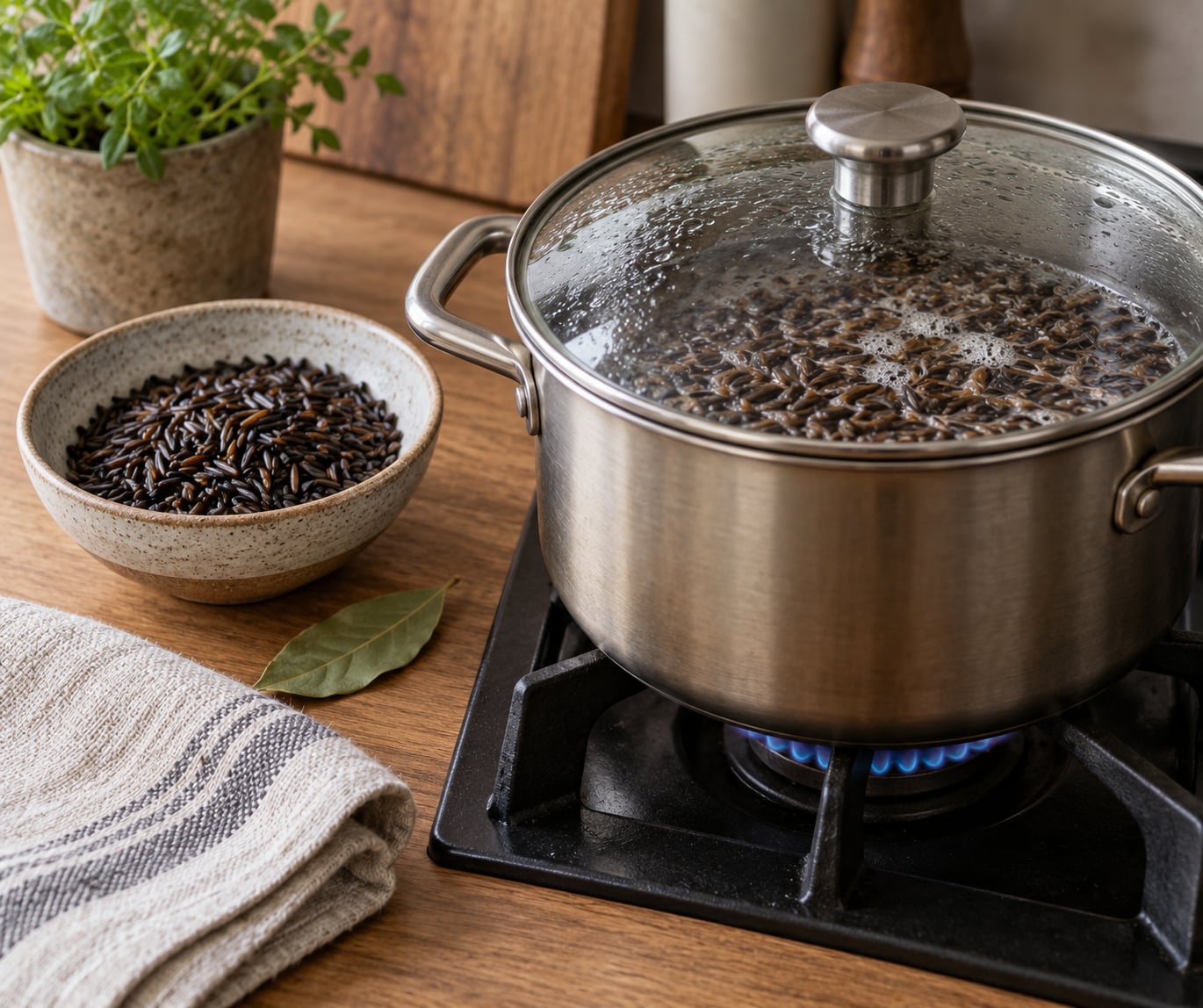
If you have never cooked wild rice before, the whole thing takes about an hour and about four minutes of your attention. Rinse one cup of grain, simmer it in four to six cups of water or broth for 45 to 55 minutes, then drain it. That is the pasta method, and it is the most forgiving way to cook wild rice properly.
One thing to clear up before you start: yes, wild rice is supposed to be chewy. A firm, almost nut-like bite is correct, and a crunchy center is not. Most people who think they have overcooked it are actually looking at rice that was never tender in the middle.
Wild rice is not rice at all. It is the seed of an aquatic grass that grew in the lakes and rivers of the Great Lakes and the Appalachian region, and it was harvested, parched over a wood fire, and milled by hand long before any of us had a rice cooker. It swells roughly three times its dry volume and takes far longer than white or brown rice. That is why the usual rice ratios do not work on it.
Table of Contents
- What You Need
- Step-by-Step: How to Cook Wild Rice Properly
- 1. Rinse and Inspect the Wild Rice
- 2. Bring the Rice and Water to a Boil
- 3. Simmer Until the Grains Are Tender
- 4. Let the Wild Rice Rest
- 5. Fluff and Check the Final Texture
- Common Mistakes When Cooking Wild Rice
- Tips for Cooking Wild Rice in a Slow Cooker, Rice Cooker, or Instant Pot
- How to Serve Cooked Wild Rice
- Frequently Asked Questions
- How long does wild rice take to cook on the stovetop?
- Do you need to rinse wild rice before cooking it?
- Why is my wild rice still crunchy after the cooking time?
- Can I cook wild rice in a rice cooker?
- How much water should I use for every cup of wild rice?
- How do I store leftover cooked wild rice?
- Conclusion
What You Need
The ingredient list is short: wild rice and liquid. Everything else is a flavor choice you can make later, once you know the grain is cooked the way you like it.
- 1 cup wild rice, rinsed, for about 3 cups cooked
- 4 to 6 cups water, stock, or broth for the stovetop method
- A fine-mesh strainer and a colander for rinsing and draining
- A pot with a tight lid, at least 4 quarts
- Salt, butter or oil, and optional aromatics such as onion, celery, bay leaf, or dried mushrooms
Use a pot bigger than you think you need. Because wild rice roughly triples in volume, only about two cups of dry grain fit comfortably in a 4-quart pot. Crowding the pot drops the temperature and gives you uneven cooking, which is how you end up with tender grains sitting next to hard ones.
Now the part that makes every recipe online look wrong: the water ratio depends on the grain, not on a single rule. Lightly parched grains with tan or bronze husks drink less water. Heavily parched, near-black grains drink more. Broken wild rice cooks faster and drinks less still.
| Grain form | Liquid per cup of dry rice (pasta method) | Simmer time |
|---|---|---|
| Whole, lightly parched (tan grain) | 3 to 4 cups water | 35 to 45 minutes |
| Whole, heavily parched (dark grain) | 4 to 6 cups water | 45 to 55 minutes |
| Wild rice pieces | 3 cups water | 20 to 30 minutes |
| Wild rice and brown rice blend | Follow the package, usually 3 to 4 cups | 40 to 50 minutes |
Check the bag before you measure. If it says wild rice blend, cook it as a blend and time it like the slowest grain in the bag.
Step-by-Step: How to Cook Wild Rice Properly
1. Rinse and Inspect the Wild Rice
Put the grain in a fine-mesh strainer and run cold water over it for about 30 seconds, swishing it with your hand until the water runs mostly clear. This washes off surface starch and hull dust, which is the main reason cooked wild rice turns gluey and clumps together in the pot.
Pick through the grain and remove any small stones or dark specks. Do not soak it. Soaking does soften the center, but it also starts washing away some of that nutty flavor, and a 4-hour soak is a big ask on a weeknight.
2. Bring the Rice and Water to a Boil
Put the rinsed grain in the pot, add 4 to 6 cups of water or broth, and season with about a teaspoon of salt per cup of dry rice. Bring it to a full boil over high heat. Add the aromatics now if you are using them, because they need the whole cooking time to flavor the grain.
Once it boils, turn the heat down to the lowest setting your stove has that still keeps a bubble going. A hard boil is what breaks wild rice apart, and a slow simmer is what lets the liquid work into the center of each grain.
3. Simmer Until the Grains Are Tender
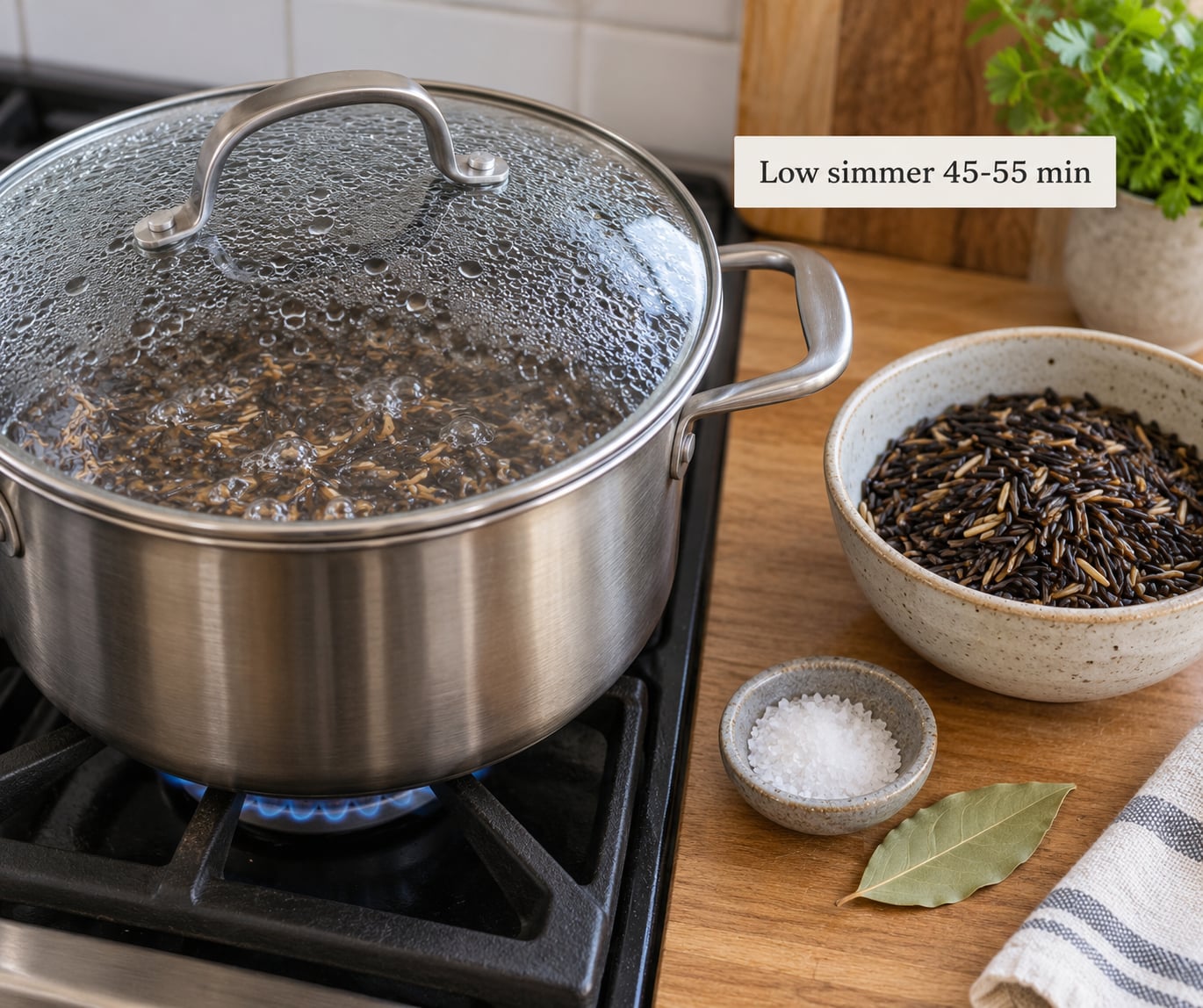
Simmer covered for 45 to 55 minutes. The liquid level drops steadily as the grain drinks it, and by the last ten minutes you will notice bubbling sounds coming from the pot rather than see moving water. That is normal.
Lift the lid once around the 35-minute mark and stir gently, scooping from the bottom. After that, leave the lid alone. Every peek lets steam out, slows the cooking, and is the reason some people finish with grains that are tender outside and still hard in the middle.
The doneness test takes one bite. A cooked grain splits open, curls back on itself, and feels firm but not raw when you press it with a fingernail. Taste two or three grains from different spots in the pot, not just from the top where the liquid sat.
4. Let the Wild Rice Rest
Turn off the heat, leave the lid on, and let the pot sit for 10 minutes. This is the step most recipes skip and it matters more than it sounds. The grains keep absorbing what is left in the pot and finish cooking from the inside out, which evens out the texture.
Cooks who grew up with a 45-minute simmer and a 15-minute stand reported on cooking forums that switching off the heat and leaving the covered pot on the warm burner is what finally fixed their overcooked batches. Same idea, ten minutes instead of fifteen.
If you used the pasta method, drain the grains in a colander now. If you cooked them in a covered amount of liquid, tip out any water that has not been absorbed.
5. Fluff and Check the Final Texture
Tip the drained grain onto a clean towel or a sheet pan and let it steam for another few minutes, or fluff it right in the pot with a fork. Use the fork, not the spoon. A spoon smashes the grains and turns them into paste.
Run the fork through gently in short motions until the grains are separate. Taste again. The texture should be distinctly chewy with a nut-like flavor, and the grains should hold their shape when you squeeze one.
Common Mistakes When Cooking Wild Rice
Nearly every wild rice complaint traces back to one of five things. Here is what goes wrong and what fixes it.
| Symptom | What caused it | The fix |
|---|---|---|
| Hard crunchy center, tender outside | Lid lifted too often, heat too high, or not enough liquid | Add a quarter cup of hot water or broth, cover, and hold on a low simmer for 10 more minutes |
| Grainy and tough all the way through | Heavily parched grain given the short water ratio for lighter grain | Next time, use the full 4 to 6 cups and simmer the full 55 minutes |
| Mushy or gluey | Under-rinsing, too little water, or cooking past doneness | Spread on a sheet pan to cool and dry, then fluff. Rinse harder next time |
| Grain broke into paste | A full boil instead of a simmer, or stirring too much | Keep it at the barest bubble and stir no more than once |
| Weak or grassy flavor | Cooking in plain water, or overcooking | Use broth, add a tablespoon of butter at the end, and stop at the first sign of tenderness |
Cooking in plain water also leaves you with cloudy, starchy cook water. That is worth doing once, deliberately, if you like a very mild flavor: cook the grain in unsalted water, drain it well, and return it to the pot with butter and salt.
Two other things people argue about. There is no reason to pour the grain into a fine sieve and run water over it after draining. You will wash away exactly what you cooked it to absorb. And do not cook it past the point where you can still bite it, hoping the last five minutes soften it.
Tips for Cooking Wild Rice in a Slow Cooker, Rice Cooker, or Instant Pot
The ratio translates directly. What changes is how much water boils away, which is why appliance recipes use less liquid than the stovetop method.
For a rice cooker, use about 3 cups of liquid per cup of dry wild rice and run the brown rice cycle. Lightly parched tan grain can go down to 2.5 cups. Do not use the white rice setting; it finishes long before the center softens. If the cooker has a keep-warm function, leave the grain on it for 10 minutes with the lid closed before opening, since the carryover heat finishes the grains the way the stovetop rest does.
For an Instant Pot, use 3 cups of dry wild rice, 3 cups broth or water as the cooking liquid, and 1 to 2 cups of water in the pot to meet the pressure minimum. Cook on high pressure for 18 to 22 minutes, then let it come to a natural release, which takes about 15 minutes more and counts as part of the cooking. A forced release leaves the center hard.
For a slow cooker, use 4 cups of liquid per cup of grain on low for 3 to 4 hours, since there is no evaporation to worry about and the pot never gets hot enough to scorch the bottom. Check at 3 hours and trust the grain, not the clock.
For the oven, combine the rinsed grain with 4 cups of broth, cover tightly, and bake at 325°F for 1 hour 15 minutes to 1 hour 30 minutes.
On microwaves, the sources disagree and one of them is wrong. A covered dish on 50 percent power for about 30 minutes can produce an uneven batch with a rubbery edge, so I would use the stovetop unless you only need a small serving. It takes longer, but it does not need babysitting.
How to Serve Cooked Wild Rice
Cooked wild rice is a side dish, a base, and a thickener, which is how it works so well in an Appalachian kitchen where dinner often runs to one pot.
- As a side dish, spoon it next to roast turkey, venison, or roast chicken and let the pan juices season it. A drizzle of butter and a handful of toasted pecans finishes it.
- In soups and stews, add it in the last 20 minutes so it does not turn to mush. It gives a lentil or bean soup a body that rice water never could.
- With vegetables, fold it through roasted squash, mushrooms, or green beans and dress it while warm with olive oil and lemon.
- As a grain bowl base, top it with roasted sweet potato, black beans, avocado, and a lime dressing for a cold-weather bowl that holds up.
- In a pilaf or stuffing, combine it with brown rice, wild rice blend, herbs, and dried fruit for a holiday side that reheats better than plain bread stuffing.
Store leftovers in a sealed container in the refrigerator for 3 to 5 days. Reheat in a buttered skillet over medium heat with a splash of broth, or spread on a sheet pan and warm in the oven, stirring once. Microwaving dries it out and makes the grains rubbery.
Frequently Asked Questions
How long does wild rice take to cook on the stovetop?
Whole wild rice needs 45 to 55 minutes at a gentle simmer after the water comes to a boil. Lightly parched tan grain finishes closer to 35 to 45 minutes, heavily parched dark grain takes the full hour, and broken wild rice pieces cook in 20 to 30 minutes. Start checking at the 35-minute mark rather than trusting the clock alone.
Do you need to rinse wild rice before cooking it?
A short rinse is worth doing. Run the grain under cold water in a fine-mesh strainer for about 30 seconds, swishing until the water runs mostly clear. This removes surface starch and hull dust, which is the main cause of gluey, clumped wild rice. Skipping the soak is fine, since soaking softens the grain but also washes off some of the nutty flavor.
Why is my wild rice still crunchy after the cooking time?
The most likely causes are lifting the lid too often, simmering too hard, or not enough liquid. Add a quarter cup of hot water or broth, put the lid back on, and hold it over the lowest heat for another 10 minutes. Taste a grain from the bottom of the pot, not the top. If your grain is heavily parched and dark, it also needs the full 4 to 6 cups of liquid and the full 55 minutes next time.
Can I cook wild rice in a rice cooker?
Yes. Use 3 cups of water or broth per cup of dry wild rice and run the brown rice setting, since it runs longer than the white rice cycle. Lightly parched grain needs closer to 2.5 to 3 cups. If your cooker has a keep-warm function, let the grain sit on it for 10 minutes before you open the lid, because the carryover heat finishes the grains evenly.
How much water should I use for every cup of wild rice?
For the stovetop pasta method, use 4 to 6 cups of water or broth per cup of whole wild rice, and start at the higher end if your grain is dark and heavily parched. In a rice cooker, use about 3 cups. In an Instant Pot, use 3 cups plus the cooker and 1 to 2 cups of water as the cooking liquid. Cooked wild rice swells about three times its dry volume.
How do I store leftover cooked wild rice?
Cool it on a sheet pan first, then move it into a sealed container and refrigerate it for 3 to 5 days. Reheat in a buttered skillet over medium heat with a splash of broth, stirring once, or warm it in the oven at 325°F until heated through. Microwaving is the one method that reliably turns wild grains rubbery, so skip it if you can.
Conclusion
Measure one cup of the grain and check whether it is tan or dark before you reach for the water. Rinse it for 30 seconds, simmer it covered in 4 to 6 cups of broth for 45 to 55 minutes without lifting the lid, then let it sit off the heat for 10 minutes before you fork it through. Those four moves are the whole difference between chewy wild rice and a pot of crunchy or paste-like grains.