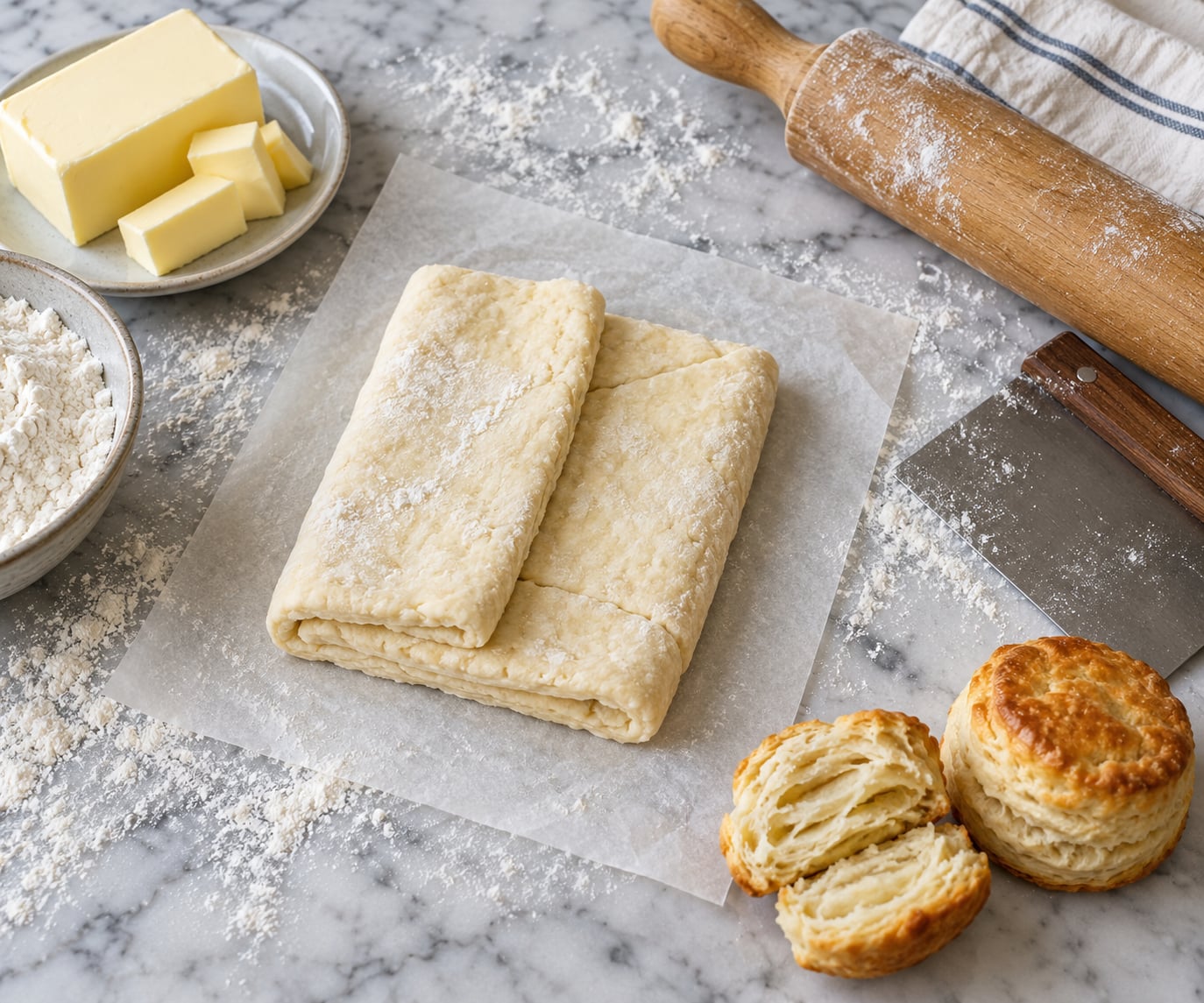
Laminating biscuit dough means repeatedly folding and rolling it so small pieces of cold butter spread into thin, even sheets between layers of dough. Those sheets steam in the oven and shove the layers apart, which is what turns a flat biscuit into a tall, pull-apart one. Three or four letter folds is enough for home bakes, and the whole process takes about an hour.
I baked three test batches while writing this: one folded four times, one folded six times out of curiosity, and one where I let the butter get soft on purpose. The four-fold batch was the winner, and the over-folded one came out of the oven tasting like a frisbee. That difference is mostly about how hard you touch the dough, which is the part nobody warns you about.
Table of Contents
- What You Need
- Step-by-Step: How to Laminate Biscuit Dough for Layers
- 1. Make the Biscuit Dough
- 2. Chill and Flatten the Dough
- 3. Add the Fat Layer
- 4. Fold the Dough into Letters
- 5. Roll and Repeat the Folds
- 6. Cut Without Destroying the Layers
- 7. Chill, Bake, and Check the Layers
- Three Lamination Methods Compared
- Common Mistakes and How to Fix Them
- Frequently Asked Questions
- How many folds should I make when laminating biscuit dough?
- Can I laminate biscuit dough with vegan butter?
- Does gluten-free flour work for laminated biscuits?
- Why are my laminated biscuit layers disappearing?
- How thick should laminated biscuit dough be before baking?
- How long should biscuit dough chill after folding?
- Conclusion
What You Need
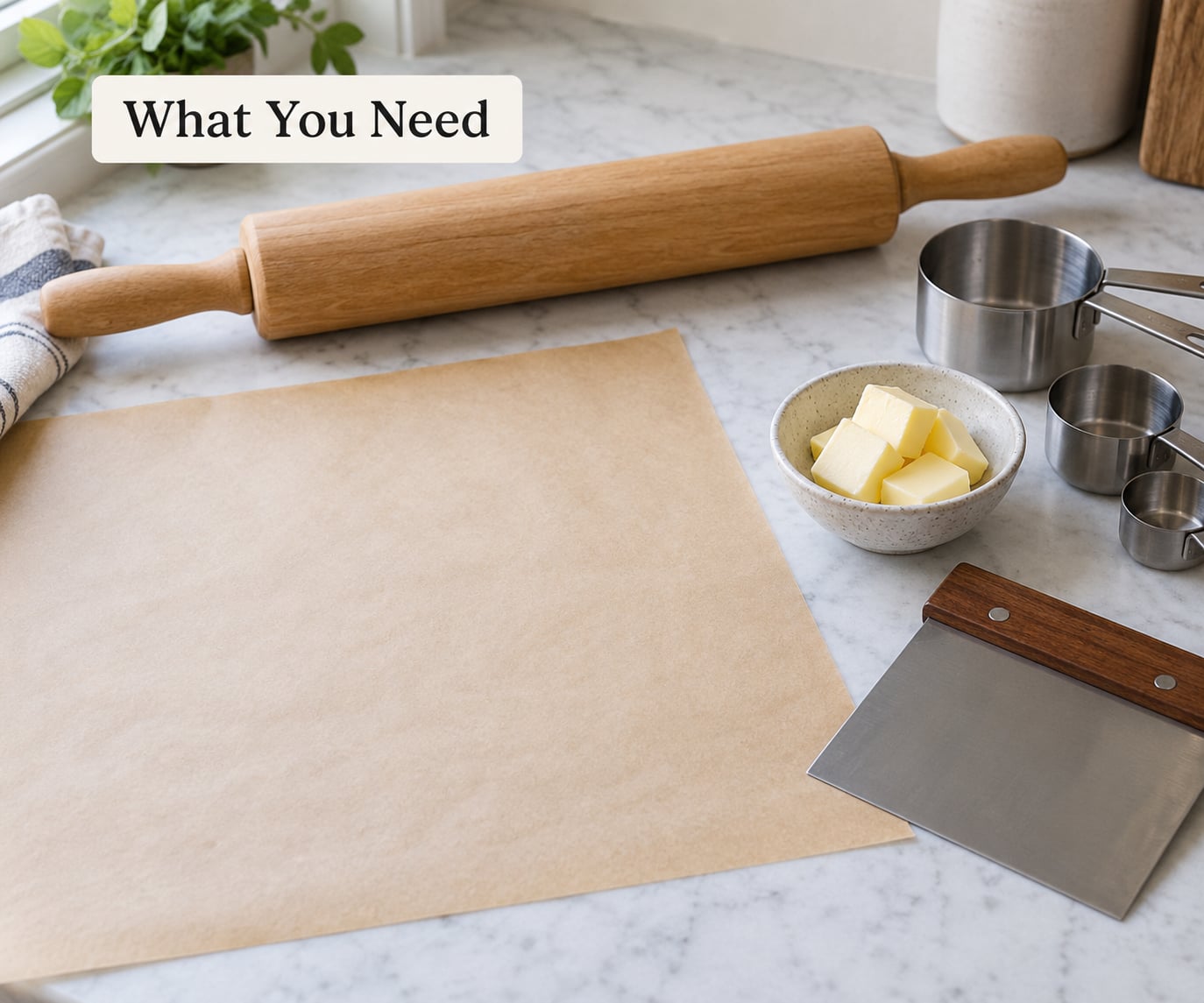
The ingredient list is short. The tools matter more than anything you buy, because cold surfaces and a flat bench do the work for you.
- Flour: all-purpose, plus a couple of tablespoons for the bench. Cake flour works, but it needs more liquid to hydrate.
- Fat: very cold unsalted butter, cubed, or a solid vegan butter block that behaves the same way in the dough. Shortening also works and is the most forgiving option for beginners.
- Liquid: buttermilk, milk, or sour cream plus milk. Cold liquid keeps the butter from melting at the bench.
- Leavening: baking powder and a little baking soda. Fresh baking powder shows up constantly in laminated biscuit discussions on r/Breadit, where people post cross-sections and say their lift vanished after switching to a tin that had been open a year.
- Tools: rolling pin, bench scraper, pastry blender or fork, a 10 by 12 inch rectangle of parchment, and a 2 inch biscuit cutter.
Two setups pay for themselves quickly. First, a marble or granite slab or countertop, which stays cold and gives the dough a smooth, non-sticky bench. People on r/FoodPorn make a point of chilling the surface first, then pressing the dough to about 1 inch thick straight onto it rather than fighting a sticky countertop.
Second, a bench scraper. It lifts the dough without tearing it and doubles as the folding guide. If you have a cast iron skillet, keep it in the oven preheating while you work, since a hot skillet is the difference between tall sides and flat ones.
For a gluten-free version, a 1-to-1 flour blend behaves well for two or three folds, then gets fragile. Cut it with less pressure and expect a tighter, crumbly layer count rather than a laminated-croissant look.
Step-by-Step: How to Laminate Biscuit Dough for Layers
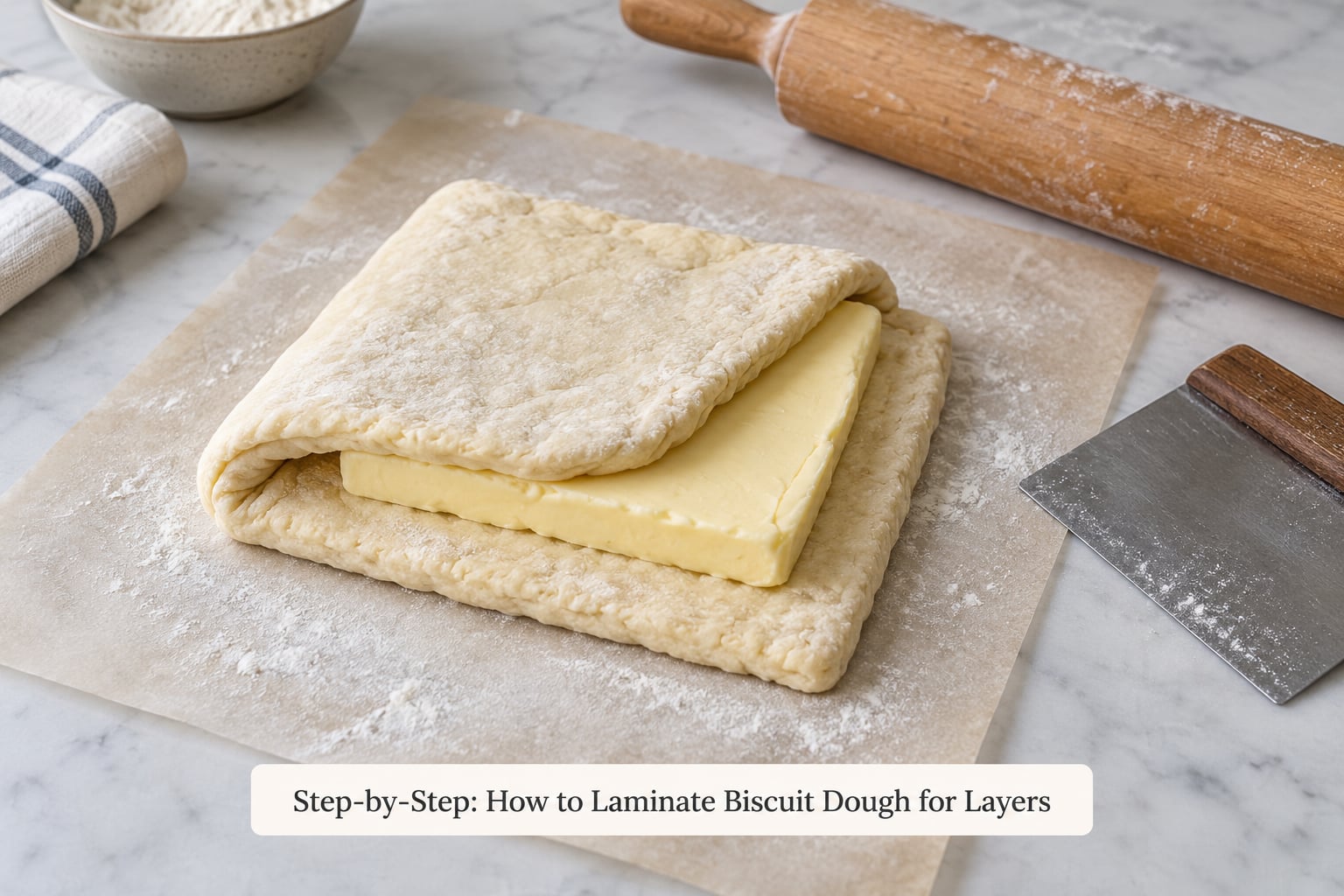
Read the whole sequence once before you start, because the order matters and the dough cannot be paused halfway through a fold without the butter softening.
1. Make the Biscuit Dough
Cut the cold fat into the flour with a pastry blender until the mixture looks like coarse crumbs, some pieces pea-sized. Pour in the cold liquid and stir with a fork just until no dry flour is visible. The dough should look shaggy and lumpy, with visible butter pieces, and that is exactly what you want.
Stop there. If it feels sticky, dust it rather than adding more liquid. On r/glutenfreerecipes the warning is blunt: overworking the dough is how you end up with hockey pucks, and the fix is to fold it a few times and leave it alone.
2. Chill and Flatten the Dough
Wrap the dough and refrigerate it 15 to 20 minutes. Turn it out onto a lightly floured cold surface and press it with your palms into a rectangle about 3/4 to 1 inch thick, roughly 10 by 12 inches. Do not use the rolling pin yet. Pressing by hand keeps air pockets from forming underneath.
3. Add the Fat Layer
Leave the butter out for 3 to 5 minutes so it bends without cracking, then dot it over the dough in a single even layer. Slide it to within a half inch of the edges on all four sides, or the butter will squeeze out when you fold.
Tap the surface of the fat with the rolling pin to flatten the lumps into one sheet. Break the sheet through the dough with the bench scraper, then fold the exposed dough over it and pat it down lightly.
Test the fat before you spread it. Bend a piece: it should curve without cracking and without smearing. Cracking means it is too cold and will shatter into shards mid-roll. Smearing means it is too soft and will leak into the dough, which is the failure mode that makes laminated dough greasy instead of flaky.
4. Fold the Dough into Letters
To fold the dough into letters, fold the bottom third up and over the center, then the top third down over that. You now have a rectangle one third the size. Press the flat of your hand over the whole surface to seal the layers together and push out air gaps, without shoving the fat out the edges.
Give it a quarter turn on the bench, pat it back out to its original footprint, and that is one full lamination cycle.
5. Roll and Repeat the Folds
How to laminate biscuit dough for layers comes down to this: three to four cycles, each one fold plus a quarter turn plus a re-roll back to 1 inch. Fold a fifth and sixth time if you want to see what over-lamination does. My batch tasted it, and it was not worth the extra flour.
Here is the layer math so you can tell where you stand. Each letter fold triples the sheets. Three cycles gives you 27 layers, four gives you 54. Two cut-and-stack cycles give you 81, which is more than a home biscuit needs.
6. Cut Without Destroying the Layers
After the final fold, roll the dough to 1/2 to 3/4 inch thick. Anything thinner and the layers compress; anything thicker and the center bakes before the edges brown.
Press the cutter straight down and lift it without twisting. Twisting shears the outer layer and produces lopsided biscuits that refuse to rise evenly. Space them 1 inch apart for tall, soft-sided biscuits that pull apart, or 2 inches apart if you want crisp edges all round.
7. Chill, Bake, and Check the Layers
Chill the cut biscuits 15 minutes, then bake at 425°F until golden brown, 12 to 15 minutes depending on size. Cold butter and hot oven are both essential: the butter needs to melt as steam, not before it reaches the oven.
Cut one biscuit in half across the middle while it is still warm. You should see distinct horizontal layers you can peel apart, and the crumb should look tender with a slightly crisp shell. If the inside is uniformly dense, you worked the dough rather than folding it.
A second rest question comes up constantly: should the dough chill between folds? A 30 minute rest is the common advice in r/Baking threads, and it is optional. If your butter softens while you roll, 20 minutes in the fridge is plenty and the layers survive it. If the butter is cracking into shards instead, the opposite move helps: let the dough sit 20 minutes so the fat warms toward bendable before you roll again.
Three Lamination Methods Compared
Letter folding is the default, but it is not the only way to get lift, and the cut-and-stack method is faster once you know it.
| Method | Hands-on time | Layers | Difficulty | Best for |
|---|---|---|---|---|
| Letter fold | 15 to 20 minutes | 27 to 54 | Low | First lamination, best-looking layers |
| Cut and stack | 10 to 12 minutes | 81 | Low | Sourdough discard biscuits, tender tall rounds |
| Block fold | 25 to 30 minutes | 54 to 108 | High | Croissant-adjacent, laminated fancier shapes |
Cut and stack works like this: roll the dough thin, cut it into 9 squares with a bench scraper, stack them, pat the stack back into a single sheet, and repeat once. It was the fastest first attempt reported in the r/52weeksofbaking laminated buttermilk thread, where the whole bake including mixing took under an hour.
Block fold means wrapping cold butter in a paper or parchment sleeve to build a square block, then enclosing it in the dough and repeating the letter folds. It gives you the highest lift and the least forgiving dough, so save it for when the letter fold feels boring.
Common Mistakes and How to Fix Them
Almost every laminated biscuit problem comes down to three things: fat temperature, flour added during folding, and dough handled too aggressively. Here is how to tell them apart.
| Symptom | Cause | Fix |
|---|---|---|
| Tall biscuit, no visible layers | Overworked dough or too much bench flour | Press and fold, never knead; scrape stray flour back off with the bench scraper |
| Buttery shards in the dough | Fat was too cold and shattered while rolling | Rest the dough 20 minutes, then fold at a cooler temperature next time |
| Greasy dough, layers melt into one | Fat softened on the bench and leaked through | Chill butter and utensils before starting; work in 10 minute bursts |
| Biscuits spread flat in the oven | Dough rolled too thin, or cuts spaced too close | Roll to 1/2 to 3/4 inch and space cuts 1 to 2 inches apart |
| Lopsided biscuits | Biscuit cutter twisted while pressing | Press straight down and lift without rotating |
| Dense, hockey-puck crumb | Dough mixed until smooth before folding | Stop at the shaggy stage with visible butter lumps |
| Tough and chewy after four folds | Gluten developed from too many cycles | Stop at three or four folds; more is not better |
| Good height, pale flat tops | Baking powder has lost its lift | Replace it; open tins lose potency within months |
One habit cuts most of these problems: keep the dough on the cold surface you are not actively rolling, and scrape it back on between cycles. Every minute at room temperature softens the butter layers you just sealed.
Frequently Asked Questions
How many folds should I make when laminating biscuit dough?
Three to four letter folds is the right range for home biscuits. Each letter fold triples the layer count, so three cycles give you 27 layers and four give you 54, which is more lift than most biscuits need. Two cut-and-stack cycles produce about 81 layers and are faster. Stop there. Six folds gave me a tough, chewy biscuit in a test batch, and gluten development, not a short fold count, is what makes dough hard.
Can I laminate biscuit dough with vegan butter?
Yes, as long as the vegan butter behaves like a solid fat rather than an oil. Blocks and sticks that hold their shape at room temperature work best, and coconut oil blends also laminate well. Watch it more closely than dairy butter, since plant fats often soften sooner, which is how they end up leaking through the layers and greasing the crumb.
Does gluten-free flour work for laminated biscuits?
A 1-to-1 gluten-free blend works for two or three folds and gives a crumbly, tender result. The dough is fragile, so roll with less downward pressure, fold with a bench scraper instead of your hands, and keep every rest short. You will get fewer clean layers than a wheat dough and a slightly grainier crumb, but the height is real and the texture is not gummy.
Why are my laminated biscuit layers disappearing?
Almost always the dough was handled too much, or the fat softened and merged into the dough. Signs of a bad bake are uniform density with no seams you can peel apart. Fold with presses instead of kneading, scrape stray bench flour off the dough, and restart with butter cold enough to bend without cracking. Cut one biscuit open warm to check; a good batch shows distinct horizontal layers.
How thick should laminated biscuit dough be before baking?
Roll to 1/2 to 3/4 inch thick after your final fold. Before the first fold, press the dough to 3/4 to 1 inch. Thinner dough compresses the layers until they vanish, and thicker dough leaves a raw center while the edges brown. Even thickness matters more than the exact number, so check a corner before you commit to cutting.
How long should biscuit dough chill after folding?
Chill cut biscuits for 15 minutes before baking, which firms the fat and keeps the layers from merging. Resting between folds is separate: 30 minutes is the common recommendation, and it is optional. If your butter is softening at the bench, 20 minutes in the fridge is enough and your layers will survive it. Over-chilling to the point where the fat shatters makes things worse.
Conclusion
Start with cold butter, cold liquid, and a cold surface, then fold three or four times without ever kneading. That is the whole method, and it is the part that separates a biscuit that soaks up gravy from one that just sits there.
Make your first batch a simple buttermilk one with nothing added to the dough but salt. Once you can see layers when you cut a biscuit open warm, add cheddar and scallion or a spoonful of honey butter, and the same technique carries straight over. Updated for 2026.