To make masa tortillas at home you only need three things: masa harina, warm water, and salt. Mix them into a soft dough, rest it 20 to 30 minutes, press or roll it thin, and cook it on a hot dry skillet until it puffs and freckles. The whole batch of six takes about 45 minutes, and once you get the feel for the dough it becomes the weeknight staple you use instead of the store-bought bag.
I make these most Sundays, and I still think of the first few as practice rounds, the same way the first couple of pancakes always come out edible but not quite what you hoped for. Twenty minutes of work, and the results get reliable fast.
Before you start, one honest note. Fresh corn tortillas are a different animal than soft flour tortillas. They are thinner, they tear if you handle them like a pita, and they need to stay wrapped or they turn brittle within an hour. Everything below accounts for that.
Table of Contents
- What You Need
- Ingredients for six medium tortillas
- Equipment
- Which masa harina to buy
- Step-by-Step: How to Make Masa Tortillas at Home
- Step 1: Mix the Masa Dough
- Step 2: Rest the Dough
- Step 3: Divide and Shape the Dough
- Step 4: Roll Thin and Evenly
- Step 5: Cook the Tortillas
- Step 6: Keep Warm and Serve
- Common Mistakes and How to Fix Them
- Tortillas crack at the edges when you roll them
- Dough is sticky and clings to your hands and the press
- Tortillas come out thick and chewy
- Nothing puffs up
- The tortilla sticks to the pan
- Uneven cooking and burnt spots
- Tortillas dry out and become brittle
- Frequently Asked Questions
- How long do homemade masa tortillas stay fresh?
- Can I make masa tortillas without a tortilla press?
- How do I keep cooked corn tortillas from drying out?
- Can masa tortilla dough be frozen?
- Are corn tortillas naturally gluten-free?
- Why does my masa dough keep cracking when I roll it?
- Start with the Right Dough Consistency
What You Need
Here is the shopping and equipment list for six medium tortillas, roughly 6 inches across. I give weights alongside cups because cups are a guess and grams are not, and the small differences in masa brands change how much water they drink.
Ingredients for six medium tortillas
- Masa harina: 1 cup (about 115 g). This is nixtamalized corn flour, not cornmeal and not plain corn flour. Any mainstream brand works, including Maseca, Masienda, Minsa, and Pan.
- Water: 2/3 cup (about 160 ml), at room temperature to warm. Lukewarm, roughly 100 to 120 degrees, is the sweet spot. Some recipes call for water hot enough to melt a spoon of lard, and that works too, but warm water is easier to judge.
- Fine salt: 1/2 teaspoon, or 1 teaspoon if you like a noticeable edge.
- Cooking fat, optional: 1 tablespoon lard or neutral oil. Skip it for the cleanest three-ingredient version, add it when you want extra tenderness in enchiladas and quesadillas.
Equipment
- A tortilla press is the fastest route, but not required. A heavy rolling pin between two sheets of parchment works, and I use that method on days when I do not feel like washing the press.
- A dry skillet or comal. Cast iron holds heat best, a heavy nonstick is the most forgiving for a beginner. Either way, no oil goes in the pan.
- Two sheets of heavy plastic or parchment paper for rolling. Cut squares roughly the size of your tortilla.
- A clean kitchen towel or a tortilla warmer for stacking the cooked ones.
- A bowl with a lid or plastic wrap for resting the dough.
Which masa harina to buy
All of these are nixtamalized and will make edible tortillas, and the differences show up in texture more than flavor.
| Masa harina | What it is like | Best for |
|---|---|---|
| Maseca | Widely stocked, dependable hydration, a little finer texture | First-timers and everyday tacos |
| Masienda | Stone-ground heritage corn, distinctly fresh corn taste | When flavor matters more than convenience |
| Minsa | Smooth dough, very forgiving at the press | Batch cooking and beginners |
| Naturelo | Organic and non-GMO, short ingredient list | Ingredient-focused cooks |
| Pan | Coarser, stickier dough, heavier corn flavor | Arepas and gorditas more than soft tortillas |
Follow the water ratio printed on the bag before you follow mine. Brands differ, and the bag is calibrated to that flour.
Step-by-Step: How to Make Masa Tortillas at Home
Read the whole sequence once, then work it. The order matters more than the individual techniques, because each step sets up the next.
Step 1: Mix the Masa Dough
Put the masa harina in a bowl, make a well in the center, and pour in about three quarters of the water. Salt goes in with the flour, not the water, so it distributes evenly.
Mix with a fork or a sturdy spoon until no loose dry flour is visible, then knead by hand for 2 to 3 minutes. The dough goes through an awkward stage that looks like wet sand and pasty clumps, then suddenly comes together. It should end up close to soft cookie dough.
Add the optional lard or oil now and knead it through, then judge the hydration. Press a thumb about a third of the way into the dough. If the dent holds its shape with no cracks around it, you are ready. If cracks radiate outward, add water one tablespoon at a time. If the dough smears and clings to your palm, dust your hands with dry masa harina and knead in a spoonful.
That thumbprint test is the whole check. Cooks on cooking forums repeat it more than any other tip for a reason: it tells you about texture faster than any timer.
Step 2: Rest the Dough
Cover the bowl and leave it at room temperature for 20 to 30 minutes. This is not optional. Resting lets the warm water fully hydrate the masa, and hydrated masa is what gives you a tender tortilla instead of one that cracks when you fold it.
You will know it worked when the dough looks a little darker and more unified, with a faint sheen on the surface, and when a piece pressed into the bowl keeps its shape rather than slumping. A rested dough also sticks less to your hands during shaping.
If you are in a hurry, 10 minutes is survivable. If you are planning ahead, an hour in the refrigerator works and the dough is slightly easier to roll cold.
Step 3: Divide and Shape the Dough
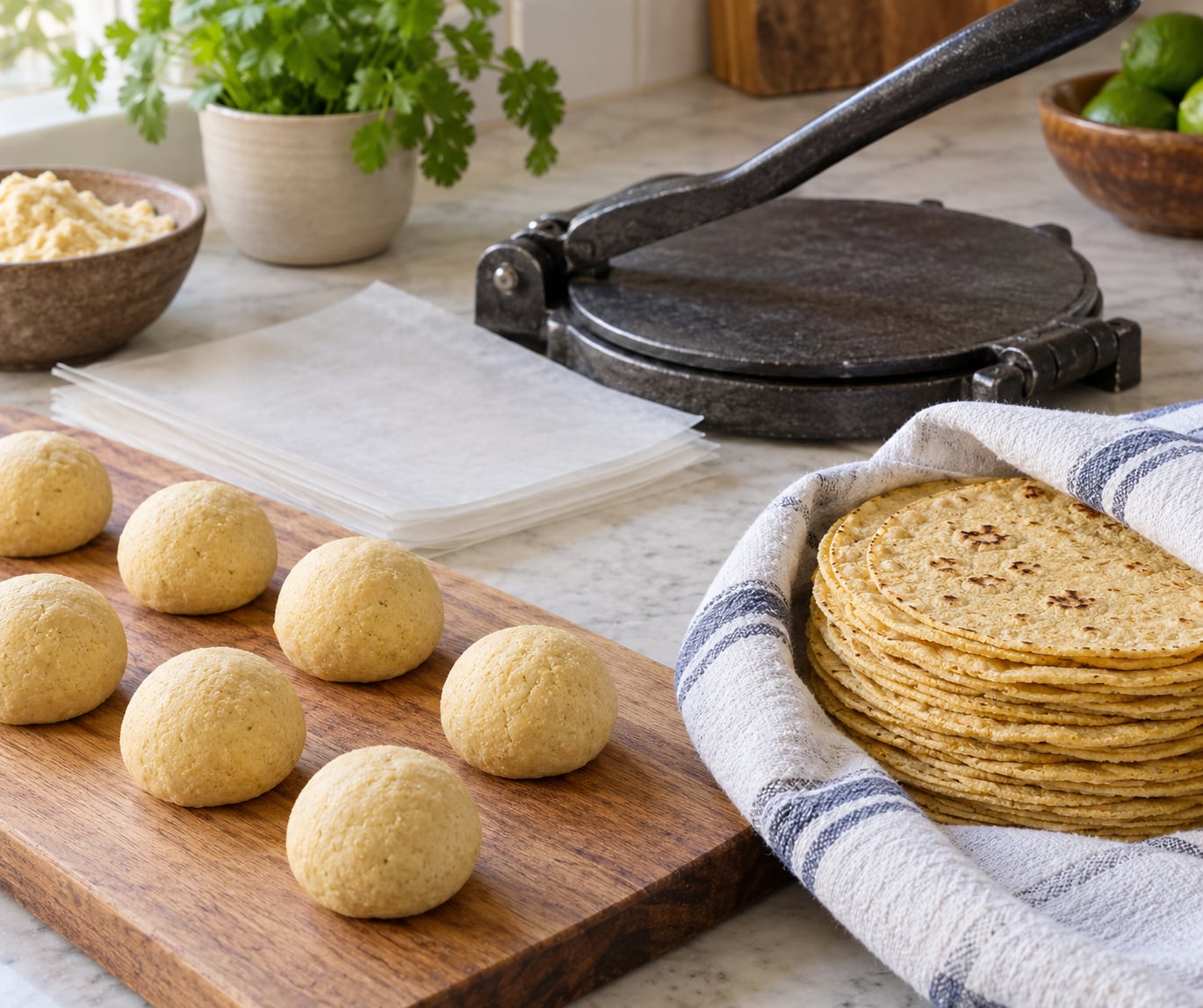
Pinch off a piece roughly the size of a golf ball, about 55 to 60 g for a medium tortilla. Weigh them if you can, and put any extra dough back under the dough you already covered so it does not dry out.
Roll the portion between your palms into a smooth ball, then flatten it slightly with your fingertips. Smooth matters more than perfect, because cracks start at rough seams.
Keep the shaped portions under plastic or under a damp towel while you work. Any masa exposed to air starts losing moisture within a few minutes, and dry masa cracks. This is the single most common reason home tortillas tear at the edges.
Step 4: Roll Thin and Evenly
Set a dough ball between two sheets of plastic or parchment and roll it out from the center outward. Rotate as you go so it stays roughly round. Turn the stack over and roll again until you can see a shadow through the dough.
You are aiming for 1 to 1.5 mm, roughly the thickness of a couple of sheets of paper. Thin is better than thick. A thick tortilla stays gummy in the middle, folds badly, and refuses to puff, because there is not enough air space for steam to expand into.
If you use a press, put the ball on the lower plate, cover with plastic, lower the top, and press once firmly with a twist of the handle rather than a straight squeeze. The twist spreads the dough evenly and keeps the thickness consistent from center to edge.
Peel off the top plastic, lift the tortilla by the edge, and lay it on your palm. If it tears, it was too thick or too dry, and both are fixable.
Step 5: Cook the Tortillas
Heat a dry skillet over medium to medium-high heat until a drop of water skitters and evaporates in a couple of seconds, roughly 350 to 400 degrees. Too cool and the tortilla steams without browning. Too hot and it burns before it cooks through.
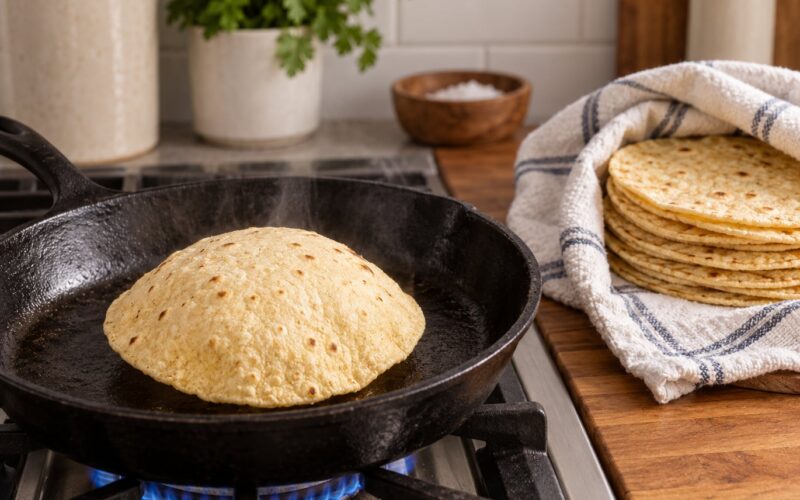
Lay the tortilla on the dry pan and press it flat. Cook for about 30 to 60 seconds until the underside is spotted and firm. Flip and give it another 30 seconds.
Then watch for the puff. The tortilla inflates within 15 to 30 seconds as steam trapped under the surface expands, which is your cue that it has cooked through. Pull it off the heat after another 15 to 30 seconds on that side, 2 to 3 minutes in total.
Some tortillas do not puff and that is not a failure. The puff means the layers separated, which is a bonus for texture. Plenty of perfectly good tortillas stay flat, especially thicker ones.
Keep a stack of cooked tortillas going. Once you get two or three down, turn the heat down slightly so the earlier ones do not overcook while you finish the batch.
Step 6: Keep Warm and Serve
As each tortilla comes off the heat, stack it inside a clean kitchen towel and fold the towel over the pile. The trapped steam softens the tortillas and keeps the last one as pliable as the first. A dedicated tortilla warmer does the same job with less heat loss.
Wrapped tortillas stay soft and foldable for a couple of hours. Unwrapped on a plate, they stiffen within 20 to 30 minutes.
Serve within the hour if you can. The simplest use is street taco night, with carnitas or grilled corn and onion, but soft corn tortillas also make excellent breakfast tacos with eggs and chorizo, and they are the right base for chilaquiles when you want the tortilla to hold up to sauce without going to pieces.
Common Mistakes and How to Fix Them
Almost every disappointing tortilla traces back to dough hydration, pan heat, or handling. Work down this list in order when something goes wrong.
Tortillas crack at the edges when you roll them
The dough is too dry. This is the number one complaint on cooking forums, and the fix takes seconds. Mix in a teaspoon of water, knead, and rest ten minutes. If the dough tears more as you roll, stop, add water, and let the masa drink before you try again.
Dough is sticky and clings to your hands and the press
You went a little too wet, or your kitchen is humid, which is more common in summer in the Appalachians than most tortilla instructions admit. Dust your hands with dry masa harina rather than adding more flour to the dough, which makes the tortilla taste dusty. Flour on the surface is a tool for your hands, not an ingredient.
Tortillas come out thick and chewy
You stopped rolling too early, or the pan was too cool to dry the surface. Roll thinner next time and let the pan reach temperature before the first tortilla goes on. Thick tortillas also resist folding, which matters most for tacos and quesadillas.
Nothing puffs up
Three causes, in order of likelihood. The pan was below temperature when you started. The dough was under-hydrated and there was not enough steam to generate. Or the tortilla was too thick to balloon. Warm skillet, properly rested dough, thinner rolling, and a quick flick of the pan edge to shake it during the first flip all nudge the puff along.
The tortilla sticks to the pan
Your skillet is not seasoning well, or the heat was too high and the surface has bonded to the corn. Lower the heat a notch, let the pan cool for a minute, and wipe it with a paper towel held on tongs. A well-seasoned cast iron comal rarely has this problem at all.
Uneven cooking and burnt spots
Your skillet is hotter in the middle than the edges, which is normal for cast iron and worse for thin tortillas. Rotate the tortilla a quarter turn after each flip, and move the flame with a small handheld burner if you cook on gas. Cooking in batches of two rather than four keeps the pan temperature steadier.
Tortillas dry out and become brittle
They sat uncovered, or they sat too long. Wrapped in a towel, they hold their softness for hours. Day-old tortillas are not ruined, so cut them into strips and fry them into tortilla chips, or dice them into chilaquiles with salsa and shredded cheese. Reheating them cold in a microwave makes them tough, which is why the skillet or the oven works better.
Two habits fix most of this list at once. Weigh your masa and weigh your water instead of scooping both, and give the dough the full rest. Everything else is technique you pick up in a batch or two.
Frequently Asked Questions
How long do homemade masa tortillas stay fresh?
Homemade corn tortillas are best the same day, which is really the point of making them. Wrapped in a clean kitchen towel or held in a tortilla warmer, they stay soft and pliable for about two hours. Refrigerated in a sealed container or bag, they hold for three to four days, though the edges start to stiffen first. Corn tortillas reheat better in a dry skillet for 15 seconds a side than in a microwave, which tends to make them tough and chewy rather than soft.
Can I make masa tortillas without a tortilla press?
Yes, and plenty of people never buy one. Roll the dough ball between two sheets of parchment or plastic with a heavy rolling pin, working from the center outward and rotating as you go, until you can see a shadow through the dough. The result is slightly less uniform than a press but very close in thickness. A second pin laid parallel to the first and rolled across the dough helps keep it even and stops it from thinning into an oval.
How do I keep cooked corn tortillas from drying out?
Stack them as soon as they leave the pan and wrap the whole pile in a clean kitchen towel, then fold the towel over the top so the steam stays trapped. A tortilla warmer does the same thing with less heat loss. Wrapped this way they stay soft for hours; left open on a plate they stiffen within 20 to 30 minutes. If your batch is large, cover the finished stack with a slightly damp towel, not dripping wet, to add moisture without making the tortillas soggy.
Can masa tortilla dough be frozen?
Yes, though it is usually easier to freeze the tortillas themselves. To freeze the dough, shape it into golf ball portions, lay them on a tray, freeze until solid, then transfer to a bag. Thaw at room temperature under plastic for 20 to 30 minutes before pressing. Expect slightly more cracking than fresh dough, so roll a touch thinner and give the thawed balls a few extra minutes of kneading. Cooked tortillas also freeze well stacked with parchment between them.
Are corn tortillas naturally gluten-free?
Yes. Corn tortillas made with pure masa harina and water contain no wheat, so they are naturally gluten-free and vegan. Watch the labels on the masa harina and on any fat you add, since some brands of lard or oil and a few masa harina products include wheat or additives. Double check if a strict gluten-free diet is the reason, and choose a brand that states gluten-free on the package. Tortilla presses lined with plastic, rather than flour-dusted, also keep the finished tortilla free of wheat.
Why does my masa dough keep cracking when I roll it?
Dough cracks when it is too dry to stretch, and the fix is more water. Add it one teaspoon at a time, knead it through, and give the dough another ten minutes to rest so the masa drinks it in. The thumbprint test tells you when you are there: press a thumb in a third of the way, and if the dent holds with no cracks around the edge your hydration is right. Cracking at only the very rim also means you rolled too thin in that spot, so rotate the dough and keep rolling from the center.
Start with the Right Dough Consistency
Everything above hangs on one thing: dough that is soft, slightly tacky, and holds a thumbprint without cracking around it. Start with room-temperature to warm water rather than cold or boiling, mix until no dry masa remains, knead for a couple of minutes, and then give it the full 20 to 30 minute rest before you shape anything.
That is the whole method. Mix, rest, press thin, cook hot, stack wrapped. Once you can feel the difference between dry and hydrated dough with your thumb, you will know when to add water without a recipe, and learning how to make masa tortillas at home stops being a recipe and turns into something you just do on a Sunday.