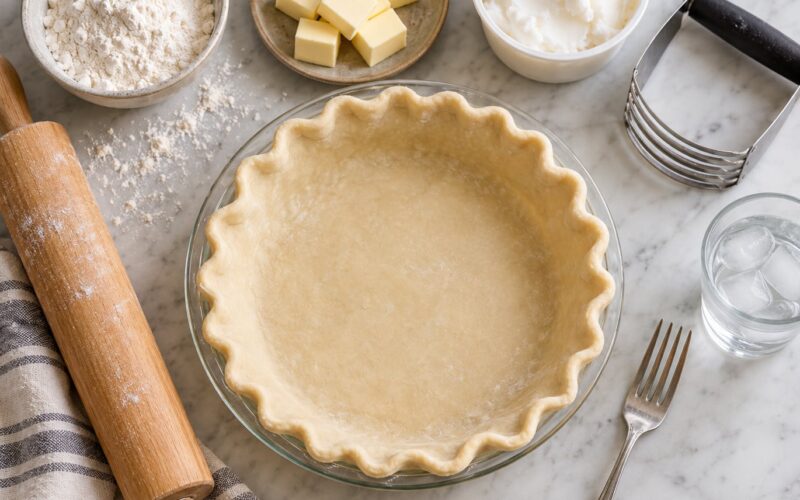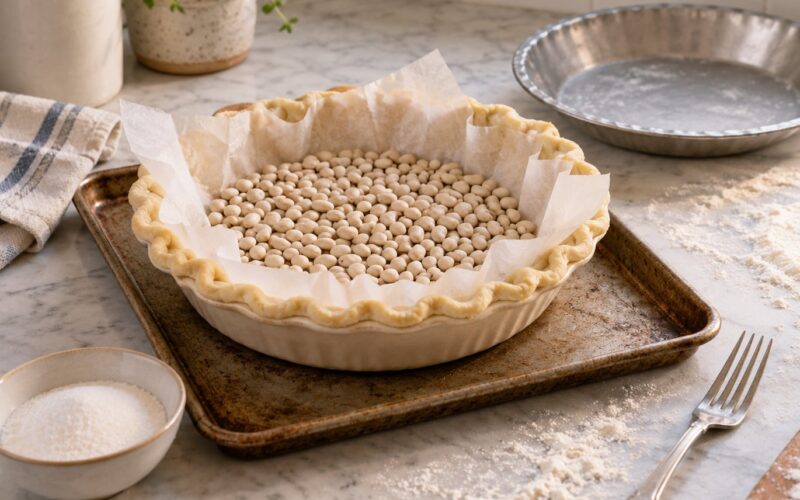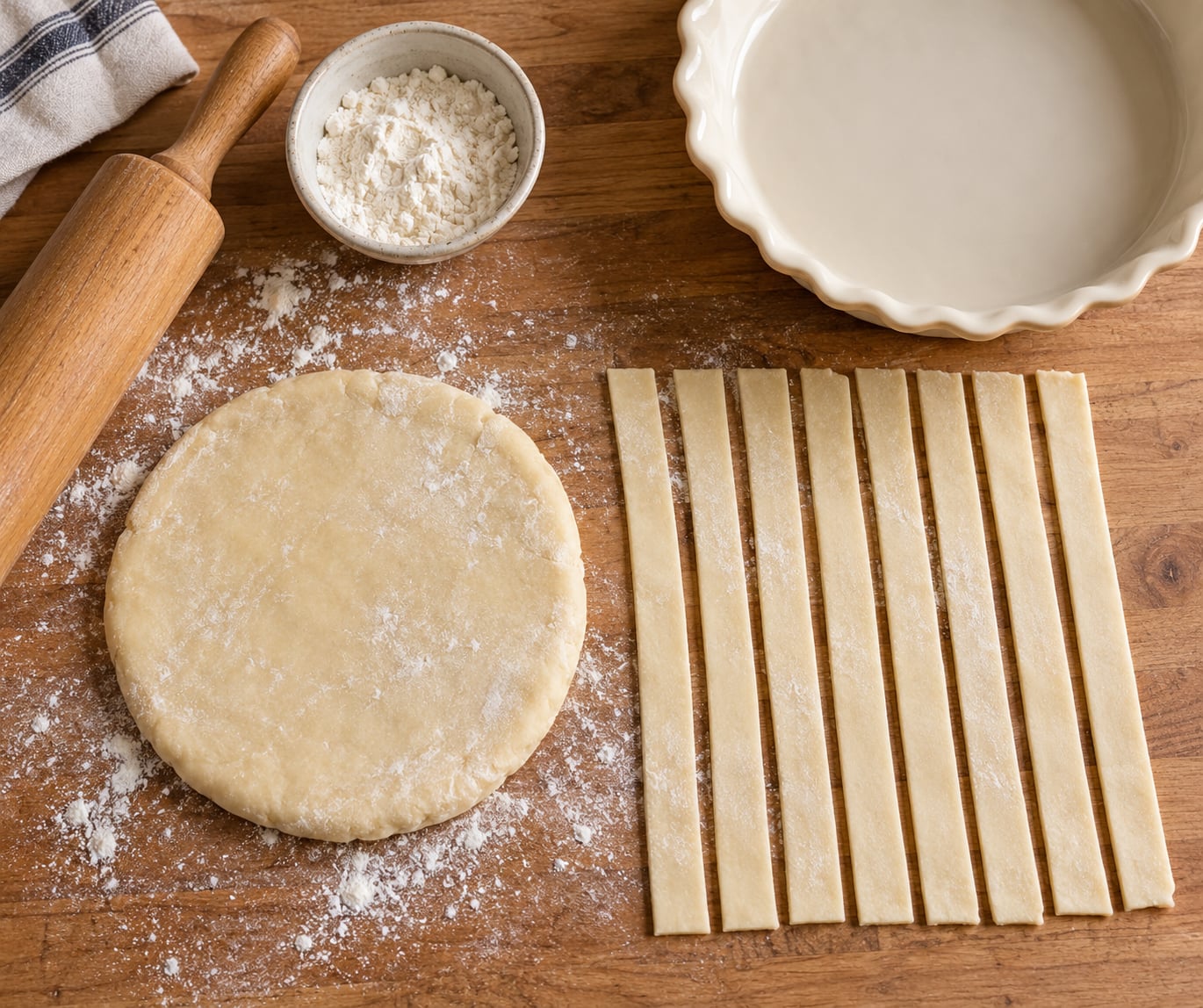
A lattice pie crust is a pie top built from even strips of pie dough laid in an over-under weave, and the gaps between them let steam out so a thick fruit filling cooks down instead of boiling over. Learning how to make a lattice pie crust takes about 20 minutes once the dough is cold, and the whole thing hinges on two habits: keep the dough chilled, and cut your strips the same width.
Most people who avoid latticing are not scared of the filling. They are scared of ruining a good pie with dough that snaps mid-weave. Remove that pressure and the technique is very forgiving. Even a crooked lattice tastes exactly like a straight one.
Table of Contents
- What You Need
- Strip math for any pie dish
- Dough substitutions that work
- Step-by-Step
- How to Make a Lattice Pie Crust Without a Pastry Mat
- How to Weave Lattice Pie Strips
- Common Mistakes
- Frequently Asked Questions
- How wide should lattice pie strips be?
- Why do my lattice strips shrink or wrinkle during baking?
- How do I fit lattice strips over a pie filling without stretching them?
- Can I make a lattice top from frozen pie dough?
- What is the best way to make a lattice crust with vegan or gluten-free dough?
- Conclusion
What You Need
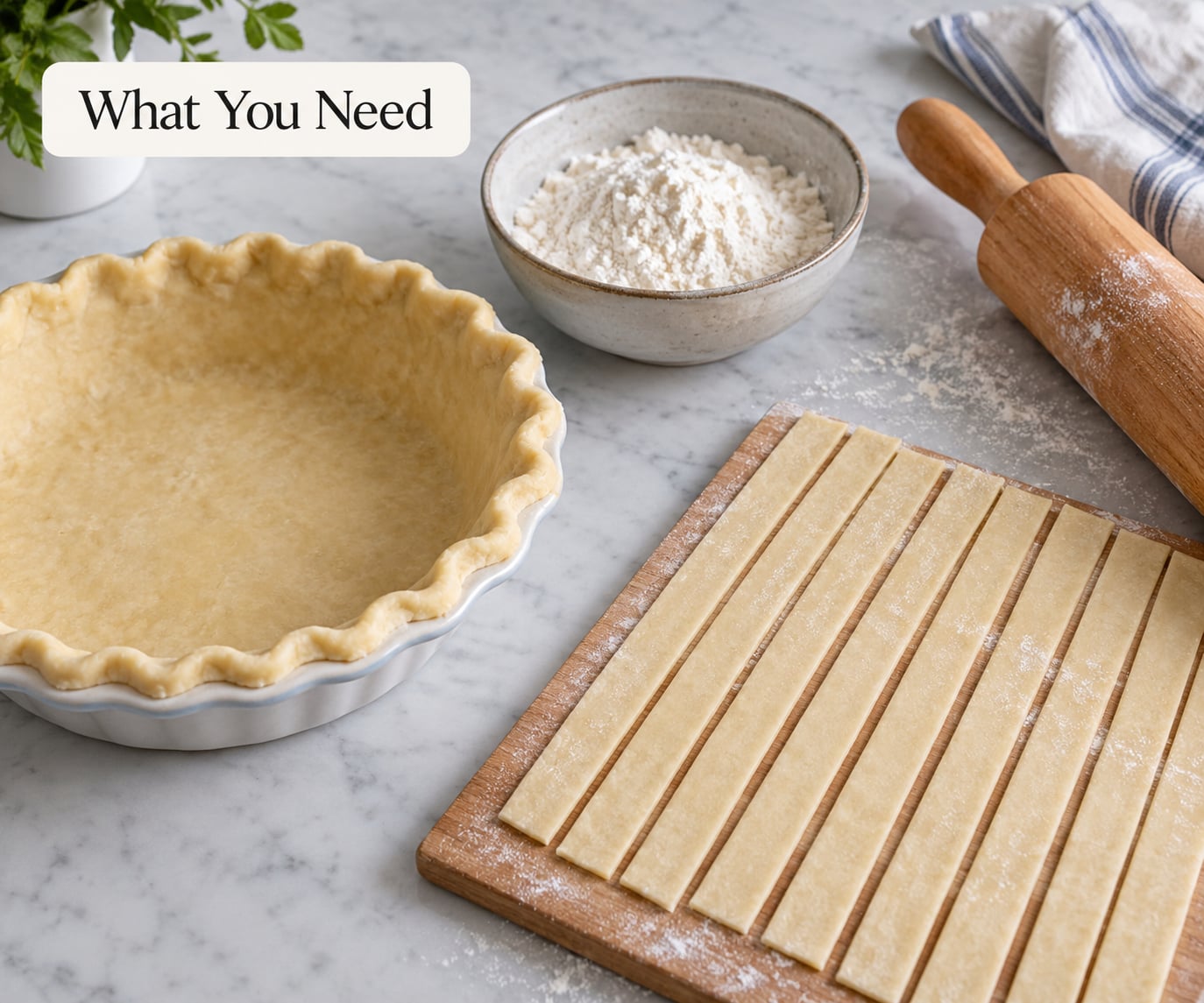
You need very little. Most of it is likely already in your kitchen drawer.
- Pie dough, fully chilled. Two disks of dough for a standard 9-inch pie, plus a third disk if you want a decorative border. Homemade dough or a store-bought disk in the refrigerator both work.
- Rolling pin. A 15-inch straight pin rolls a 12-inch circle without the dough grabbing at the ends.
- Ruler and sharp knife, or a pastry wheel. A pizza wheel and a ruler are a fine substitute for a fluted pastry wheel.
- Parchment or wax paper. Two sheets, roughly 15 by 20 inches, for rolling and for the staging area.
- Small bowl of flour. For dusting, plus a tablespoon or two of cold water.
- Pastry brush, egg, and a splash of milk or water. For the wash that gives the top its shine.
- Coarse sugar, optional. A teaspoon scattered over the lattice before baking adds a crackly sweetness that plain granulated sugar does not.
Strip math for any pie dish
Most bakers guess at this, then wonder why the weave looks crooked. Measure instead. Roll the lattice dough to about 1/8 inch thick, thinner than you would for a solid top crust, because the strips double in thickness once they cross over each other.
- 9-inch pie: 10 to 12 strips, each 1/2 to 3/4 inch wide, spaced about 3/4 inch apart.
- 10-inch pie: 11 to 13 strips, each 3/4 inch wide, spaced about 3/4 inch apart.
- 12-inch deep-dish pie: 13 to 15 strips, each 1 inch wide, spaced about 1 inch apart.
Narrower strips make a finer, more traditional weave. Wider strips brown more evenly and are far easier to handle if this is your first one.
Dough substitutions that work
Plant-based and gluten-free dough both make a fine lattice, with a few handling notes. Roll them between two sheets of plastic wrap rather than directly on a board, because neither dough has enough gluten to forgive sticking. Chill them 15 minutes before cutting instead of 30, since they firm up faster than a wheat dough.
A vegan all-butter dough works exactly like a standard one. If the dough tears as you weave, press the broken ends together with a fingertip rather than wetting them, since water makes vegan dough gummy.
Step-by-Step
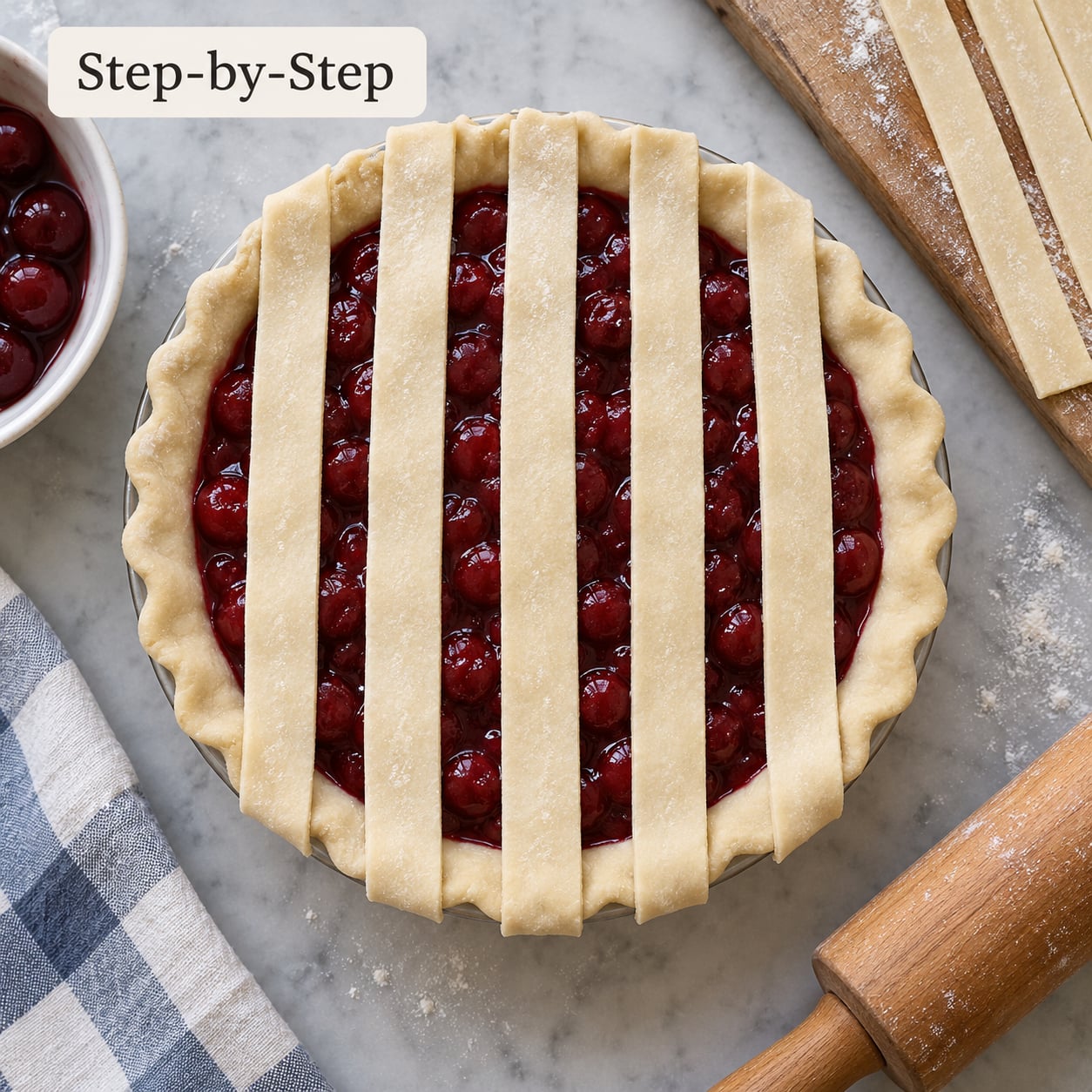
Work in this order and nothing will surprise you.
- Chill the dough for 20 minutes. Take it straight from the refrigerator. Dough that is cold snaps when rolled and warm dough smears into the flour. Both give you cracked or sticky strips.
- Roll the top dough to 1/8 inch thick. Give the rolling pin an occasional lift so you can check the thickness by feel. You should be able to see the shadow of your hand through the dough.
- Cut the strips with a ruler as your guide. Mark the widths with a sharp knife first, then finish the cuts with a pastry wheel or pizza cutter in one confident pass. Measured strips that are all the same width are what separate a neat lattice from a lopsided one.
- Chill the cut strips for 10 minutes. Lay them on a parchment-lined baking sheet. Stiff strips handle better and are far less likely to stretch when you lay them across the pie.
- Lay the first row. Arrange 5 or 6 strips parallel across the filling, spacing them evenly. They should overhang the rim by about 1 inch on both sides.
- Fold back every other strip. Working from one edge, lift strips 1, 3, and 5 and lay them back on themselves. The gap you just opened is where the perpendicular strips go.
- Weave row by row. Lay a perpendicular strip over the gap, push it down gently, and unfold the folded strips over it. Every strip goes over one and under the next. At the end of the row, shift which strips you fold back so the weave stays consistent.
- Trim, crimp, and chill. Snip the overhang flush with the rim, fold the ends of the strips underneath so no raw ends show, crimp the edge, brush with egg wash, and refrigerate the pie for 15 to 20 minutes before it goes in the oven.
Bake lattice-top fruit pies at 375 to 400°F until the crust is deeply golden and the filling bubbles thickly in the center, usually 45 to 60 minutes depending on the fruit. Loosely tent foil over the rim if it browns before the center is set.
How to Make a Lattice Pie Crust Without a Pastry Mat
Skip the mat entirely and roll on parchment. Lay a sheet down, dust it well, roll the dough directly on it, then lift the paper and dough together onto the baking sheet to chill. When you need the strips, peel the parchment away from the dough rather than trying to move dough off paper.
For narrow strips, dust the counter with a light film of flour instead of relying on flour on top. Too much surface flour keeps the strips from lying flat and they curl as they bake. Move strips with a bench scraper or the edge of a knife, sliding them under rather than picking them up, so nothing stretches.
How to Weave Lattice Pie Strips
The vocabulary makes the technique easier. The strips running in one direction are the warp. The strips crossing them are the weft. All the warp strips together form the warp field, and that field is what you lift to let each weft strip through.
Start your warp field perpendicular to the edge of the counter that is nearest you, so you fold strips back away from yourself and can see every gap. Fold back alternating strips in neat groups rather than one at a time, which keeps spacing honest. If the pie is smaller than 9 inches, use six warp strips and three weft strips instead, and overlap the weft ends so they cross the far warp strip before you trim.
If you are still nervous about weaving over the filling, weave the whole thing on a flat plate, freeze it 20 minutes, and then invert it onto the pie in one motion. A warm filling is fine for this method, which is a real advantage when the fruit is already cooked down.
Common Mistakes
Almost every lattice problem traces back to temperature, spacing, or a rim that did not get sealed. Here is what to look for.
If the dough cracks as you roll it, it is too cold. Wait 5 to 10 minutes and try again, or press the cracked edge together with your palm and roll over it once more. Flour the crack if it keeps reopening.
If the strips crumble and fall apart, there is not enough fat or liquid. Add a tablespoon of cold water at a time and knead gently, or pinch a tablespoon of butter or shortening into the dough until it holds together when squeezed.
If the finished crust is tough rather than flaky, it was overworked. Once you add water, stop kneading as soon as the dough comes together. Overworking develops gluten and turns pie dough into bread dough.
If the strips slump and sink into the filling, they were handled too warm. Chill the assembled pie for 20 minutes before baking, and skip the egg wash until after the chill. The wash makes wet dough slippery.
If the spacing looks uneven, the strips were cut by eye. Mark every strip with a ruler before cutting. That minute of measuring fixes the whole top.
If the filling boils over the lattice, the pie was overfilled or the strips sit too high. Fill no higher than the shoulder of the bottom crust so the mounded strips clear the fruit, and cover the rim loosely with foil for the first 20 minutes of baking.
If there is a gap between the filling and the crust edge, pour cold water into that empty ring before the pie bakes. The pastry soaks it up and seals the hole against leaking.
If the edges brown long before the lattice sets, use a shield. A wide strip of foil bent over the crimped rim keeps the pretty part from taking on too much heat.
Frequently Asked Questions
How wide should lattice pie strips be?
Aim for 1/2 to 3/4 inch wide strips on a 9-inch pie, and closer to 1 inch on a 12-inch pie. Roll the dough to 1/8 inch thick first, since strips double in thickness as they weave. Mark each strip with a ruler before cutting so every one matches. Narrow strips give a finer, more traditional look; wide strips are easier to handle and brown more evenly.
Why do my lattice strips shrink or wrinkle during baking?
Warm dough and stretched dough are the two usual causes. Strips laid across a filling naturally want to shorten, so leave each one slightly longer than the pie and trim after it relaxes. Chilling the cut strips for 10 minutes and the assembled pie for 20 minutes before baking keeps everything firm. Flour on the surface also causes curling, so dust the board lightly rather than the dough.
How do I fit lattice strips over a pie filling without stretching them?
Let the filling cool slightly, then lay strips across rather than lowering them straight down. Support the middle of each strip with two fingers and let the ends drape. Overhang the rim by about an inch on each side, which is what you need for crimping. If strips keep slipping, chill the pie 15 minutes first so the butter in the filling firms up and grips them.
Can I make a lattice top from frozen pie dough?
Yes, and frozen dough actually cuts cleaner. Thaw it just until it is pliable, roughly 15 to 20 minutes at room temperature or under cool water. Rolling it frozen is what makes strips shatter, so wait for the give. A frozen disk of store-bought crust usually contains two disks, one for the bottom and one to roll for the lattice, so check the label before adding extra dough.
What is the best way to make a lattice crust with vegan or gluten-free dough?
Roll between two sheets of plastic wrap instead of on a floured board, since neither dough has gluten to forgive sticking. Chill 15 minutes rather than 30, then cut strips with a pizza wheel in one pass. Press any torn ends together with a fingertip instead of wetting them. Gluten-free dough browns faster, so tent the pie with foil early in the bake.
Conclusion
Start by chilling your dough for 20 minutes and cutting every strip to the same width. Those two steps prevent nearly every failure people run into, and everything after them is just folding, laying, and a light touch.
Once the classic weave feels easy, try it with savory fillings like a chicken and vegetable pie, or with whatever fruit is best that week. Apple and blackberry is a good first pairing, and a lattice makes any filling look like you meant it to. If you are working with vegan or gluten-free dough, just keep rolling between plastic wrap and chill for the shorter time.