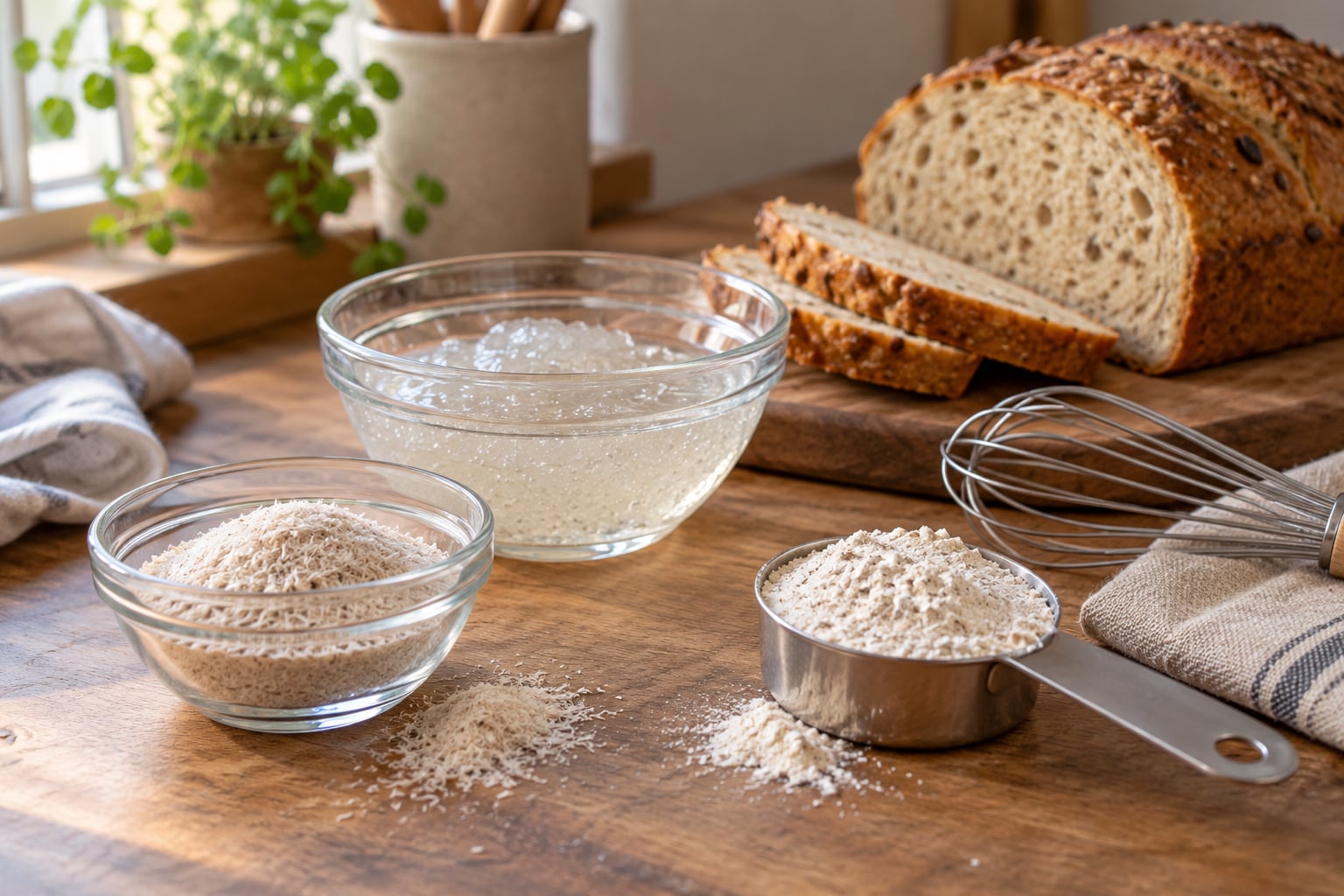
Psyllium husk forms a gel when it meets water, and that gel is what holds a gluten-free dough together. It binds crumbly flour and starch particles, traps the gas yeast releases so a loaf rises, and locks moisture into the finished crumb so the bread stays soft a day or two longer than it would without it.
What it does not do is behave like gluten. There is no elastic protein network here, only a hydrated gel, so psyllium supplements a formula rather than replacing the flour, starch, fat, leavening, or egg your recipe still needs. That distinction explains both its usefulness and the disappointment a lot of first-time users hit.
On this site we lean on psyllium in a lot of our flour blends, mostly because it does two jobs at once that starches cannot do alone. If you are new to it, start with the dosage table further down and use one measured teaspoon per cup of flour as your first experiment.
Table of Contents
- What Does Psyllium Husk Do in Gluten-Free Baking?
- How Does Psyllium Husk Work When Mixed with Water?
- The Five Main Functions of Psyllium Husk
- What psyllium husk does for structure and binding
- How Much Psyllium Husk Should You Use?
- How to Add Psyllium Husk Without Lumps
- How Psyllium Husk Changes Dough and Batter Texture
- Does Psyllium Husk Make Gluten-Free Baking Soft or Gummy?
- Psyllium Husk vs Other Gluten-Free Binders
- When to Use or Skip Psyllium Husk
- Frequently Asked Questions
- Does psyllium husk have a noticeable flavor or color?
- Can I use psyllium husk instead of xanthan gum in a gluten-free recipe?
- Does psyllium husk work in yeast-leavened gluten-free bread?
- Is psyllium already included in commercial gluten-free flour blends?
- What happens if I add too much psyllium husk to a recipe?
- Conclusion
What Does Psyllium Husk Do in Gluten-Free Baking?
In plain terms, psyllium husk is a binder, a water absorber, and a texture thickener all in one ingredient. Ground psyllium powder is the outer shell of Plantago ovata seed, and it is loaded with a soluble fiber called mucilage that swells into a viscous gel when hydrated.
Wheat gets its structure from gluten, a protein that links into an elastic web when water is added. Gluten-free flour has no such protein, so batters rely on starch, fiber, and added binders to hold shape instead. Psyllium supplies that missing scaffold, which is why it has moved from the health-food aisle into nearly every gluten-free bread recipe written in the last decade.
Here is what that gel actually does inside the dough or batter:
- Binds loose flour and starch particles so slices and cookies hold together instead of shedding crumbs.
- Traps gas released by yeast or chemical leaveners, giving lift and oven spring in breads, muffins, and buns.
- Distributes bubbles more evenly, which shows up as a more open, less tunnel-y crumb.
- Holds moisture against starch and protein, slowing staling and keeping cookies soft for days.
- Adds body to lean batters made from rice, almond, or coconut flour that would otherwise spread flat and bake up greasy.
Buy superfine or powdered psyllium rather than whole husk for most baking. Whole husk is coarse, does not disperse evenly, and leaves visible flecks in a cookie crumb.
How Does Psyllium Husk Work When Mixed with Water?
Psyllium works by swelling, not by dissolving. The mucilage in the husk takes on many times its own weight in water and turns into a slimy, cohesive gel, and the finer the powder the faster that gel forms.
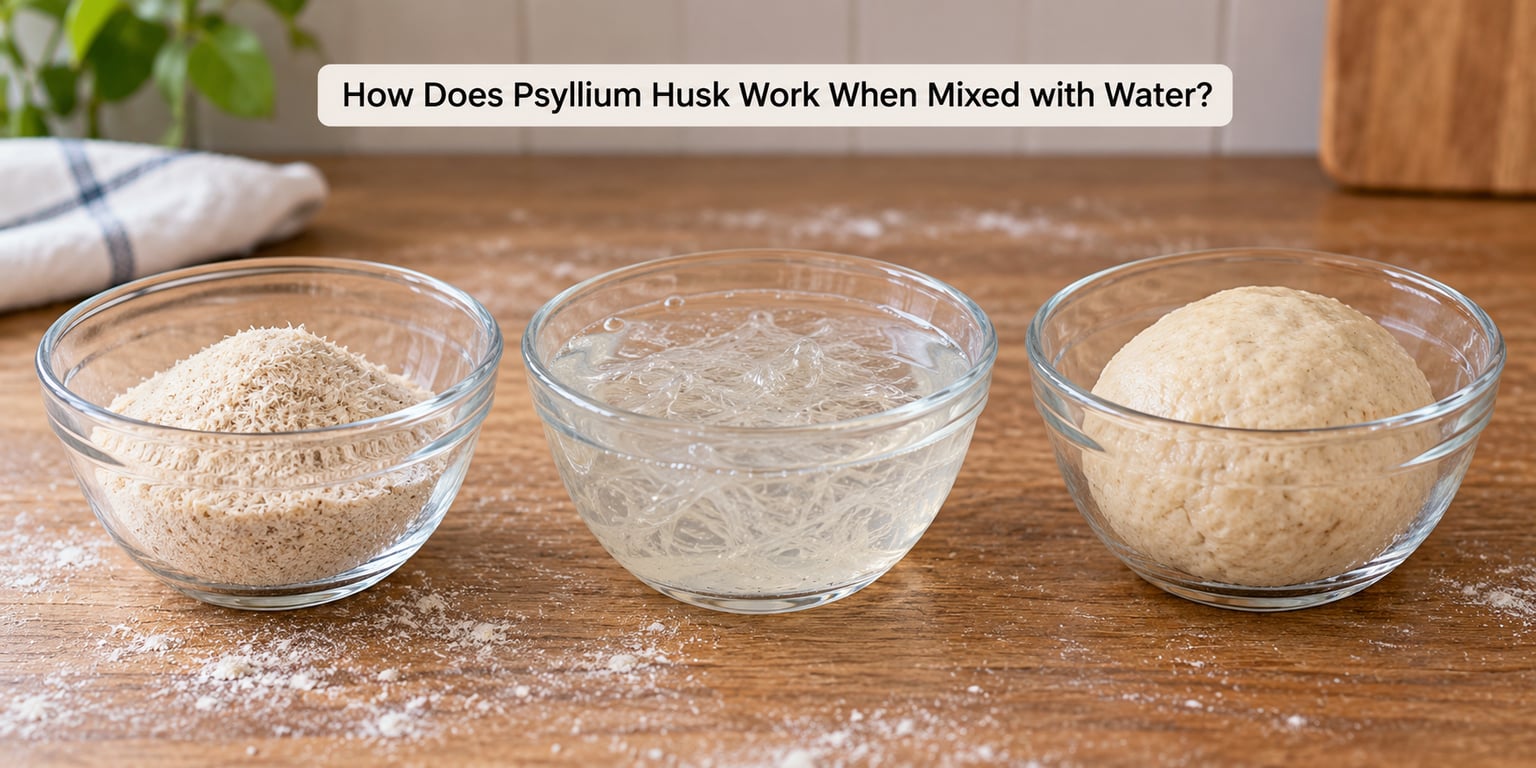
That single fact explains most of the trouble people have with it. Dump dry psyllium into a wet bowl and you get a waxy clump in the middle and dry powder at the edges. Disperse it first and the same amount produces a smooth, even gel that distributes through the whole dough.
Three hydrated mixtures, compared so you can picture what you are aiming for:
| Mixture | What happens with water | Result in a dough |
|---|---|---|
| Wheat flour dough | Gluten proteins link and stretch into an elastic web | Springy dough that holds gas and proofs with structure |
| Ground flax or chia gel | Seeds swell and thicken the water into a loose gel | Binding and moisture, plus visible seeds and a nuttier flavor |
| Properly hydrated psyllium | Mucilage swells fast into a clear, viscous gel | Smooth, neutral gel that binds particles and holds gas |
| Psyllium dumped in dry | Powder clumps before it can hydrate evenly | Waxy pockets, gummy streaks, and dry spots |
The gel is odorless and colorless, which makes it one of the more neutral binders available. Once mixed, give it time. Most recipes benefit from ten to fifteen minutes of rest after the psyllium meets liquid, whether that is in the dough or in a small bowl of water you plan to add later.
The Five Main Functions of Psyllium Husk
The five jobs are binding, water absorption, thickening, moisture retention, and dough stabilization. In practice they overlap, because the same gel doing the binding is also the gel holding the water.
1. Binder. Psyllium coats flour particles and starches and holds them in a continuous sheet. This is the job that stops a gluten-free cookie from falling apart when you pick it up, and the reason sandwich bread can be sliced without crumbling.
What psyllium husk does for structure and binding
Structurally, psyllium husk does for a gluten-free dough what a net does for a batch of irregular shapes. It links separate particles together and resists tearing, but it does not stretch. Wheat gluten can be pulled into long elastic strands that expand around a growing gas bubble; a psyllium gel is more like a stiff, slippery web that simply holds the bubble shape in place.
That difference matters in practice. A psyllium dough ferments a little more slowly and spreads a little more during proofing than a gluten dough, so it usually benefits from a slightly cooler or shorter proof. It also means psyllium cannot fix a formula that has no leavening at all, or a batter that is far too wet to hold anything. No binder substitutes for a balanced recipe.
2. Water absorber. Psyllium takes up liquid and holds it. That is helpful in lean flours like almond and coconut that drink water fast, and it is also why adding psyllium without adjusting the recipe liquid can produce a stiff, tight dough that cracks when you roll it.
3. Texture thickener. The same gel keeps batters from spreading too thin. It is the reason a gluten-free pancake holds a stack of four without the top pancake sliding off, and it gives puddings and ice cream bases body without cream.
4. Moisture manager. Because the gel surrounds starch granules, it slows the starch from taking up water and going over to a firm, stale state. Bakers notice this most in cookies and muffins, which stay tender for days instead of going hard overnight.
5. Dough stabilizer. In breads and rolls, that gel holds bubble walls steady through the early oven minutes, when the crumb is still fragile. It is why a psyllium loaf springs better in the first ten minutes than a loaf made from the same flour blend without it.
How Much Psyllium Husk Should You Use?
Start at about one teaspoon of psyllium husk powder per cup of flour, then adjust for the baked good. Heavy, wet applications like yeast bread can take more, and dry applications like crackers or pie crust usually want less.
| Baked good | Per 1 cup flour (about 120 g) | By weight | Note |
|---|---|---|---|
| Yeast bread or rolls | 1.5 to 2 teaspoons | 1.5% to 2% | Add extra liquid with it or the dough tears |
| Sourdough-style loaves | 2 teaspoons | about 2% | Use carefully; these are already wet |
| Muffins and quick breads | 1 to 1.5 teaspoons | 1% to 1.5% | Works well with egg and baking powder formulas |
| Cakes and cupcakes | 1 teaspoon | about 1% | Go light or the crumb turns chewy |
| Cookies | 1/2 to 1 teaspoon | 0.5% to 1% | Reduces crumbling and keeps cookies soft |
| Crackers and flatbread | 1/2 teaspoon | about 0.5% | Enough for snap without gumminess |
| Pie crust | 1/2 to 3/4 teaspoon | 0.5% to 0.75% | Any more and the dough refuses to roll |
Why the numbers you read elsewhere disagree is simple. Supplier guidance usually quotes a percentage of total flour weight, while home recipes call for spoonfuls per cup, and a cup of almond flour is not a cup of rice flour by weight. Brands also vary in how much pure psyllium powder they contain and how finely it is milled, which changes how quickly the gel forms.
The whole formula decides the final amount. A dough with eggs and tapioca starch needs less psyllium than one made purely from oat and sorghum flours. Treat the table as a starting point, and change one thing at a time between batches.
How to Add Psyllium Husk Without Lumps
Whisk the psyllium into the dry ingredients first, and most lump problems disappear. The powder disperses through flour far more evenly than it ever will through a bowl of wet batter.
Three reliable methods, in order of preference for most recipes:
- Whisk with the dry blend. Combine the psyllium with the flour, starches, sugar, and leavening until no pale streaks remain, then add the liquids as the recipe directs. This is the default for breads, muffins, and cakes.
- Mix into a measured portion of liquid. Stir the psyllium into a few tablespoons of warm water until it swells into a gel, roughly ten minutes, then fold that gel into the batter. This is the method to use when the batter is already wet or when you want the gel fully formed before it meets the flour.
- Pre-hydrate the whole dough liquid. When a bread formula already calls for extra water to accommodate psyllium, whisk the psyllium into that water and rest it before mixing. Slower to mix, but it produces the smoothest dough I have gotten from this ingredient.
You know the dispersion worked when the dough looks uniformly pale and slightly tacky, with no dry flour at the bottom of the bowl and no translucent lumps in the batter. Scrape the bottom and sides of the bowl once, then mix again, because settled psyllium hides there.
If the dough feels too tight after mixing, the fix is liquid, not more flour. Add water a tablespoon at a time, mixing fully between additions, until the dough feels supple. If it feels slack or wet, dust in a teaspoon of your flour blend and mix it through.
How Psyllium Husk Changes Dough and Batter Texture
Psyllium changes texture more in some baked goods than others, because what it is fixing differs by application. In a crumbly cookie it prevents crumbling. In a thin cracker it makes the difference between snapping and shattering.
Breads and rolls. The gel holds gas bubble walls, so you get better oven spring and a crumb with fewer dense patches around the base. The loaf also ages more slowly. The tradeoff is a slightly tighter, denser crumb if you under-hydrate, and a spread-out flat loaf if you over-hydrate.
Muffins and quick breads. This is psyllium’s sweet spot. A gel-supported batter gives you domed tops, a tender interior, and a crumb that stays moist into day two. Because these formulas already contain egg, sugar, and fat, a modest amount goes a long way.
Cookies. Expect less crumbling, softer centers, and edges that stay crisp because the center stays moist. Watch the spread. A wet cookie dough with psyllium can spread further than a wheat dough, so chill it before slicing and give it a little more room on the sheet.
Cakes and cupcakes. A teaspoon per cup keeps a delicate almond or rice flour cake from crumbling when you cut it. More than that pushes the crumb toward dense and chewy rather than tender, which is why cake is the application to be most restrained with.
Crackers, flatbread, and tortillas. A small amount gives a cleaner snap and stops thin breads from cracking when you roll or fold them. This is the least forgiving place to overdo it, because there is very little liquid to hide excess gel.
Pie and pastry crust. Just enough psyllium holds gluten-free pastry together through rolling and baking. More than a teaspoon per cup and the fat gets coated so thoroughly that the dough will not roll and the crust shatters in the oven instead of flaking.
Does Psyllium Husk Make Gluten-Free Baking Soft or Gummy?
Yes, it can, and overuse is the usual reason. Too much psyllium produces a dense, moist, chewy crumb that pulls like taffy instead of tearing cleanly, and that gummy interior is the single most common complaint I see in gluten-free baking forums.
The four causes, in the order I check them:
- Over-dosing. The most frequent cause by a wide margin. More than 2% of flour weight in a bread formula is usually the threshold where gummy starts appearing, and the effect kicks in fast.
- Too much liquid. Psyllium already absorbs water. Adding it on top of a wet formula without cutting the liquid produces a loose batter that sets into paste rather than crumb.
- Poor dispersion. Waxy clumps read as gummy even when the average dose is fine. If the gummy spots are patchy rather than uniform, this is your culprit.
- An unbalanced formula. Psyllium cannot rescue a dough that has too little starch structure, no leavening, or an excess of fibrous flour.
The repeatable response is unglamorous. Measure the psyllium accurately rather than spooning it in, mix it evenly through the dry ingredients, check the dough’s hydration before shaping, and reduce the psyllium by half a teaspoon on the next batch rather than adding flour to patch a wet dough. Flour added after the fact tightens the crumb and makes the loaf heavier.
If your loaf is dense but not gummy, that is the opposite problem: usually not enough psyllium, or not enough liquid alongside it. Dense and dry points to under-dosing, while dense and tacky points to over-dosing.
Psyllium Husk vs Other Gluten-Free Binders
No binder is interchangeable one-for-one with psyllium, and the differences are large enough that substitution always needs a recalculation. The practical verdict is that psyllium wins on neutral flavor and clean-label appeal, while gums win on predictability and dose-for-dose strength.
| Binder | Water absorbed | Gel strength | Flavor and color | Ease of use | Best suited to |
|---|---|---|---|---|---|
| Psyllium husk powder | Very high | Medium, viscous | Neutral gel, faint hay note in dry powder | Must be dispersed evenly or it clumps | Bread, muffins, cookies, clean-label baking |
| Ground flaxseed | High | Medium | Nutty, visible dark flecks | Easy, but needs resting to gel | Quick breads, cookies where flecks are welcome |
| Chia seeds | High | Loose, slimy | Mild, visible seeds | Easy, must rest 10 to 15 minutes | Batters and puddings, low-carb baking |
| Xanthan gum | Low | Very strong | Clean, no flavor | Very easy, tiny amounts | Cakes, cookies, breads needing stable suspension |
| Guar gum | Medium | Strong | Slightly bean-like | Easy, a little clumping risk | Ice cream, soft breads, cupcakes |
| Commercial gluten-free blend | Varies | Varies | Varies by brand | Easiest, already balanced | When you want a repeatable result without measuring |
Two rules of thumb for swapping. Psyllium is roughly two to three times weaker than xanthan by weight, so a recipe calling for half a teaspoon of xanthan usually needs roughly one to one-and-a-half teaspoons of psyllium, and you should expect to add extra liquid. And two binders at once change the hydration demand of the whole formula, so if you combine psyllium with flax or chia, cut the liquid rather than assuming each one works the same way alone.
When to Use or Skip Psyllium Husk
Use psyllium when the recipe’s main problem is that something falls apart. That covers cookies that shed crumbs, muffins that turn dry by noon, cakes that tear when sliced, and breads that crumble when you try to cut them. It is also the right choice for anyone avoiding added gums and looking for a clean-label formula built on a seed hull instead of a fermentation byproduct.
Skip it, or keep the dose low, when the recipe depends on being delicate, extremely airy, or very dry. Laminated pastries need fat layers intact rather than coated in gel. Very crisp crackers want a dry, brittle crumb that psyllium works against. Angel food cake and meringue-style recipes already have their own structure from egg white and sugar and gain nothing from it.
One more case to know about: if you are using a well-made gluten-free flour blend, it very often already contains a binder. Adding psyllium on top means double-dosing it, which is how people end up with a dense loaf and no idea why. Read the ingredient list before you measure.
Two practical notes on sourcing and safety. Psyllium is naturally gluten-free and celiacs can bake with it, but buy from a supplier that states gluten-free handling and a dedicated facility, since cross-contamination is common in bulk seed and spice packing. And take it with liquid, never dry, because the husk swells and a dry spoonful is a choking risk. Anyone with IBS or on a low-FODMAP diet should know that psyllium is high in fructans and talk to their doctor or a registered dietitian before eating it regularly.
Frequently Asked Questions
Does psyllium husk have a noticeable flavor or color?
The gel itself is neutral and colorless. The mild hay or earthy note people notice comes from the raw husk powder, and it shows up in plain cookies, muffins, and cakes where nothing else covers it. Chocolate, coffee, peanut butter, molasses, and spice-forward flavorings hide it well. Using superfine powder instead of coarse husk also reduces it, since the whole husk leaves visible flecks that read as plant matter.
Can I use psyllium husk instead of xanthan gum in a gluten-free recipe?
You can, but not one-for-one. Xanthan gum forms a far stronger gel at a much lower dose, so psyllium generally needs two to three times the weight and extra liquid to compensate for how much it absorbs. Many gluten-free bakers report better flavor and a more tender crumb with psyllium, especially in bread. Start at roughly one and a half teaspoons of psyllium for half a teaspoon of xanthan, then adjust.
Does psyllium husk work in yeast-leavened gluten-free bread?
It is one of its strongest applications. The hydrated gel holds the walls of gas bubbles steady through proofing and the first minutes in the oven, which improves oven spring and produces a more open crumb. Use about 1.5% to 2% of flour weight and add matching extra liquid, or the dough will feel tight and tear as you shape it. Proof slightly cooler and shorter than a wheat dough, since psyllium spreads more.
Is psyllium already included in commercial gluten-free flour blends?
Very often, yes. Many supermarket gluten-free blends list psyllium husk, xanthan gum, guar gum, or cellulose among their first ingredients, because that is what keeps the dough together. Adding your own on top double-doses the binder and is a frequent reason home bakers get a dense, gummy loaf they cannot explain. Always read the ingredient list before you measure anything, and start from the blend as sold.
What happens if I add too much psyllium husk to a recipe?
The crumb turns dense, moist, and chewy, and thin batters turn to paste. It also soaks up more liquid than you gave the recipe, so the dough can end up tight or gummy at the same time, depending on the formula. The fix is to reduce the psyllium by half a teaspoon on the next batch and add water or flour to the dough before baking, not after. Over 2% of flour weight is where gummy results usually begin.
Conclusion
What psyllium husk does in gluten-free baking comes down to one thing: it turns into a gel that stands in for the structure wheat flour gets from gluten. It binds, it holds gas, and it keeps moisture in the crumb, and it does all three without the flavor or the additive label that sends some bakers looking for something else.
Start with one teaspoon per cup of flour, whisk it into the dry ingredients before any liquid goes in, and add a little extra water when the dough feels tight. Then adjust the rest of the formula based on the finished crumb rather than on the number printed in someone else’s recipe.