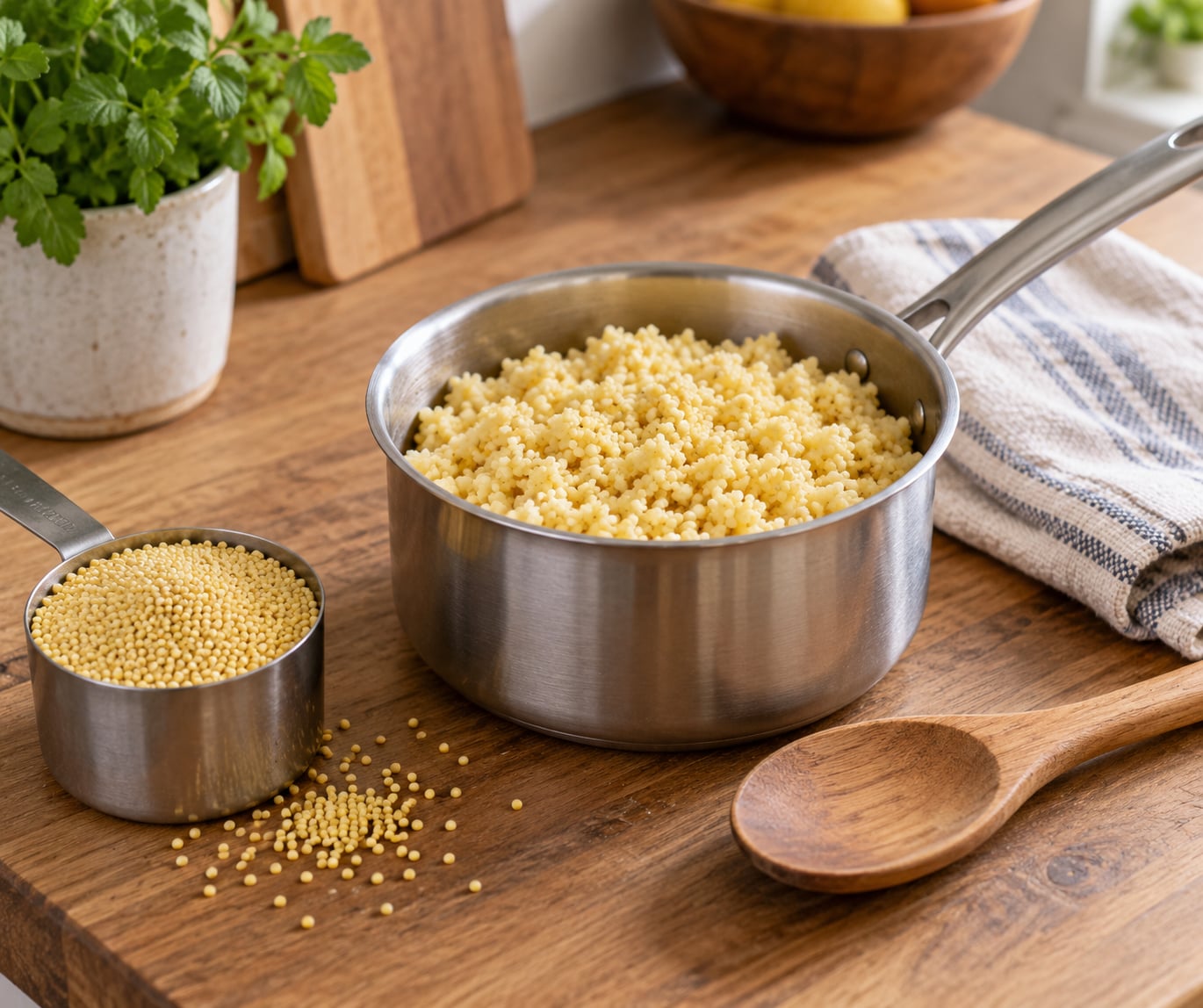
To cook millet so it is fluffy, use 1 cup of hulled millet to 2 cups of liquid, bring that liquid to a rolling boil first, add the grain, cover, and cook on the lowest heat for 15 to 18 minutes without stirring once. Then turn off the heat, leave the pot covered for 10 minutes, and fluff with a fork. The whole thing takes about 30 minutes start to finish, and it is the least forgiving method I know: skip the boil, lift the lid early, or stir out of boredom and you get porridge instead of grain.
Millet gets blamed for a lot of things it did not do. It is not a fussy ingredient, and it cooks faster than rice. The trouble is that almost every ratio you will read online treats it like rice, and millet does not drink like rice.
I cook it weekly in a small Appalachian kitchen with a temperamental gas burner, which makes me a decent test subject for this. What follows is the method that keeps working, plus the specific reasons each failure happens.
Table of Contents
- What You Need
- Step-by-Step: How to Cook Millet So It Is Fluffy
- Rinse and Measure the Millet
- Toast the Millet
- Add Liquid and Bring to a Simmer
- Cook Until Tender, Then Let It Rest
- Fluff and Serve
- Liquid Ratio by Millet Variety
- Common Mistakes
- Why is my millet mushy?
- Why is it crunchy or hard in the center?
- Why does mine turn gummy?
- Why does millet stick and scorch on the bottom?
- Why do I still find husks in every bite?
- How do I store and reheat cooked millet?
- Frequently Asked Questions
- Why is my millet mushy?
- How much water should I use for fluffy millet?
- Do I need to rinse millet before cooking it?
- How long should millet simmer on the stovetop?
- Can I cook millet in vegetable broth instead of water?
- Should I soak millet before cooking, and do I keep the soaking water?
- Can millet be cooked in a rice cooker?
- How do I use up leftover millet?
- Conclusion
What You Need
Fluffy millet starts with three things: a measured grain, a measured liquid, and a pot with a lid that actually fits. Everything else is seasoning.
- 1 cup hulled millet — hulled (also called dehulled) is the pale, round grain sold for cooking. Whole millet still carries the husk and cooks slower and crunchier.
- 2 cups water, broth, or stock — broth adds savory depth and roughly no extra salt if you season lightly.
- 1 tablespoon butter, ghee, or oil — optional, but it coats the grains and keeps them from welding together.
- 1/2 teaspoon salt — add it with the liquid, not at the end.
- A fine-mesh sieve or colander — for rinsing, and for catching husks.
- A small saucepan with a tight lid — 2 to 3 cups is plenty. Crowding the grain in a big pot gives you uneven heat and a scorched bottom.
Skip the rinsing if you like. Millet is tiny and a couple of swirls under the tap take ten seconds, but nobody is timing you.
Step-by-Step: How to Cook Millet So It Is Fluffy
Rinse and Measure the Millet
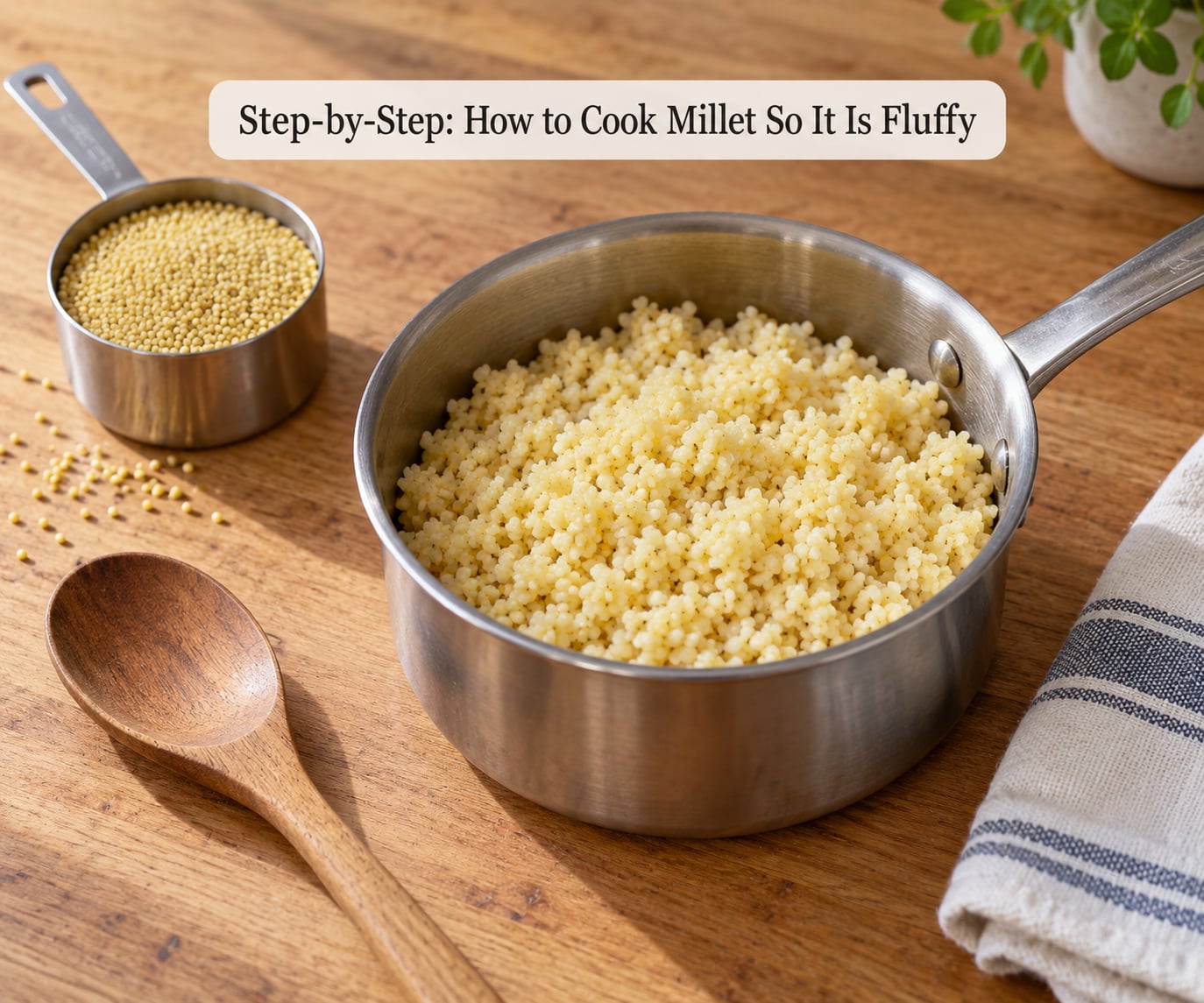
Measure one cup of millet with a dry measuring cup. Level it, do not scoop and shake — packed millet drinks noticeably less liquid than it looks like it should.
Rinse it in a fine-mesh sieve under cold water until the water runs mostly clear, two or three swirls. The rinse pulls off surface starch and the bitter, soapy compounds that sit in the husk dust, and it is the difference between a nutty grain and something that tastes like a wet paper towel.
Do you soak millet first? You can, for 30 minutes or overnight, and it softens the grain and reduces the phytic acid. But soaking is not what makes it fluffy. If you soak, drain and discard that water — it carries the bitter compounds and it is not part of your 2 cups.
Toast the Millet
Put the drained millet in the dry pot with the butter or oil and set it over medium heat for 2 to 3 minutes, stirring constantly, until the grains smell like popcorn and look slightly darker at the edges.
That smell is your cue, not the clock. Toasting dries the surface of each grain, which is what keeps the grains separate later. If you are in a hurry, skip it and accept a slightly softer, less nutty result — the texture is not ruined, only the flavor.
Add Liquid and Bring to a Simmer
Pour in 2 cups of boiling water or hot broth and the salt. The liquid should be at a full boil when it hits the grain, not a lukewarm trickle.
This is the single step people get wrong. Millet is a thirsty, dense seed, and cold liquid makes the outside of each grain swell while the center stays hard. Boiling liquid starts every grain swelling at the same rate, which is why the batch cooks evenly in 15 minutes instead of 25.
Stir once, just to make sure no dry patches are stuck to the bottom. Then bring it back to a boil, cover the pot, and turn the heat down to the lowest setting your stove has.
Cook Until Tender, Then Let It Rest
Cook covered at the lowest heat for 15 to 18 minutes. Do not lift the lid. Do not stir. This is the part where people lose their nerve.
Each stir breaks the surface of the grains and releases starch into the water, and that starch gels into the gummy, clumpy coating you are trying to avoid. Judge by the liquid, not the clock: while the mixture is still loose and wet, the grain is not done. When the last of the moisture disappears and the grains look dry and puffy at the edges, cooking is done.
Now turn off the heat and leave the lid on for 10 minutes. Steam trapped under that lid keeps moving through the grain, and the center of every kernel finishes cooking in the residual moisture. Skipping the rest is the second most common reason millet turns out dense. It is not optional, and it is not a garnish step.
Fluff and Serve

Take the lid off and fluff with a fork, lifting from the bottom in short strokes. A spoon will mash the grains; a fork separates them without pressing. Taste and adjust the salt now, when you can still fix it.
Serve it as a side for fried chicken or a bowl of soup, or let it cool and use it as a salad base. It is good cold in a grain bowl with cucumber, herbs, and a lemon dressing, and it thickens a soup in a way flour does not.
Liquid Ratio by Millet Variety
Here is why the 1:2 ratio keeps failing people: millet is not one grain. Pearl, foxtail, little, barnyard, and proso all absorb differently, and a bag labeled simply “millet” is usually hulled foxtail or pearl.
- Hulled foxtail millet — 1 cup grain to 2 cups liquid, 15 to 18 minutes. The everyday ratio and the most forgiving.
- Pearl millet (bajra) — 1 cup to 2.5 cups, 20 to 25 minutes. Denser and larger, so it drinks more and takes longer.
- Little millet — 1 cup to 1.75 cups, 12 to 15 minutes. Small and quick; extra water turns it to paste fast.
- Barnyard millet (sanjeera) — 1 cup to 2.5 cups, 18 to 22 minutes. Very absorbent, and worth watching the pot.
- Proso millet — 1 cup to 2 cups, 15 minutes. Light and fluffy, almost no adjustment needed.
If you are above roughly 3,000 feet, or your stove runs hot on its lowest setting, add a quarter cup more liquid. High altitude raises the boiling point, so the grain dries out faster before the water can fully penetrate.
Common Mistakes
Four textures come up again and again, and each one points to a specific cause.
Why is my millet mushy?
Too much liquid, and usually a stirred pot. Millet expands roughly two to three times its dry volume, so extra water has nowhere to go but into a paste. Next time measure the liquid, keep the lid on, and trust the 15-minute mark before adding more.
Why is it crunchy or hard in the center?
Not enough liquid, or heat that was too high. High heat boils the water off before the center of the grain hydrates, so you get a crunchy outside and a hard core. Lower the heat further, add a quarter cup of hot water, put the lid back on, and give it five more minutes on low.
Why does mine turn gummy?
Stirring, and stirring is almost always the culprit. Every time you break the grain, you release surface starch that thickens the water into glue. Fork-fluffing at the very end is fine; a wooden spoon mid-cook is not.
Why does millet stick and scorch on the bottom?
A pan that is too wide for the amount of grain, or a thin pan. Millet scorched on the bottom also means heat hitting the liquid before the grain can absorb it. Use a smaller pot, add the oil before the liquid, and keep the heat genuinely low.
Why do I still find husks in every bite?
Rinsing cannot save a bag of whole millet. Rinse the dry grain in a sieve, then float it in a bowl of water — the light empty husks rise and the grain sinks. Skim the floaters off. A few hulls are normal in any bag, so strain if it bothers you.
How do I store and reheat cooked millet?
Cool it fast, spread it shallow in a container, and refrigerate for up to four days; freeze it flat in portions for longer. Millet is a thirsty seed and dried-out leftovers taste dusty, so add a splash of water and steam it back in the pan with the lid on, or microwave it with a damp paper towel over the top. Reheat only what you plan to eat — repeated warming is what makes it rubbery.
Cooked millet is genuinely useful the next morning. Breakfast: warm it with milk, honey, and cinnamon. Lunch: fry the cold grains into patties with an egg and shredded cheese. Dinner: stir it into soup or soup stock to thicken it, or fold it into a stuffing mix with chopped herbs and onion.
Frequently Asked Questions
Why is my millet mushy?
Mushy millet is almost always too much liquid plus stirring. Millet expands roughly two to three times its dry volume, so surplus water has nowhere to go but into a paste, and every stir releases starch that thickens the remainder into glue. Use 1 cup of hulled millet to exactly 2 cups of liquid, keep the lid on, and do not stir after the initial mix.
How much water should I use for fluffy millet?
For hulled foxtail or proso millet, use 1 cup of grain to 2 cups of water or broth. Pearl and barnyard millet are thirstier and want closer to 2.5 cups, while little millet only needs 1.75 cups. The liquid should hit the grain at a full boil, not cold, or the outside of the grain swells while the center stays hard.
Do I need to rinse millet before cooking it?
Rinsing is quick and worth it. Swirl the grain in a fine-mesh sieve under cold water for a few seconds until the water runs mostly clear. This removes surface starch that causes stickiness and the bitter, soapy compounds left over from the hull, which is the single most common complaint about store-bought millet. If you skip it, expect a slightly gummier, less nutty result.
How long should millet simmer on the stovetop?
Fifteen to eighteen minutes at the lowest heat with the lid on, then a ten-minute covered rest off the heat. The rest is not optional: steam trapped under the lid keeps cooking the centers and is what separates fluffy grain from dense grain. If you finish the grain in a multicooker, drop the cook time to about eight minutes on high pressure with 1.75 cups of liquid.
Can I cook millet in vegetable broth instead of water?
Yes, and it is the easy way to make a plain grain taste like it belongs next to a stew. Use the same 2 cups of liquid so the texture does not change, and hold the salt back since broth already carries salt. Remember that liquid volume drives texture, not flavor, so do not add extra broth to make it taste more savory.
Should I soak millet before cooking, and do I keep the soaking water?
Soaking is optional and mostly a digestibility move. Thirty minutes to overnight softens the grain and reduces phytic acid, but soaking is not what makes millet fluffy, so the ratio stays the same. Drain and discard the soaking water because it carries the bitter compounds from the hull, and measure fresh liquid for cooking.
Can millet be cooked in a rice cooker?
Yes, and it is close to hands-off. Use the same 1:2 ratio, add the millet and hot liquid together, and run the white rice setting since millet cooks faster and has less starch than brown rice. Skip the butter and let it rest 10 minutes after the cooker switches to warm, then fork-fluff. Expect about 20 minutes on the white rice cycle.
How do I use up leftover millet?
Four reliable routes: warm it with milk, honey, and cinnamon for breakfast; fry the cold grains into patties with an egg and shredded cheese; stir a scoop into soup or stock to thicken it without flour; or chill it and use it as the base for a grain bowl with cucumbers, herbs, and a lemon dressing. Millet keeps about four days refrigerated and reheats best with a splash of water and the lid on.
Conclusion
Getting fluffy millet right comes down to two habits: measure your liquid at a 1:2 ratio and let the covered pot sit for 10 minutes after you turn off the heat. Do those two things and the rest — the boil, the low heat, no stirring, fork-fluffing — is just detail.
Start with a batch this week and serve it beside something saucy, like fried chicken or greens with pan drippings. It is a genuinely good weeknight grain, and it will never turn to porridge again once the ratio sticks in your head.