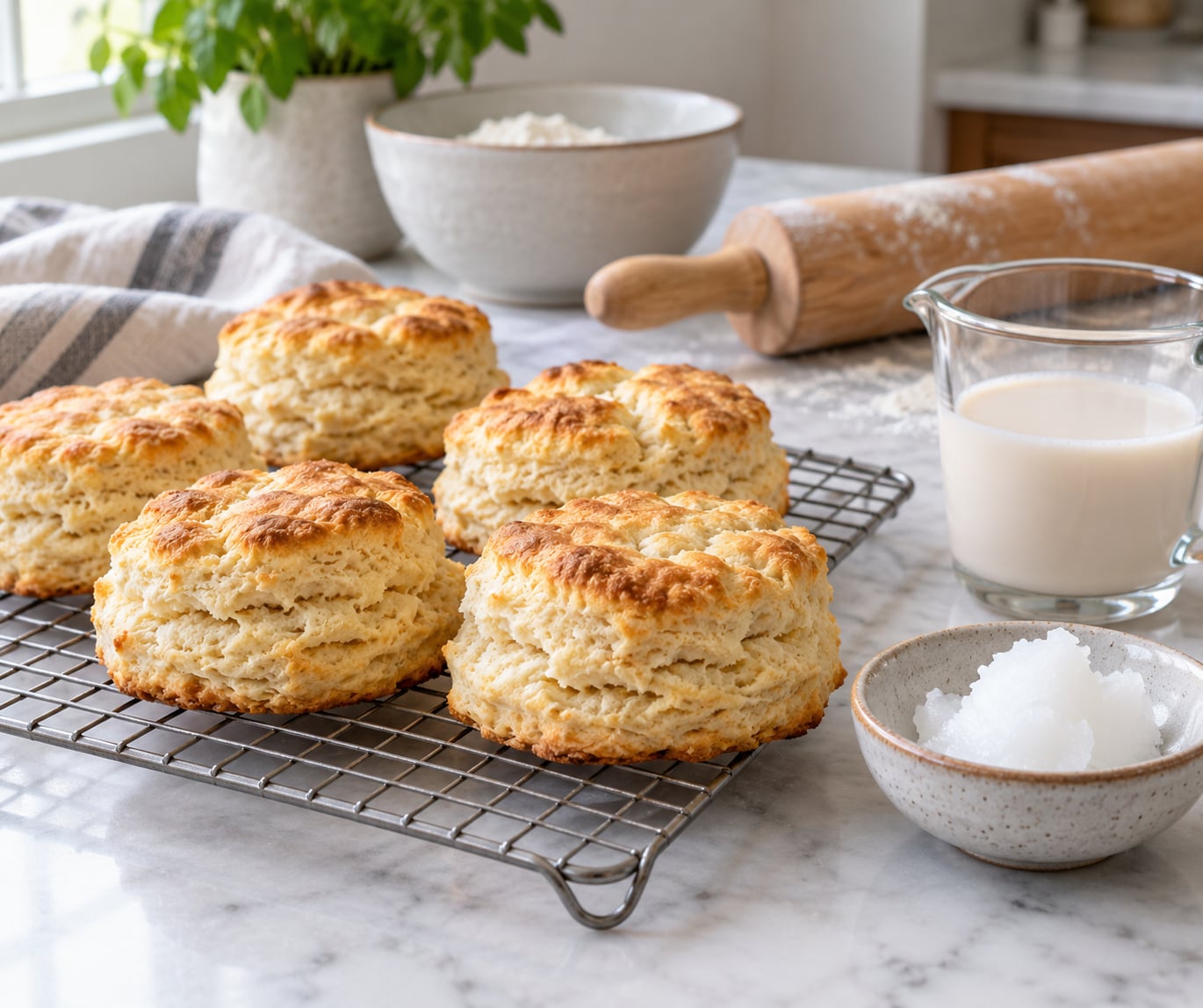
How to make vegan biscuits with coconut oil takes three ingredients: 2 cups self-rising flour, 1/4 cup solid coconut oil cut into the flour, and 3/4 cup plant milk. Bake at 425F for 10 to 12 minutes and you get a tall biscuit with crisp edges, flaky layers, and a tender center. Total time is about 35 minutes, and the method is easy once you keep the fat cold.
Most of the trouble with coconut oil biscuits comes down to one thing: coconut oil melts at about 76F, which is roughly room temperature in an Appalachian summer kitchen. Vegetable shortening holds solid until 117F. When the fat is warm, it never coats the flour properly, the dough spreads, and you get a flat, tough puck instead of a biscuit that climbs.
I spent a couple of months testing ratios before I stopped tweaking this one. The batch below made eight biscuits in a 2 inch cutter, and they came out of the oven standing two inches tall. Here is the full method, plus the fixes for every way it can go wrong.
Table of Contents
- What You Need: How to Make Vegan Biscuits with Coconut Oil
- The three-ingredient base
- Refined or unrefined coconut oil?
- Tools you actually need
- Gluten-free version
- Making your own self-rising flour
- Step-by-Step: Mix, Chill, Cut, and Bake
- How to Make Vegan Biscuits with Coconut Oil: Mix the Dry Ingredients and Cut the Fat
- The freeze-and-flake method for extra lift
- Add the Wet Ingredients and Bring the Dough Together
- Fold, Chill, and Shape the Biscuits
- Bake Until Golden and Serve Warm
- Storing, freezing, and reheating
- Common Mistakes and How to Fix Them
- Frequently Asked Questions
- Do vegan biscuits with coconut oil need an egg replacer?
- Can I use unrefined coconut oil instead of refined coconut oil?
- How do I make these biscuits gluten-free without making them dense?
- Why does my coconut oil melt before I finish mixing the dough?
- What should I serve with vegan biscuits made with coconut oil?
- Conclusion
What You Need: How to Make Vegan Biscuits with Coconut Oil
The three-ingredient base
- 2 cups self-rising flour (240 g) — this already carries baking powder and salt
- 1/4 cup solid coconut oil (55 g) — chilled, not melted
- 3/4 cup plant milk (180 ml) — coconut milk, or whatever you keep in the fridge
That is the whole recipe. The self-rising flour does the leavening and salting, so you do not need baking powder or salt on top of it. If you want a sweet biscuit, add 1 tablespoon of sugar with a tablespoon of the milk, plus a teaspoon of vanilla.
Refined or unrefined coconut oil?
Use refined for biscuits. It tastes neutral, so the biscuit tastes like a biscuit. Unrefined (also called virgin) is made from cold-pressed coconut meat and carries a real coconut flavor that gets louder as the fat melts in the oven. It is not bad, but it is not what you want in a savory biscuit-and-gravy situation.
Tools you actually need
- A pastry cutter or two forks for cutting the fat into the flour
- A rolling pin and a 2 inch round biscuit cutter
- A rimmed baking sheet lined with parchment paper
- A baking sheet for resting the dough on, or just use the counter
Gluten-free version
Swap the self-rising flour for a 1-to-1 gluten-free baking blend and add 1/2 teaspoon of xanthan gum. The gum is doing the job gluten normally does, holding the dough together and slowing the spread. Without it, gluten-free biscuits spread into thin, crisp wafers no matter how carefully you roll them. Note that a gluten-free blend behaves differently, so give the dough a longer chill, about 30 minutes, before cutting.
Making your own self-rising flour
For every cup of all-purpose flour you use, add 1.5 teaspoons of baking powder and 1/4 teaspoon of fine salt, then whisk it together. That means a 2 cup batch needs 3 teaspoons of baking powder and 1/2 teaspoon of salt. Home grist mills sell unseasoned all-purpose flour constantly, and this is the fastest way to use it up in biscuits.
Step-by-Step: Mix, Chill, Cut, and Bake
How to Make Vegan Biscuits with Coconut Oil: Mix the Dry Ingredients and Cut the Fat
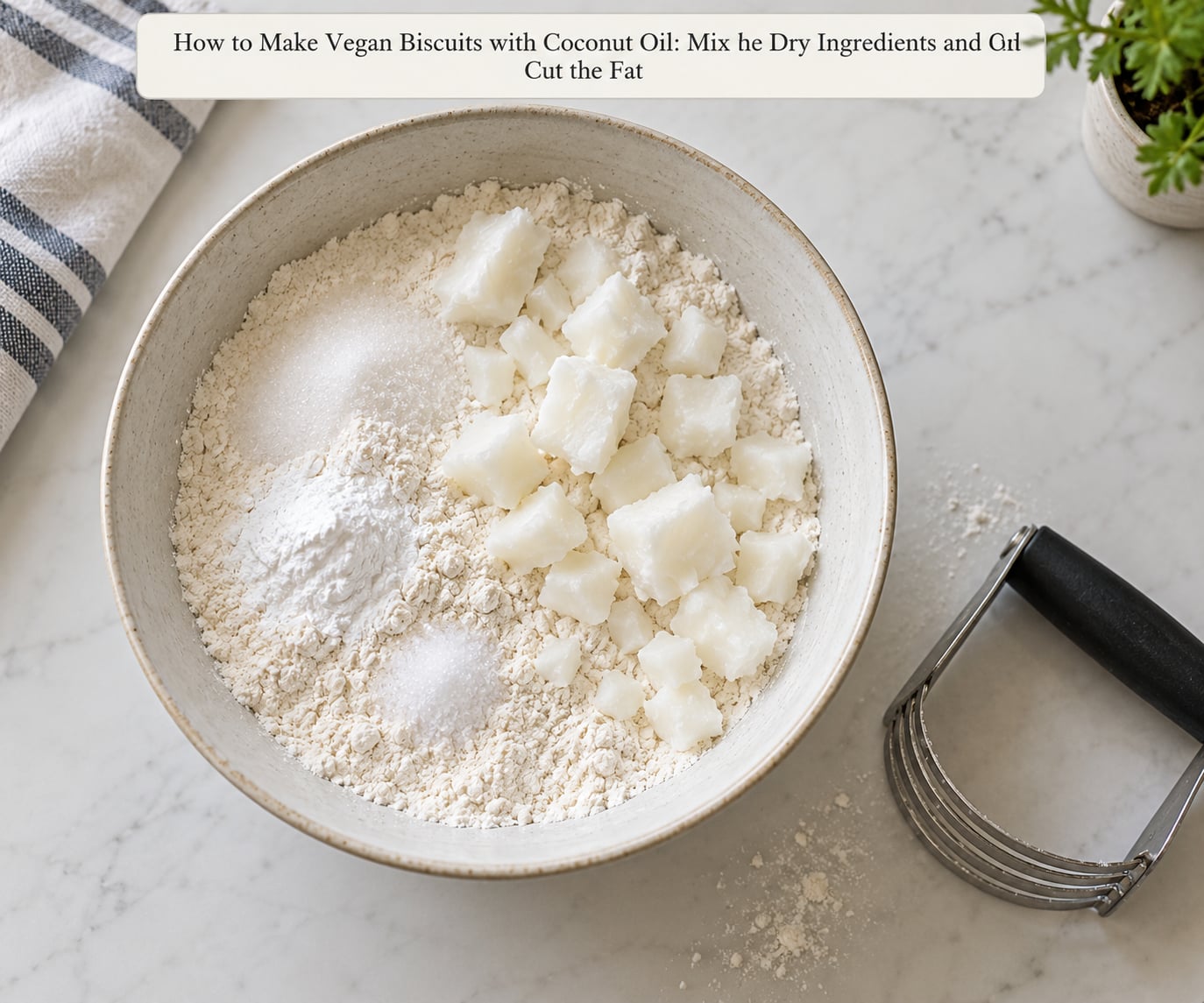
Heat the oven to 425F and line a sheet with parchment. Put the cold coconut oil in the freezer while the oven heats, then whisk the self-rising flour in a large bowl. If you are going sweet, whisk the sugar and a pinch of salt in now.
Cut the chilled oil into the flour with a pastry cutter, keeping the blades mostly vertical and rotating the bowl as you go. You are after pieces about the size of dried peas, with a couple of larger lumps left in place. Squeezing a pinch between two fingers should feel sandy, not oily, and the flour should look like damp sand rather than wet clay.
Two mistakes show up here. If you cut the oil into fine paste, you have gone too far and the biscuits will be heavy. And if the oil smears into shiny streaks instead of breaking into crumbs, it was warm. Set the bowl back in the fridge for ten minutes and start again.
The freeze-and-flake method for extra lift
For the tallest results, freeze the oil harder. Spoon it onto a sheet of plastic wrap, flatten it to about a quarter inch, and put it in the freezer until solid, roughly 20 minutes. Break the frozen sheet into flakes with the heel of your hand and toss those through the flour. Cold shards of fat leave open pockets in the dough that steam during the bake, and that is where the lift comes from.
Add the Wet Ingredients and Bring the Dough Together
Make a well in the center of the crumbly mixture, pour in the 3/4 cup of milk, and stir from the middle outward with a fork. Add 1 tablespoon of vinegar or the juice of half a lemon if you want the slight tang of buttermilk. Stir just until the flour is damp and the whole mass holds together in loose clumps.
The dough should look shaggy, like a very rough, slightly damp biscuit mix. It is normal to see dry patches at the edges. Tip everything onto a surface, press it together with three or four firm pushes, and stop. Overworking here is what gives you a rubbery, dense biscuit that chews instead of tearing.
Two quick checks before you move on. Squeeze a piece: it should clump and hold when you press it, not crumble back to powder. If it crumbles, add milk a tablespoon at a time. If it turns tacky and sticky, dust a little more flour over it rather than adding more liquid.
Fold, Chill, and Shape the Biscuits
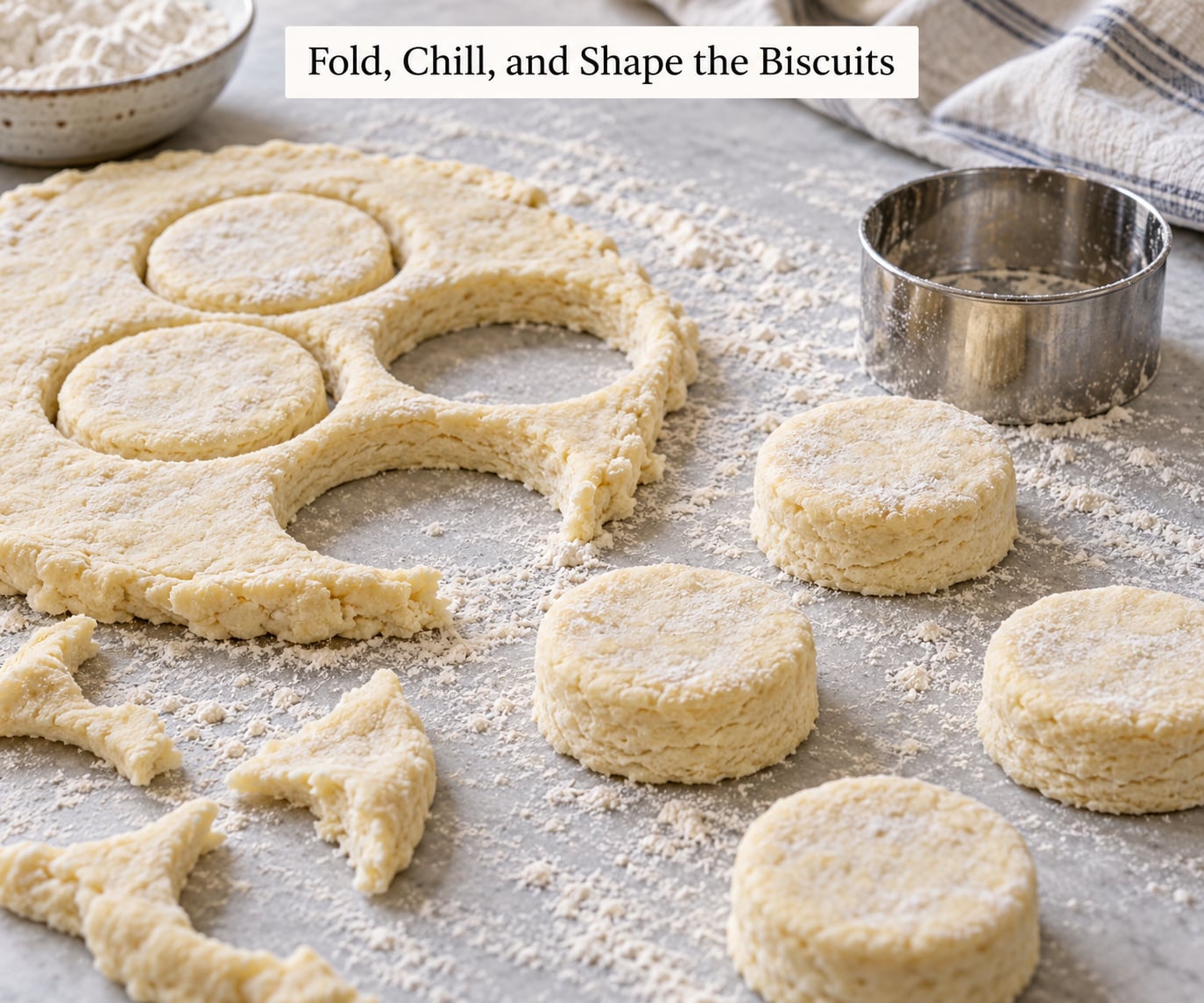
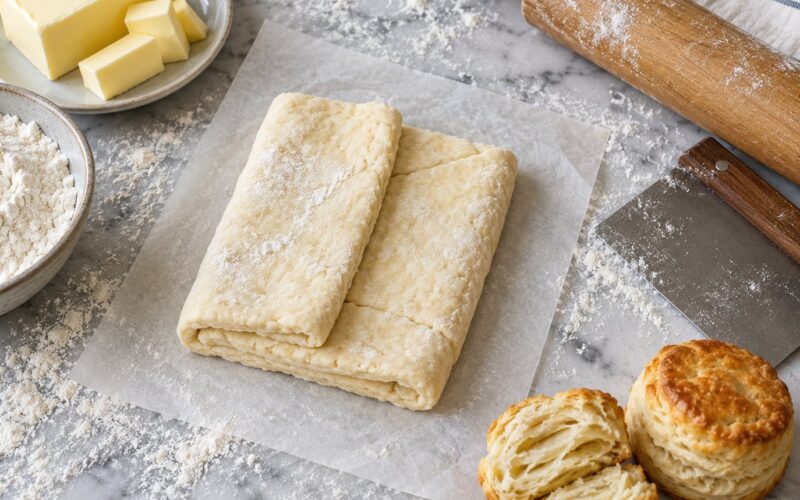
Flakiness comes from layers, and layers come from folding. Press the dough into a rough rectangle, fold it in thirds like a letter, then roll it out. Do that two or three times and the interior picks up visible seams you can see in the split biscuit.
Wrap the dough and chill it for 15 minutes. This step is not optional if your kitchen is warm, because the buttery flavor compounds cool fat gives way to melted fat. Roll the chilled dough to about half an inch thick, an even sheet with no thin spots, and cut with a floured 2 inch cutter, pressing straight down without twisting.
You will get eight biscuits from this batch, with a few scraps for the cook. Pack the rounds onto the lined sheet so they touch each other but do not overlap. Biscuits that sit side by side climb higher and keep their edges soft, and the leftover bits bake into what I call cook’s biscuits, which nobody in my house has ever complained about.
Bake Until Golden and Serve Warm
Bake on the upper rack at 425F for 10 to 12 minutes. They are done when the tops are golden brown, the bottoms sound hollow when you tap them, and the centers spring back lightly. Pull them at 10 minutes if your oven runs hot.
An oven thermometer is worth more than any recipe tweak. Plenty of ranges read 50 degrees off at the door, and a hot oven bakes the outside hard before the center sets.
For an air fryer, preheat to 400F and bake for 8 to 10 minutes at full speed, with the rounds spaced so air can move around them. Check two minutes early since the basket is small and the top browns fast.
Cool them on a wire rack for 5 to 10 minutes. The crumb is still setting as they cool, so cutting one straight out of the oven gives you a gummy middle. Warm biscuits with salted vegan butter and strawberry jam, or split one and ladle savory white pepper gravy over the top.
Storing, freezing, and reheating
Keep baked biscuits in an airtight container at room temperature for about a day. For up to three days, refrigerate them, though the crumb firms up a little in the cold. Freeze the rest and they will hold for two to three months.
To refresh day-old biscuits, heat them at 350F for 6 to 8 minutes, or 5 minutes in a toaster oven. A sprinkle of water on the tops before reheating steams the crust back to crisp. A microwave works in 20 seconds, but the outside goes chewy and soft, so the oven is the better bet.
There is a second freezing option worth knowing: freeze the raw cut rounds on a tray, then bag them once solid. Bake from frozen at 425F with 2 to 3 extra minutes. This is the useful make-ahead version, and it is not the same thing as freezing the oil, which helps the dough rather than hurting it.
Common Mistakes and How to Fix Them
Almost every bad batch of coconut oil biscuits comes from one of five things: warm fat, a hot oven, too much handling, uneven thickness, or dough that got mixed dry. Here is how to spot each one, what caused it, and how to fix it.
- Biscuits come out flat and spread. The coconut oil was soft or liquid when it went into the flour, so it coated the flour instead of sitting in distinct pieces. Chill the oil until it is hard, cut it fast, and bake immediately. Keep the dough cold from mixing to sheet.
- Biscuits are hard as a rock. Usually underbaked inside, or baked too long, and not enough fat is the other cause. Pull at 10 minutes, not 15. If the center stays dense, add another 2 tablespoons of oil per cup of flour.
- Center is gummy or raw. Oven too cool, tray overcrowded, or biscuits touching so the heat cannot reach the middle. Verify with an oven thermometer, leave a finger of space between rounds, and add 2 minutes to the bake.
- Dough is rubbery or tough to roll. Overmixed once the flour was wet, so gluten developed before the fat could coat it. Stir with a fork until damp, then press rather than knead, and handle the dough only a few times.
- Dough will not hold together. Too much flour relative to liquid, which is easy to do with self-rising flour since it carries extra baking powder and salt. Add milk one tablespoon at a time, or a teaspoon of maple syrup for a sweet version, until a pinch clumps.
- No rise at all. Coconut oil liquefied at a warm kitchen temperature, or the fat was melted before it was cut in. Freeze the oil and shatter it into flakes, then retest your baking powder with a cup of hot water. It should foam hard.
- Bottom burns before the top browns. Low shelf with a hot oven underneath. Move the tray to the upper rack and drop the temperature to 400F.
- Gluten-free biscuits spread thin. No binder in the flour to hold the dough together. Add 1/2 teaspoon of xanthan gum per cup of flour and chill the dough 30 minutes.
A few habits cover most of the above. Keep the fat cold, handle the dough gently, roll to an even half inch, and check your oven with a thermometer. A side-by-side arrangement gives you a taller biscuit than any amount of extra baking powder will.
On the question of whether coconut oil is worth using here, the honest answer is that it is high in saturated fat, and dietitians often advise limiting it. A couple of tablespoons split across eight biscuits is a small amount, and if saturated fat is a concern for you specifically, plant-based butter or a stick-style vegan margarine works in the same quantity with a higher rise. Treat coconut oil as a flavor and fat choice, not a health claim.
Frequently Asked Questions
Do vegan biscuits with coconut oil need an egg replacer?
No. The three-ingredient version needs nothing but self-rising flour, solid coconut oil, and plant milk, because the flour already contains the baking powder that a conventional egg biscuit relies on for lift. Egg-free dough is also less likely to turn rubbery, since there is no protein network to overdevelop. Only add a flax or chia egg if you are also adding sugar and want a more cake-like crumb, and mix it into the milk first.
Can I use unrefined coconut oil instead of refined coconut oil?
Yes, and the biscuits will still rise, because the melting behavior is identical. The difference is flavor. Unrefined coconut oil is pressed from coconut meat and tastes distinctly of coconut, and that flavor strengthens as the fat liquefies in a 425F oven. Use refined for neutral, Southern-style biscuits, and save unrefined for a coconut-forward version where you want that taste to come through.
How do I make these biscuits gluten-free without making them dense?
Use a 1-to-1 gluten-free baking blend in place of the self-rising flour and add 1/2 teaspoon of xanthan gum per cup. The gum replaces the structure gluten normally provides, which is what stops the dough from spreading and turning brittle. Chill the shaped rounds for 30 minutes before baking, since gluten-free dough needs more time to set, and expect to pull them when the edges are set even if the middles still look slightly pale.
Why does my coconut oil melt before I finish mixing the dough?
Because coconut oil solidifies at about 76F, and a kitchen above that temperature is above its melting point. This is the root cause of most flat coconut oil biscuits. Chill the jar in the fridge, then work with fat straight from the freezer. Freezing the oil and shattering the frozen sheet into flakes is even better, and keep the dough refrigerated between mixing and baking if your room runs warm.
What should I serve with vegan biscuits made with coconut oil?
For a savory plate, split them and ladle over white pepper or country gravy, the way biscuits and gravy works at any Appalachian table. They also pair with fried eggs, buttered beans, or a bowl of soup. For sweet, warm them for 2 minutes and add salted vegan butter with strawberry jam, or a maple pecan spread. A cup of strong coffee is worth as much as any of it.
Conclusion
Start with the three ingredients: 2 cups self-rising flour, 1/4 cup coconut oil straight from the fridge, and 3/4 cup plant milk. Chill the fat, cut it into pea-sized crumbs, add the milk with a fork, press the dough together without kneading, and bake on a lined sheet at 425F for 10 to 12 minutes. That combination is what gets you crisp edges and flaky layers with a center that stays tender, instead of a flat biscuit that chews.
Once the first tray works, try the variations that follow from the same dough: a tablespoon of sugar and vanilla for a sweet biscuit, chopped rosemary and garlic powder for a savory one, or a cinnamon sugar finish rolled across the top before baking.