Yes, you can absolutely blind bake a pie crust without weights. Fill the lined shell with granulated sugar, dry rice, or dried beans, bake it, pull the fill out, then finish baking until the crust is set and pale gold. If your kitchen rules out every pantry staple, a second pie pan inverted inside the first one does the same job.
The whole technique exists to stop a wet filling from turning the bottom of your pie into paste. Custard, pumpkin, pecan, and quiche all leak steam and sugar straight into raw dough, and no amount of butter flakiness fixes that. Ten extra minutes of empty-shell baking buys you a sealed crust that the filling slides over instead of soaking into.
Budget about 25 minutes of active time plus baking, and chill time you can run in the background. The oven does most of the work. If you have never blind baked before, the order of operations below is the part that matters: chill, dock, line, fill, bake weighted, pull, finish.
Table of Contents
- What You Need
- What to use instead of pie weights
- The zero-substitute method when beans and rice are off the table
- Step-by-Step: How to Blind Bake a Pie Crust Without Weights
- 1. Chill the shaped dough
- 2. Dock the bottom
- 3. Line the shell with parchment
- 4. Fill the lined crust edge to edge
- 5. Bake the weighted crust
- 6. Pull the weights and re-prick the bottom
- 7. Finish baking until set
- How long to blind bake a pie crust without weights
- Partial blind bake vs full blind bake
- Which pies actually need a blind bake
- Common Mistakes
- Frequently Asked Questions
- What can I use instead of pie weights?
- How long do I blind bake a pie crust without weights?
- Do I need to remove the beans before adding the pie filling?
- Can I blind bake a gluten-free pie crust the same way?
- What temperature should I use for blind baking?
- How do I know the crust is fully baked?
- Conclusion
What You Need
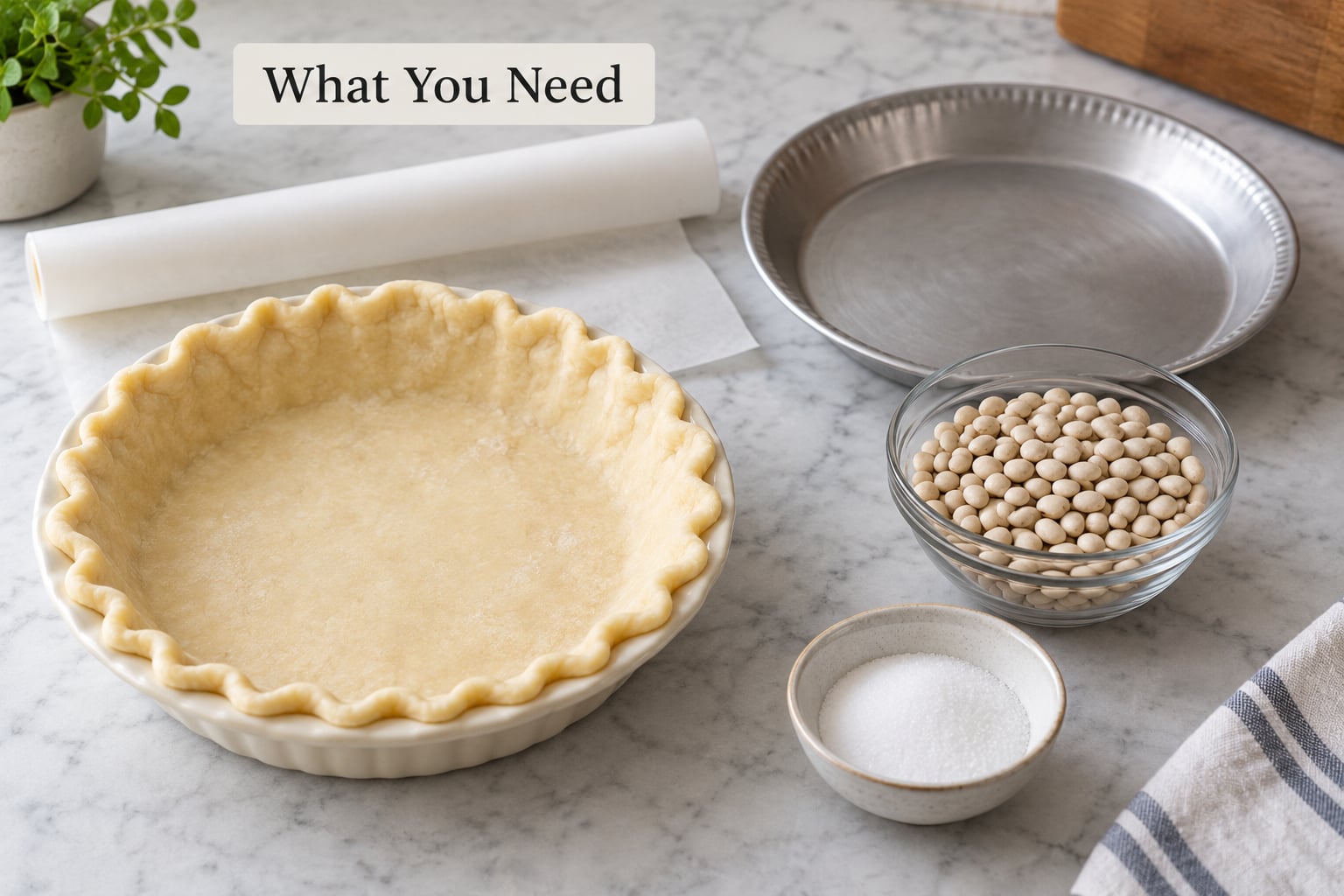
A 9-inch pie plate, a sheet of parchment paper or heavy-duty foil, a fork, and whatever dry material you have chosen to weigh the crust down. A baking sheet is optional but worth having, because it catches a leaking fruit pie and takes the shock of the pan hitting a hot oven rack.
Glass, stoneware, and light-colored ceramic all show you the browning on the bottom, which is the only reliable way to know the underside is done. Dark metal heats faster and hides color, so a crust in a black steel pan usually needs a few minutes less on the unweighted bake.
What to use instead of pie weights
Every substitute works by the same rule: fill the lined crust edge to edge, packing the material down so it sits flat against the bottom and up the sides with no empty air pockets. For a standard 9-inch pie, that is roughly 2 cups of dry material.
- Granulated sugar – about 2 cups, fill to the rim. Melts into a thin glassy layer and you can still eat it afterward, though it is not the same sugar for baking.
- Dry rice – about 2 cups, uncooked and long grain. Cheap, reusable, but it gets hot enough in the oven that it is a blind-baking weight only, never food again.
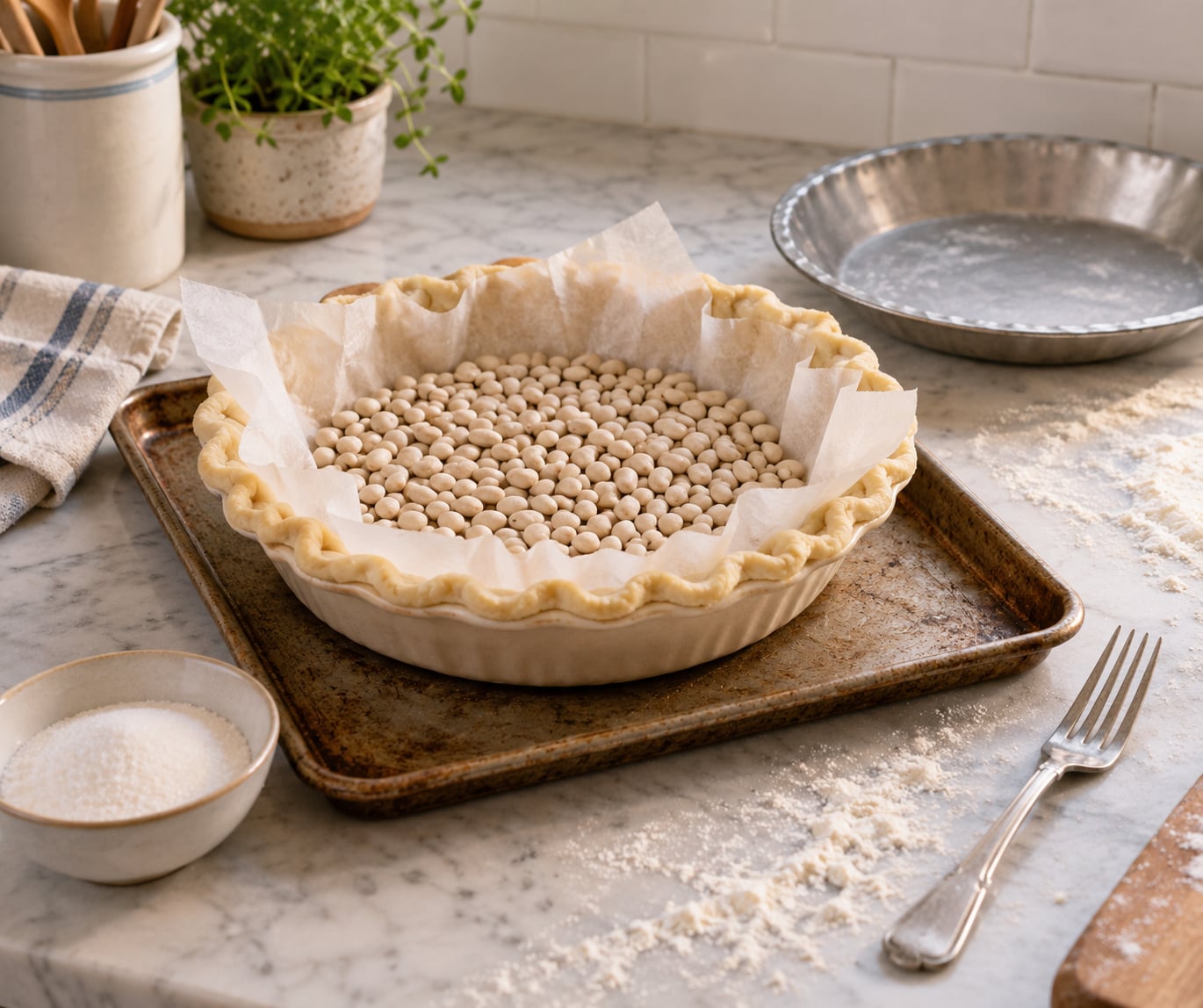
- Dried beans – about 2 cups. The traditional pantry choice, and the one that works best for a chunky weigh-down. Same rule: blind baking only, not for eating.
- Aluminum foil packets – two or three tightly packed balls sitting in the center of the shell. Useful when you have foil but nothing to pour.
- A second pie pan – the same size inverted inside the shell. The only method that needs no dry material at all.
Sugar has become the most-repeated tip in community threads because it is heavier than rice at the same volume and spreads heat across the bottom evenly. It caramelizes slightly and leaves the shell cleaner afterward. Dry rice and beans are reusable for the next pie, provided you keep them in a separate container from your cooking supply.
The zero-substitute method when beans and rice are off the table
Some kitchens have rules, allergies, or roommates who object to dedicating a jar of food to pie duty. Invert a second same-size pie pan inside the crust and tuck a folded kitchen towel around the rim to stop it sliding, or line the shell with two layers of foil and set a handful of crumpled foil balls on top.
This is the version people describe in baking forums when nothing else is allowed, and it works because the pan does exactly what a bag of weights does: it holds the dough flat and transfers heat downward. Expect the finished shell to take a few minutes longer to crisp on the bottom, since the pan sits on the crust rather than a loose layer of material.
Step-by-Step: How to Blind Bake a Pie Crust Without Weights
1. Chill the shaped dough
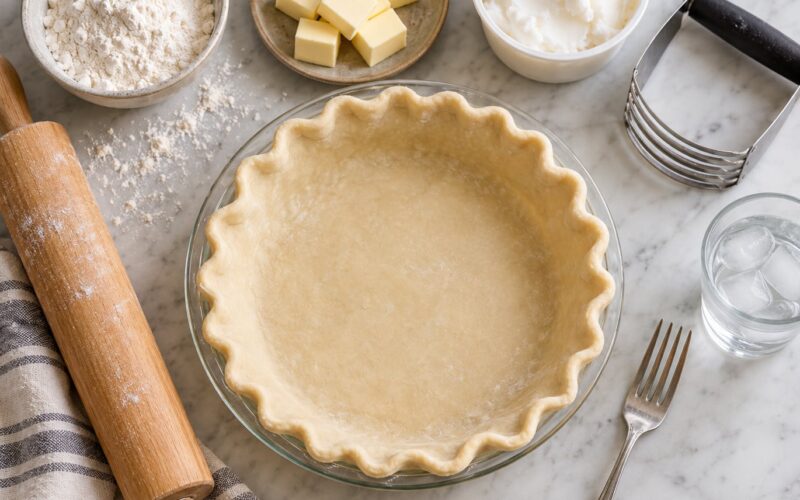
Roll, fit, and crimp your crust, then put the pan in the freezer for 30 minutes or the fridge for an hour. Cold dough has relaxed gluten, so it holds its shape instead of slumping back down the sides of the plate while it bakes. A warm shell is the single most common reason for shrinking, and the chill is a free fix.
2. Dock the bottom
Take the pan out and prick the base all over with a fork, spacing holes about an inch apart. This is docking, and its only job is letting steam escape so the bottom stays flat instead of ballooning. Work in straight lines rather than random jabs so you cover the whole base evenly.
3. Line the shell with parchment
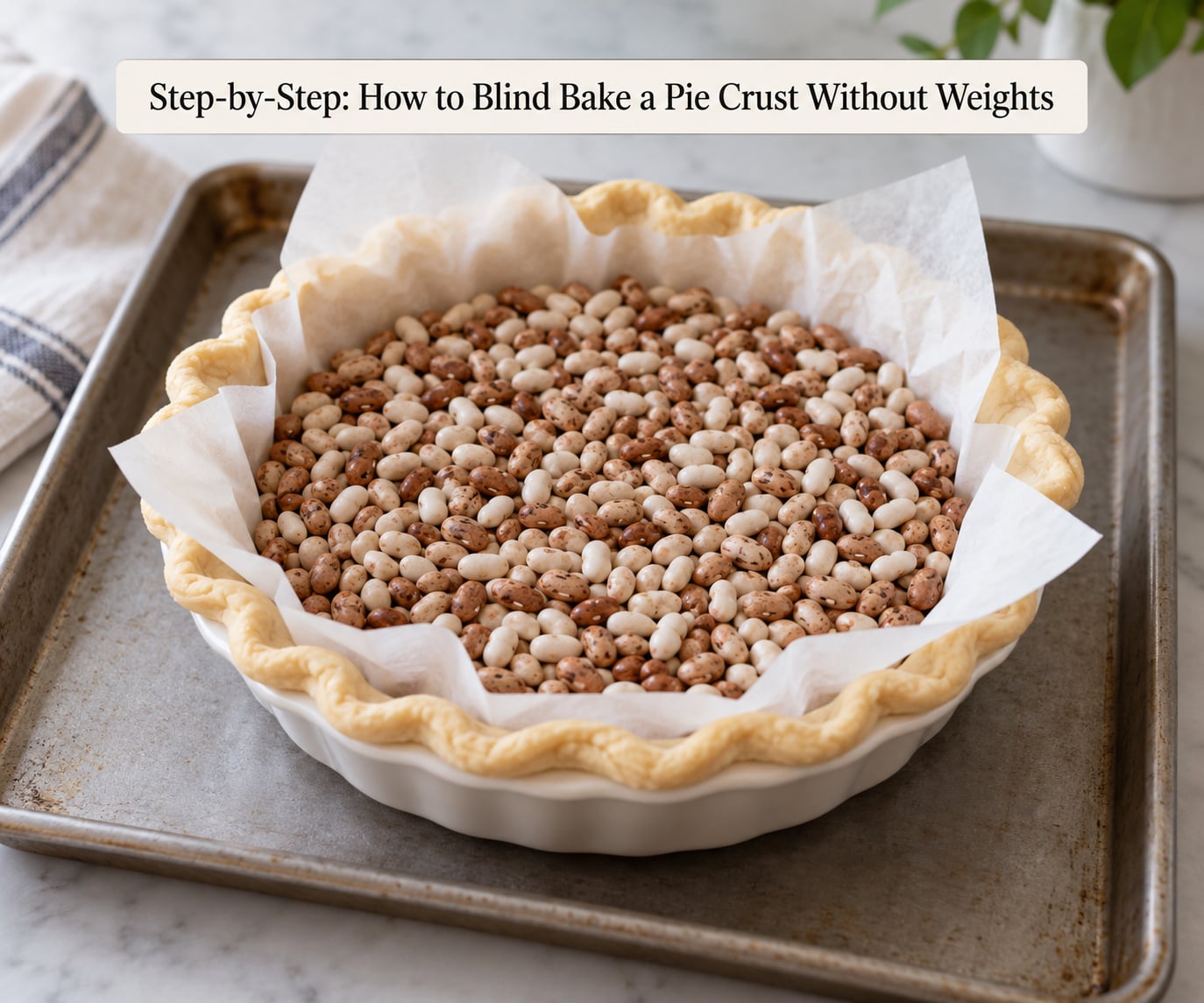
Crumple a sheet of parchment into a loose ball, then flatten it out, because the creases make it fit the curve of a raw shell far better than a flat sheet does. Press it into the bottom and up the sides, leaving the top edge overhanging the rim. Foil works the same way and does a slightly better job insulating a thin dough.
4. Fill the lined crust edge to edge
Pour in your sugar, rice, or beans until the shell is full, then push the material down the sides with your fingers so it forms an even wall that meets the parchment. The single most common failure here is leaving the sides unfilled, which lets them slump inward and pulls the rim out of shape. Set the pan on a baking sheet to catch whatever escapes.
5. Bake the weighted crust
Put the pan on the lower third of the oven at 375°F (190°C) for 20 to 25 minutes, or 400°F (200°C) for 15 to 20 minutes if you are using a thin dough. Rotate once halfway through if your oven runs hot on one side. The edges of the crust should look dry and set, with no wet dough showing at the rim.
If you bake in a convection oven, drop the temperature by 25°F (about 14°C) and check ten minutes early. Convection moves moisture away fast enough to over-brown the rim before the base finishes, which is why people in forum threads who switched to convection usually shorten their times rather than adding them.
6. Pull the weights and re-prick the bottom
Lift out the parchment and tip the sugar, rice, or beans into a heatproof bowl. If you are doing a full blind bake, prick the exposed base again with a fork, since trapped moisture under the lining can leave a damp patch. For a custard or quiche shell, brush the hot base with a beaten egg yolk and a pinch of salt; that egg seal is the trick recommended for shells that hold liquid.
7. Finish baking until set
Return the pan to the oven for 5 to 10 minutes more for a partial blind bake, or 12 to 15 minutes for a fully baked shell. A par-baked crust is dry to the touch and still slightly pale in the center. A fully baked one is matte all the way across, evenly pale gold on the bottom, and cool to the touch in the middle after two minutes out of the oven.
How long to blind bake a pie crust without weights
Budget 20 to 25 minutes weighted at 375°F, then 5 to 15 minutes unweighted depending on how done you want the shell. A shallow fruit pie only needs the short unweighted finish. A custard pie, quiche, or lemon meringue needs the full 12 to 15 minutes, because those fillings sit in the shell for a long time and will find any raw patch.
If you want to bake ahead, an unbaked docked dough wrapped in plastic holds in the freezer for two to three months. A baked shell covered at room temperature keeps one to two days, and up to a month in the freezer. Let a frozen shell thaw in the fridge while you make the filling, not on the counter.
Partial blind bake vs full blind bake
Partial blind baking, often called par-baking, sets the shell without browning it through. Full blind baking cooks and dries the crust all the way so it can be filled days in advance. Choosing between them is really a question of what is going in the dish and how long it will wait there.
| Bake type | Temperature | Weighted time | Unweighted time | Best for |
|---|---|---|---|---|
| Partial blind bake | 375°F (190°C) | 20-25 min | 5-7 min | Berry and apple pies, fresh fruit tarts, pies finished the same day |
| Full blind bake | 375-400°F (190-200°C) | 20-25 min | 12-15 min | Custard, pumpkin, pecan, quiche, lemon meringue, and make-ahead shells |
Pecan pie sits in that second row. The filling cooks for 45 to 50 minutes, so a par-baked shell leaves you with a raw ring near the rim and a thin layer under the nuts. Pumpkin and custard need the same treatment for the same reason.
Which pies actually need a blind bake
Any pie with a liquid or very wet filling needs one: custard, pumpkin, pecan, chess, lemon meringue, quiche, and cream pies. Fruit pies are the judgment call, because apples and berries release their own liquid as they cook. A sliced apple pie is generally fine with a par-bake, while a fresh berry or rhubarb pie is safer fully baked.
Store-bought roll-out dough can be blind baked the same way, with two adjustments: it is thinner and it holds more water than homemade dough, so dock it well and set it on a baking sheet. It also bakes faster, so check it about five minutes early. Supermarket frozen crusts are the one case most guides warn against, since the crimped edge and the high shortening content brown unevenly.
Common Mistakes
Almost every disappointing blind-baked shell comes down to one of these. Work down the list and you will usually find the cause in under a minute.
- The crust shrank away from the rim. Usually warm dough or a stretched base. Chill the shaped crust 30 minutes in the freezer, fit the dough without stretching it under the sides, and leave an overhang to trim later.
- The sides slumped inward. You either did not fill the weights up the sides or you removed them too soon. Pack the material against the parchment all the way up the wall, and keep the weighted bake to 20 to 25 minutes rather than rushing it.
- The bottom puffed up. Steam had nowhere to go, which means the docking holes were too sparse or the fill was too loose. Re-prick after removing the weights, and tamp the material down flat before it goes in the oven.
- The bottom is soggy after filling. The shell was underbaked or the filling sat too long. Give a full 12 to 15 minutes unweighted, brush on an egg-yolk seal for custard shells, and cool the shell completely before pouring in anything wet.
- The crust cracked in the oven. Overworked dough is the usual cause, but under-chilled dough contributes. Handle the dough gently, and if your kitchen is warm, rest it in the fridge rather than the freezer for the final chill.
- The crust stuck to the pan. You skipped the parchment entirely or used a short lining. Even with a foil lining, the foil needs to be greased lightly so the base releases when you lift it out.
- The rim browned while the base stayed pale. The oven is hotter than its dial says, or the pan is dark metal. Buy an oven thermometer, and use a foil ring or pie crust shield on the rim once you remove the weights.
- The shell looked done but was raw underneath. Color on the side is not a test. Lift the shell out of the pan and look at the base, which should be uniformly pale gold and dry, not gray or tacky.
One more worth naming: do not reuse baked rice or beans as food. They reach temperatures well past safe to eat and pick up baked-on oils and glaze. Keep them in a jar labeled for blind baking only. Baked sugar is the exception, though you still would not want to scoop it straight out of a pie shell into a cup of coffee.
Around here in the mountains, an old stoneware or cast-iron plate takes a hot shell off the rack without warping it, and a sack of dried field peas does the same work as any bag of pie weights. Docking and filling are the technique; what you fill with is just whatever is in the pantry.
Frequently Asked Questions
What can I use instead of pie weights?
Granulated sugar, dry rice, or dried beans all work, and so does foil. Fill a 9-inch lined crust edge to edge with about 2 cups of any of them, packing the material down the sides so the shell stays upright. Sugar can be eaten afterward, though baked rice and beans get hot enough that they are for blind baking only. The only method that needs no dry material at all is a second pie pan inverted inside the crust.
How long do I blind bake a pie crust without weights?
At 375°F (190°C), give the weighted bake 20 to 25 minutes, then 5 to 10 minutes unweighted for a partial blind bake or 12 to 15 minutes for a fully baked shell. A dark metal or thin dough needs a few minutes less, and a convection oven usually needs the temperature dropped by 25°F (14°C) and the time trimmed by about ten minutes. Watch the bottom color, not the timer, since ovens vary widely.
Do I need to remove the beans before adding the pie filling?
Yes, always. Lift out the parchment and tip the beans, rice, or sugar into a heatproof bowl before you add any filling, then give the bare crust a few more minutes in the oven. That final unweighted bake is what dries the base. For custard or quiche shells, brush the hot bottom with a beaten egg yolk and a pinch of salt first to seal it, then let the shell cool completely before the liquid goes in.
Can I blind bake a gluten-free pie crust the same way?
Mostly yes, with one difference. A gluten-free dough is more fragile and crumbly, so skip the fork docking if you can or use the blunt end of a spoon, since punctures can tear it. Chill it the same 30 minutes, line with parchment so you never have to lift a bare shell, and shorten the unweighted bake by 3 to 5 minutes because gluten-free crusts brown faster once the moisture is gone.
What temperature should I use for blind baking?
Use 375°F (190°C) for most pie dough, or 400°F (200°C) if your crust is thin and you want faster browning. The weighted bake runs 20 to 25 minutes at 375°F and 15 to 20 at 400°F. An oven thermometer is worth having: a dial that reads 25°F low is the usual reason a shell browns on the rim while the bottom stays pale.
How do I know the crust is fully baked?
Look at the bottom, not the side. Lift the shell out of the pan and check that it is uniformly pale gold, dry, and no longer translucent in the center. A fully baked shell is matte all over, both sides and base, and feels room temperature after two minutes on the counter. Any gray, damp, or tacky patch on the base means it needs another five minutes before the filling goes in.
Conclusion
Learning how to blind bake a pie crust without weights comes down to four moves. Chill the shaped dough for 30 minutes so it keeps its shape, dock and line it so the base stays flat, pack the substitute weight edge to edge so the sides cannot slump, and judge the finish by the color of the bottom rather than the timer. Sugar, rice, dried beans, foil, or an inverted second pan all do the same job. Pick the one your kitchen allows, and let the shell cool completely before anything wet goes in.