Here’s how to make cobbler with frozen fruit without thawing it first, why frozen fruit needs extra thickener and extra bake time, and how to keep the topping golden instead of sinking into the juices. Prep takes about 15 minutes; the bake runs 30 to 40 minutes in a 375°F oven. It is one of the easiest desserts I know when the fruit is already in the freezer and you have nothing else to do.
A cobbler is fruit baked under a sweetened biscuit, cake, or crumble topping. The word is worth pinning down because people mix it up with a crisp (oat topping, flatter) and a crumble (streusel, more crumbly). If the topping goes on top in rough clumps, you are making a cobbler, which is exactly what you want here.
Table of Contents
- What You Need
- Fruit base
- Southern-style topping
- Optional equipment and extras
- Step-by-Step: How to Make Cobbler with Frozen Fruit
- 1. Preheat the oven and prepare the frozen fruit filling
- 2. Make the Southern-style topping
- 3. Assemble the cobbler without sealing it
- 4. Bake until the topping is golden and the center bubbles
- 5. Cool, serve, and store the cobbler
- Common mistakes and how to make cobbler with frozen fruit that sets right
- Frequently Asked Questions
- What kind of frozen fruit works best for cobbler?
- Can I use canned pie filling to make cobbler?
- How can I adjust the sugar for sweeter or less-sweet fruit?
- Can frozen fruit cobbler be made ahead of time?
- Can frozen fruit cobbler be made vegan and gluten-free?
- Conclusion
What You Need
An oven-safe 8-inch square dish, or a 2-quart round baking dish. That size holds about 4 cups of fruit with a proper layer of topping. A 9×13 works, but you need to double the whole recipe or the topping will be thin and the fruit will bake unevenly.
Prep is 15 minutes. The bake is 30 to 40 minutes. No mixer, no rolling pin, no canned pie filling required.
Fruit base
- 4 cups (about 550 g) frozen mixed berries, or frozen sliced peaches, blackberries, blueberries, or cherries
- 3/4 cup (150 g) granulated sugar
- 1 tablespoon lemon juice
- 1 tablespoon cornstarch, or 2 tablespoons instant tapioca
- 1 teaspoon vanilla extract
- 1/2 teaspoon ground cinnamon (optional)
- Pinch of salt
Southern-style topping
- 1 cup (120 g) all-purpose flour
- 1/3 cup (65 g) granulated sugar
- 1 teaspoon baking powder
- 1/4 teaspoon salt
- 6 tablespoons (85 g) cold unsalted butter, cut into cubes, or a solid vegan butter
- 1/3 cup (80 ml) milk, buttermilk, or a dairy-free milk such as oat or almond
Optional equipment and extras
A rimmed baking sheet set under the dish catches drips if bubbles escape. A squeeze bottle makes pouring milk over the topping far easier than a spoon, and a pastry brush or the back of a spoon is all you need to moisten the crumbs. Keep vanilla ice cream, heavy cream, or coconut cream in the freezer for serving.
You do not need to thaw the fruit. That question comes up constantly, so the honest answer is in the next section, and it is the one place where frozen-fruit cobbler genuinely differs from a fresh-fruit one.
Step-by-Step: How to Make Cobbler with Frozen Fruit
1. Preheat the oven and prepare the frozen fruit filling
Set the oven to 375°F (190°C) and put the empty dish in while it heats. Frozen fruit goes into the dish straight from the freezer, no thawing, no draining, no patting dry.
Combine the 4 cups of frozen fruit with the sugar, lemon juice, cornstarch, vanilla, cinnamon, and salt in a bowl and stir just until the dry ingredients coat the fruit. Stirring hard breaks the berries into juice, and that is the first step toward a soupy filling. A few lumps are fine; a broken-down purée is not.
The cornstarch is not optional with frozen fruit. Ice crystals that form in the freezer carry water into the dish, and that extra liquid is exactly what makes a frozen-fruit cobbler thin. One tablespoon of cornstarch per cup of fruit is the reliable starting point.
2. Make the Southern-style topping
Work the cold butter into the flour, sugar, baking powder, and salt with your fingertips or a pastry cutter until the mixture looks like coarse crumbs, some pieces the size of a pea. Keep everything cold; warm butter melts into flour and turns the topping into a flat crust instead of crumbs.
Pour the milk over the crumbs and stir with a fork until the dry bits disappear. The topping should be damp and clumpy, not pourable. Add a splash more milk if a few flour pockets remain dry, or a spoonful of flour if it looks wet.
For a gluten-free version, swap the all-purpose flour for a 1-to-1 gluten-free baking flour, cup for cup, and use milk or a dairy-free milk. Those blends already carry the starch that plain cornstarch lacks, so the filling holds better with them. For a vegan version, use solid plant butter and dairy-free milk; nothing else in the recipe changes. If you use certified gluten-free oats in place of some of the flour for a crunchier top, check that the bag is certified, since regular oats carry gluten.
3. Assemble the cobbler without sealing it
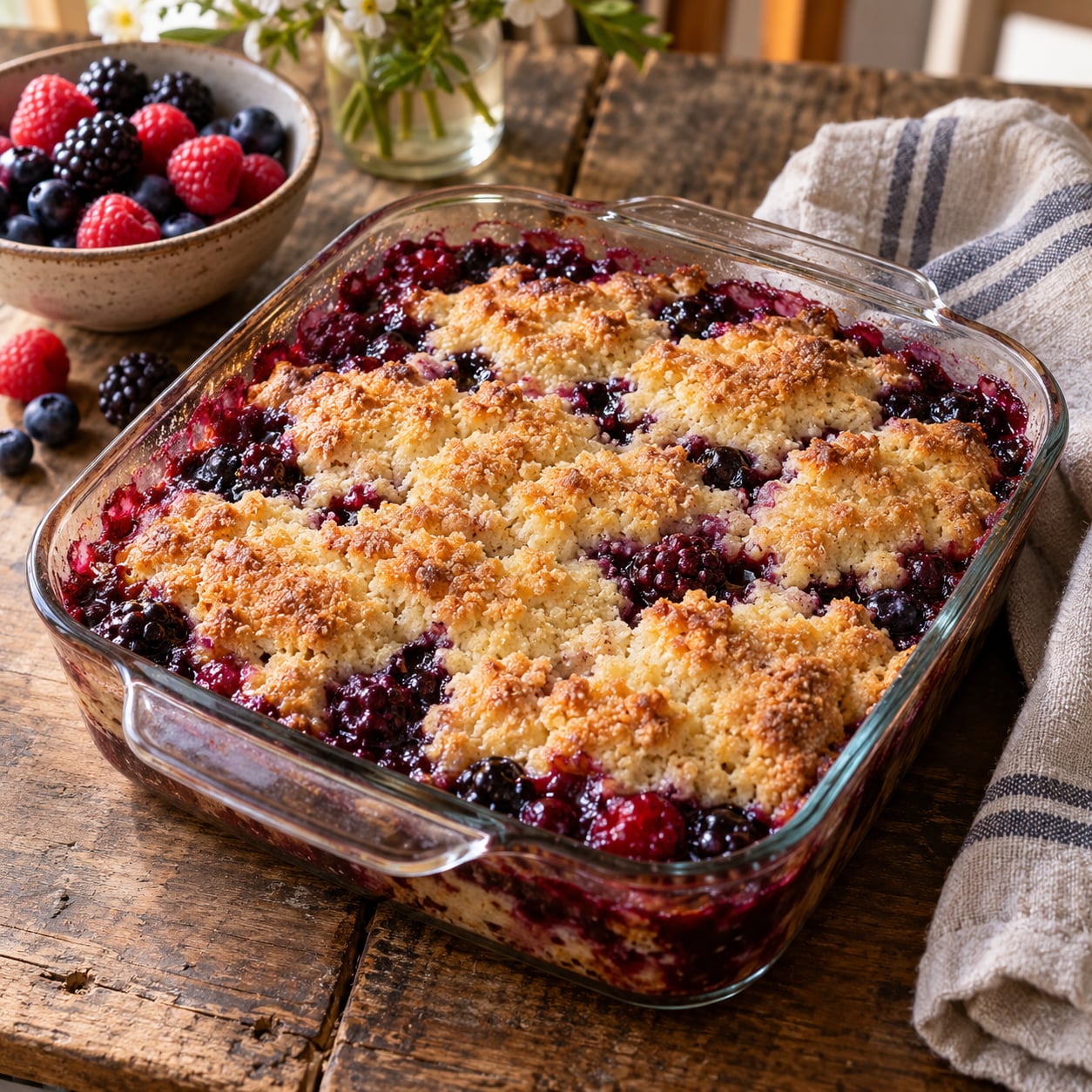
Spread the fruit mixture in the hot dish in an even layer, then scatter the topping over it in loose clumps. Do not press it down and do not pour it on like a glaze. Leave visible gaps between the clumps.
Those gaps are where the fruit juices bubble up through the dish during the bake. A sealed, flat layer of topping traps steam, stays pale in the center, and is one of the main reasons frozen-fruit cobblers disappoint people.
4. Bake until the topping is golden and the center bubbles
Bake at 375°F for 30 to 40 minutes, until the topping is deep golden brown and thick bubbles rise through the middle of the dish, not just around the edges. Bubbling at the rim tells you very little; the center is the last part to finish.
Lift the topping near the center with a spatula and watch a drop of juice. Clear, thickened juice that runs slow means it is done. Pale, watery juice means it needs more time. If the top is browned but the center is still loose, put the dish under the broiler for one or two minutes; that is far better than another ten minutes in a hot oven, which dries the fruit and scorches the top.
Frozen fruit usually adds 10 to 15 minutes over fresh fruit, and some fruit needs even more. Blueberries and other small berries can take 45 to 50 minutes, which surprises nearly everyone the first time. Fruit that has been sitting in the fridge and is only partly thawed bakes closer to the fresh-fruit timing.
Adjust for the pan. Dark metal and cast iron run hotter than glass, so check a metal dish about 5 minutes early and give a glass dish 5 to 10 extra minutes. Ramekins bake in 20 to 25 minutes; watch them closely since they brown fast.
5. Cool, serve, and store the cobbler
Let the dish sit on a wire rack for 15 to 20 minutes before the first serving. The fruit filling finishes thickening as it cools, and cutting in too early releases a wave of thin juice onto the plate.
Serve warm with vanilla ice cream, cold heavy cream, whipped cream, or a spoonful of coconut cream for a dairy-free dessert. A drizzle of warm cream is worth trying on peach cobbler, and a pinch of cinnamon over the top does more than another spoonful of sugar.
Refrigerate a baked cobbler in an airtight container for up to 3 to 4 days. Cool it fully before covering, and get it into the fridge within 2 hours of baking. To freeze a baked cobbler, wrap the dish or individual portions in foil, freeze up to 3 to 4 months, then thaw overnight in the refrigerator and reheat at 350°F for 20 to 25 minutes, covered with foil so the topping does not dry out. Reheating an unbaked cobbler straight from the freezer works too; go from freezer to a cold oven and add 5 to 10 minutes to the bake.
Common mistakes and how to make cobbler with frozen fruit that sets right
- Runny filling. Too much liquid, almost always from frozen fruit. Next time add 1 tablespoon of cornstarch per cup of fruit, or 2 tablespoons of instant tapioca, which thickens and adds a slight crunch at the same time. If the cobbler is already baked and loose, stir 1 to 2 tablespoons of cornstarch into the hot filling and give it five minutes on the stovetop.
- Topping that sinks. The same liquid problem, and the fix happens before baking. Leave gaps in the topping, add the thickener, and do not press the topping flat. A collapse in the middle after 20 minutes is normal, and the crumbs ride back up as the filling thickens.
- Topping stays pale or soggy. Cover it loosely with foil for the first 15 minutes if your oven runs hot, then remove the foil. If the fruit is wet enough to steam the crust, the answer is more thickener, not more heat. Finish under the broiler for a minute at the end.
- Browned top, raw center. The edges fooled you. Push a spatula into the middle and check the juice rather than the crust. Add 5-minute increments until the juice runs thick.
- Uneven fruit. Thawing the fruit in the bag during transport creates hard and mushy pieces in the same spoonful. Bake from frozen, but if the bag has fully thawed, blot the fruit on a towel and add an extra tablespoon of thickener before it goes in the dish.
- Bland flavor. Cold oven to cool fruit dulls everything. A teaspoon of vanilla, a squeeze of lemon, and a pinch of salt sharpen the fruit. Almond extract pairs well with peaches and pears; orange zest lifts berries.
- Wrong pan size or temperature. A 9×13 with a single recipe is the most common sizing error, and it produces a thin, dry, cracked cobbler. 350°F gives a softer, paler top; 375°F is the sweet spot for a crisp golden crust in 30 to 40 minutes.
Frequently Asked Questions
What kind of frozen fruit works best for cobbler?
Sliced peaches, blackberries, mixed berries, blueberries, cherries, and apples all work well. Large fruit like peaches and pears holds its shape and needs a longer bake. Pineapple releases a lot of juice, so add an extra tablespoon of thickener. Very soft berries such as raspberries and strawberries break down further, so stir the filling gently and use only 3/4 cup of sugar.
Can I use canned pie filling to make cobbler?
Yes, and it is the fastest route. Spoon two 21-ounce cans of cherry or apple pie filling into the dish, dot with cold butter, then scatter the topping over it. Cut the sugar in the topping to 2 tablespoons, since the filling is already sweetened, and stir in 1 tablespoon of cornstarch for thickness. Bake at 375 degrees for 30 to 40 minutes.
How can I adjust the sugar for sweeter or less-sweet fruit?
Most frozen fruit is unsweetened, so 3/4 cup of sugar for 4 cups of fruit is a good balance. For a less sweet cobbler, cut it to 1/2 cup and add a tablespoon of lemon juice to make the fruit taste brighter. For a sweeter one, raise it to 1 cup and leave out the lemon. Sweetened frozen fruit, including fruit packed in syrup, needs half the sugar or none.
Can frozen fruit cobbler be made ahead of time?
Yes. Assemble the fruit and topping in the dish up to 24 hours ahead, refrigerate, and bake the next day with 5 to 10 extra minutes, since a cold dish takes longer to heat. A fully baked cobbler keeps 3 to 4 days in the refrigerator, airtight. It also freezes well for 3 to 4 months; thaw in the fridge overnight and reheat at 350 degrees for 20 to 25 minutes.
Can frozen fruit cobbler be made vegan and gluten-free?
Both are straightforward. Use solid vegan butter and a dairy-free milk such as oat or almond, and replace the all-purpose flour with a 1-to-1 gluten-free baking flour cup for cup. That blend has its own starch, so the filling sets nicely. Certified gluten-free oats can replace half the flour for a crunchier top. The recipe still contains sugar, so it is not sugar-free.
Conclusion
The three things that decide whether frozen fruit cobbler works are the same every time: enough thickener for the extra water frozen fruit brings to the dish, a crumb topping scattered loosely enough for juices to bubble through it, and enough bake time to see golden crust and thick juice in the center, not just bubbling edges. Get those right and the rest is straightforward.
Start by heating the oven to 375°F and getting the frozen fruit into the dish with the sugar, lemon juice, cornstarch, and vanilla. Stir it lightly, make the crumbs, scatter the topping, and walk away for 35 minutes.