The safest way to thaw frozen food is in the refrigerator, at 40°F (4°C) or below, on the bottom shelf. Three faster options also work — cold water, the microwave, and sealed portions under cool running water — but each one puts the food in front of you the moment it comes out, so it has to be cooked right away.
That is the whole story of safe thawing, and I mean that almost literally. Freezing pauses bacterial growth; it does not kill the bacteria already on a piece of chicken or a bag of frozen spinach. Thawing is the window where those bacteria wake up, and how you handle that window decides whether dinner is fine or somebody is running for the bathroom at midnight.
These four methods are the ones the USDA Food Safety and Inspection Service and NSF list as safe. Everything else — the countertop, the warm tap, the grill you left on overnight — is a gamble with a bad payout.
Table of Contents
- What You Need
- Step-by-Step: 4 Safe Ways to Thaw Frozen Food
- Method 1: The refrigerator, safest and slowest
- Method 2: Cold water, fast and predictable
- Method 3: The microwave, fastest and trickiest
- Method 4: Sealed portions under cool running water
- How to Know When Frozen Food Is Fully Thawed
- How Long Does It Take to Thaw Frozen Food Safely?
- Can You Refreeze Food After Thawing It?
- Common Mistakes
- What to Do If You Thawed Food Too Slowly
- Frequently Asked Questions
- Is it safe to thaw food on the counter?
- What is the safest way to thaw frozen chicken?
- Can frozen vegetables be thawed in the microwave?
- How long should frozen food thaw in the refrigerator?
- Can you cook frozen food without thawing it first?
- How do I safely thaw frozen bread?
- A Quick Thawing Recap
What You Need
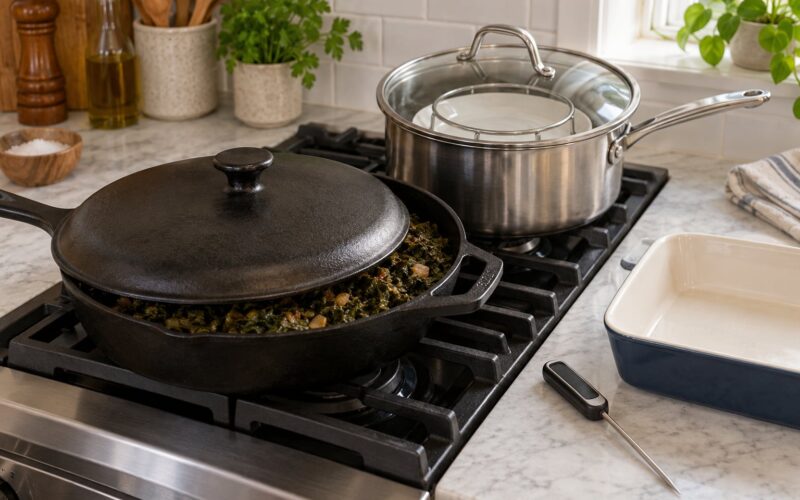
You do not need a single special gadget, but a few ordinary kitchen items make the difference between a clean thaw and a mess you will smell tomorrow.
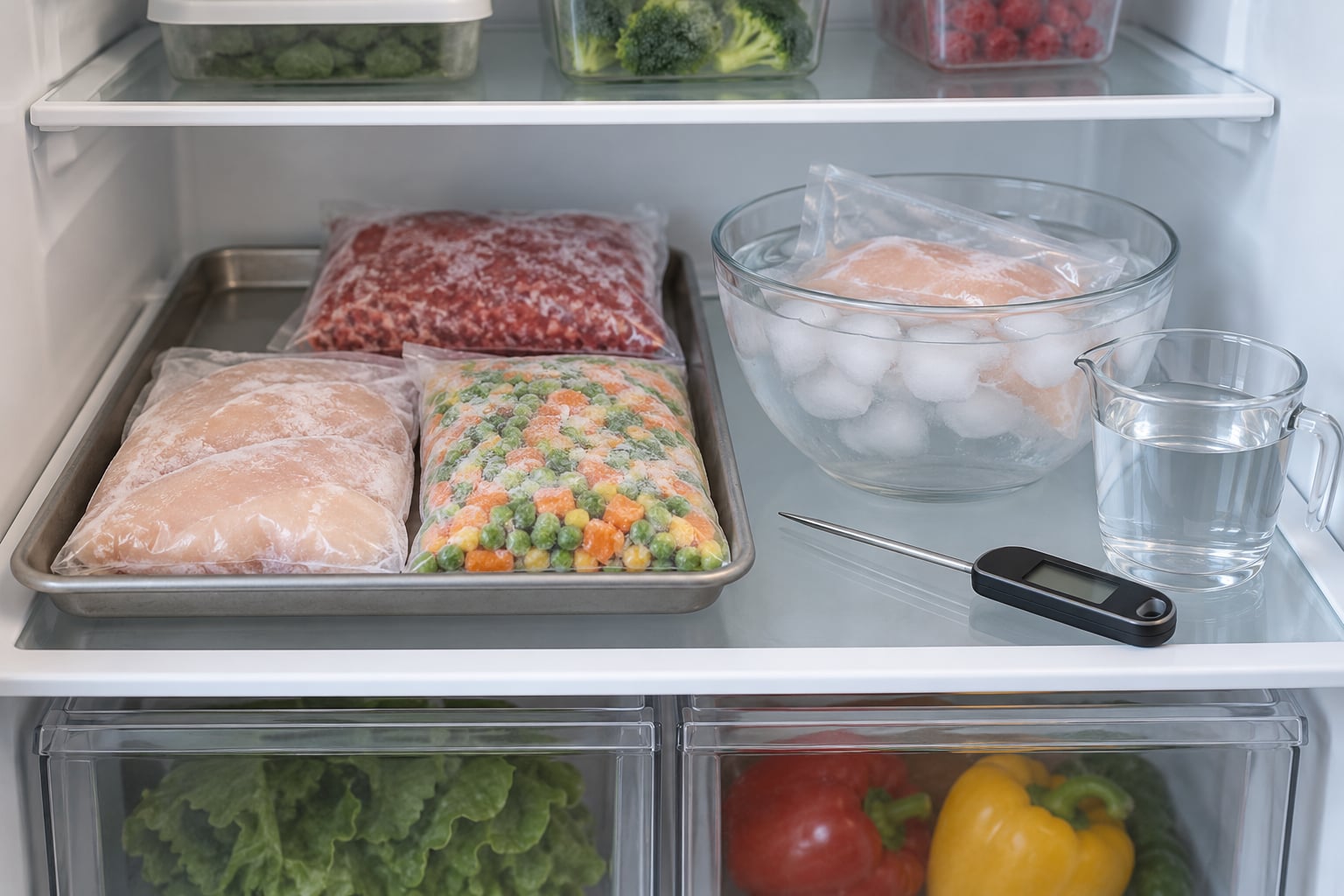
- A refrigerator with a real thermometer in a glass of water on the middle shelf, so you know it is actually holding 40°F or below.
- A leak-proof bag or food-safe container — a freezer zipper bag works, or double-bag the original package.
- A deep bowl or measuring container big enough to submerge the food completely.
- A microwave-safe dish with a loose lid or a second plate to hold heat and moisture in.
- A clean kitchen towel for patting meat dry and for catching drips.
- An instant-read or probe thermometer, which is the only way to stop guessing.
- A cutting board, ideally a separate one you use for raw meat, or scrub the board well after.
Step-by-Step: 4 Safe Ways to Thaw Frozen Food
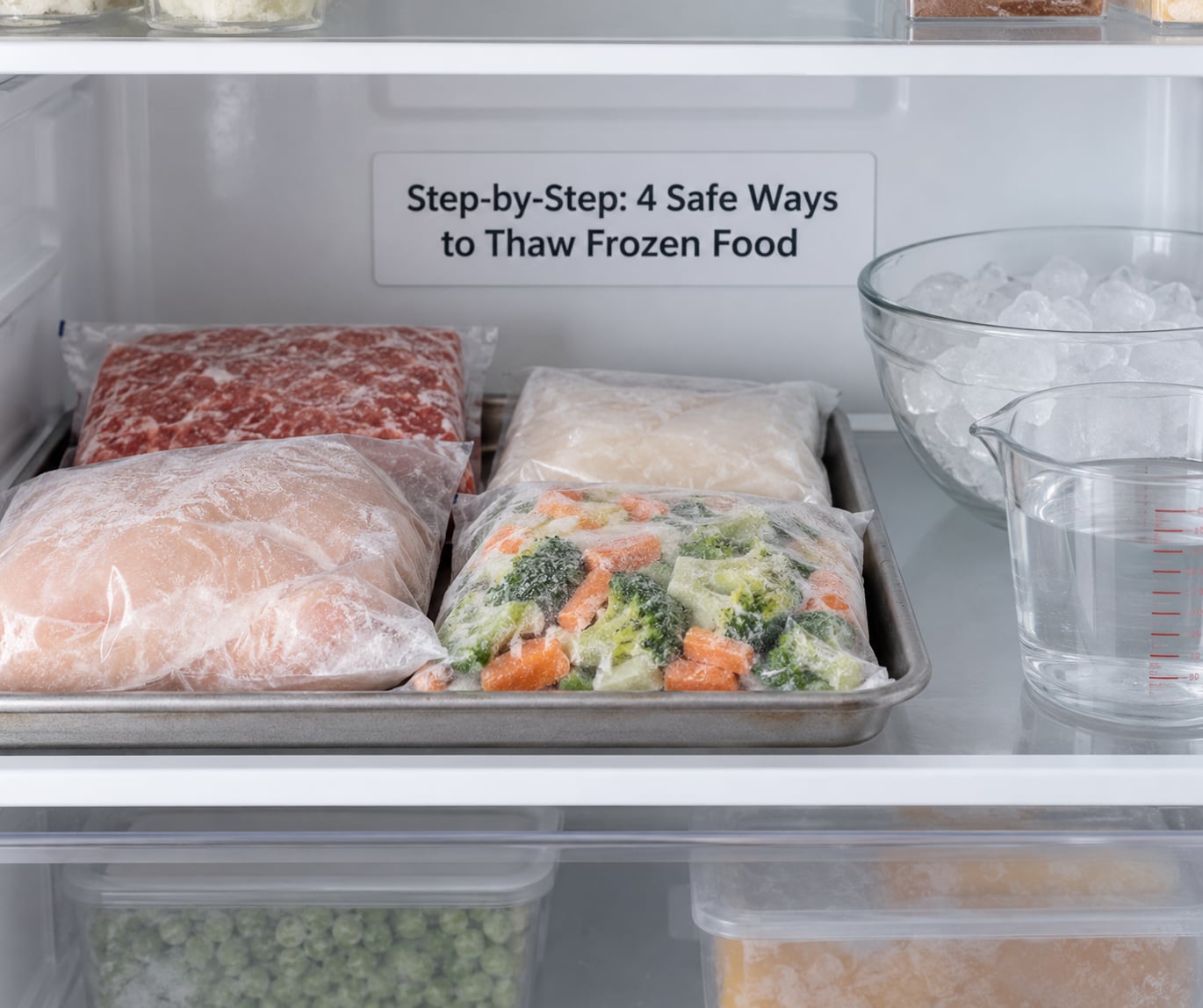
These run from safest and slowest to fastest and least forgiving. Use the refrigerator unless you have a reason not to.
Method 1: The refrigerator, safest and slowest
Put the frozen package in a bowl or on a tray and place it on the bottom shelf of the refrigerator, loosely covered. The bottom shelf matters because a thawed roast or a bag of frozen shrimp leaks, and you do not want that juice near your salad greens or your eggs.
Budget roughly 24 hours per 5 pounds of food, which works out to about 4 to 12 hours for most dinner-sized portions. A 1-pound package of chicken thighs usually gives up overnight. A 12-pound frozen turkey will sit in there for three or four days, so put it in the fridge the day before Thanksgiving, not the morning of.
Food thawed in the refrigerator can be refrozen without cooking it first, and you get up to a day or two of slack before it has to be cooked.
Method 2: Cold water, fast and predictable
Seal the food in a leak-proof bag. Submerge it completely in cold tap water in a bowl or measuring container, and change the water every 30 minutes so the food never sits in water that has warmed up.
Allow about 30 minutes per pound. A 2-pound bag of chicken breasts takes roughly an hour. Cook it immediately after it thaws, and never refreeze it raw unless you cook it first — cold-water-thawed food is already in the danger zone.
Method 3: The microwave, fastest and trickiest
Use the defrost setting rather than full power, enter the food’s weight if the microwave asks, and start at about 5 minutes for small packages. Turn the food over halfway through so the thawing happens evenly rather than cooking the outer edges.
Cook the food straight out of the microwave. The microwave is the one method where the outside can start cooking while the center is still frozen, and every minute it sits afterward is bacteria getting free time at 40°F to 140°F.
Method 4: Sealed portions under cool running water
This is the fastest option for small sealed items — a frozen bag of shrimp, a block of fish, a vacuum-sealed single serving of stew. Keep the food in an airtight bag, hold it under cool running tap water, and keep the water moving.
Thaw for roughly 20 to 30 minutes per pound, then cook it at once. Some vacuum-sealed fish develops pale frost or ice crystals as it warms; that is normal freezer burn from the water in the packaging, not spoilage, so long as the seal held and the food still smells like fish rather than fish left in the sun.
How to Know When Frozen Food Is Fully Thawed
Flexibility is the test, not looks. A chicken breast that springs back and leaves a hard icy core in the middle is not thawed, whatever the bag says. Bite into it or press a finger hard into it — resistance means keep going.
Here are the cues that work per food:
- Chicken and poultry: pliable all the way through, no hard core, joints bend without resistance.
- Ground beef: soft enough to separate into crumbles, no frosty patches in the middle.
- Fish and shrimp: the fillet bends easily, the shrimp turn opaque and pearly, and the flesh looks translucent rather than glassy.
- Steaks and chops: you should be able to pierce it easily with a fork.
- Frozen vegetables: loose and separated, with no ice block holding them together.
- Bread dough: thawed in the refrigerator it should be puffy, no hard edges, and still soft to the touch.
- Baked goods: let the wrapping sit at room temperature 15 to 20 minutes; they cannot be refrozen crisp.
Thermometer beats all of this. A probe in the thickest part reads 34°F to 38°F when thawed and still cold. If it reads 40°F or above, the food is no longer thawing — it is starting to grow bacteria.
How Long Does It Take to Thaw Frozen Food Safely?
How long it takes to thaw frozen food safely depends almost entirely on weight, not shape. A flat fillet and a thick round roast of the same weight thaw at very different speeds, which is why people keep cutting into a supposedly thawed breast and finding ice.
| Food | Refrigerator | Cold water |
|---|---|---|
| Chicken breast (1 to 2 lb) | 1 to 2 days | 30 to 60 min |
| Chicken thighs (2 lb) | 1 to 2 days | 60 min |
| Ground beef or turkey (1 to 2 lb) | 1 to 2 days | 30 to 60 min |
| Whole chicken (4 to 6 lb) | 2 to 3 days | 2 to 3 hours |
| Whole turkey (12 to 16 lb) | 3 to 4 days | 6 to 8 hours |
| Pork chops (2 lb) | 1 to 2 days | 60 min |
| Steak (1 to 1.5 lb) | 1 day | 30 to 45 min |
| Salmon fillet (1 lb) | 12 to 18 hours | 30 min |
| Shrimp (1 lb) | 12 to 18 hours | 30 min |
| Frozen vegetables (1 to 2 lb) | not needed — cook from frozen | not needed |
| Bread dough ball (1 lb) | 8 to 12 hours in the fridge | do not use water |
| Bagels, English muffins, rolls | 6 to 12 hours | do not use water |
Plan backward from dinner. If the recipe takes 40 minutes and you are thawing 2 pounds of chicken breasts in water, start at least an hour and a half ahead.
Can You Refreeze Food After Thawing It?
You can refreeze food thawed in the refrigerator, and that is the one real advantage of being patient. Quality drops a little — freezer burn sneaks in, and ice crystals can make fish or meat lose moisture — but the food stays safe.
Food thawed in cold water or in the microwave should not go back in the freezer raw. Cook it first, then refreeze the cooked food. Raw boneless chicken breasts thawed in cold water and cooked the same hour are fine; the same breasts sitting on the counter from breakfast to dinner are not.
Ground beef, fish, shrimp and cooked leftovers follow the same rule. Bread dough is the odd one out — yeast dough thawed in the refrigerator can be refrozen and will rise again, but it loses some structure. Baked goods and bread should never be refrozen; they go stale and soft for good.
Common Mistakes
Thawing on the counter. This is the big one, and it is why a whole chicken sitting out “for a few hours” is a bad idea. The outer layers enter the danger zone of 40°F to 140°F while the center is still frozen, and bacteria multiply fast. Correction: refrigerator, cold water or microwave, every time. Tip: if dinner is at 7 pm, put the food in the fridge at breakfast instead of at noon.
Using warm or hot tap water. Warm water thaws the outside first and holds it there in the danger zone, which defeats the entire purpose of sealing the bag. Correction: cold water only, changed every 30 minutes. Tip: fill the container with cold water and a handful of ice cubes, then dump and refill it on a timer with the rest of dinner.
Wrapping meat tightly in foil or burying it in dry ice. Dry ice in an unventilated freezer releases carbon dioxide, and foil-wrapped meat traps warmth and slows the thaw. Correction: loose covering in the fridge, or a bag in water. Tip: put a folded towel on the shelf under the tray so any leak never reaches the food underneath.
Overcrowding the refrigerator. A tightly packed fridge circulates cold air poorly, and a new frozen roast wedged between two containers can hold itself in the danger zone for hours. Correction: leave air space around thawing food and give it its own shelf. Tip: move the ice trays and the condiments before dinner, not the day before.
Cooking partially frozen food without checking. A frozen center means the middle of the chicken is still cold while the outside is well past the danger zone. Correction: check with a thermometer, not by cutting. Tip: if you cook from frozen, add about 50 percent to the cooking time and start checking temperature in the last third of the cook.
Letting thawed food sit out past two hours. The two-hour rule — often taught as the 2-2-2 rule along with two hours in the danger zone and two hours for leftovers — means perishables get one hour instead of two when the air is above 90°F. Correction: put it back in the fridge or cook it. Tip: set a kitchen timer for the moment you take food out, not for when you plan to serve it.
Assuming a cold kitchen counts as refrigeration. An unheated porch, a garage in winter, or a cooler car is nowhere near 40°F. Correction: use a cooler with plenty of ice around the food, and treat a package as perishable once it is out of the cooler. Tip: a separate thermometer in the cooler tells you more than your memory does.
What to Do If You Thawed Food Too Slowly
Still solid after an hour in cold water, or still icy after a full day in the fridge? Nothing is ruined. Escalate instead of giving up and setting it on the counter.
Move the food to cold water if the fridge thaw has stalled, or to the microwave on defrost if the water thaw has stalled. Cook from partially frozen when the food allows it — thick roasts, whole chickens and large blocks of ground meat cook fine straight from the freezer, just with roughly 50 percent extra time. Thin steaks, fillets and anything that cooks fast will only burn on the outside, so finish those gently on the stovetop with a lid and a thermometer in the pan.
Frozen vegetables, butter blocks, and bread dough are the exceptions where no amount of rushing helps. Just let them sit and move on.
Frequently Asked Questions
Is it safe to thaw food on the counter?
No. The outer layers of the food enter the bacterial danger zone of 40 to 140 degrees F while the center is still frozen, and bacteria can multiply quickly in that warm, moist outer layer. Safe methods are the refrigerator at 40 F or below, cold water changed every 30 minutes, the microwave defrost setting, or cooking straight from frozen.
What is the safest way to thaw frozen chicken?
The refrigerator, on the bottom shelf, in a bowl or tray to catch drips. Budget about 24 hours per 5 pounds, so a 1-pound package of breasts usually takes overnight. If you need it the same day, seal it in a leak-proof bag and submerge it in cold water for roughly 30 minutes per pound, then cook it immediately.
Can frozen vegetables be thawed in the microwave?
Usually you do not need to. Frozen vegetables, along with fruit and single portions, are best cooked from frozen in a hot pan or oven, which preserves more of their nutrients than thawing first. If you do want them thawed, the microwave defrost setting in a covered dish works, but cook or use them right away rather than letting them sit.
How long should frozen food thaw in the refrigerator?
Plan on about 24 hours per 5 pounds, which is around 4 hours per pound. Most dinner-size portions are ready overnight, while a 12-pound turkey needs three to four days. Food thawed in the refrigerator stays safe the longest and can be refrozen, so it is the best choice when you can plan ahead.
Can you cook frozen food without thawing it first?
Yes. Cooking from frozen is a safe method as long as the food goes into the cooking process frozen and cooks to a safe internal temperature. Add roughly 50 percent to the usual cooking time, and check with a thermometer rather than color: 165 F for poultry, 160 F for ground meat, and 145 F for whole cuts and fish with a 3-minute rest.
How do I safely thaw frozen bread?
Thaw it in the refrigerator overnight, inside its bag or wrapped in a clean towel so it does not dry out. For faster results, run cool tap water over the bag for 20 to 30 minutes, or warm it briefly in the oven or toaster. Bread that has thawed cannot be refrozen and will go stale, so slice it and freeze it next time if you only need part of a loaf.
A Quick Thawing Recap
Refrigerator by default, at 40°F or below, on the bottom shelf, roughly 24 hours per 5 pounds. Cold water when you need it today, 30 minutes per pound, water changed every 30 minutes. Microwave when the clock is winning, defrost setting, food turned halfway, cooked the minute it comes out.
The action to take first is boring and it works: move food from the freezer to the refrigerator a full day before you plan to cook it. Everything else on this page is a recovery plan for the days that do not go that well.
Safety guidance here follows USDA Food Safety and Inspection Service and NSF recommendations, including the safe minimum internal temperatures of 165°F for poultry, 160°F for ground meat, and 145°F for whole cuts and fish.