How to cook in a slow cooker without mushy vegetables comes down to sequencing. Dense root vegetables go in at the start, mid-firmness vegetables join about two hours in, and tender ones like zucchini, peppers, squash, and greens get the final 30 to 60 minutes. Cut size and how much liquid you add matter just as much as the clock.
The reason is simple once you know it. A slow cooker on LOW holds food at roughly 185 to 195°F, which is a gentle simmer and not a boil. Nothing is falling apart violently, but heat works on vegetable cellulose slowly and without pause, so every extra hour softens it a little more. The dial changes how fast the pot climbs to temperature. It does not change how hard that simmer works on a carrot.
Most mush in a crock pot comes from dumping everything in at once, adding more liquid than the vegetables need, and cutting pieces too small to survive a long cook. Fix those three things and the same recipe tastes noticeably better.
- Start with dense root vegetables only: carrots, potatoes, rutabaga, turnips, parsnips, beets.
- Add mid-firmness vegetables about 2 hours before serving.
- Save zucchini, summer squash, peppers, green beans, peas, and greens for the final 30 to 60 minutes.
- Keep vegetables above the liquid line, on a trivet or in a steamer basket, whenever you can.
- Add just enough liquid to cover the bottom third of the pot, not to bury the food.
- Cut sturdy vegetables evenly, and cut delicate ones larger than the recipe photo suggests.
Table of Contents
- What You Need
- Step-by-Step: How to Cook in a Slow Cooker Without Mushy Vegetables
- 1. Choose Vegetables by Texture
- 2. Cut Vegetables Evenly and Sized for the Recipe
- 3. Control the Amount of Liquid
- 4. Layer Ingredients by Cooking Time
- 5. Use the Right Heat Setting
- 6. Add Delicate Vegetables Late
- 7. Check Texture Before Serving
- Common Mistakes
- How to fix vegetables that have already gone soft
- Planning, reheating, and food safety
- Frequently Asked Questions
- Which vegetables are least likely to become mushy in a slow cooker?
- Should I add all vegetables at the same time?
- Why are my slow cooker vegetables watery?
- Can I keep vegetables crisp on low in a slow cooker?
- How do I reheat slow-cooker vegetables without making them soggy?
- Can you use this method for vegan and gluten-free meals?
- Conclusion
What You Need
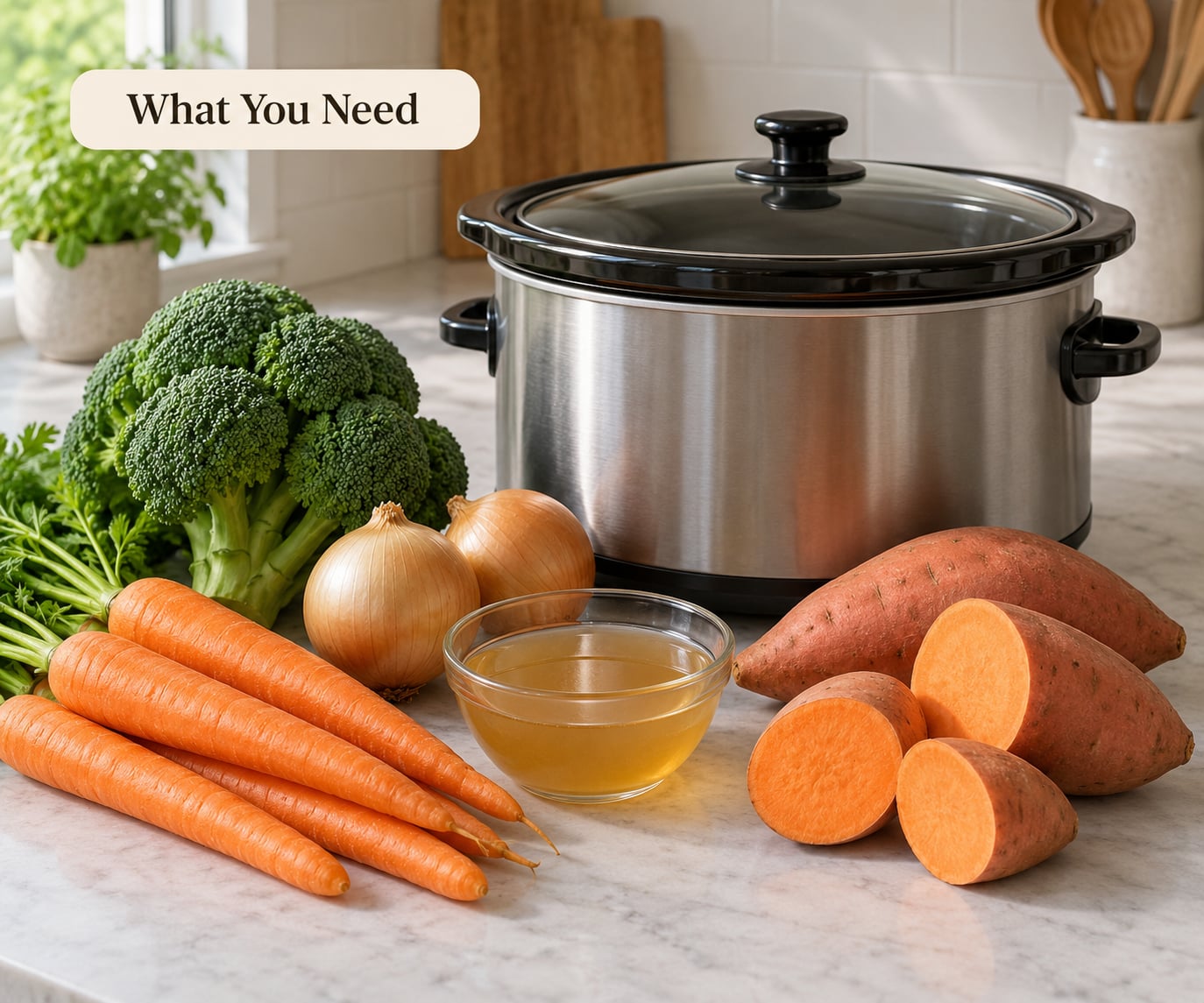
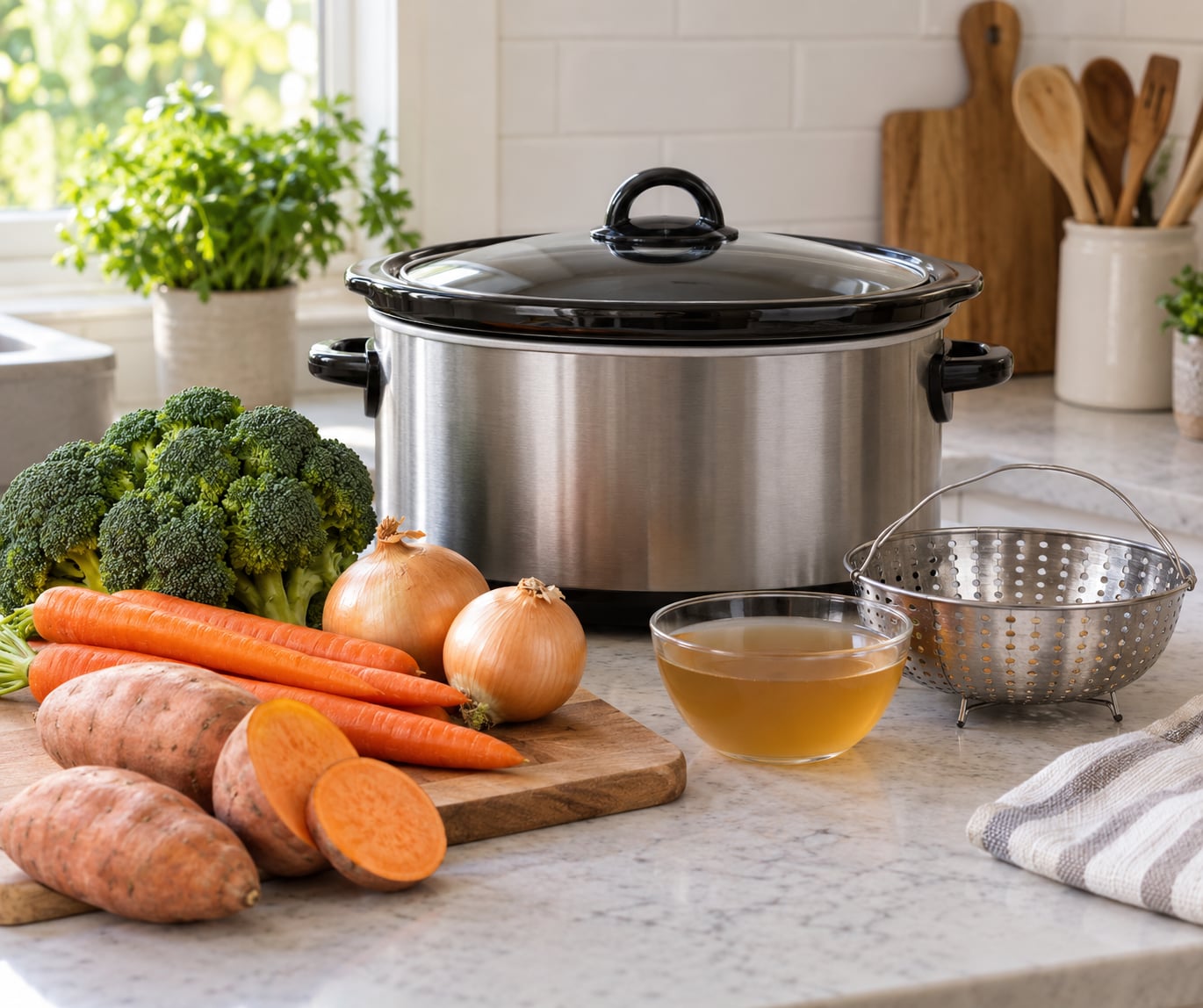
A slow cooker in the 6-quart range handles most vegetable-forward meals for a family. A 4-quart pot heats faster and dries out sooner, so it needs less liquid, while an 8-quart pot holds heat longer and rewards a trivet rack to keep vegetables out of the broth.
Two small accessories do more for texture than any recipe change. A trivet or steamer basket lifts food above the liquid so vegetables steam instead of simmering, and a wire rack gives you a second level for a tray of cut vegetables. This is the fix that keeps coming up in slow cooking forums, and it works because moisture is what breaks structure down fastest.
For produce, buy firm vegetables. Carrots and rutabaga should resist the knife, cabbage heads should be tight, and squash should feel heavy for its size. Soft spots and pale, rubbery surfaces will not recover no matter how you time the cook.
Liquid is the ingredient people overdo. Broth, water, tomato juice, or canned tomatoes all work, and the only rule is that liquid should come up the sides of the pot, not over the top of the food. A layer of denser ingredients in the bottom, such as pureed tomatoes or a small amount of broth, steams everything resting above it and keeps the texture firmer.
Protein is mostly a scheduling decision. Beef and pork can cook for six to eight hours, so their vegetables get added in stages. Chicken usually needs four hours or fewer, which means a shorter window for the delicate add-in.
Seasonings work here the same way they do anywhere: salt early, acid late. A splash of vinegar or lemon at the end brightens vegetables that have spent hours losing brightness. If you brown meat or mushrooms first in a hot skillet, that caramelized layer survives the long cook and does more for flavor than doubling the spice.
Step-by-Step: How to Cook in a Slow Cooker Without Mushy Vegetables
1. Choose Vegetables by Texture
Sort produce into three groups before it hits the pot. Group one is dense roots and sturdy all-day vegetables. Group two is mid-firmness vegetables that need a couple of hours. Group three is delicate vegetables that turn to paste in anything past the last hour.
The practical test is how much structure the vegetable has left to lose. A rutabaga cube can sit for eight hours and still be a solid cube. A zucchini slice cannot. When a recipe mixes both, the cooking time belongs to the softest vegetable in the pot, which is why dump dinners fail.
Group one: carrots, potatoes, sweet potatoes, parsnips, rutabaga, turnips, beets, and winter squash. Group two: green beans, cauliflower, broccoli florets, celery, onions, green bell peppers, artichoke hearts, and dried beans. Group three: zucchini, yellow squash, eggplant, mushrooms, asparagus, peas, spinach, kale, collards, and bok choy.
2. Cut Vegetables Evenly and Sized for the Recipe
Uniform cuts cook at the same rate, and that is the whole point. A stew with half-inch carrot coins and quarter-inch carrot coins will have two textures, and the small ones will be the mushy ones nobody can fix.
Sturdy vegetables want the size the recipe calls for, matched piece by piece. Delicate vegetables want to be cut noticeably bigger than feels right. Two-inch chunks of zucchini survive a one-hour add; thin half-moon slices do not. Home cooks on cooking forums consistently cut squash, peppers, and green beans larger than the photos in the recipe imply, and that instinct is correct.
You will know the cut size worked when a fork meets resistance instead of sliding through without a sound.
3. Control the Amount of Liquid
Fill the pot so liquid reaches the bottom third, which is where it sits once everything else goes in. Vegetables sitting above that line steam. Vegetables sitting in it simmer and give up their structure to the broth.
Steamed vegetables also keep their flavor, since nothing leaches out into liquid you end up discarding. This is the same reason a steamer basket works so well: a small amount of water in the bottom produces a closed, steamy chamber instead of an open bath.
You can cook vegetables in a slow cooker with very little liquid, and for a vegetable-only side that is often the better choice. Half a cup of broth in a 6-quart pot is plenty when the food is broken into sturdy chunks.
4. Layer Ingredients by Cooking Time
Build the pot in the order that matches cooking time, from the bottom up.
- Protein or the densest root vegetables, such as potatoes and rutabaga.
- Mid-firmness vegetables, such as carrots, onions, celery, and green beans.
- Liquid, poured down the side so it settles without soaking the layers above.
- A trivet, then a basket of delicate vegetables that need steam rather than a bath.
- Herbs and anything acidic, added at the end.
The reason dense items go low is heat. The bottom of the pot sits closest to the element, so the pieces that can take the most treatment get that position. When vegetables go under the meat, they spend the whole cook pressed into liquid at the hottest point, which is exactly the combination that produces grey, limp results.
For very long cooks of eight to ten hours, add even the mid-firmness group partway through. Several experienced cooks stagger their potatoes and carrots in around the four-hour mark, and the difference in texture is noticeable.
5. Use the Right Heat Setting
LOW is roughly 185 to 195°F, a simmer that works on tough cuts for hours. HIGH pushes closer to a boil, which is useful for bringing a cold pot of ingredients up to temperature faster and for finishing a batch of vegetables that are already tender.
Constant HIGH is where texture gets destroyed. Boiling water agitates the pieces, breaks down pectin, and pushes starch into the liquid, and that combination is what makes vegetables fall apart rather than soften. If a recipe needs HIGH to save time, run HIGH for the first hour to get everything hot, then drop to LOW.
WARM is a holding setting. It is not a cooking setting, and it is not gentle on delicate vegetables, since anything sitting at a simmer for hours keeps softening.
6. Add Delicate Vegetables Late
This is the step that decides whether you cook in a slow cooker without mushy vegetables at all. Fold in zucchini, squash, peppers, green beans, peas, asparagus, mushrooms, and greens during the final 30 to 60 minutes.
Watch the clock against the food, not the recipe. Vegetables added to a cold pot at the start of a six-hour cook get six hours of heat. Vegetables folded into a hot stew two hours before service get two hours, and usually far less in practice because the pot is no longer at a rolling simmer. That is why the same add-time advice can look contradictory until you separate the two situations.
For a 4-hour chicken dinner, delicate vegetables can join at the two-hour mark. For an 8-hour pot roast, wait for the last 45 minutes. Greens go in during the final 5 to 10 minutes, since they wilt almost instantly and only need to warm through.
Lift the lid fast, drop the vegetables in, and put the lid back on. Home cooks often tuck a folded kitchen towel over the rim so the lid sits a little higher and loses less heat while they work.
7. Check Texture Before Serving
Test with a fork or the back of a spoon. You want a clean slide with a little resistance left in it. If the fork goes in with no resistance, the vegetable has passed the point you wanted and more time will not bring it back.
Stir before serving, and take the pot off the heat. A stir redistributes the vegetables so the top layer is not sitting in a puddle while the bottom layer dries out, and it changes how the texture reads on the plate more than anything else at this stage.
For a short finishing step, spread vegetables on a hot sheet pan and run them under a hot broiler for three to five minutes, or sear them in a skillet with a little oil. That blast of dry heat drives off surface moisture and firms up the outside, which is a genuine rescue for a batch that is soft rather than simply tender.
Timing cheat sheet for a typical 6-hour cook on LOW:
| Vegetable | Add | Cut size | Setting |
|---|---|---|---|
| Potatoes, rutabaga, turnips | Hour 0 | 2 inch chunks | LOW |
| Carrots, parsnips, beets | Hour 0 to 2 | 1 inch slices | LOW |
| Onions, celery | Hour 0 to 2 | 1 inch pieces | LOW |
| Green beans, cauliflower | 2 hours before serving | Whole or large florets | LOW |
| Bell peppers | Last 45 minutes | 2 inch strips | LOW or HIGH |
| Broccoli florets | Last 30 minutes | Large florets | HIGH |
| Zucchini, yellow squash | Last 30 minutes | 2 inch chunks | LOW |
| Eggplant | Last 45 minutes | 2 inch cubes | LOW |
| Mushrooms | Last 30 minutes, sauteed first | Halved | LOW |
| Asparagus | Last 20 minutes | 2 inch spears | LOW |
| Peas | Last 10 minutes | Whole, frozen works well | LOW |
| Spinach, kale, collards | Last 5 to 10 minutes | Torn or chopped | LOW |
Common Mistakes
Everything goes in at once. This is the most common cause of mush, and it is a scheduling error rather than a technique error. Separate the produce and stage the additions, using the chart above as a starting point.
Too much liquid. Recipes written for meat are frequently written for the broth, and the vegetables end up submerged. Cut the liquid back by a cup and test again next time.
Cuts that are too small. Uniform does not mean tiny. Small pieces have more surface area exposed to the same heat and collapse sooner.
Vegetables buried under the meat. Position matters more than most cooks expect. Keep delicate items high and dry.
Constant HIGH heat. Useful for bringing a pot to temperature, punishing for anything tender. Drop to LOW once the pot is hot.
Frozen vegetables added early. They thaw in the pot, release water, and accelerate breakdown. Frozen is actually more forgiving than fresh, but only if you add it late, in the last 30 minutes.
Green beans, peppers, and zucchini left for hours. The three most commonly reported casualties. All three belong in the final window.
Believing LOW means gentle on vegetables. The crock holds a simmer around 185 to 195°F, which is plenty of sustained heat to turn soft vegetables into paste over a long evening.
Not stirring before serving. Cheap, fast, and it fixes the uneven-texture problem that makes a good batch look like a bad one.
How to fix vegetables that have already gone soft
Pull the pot off the heat and lift out the meat. Drain the vegetables and pat them dry on a towel, which removes the surface water that is making them feel wet rather than tender.
Spread them on a hot sheet pan in a single layer and give them three to five minutes under a hot broiler, or a few minutes in a skillet over high heat with a little oil. Dry heat is the fastest route back to texture, and it leaves the flavor alone where a thick sauce would bury it.
Alternatively, fold them into a sauce where softness stops being a problem. A cornstarch-thickened broth, a tomato sauce, or a vinaigrette turns soft vegetables into a side dish rather than a failure. Mushy vegetables and a good reduction are friends.
If a whole batch is overcooked and you cannot rescue it tonight, serve it as soup the next day. Overcooked vegetables blend into a perfectly smooth purée with almost no effort, which is how many good soups got started in the first place.
Planning, reheating, and food safety
Cooking vegetables in a slow cooker for a crowd works on the same principle. Cook the sturdy vegetables in the big pot, then hold them on WARM with a trivet underneath so they are not sitting in liquid while you wait for the crowd to arrive. Timing the delicate add-in for 30 minutes before you plan to serve avoids the problem entirely.
Reheat slowly and briefly. A skillet over medium heat with a splash of liquid and a tight lid steams the vegetables back to hot without extending their time in water, while a microwave run on full power for a full minute can push already-tender pieces past the point of no return. Add a splash of fresh broth or a squeeze of lemon after reheating to wake up the flavor.
Keep poultry to 165°F, ground meats to 160°F, and whole cuts to 145°F as a minimum internal temperature, and use a thermometer rather than a guess. Refrigerate cooked food within two hours. Slow cookers hold food in a temperature range favorable to bacterial growth, so do not use WARM as a parking spot for a finished batch, and reheat leftovers to 165°F.
Frequently Asked Questions
Which vegetables are least likely to become mushy in a slow cooker?
Dense root vegetables hold their shape best. Carrots, potatoes, rutabaga, turnips, parsnips, beets, and winter squash can handle six to eight hours on LOW and still hold a fork. Firm cabbage wedges, whole onions, and cauliflower also survive a long cook. The vegetables that fall apart fastest are zucchini, yellow squash, eggplant, mushrooms, green beans, and any leafy green, which is why they get the final 30 minutes.
Should I add all vegetables at the same time?
No. Staging your additions is the single biggest change you can make. Put dense roots in at the start, mid-firmness vegetables in about two hours before serving, and delicate vegetables in during the final 30 to 60 minutes. Remember that vegetables dropped into a cold pot at the start of a six-hour cook get the full six hours, while vegetables folded into a hot stew at the end get far less.
Why are my slow cooker vegetables watery?
Usually one of three things: too much liquid, frozen vegetables thawing in the pot and releasing water, or a cut size that leaves too much surface area exposed. Keep liquid to the bottom third of the pot, add frozen vegetables from frozen during the last 30 minutes, and cut pieces larger than feels natural. Resting finished vegetables on a trivet above the liquid instead of submerged also helps.
Can I keep vegetables crisp on low in a slow cooker?
Perfectly crisp, no. A slow cooker on LOW holds about 185 to 195°F, which is a sustained simmer, and that is enough heat to break down delicate vegetables over several hours. What you can do is get close: cut delicate vegetables large, keep them above the liquid on a trivet, add them in the last 30 to 60 minutes, and finish under a hot broiler or in a hot skillet for a few minutes before serving.
How do I reheat slow-cooker vegetables without making them soggy?
Reheat briefly and with moisture sealed in. Put the vegetables in a skillet over medium heat with a splash of broth or water, cover tightly for three to four minutes, then stir. That steams them back to hot without adding time in liquid. Microwaving on high for a full minute is the most common way to turn tender vegetables into mush, so use short bursts and check between them.
Can you use this method for vegan and gluten-free meals?
Yes, and the method actually helps. Vegetable-forward dishes without meat have less liquid than a pot roast, which is usually an improvement. Use vegetable broth in place of chicken broth, check that your stock is gluten free if that matters to you, and build protein from beans, lentils, or tofu, which are all firm enough to sit at the bottom of the pot. Stage the beans with the dense vegetables and add greens at the end.
Conclusion
Start with the first action tonight: cook the dense vegetables alone at the start of the pot, keep liquid to the bottom third, and hold the tender ones back for the last 30 to 60 minutes. That one change fixes more mushy batches than anything else in this guide.
From there, adjust to your own pot and produce. A 4-quart pot reaches temperature faster and wants less liquid than an 8-quart one, and vegetables bought at the peak of their season need less cooking time than out-of-season ones. Keep notes on what worked, and the same recipe will stop being a gamble.
Updated for October 2026. Tested in a home kitchen with 4-quart and 6-quart slow cookers; cook times shift with pot size and how full the pot is.