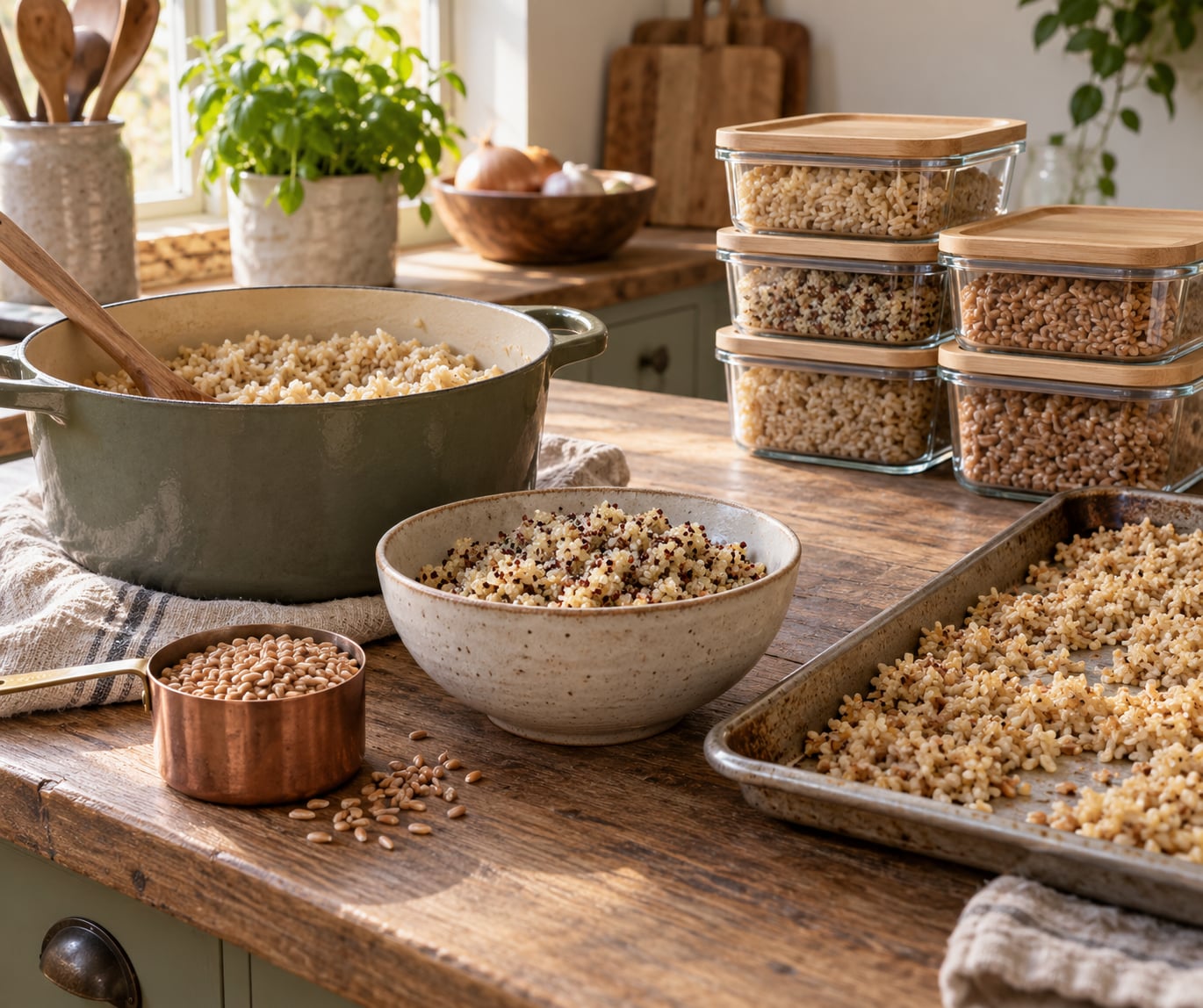
To batch cook grains for the week, cook two large pots on a Sunday, spread them thin to cool fast, then portion them into shallow airtight containers for the fridge and freeze the rest. One batch of rice or farro takes barely longer than a single serving, so one cooking session removes 20 to 40 minutes of stovetop time from most weeknight dinners. Expect about 90 minutes of work for a full week’s worth of two grains, plus 15 minutes at dinner time to reheat with a splash of water.
I do this every Sunday and the thing I did not expect was how much calmer it makes the week. Nobody asks what the base is, because it is already in the fridge. What varies is what goes on top.
Table of Contents
- What You Need
- Step-by-Step: How to Batch Cook Grains for the Week
- Choose Your Grains and Menu
- Measure and Cook in Batches
- Cool, Portion, and Store
- Reheat Without Losing Texture
- Turn Batched Grains Into Meals
- Common Mistakes
- Frequently Asked Questions
- How long will cooked grains last in the fridge?
- How far in advance can I batch cook grains?
- Can you meal prep rice for all seven days?
- Do you have to rinse quinoa before cooking?
- Is it safe to reheat rice more than once?
- How much dry grain should I cook for my family?
- Conclusion
What You Need
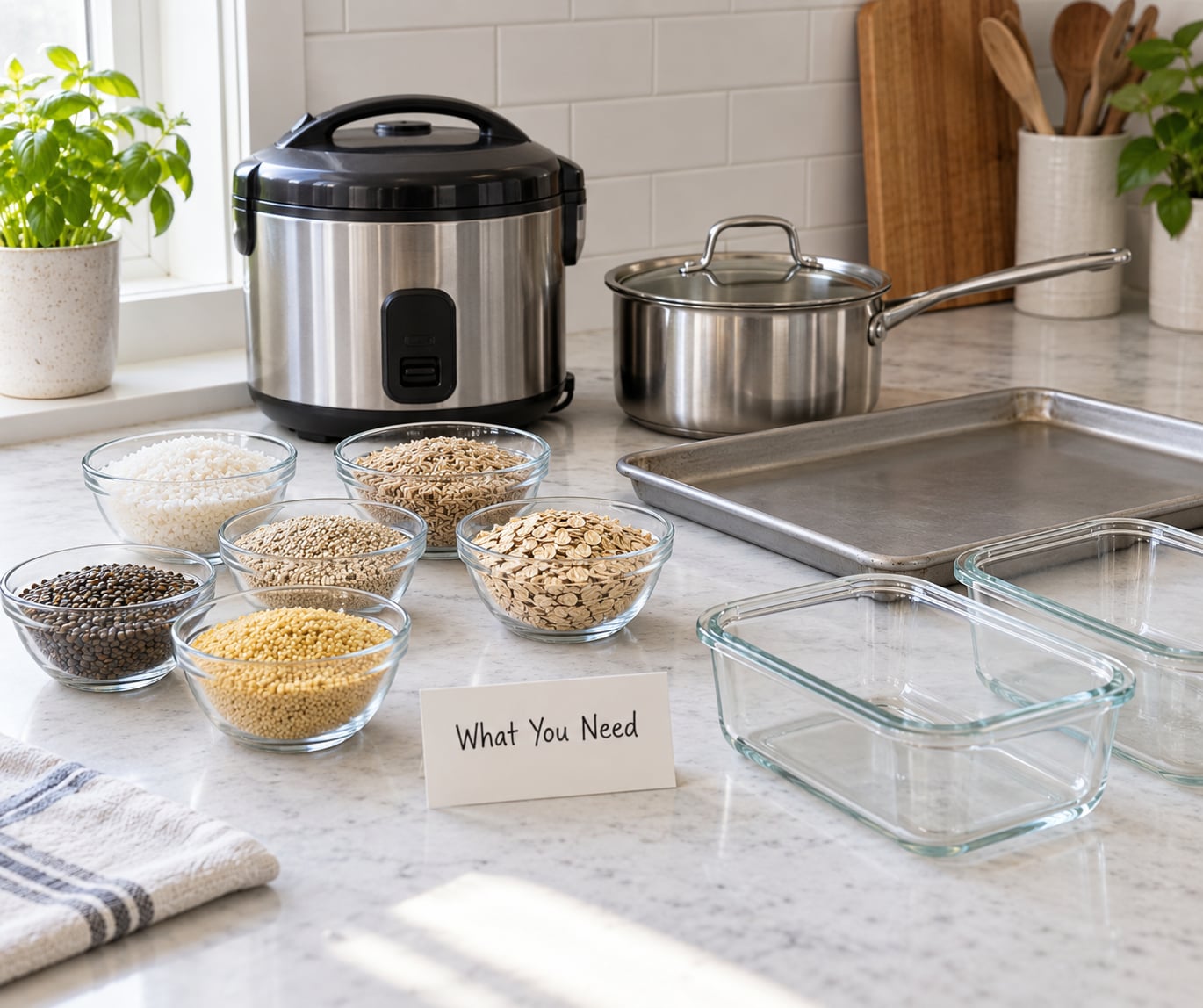
Gather everything before you start. Once a pot is on, you want to be measuring and labeling, not hunting through cabinets.
- A large pot with a tight lid for stovetop absorption cooking. A heavy bottom distributes heat better than a thin pan.
- A rice cooker or pressure cooker if you have one. Both free your hands and cut hands-on time roughly in half.
- A rimmed sheet pan or two for cooling. This is the step most people skip and it is the one that keeps grains safe.
- Two or three grains in the grains you already cook. Rice, quinoa, farro, barley, millet, buckwheat and sorghum all hold up well.
- Liquid — water, broth, or coconut milk for a creamier pot. Broth seasons the whole batch so you do not have to salt twice.
- Salt, oil and any aromatics you want baked in. A bay leaf, a smashed garlic clove or a spoon of oil goes in with the grain, not after.
- Shallow glass or stainless containers that seal airtight. Go shallow and wide rather than deep and tall; heat leaves a deep container faster.
- A marker and masking tape for dates. You will not remember which container was Tuesday’s.
Skip the plastic tubs if you can. Glass or stainless holds temperature better in the fridge and does not pick up odors from chili or onions the way plastic does.
Step-by-Step: How to Batch Cook Grains for the Week
Choose Your Grains and Menu
Pick two or three grains that eat differently. If you cook rice and brown rice, you have two dinners that taste the same, and you will get bored by Wednesday. The way to batch cook grains for the week is to map each grain to a different job.
- Long-grain white or brown rice — grain bowls, fried rice, burrito filling, the base for a Monday soup.
- Quinoa — cold salads, breakfast porridge, a thickener for soups. It reheats chewy rather than mushy, and rinsing it well is what keeps it from going pasty in the pot.
- Farro and barley — grain salads and soups. Both keep a firm bite for four days, longer than rice does.
- Millet — fast cooking, mild, and it doubles as a hot breakfast cereal with milk and fruit.
- Buckwheat — a pseudograin rather than a true grain, naturally gluten-free, with a dark nutty flavor that stands up to strong seasonings.
- Sorghum — an Appalachian and Southern staple with a chewy bite, worth using wherever you would use farro.
- Grits, cornmeal and hominy — batch these for breakfast and for fried grits, keeping them in their own containers.
Quinoa and buckwheat are naturally gluten-free. If you are cooking for someone with celiac disease, keep them in a clean pot with clean utensils, because oats and farro are not safe on the same surface.
Measure and Cook in Batches
Batch size math is simpler than most people make it. One cup of dry long-grain rice yields about three cups cooked. Plan on half a cup to three quarters of a cup dry per person per meal, and cook for the meals you will actually eat, not the theoretical seven days.
| Grain | Water per 1 cup dry | Cook time | Best method | Yield from 1 cup dry |
|---|---|---|---|---|
| Long-grain white rice | 2 cups | 15-18 minutes | Stovetop or rice cooker | 3 cups |
| Brown rice | 2 to 2.25 cups | 35-45 minutes | Stovetop or pressure cooker | 3 cups |
| Quinoa | 2 cups | 12-15 minutes | Stovetop or rice cooker | 3 cups |
| Farro | 3 cups | 25-30 minutes | Stovetop | 3.5 cups |
| Pearled barley | 3 cups | 30-35 minutes | Stovetop or pressure cooker | 3.5 cups |
| Millet | 2 cups | 15 minutes | Stovetop or rice cooker | 3 cups |
| Buckwheat groats | 2 cups | 12-15 minutes | Stovetop or rice cooker | 3 cups |
| Sorghum | 3 cups | 45-60 minutes | Stovetop or pressure cooker | 3 cups |
| Oats (old-fashioned) | 2 cups | 8-10 minutes | Stovetop | 3 cups |
| Cornmeal (grits) | 4 cups | 25-30 minutes | Stovetop, stir often | 5 cups |
These are stovetop absorption times at a gentle simmer. A pressure cooker cuts brown rice, barley and sorghum roughly by two thirds, which matters when you are cooking sorghum and farro in the same session.
Rinse quinoa until the water runs clear; the saponins that make it taste bitter are on the outside and rinse away. Toasting grains in a dry pan for a minute or two before the liquid goes in builds a nutty flavor that plain salted water cannot. Cook each grain in its own pot. A rice cooker is fine for two grains if the second goes in within ten minutes of the first, but rice sitting for an hour gets dry along the sides.
Your texture checkpoints: rice should be tender with a distinct grain and no standing liquid in the bottom of the pot. Quinoa should show the little white spiral tail on each grain. Farro and barley should resist a fork but bend without snapping.
Cool, Portion, and Store
Cooking stops the clock only when the food is cold. Grains left in a warm pot or a sealed warm container spend hours in the 40 to 140 degree range, which is exactly what bacteria such as Bacillus cereus, the one associated with reheated rice, need. Get them into the refrigerator within two hours of leaving the heat, and within one hour if your kitchen is hot.
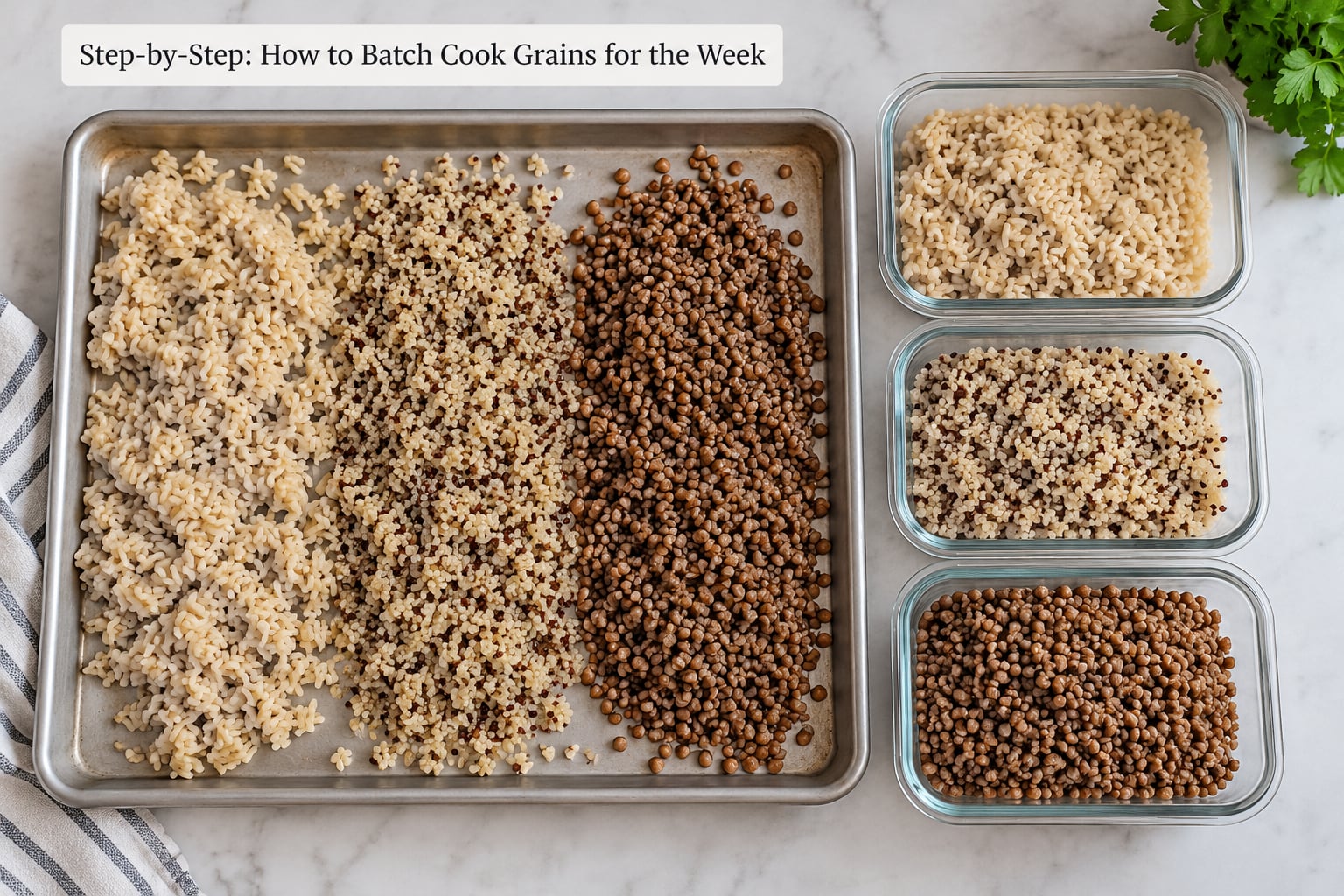
Tip the pot onto the rimmed sheet pan and spread the grains into a thin layer with a fork. That spreads the cooling surface and drops the temperature fast. Once they feel room temperature or barely warm, portion them.
| Grain | Fridge days | Freezer months | Best reheating method |
|---|---|---|---|
| White rice | 3 to 4 | 2 to 3 | Microwave with a damp paper towel |
| Brown rice | 4 to 5 | 2 to 3 | Skillet with a splash of water |
| Quinoa | 4 to 5 | 2 to 3 | Skillet or microwave, no liquid |
| Farro and barley | 4 to 5 | 2 to 3 | Skillet with broth |
| Millet | 4 to 5 | 2 to 3 | Microwave with a splash of water |
| Buckwheat | 4 to 5 | 2 to 3 | Skillet, dry |
| Sorghum | 4 to 5 | 2 to 3 | Simmer in broth |
Fill containers no more than two thirds full. A full container cools slower and steams itself back into mush overnight. Press a piece of parchment or a damp paper towel onto the surface of rice before sealing; it is the single most effective trick against dry day-four rice.
Store the grains alone. Sauces, dressings and roasted vegetables belong in separate containers until the night you eat them, because anything wet turns the grains gummy by Wednesday. Label each one with the grain and the date.
For freezing, spread portions on a baking sheet, set it in the freezer for an hour until solid, then scoop them into freezer bags laid flat. Freezing flat stops the clumps and the freezer burn that a soft lump develops. Use frozen bags first, oldest first, and pull one out the night before you plan to eat it.
Reheat Without Losing Texture
Day-old grains get hard and dry because the starch molecules set into a rigid structure as they cool. That is retrogradation, and it is why a Sunday pot of rice can turn crunchy by Thursday. Moisture and steam fix it.
- Microwave steam method: put the portion in a bowl, sprinkle a tablespoon of water over it, cover with a damp paper towel or plate, and heat for 60 to 90 seconds. This is the best method for white and brown rice.
- Skillet: a splash of water or broth in a hot skillet, grains in, lid on, about two minutes. Best for farro, barley, buckwheat and quinoa, which should stay dry.
- Oven: a covered casserole at 350 degrees with a little liquid, about 15 minutes, then a quick toss. Good when you are reheating two cups for a side dish.
- Stovetop soup: drop frozen grains straight into simmering broth. They thaw and heat in the same pot and need no reheating step at all.
Reheat grains only once, and bring them to 165 degrees. Reheating a second time is where most of the worry about rice comes from, so if you only need half a portion, reheat half.
Turn Batched Grains Into Meals
This is where the system pays off. The same pot of farro becomes six different meals over a week.
- Grain bowls: quinoa or rice, roasted squash, chickpeas, tahini drizzle.
- Collard wraps: chilled rice, black-eyed peas, salsa, topped with avocado. Collards hold up better than lettuce and suit a Southern kitchen.
- Fried rice: day-old white rice is genuinely better here than fresh, so plan a portion for Wednesday.
- Soups and chili: add barley or farro to lentil soup in the last 20 minutes so it does not turn to paste.
- Skillet dinners: brown rice with eggs and greens in one pan, hot sauce over the top.
- Cold salads: buckwheat or quinoa with roasted tomatoes, herbs and a lemon vinaigrette. These are best made fresh, since dressing ruins grain texture overnight.
- Stuffed squash: farro or millet cooked down with onion and herbs, stuffed into a halved butternut squash and baked.
- Breakfast: oats or millet with milk, apple and cinnamon, or grits with butter and salt.
Common Mistakes
Cooking every grain to the same texture. Rice wants tender, quinoa wants chewy, sorghum wants firm. Use the chart, not one instinct for all of them.
Overfilling the cooker. A rice cooker that is more than two thirds full cooks unevenly and the top layer dries out. Two batches of a smaller size beat one crowded batch.
Storing grains warm. This is the safety mistake that matters most. Spread, cool fast, refrigerate within two hours.
Skipping labels. Six containers of beige grains, no dates. You will cook again on Wednesday out of pure confusion.
Reheating dry. A tablespoon of water and a cover fixes most complaints about hard or crunchy meal-prepped rice.
One seasoning profile for every batch. Cook one pot in broth with garlic, one in water with coconut milk, one plain. The seasoning becomes the decision you make on Sunday instead of the one you make at six on a Wednesday.
Frequently Asked Questions
How long will cooked grains last in the fridge?
Most cooked grains keep four days in the refrigerator at 40 degrees or below, and white rice is the shortest at three to four days. Farro, barley, quinoa, millet and sorghum usually hold five days. Cool them fast, store them in shallow airtight containers, and keep wet toppings separate. Anything older than that belongs in the freezer.
How far in advance can I batch cook grains?
In the fridge you can cook up to four or five days ahead. In the freezer, cooked grains keep well for two to three months if you cool them fully, freeze them flat on a sheet pan, then bag them. That makes it practical to cook two sessions a month and restock your freezer for the weeks ahead.
Can you meal prep rice for all seven days?
Not safely in the refrigerator alone. Rice keeps three to four days chilled, so a Sunday cook covers Monday through Thursday for most households. Cook a smaller second batch midweek, or freeze the Thursday and Friday portions on Sunday so you have two grains to pick from late in the week.
Do you have to rinse quinoa before cooking?
Yes, and it is quick. Rinse quinoa in a fine sieve under cold water until the water runs clear, usually about 30 seconds. The bitterness comes from saponins on the outside of the seed, and rinsing removes them. Skipping the rinse is the usual reason homemade quinoa tastes harsh.
Is it safe to reheat rice more than once?
Reheat leftovers only once, and take them to 165 degrees. Rice left at room temperature can pick up Bacillus cereus toxins that reheating does not destroy, so the important step is cooling grains fast and refrigerating them within two hours. If you only need half a portion, warm only half and leave the rest cold.
How much dry grain should I cook for my family?
Cook about half a cup to three quarters of a cup of dry grain per person per meal. One cup of dry long-grain rice yields roughly three cups cooked. For a family of four eating rice four times that week, that is eight cups of dry rice and about 24 cups cooked, which usually means cooking in two batches.
Conclusion
Start smaller than you think. Choose two grains that eat differently, cook them in separate batches on a Sunday, spread each one thin to cool, then label the containers before anything goes in the fridge. Freeze the portions you will not reach within four days, reheat with a splash of water and a lid, and keep the sauces on the side. Once that rhythm settles in, adding a third grain takes ten extra minutes, not a second session.