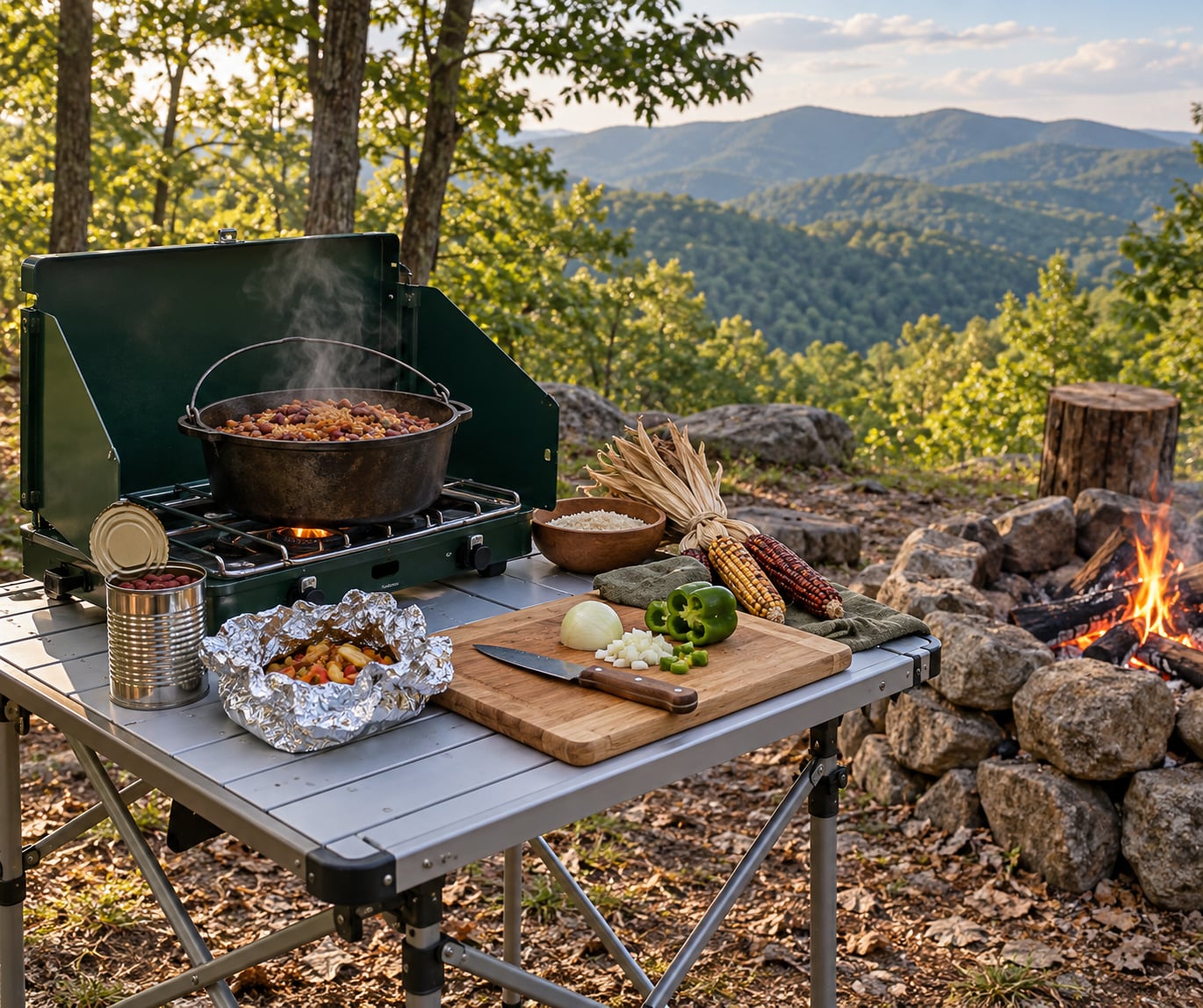
To cook while camping without a cooler full of meat, build your menu around shelf-stable proteins — canned beans and tuna, dried lentils and split peas, beef jerky, cured sausage, hard cheese, nut butter — and cook them fresh over a stove, a grate or hot coals, so nothing has to stay cold in the first place.
That single change does more than shrink your cooler. It cuts pack weight, frees up half the cargo space, and removes the most common way campers get food poisoning: a cooler chain that broke somewhere between the driveway and the trailhead.
I cook this way most weekends of the year, and the honest reason is not virtue. It is that a cooler is the heaviest, bulkiest, most failure-prone part of a camp kitchen. Every pound of beans or lentils replaces roughly the same number of servings of raw meat, and none of them turn if the ice goes.
The catch is that you have to plan for it. Shop the pantry instead of the meat counter, do your chopping at home, and treat the camp stove as a real kitchen rather than a novelty. What follows is the system I use, including the food-safety numbers that most cooler-free guides leave out.
Table of Contents
- What You Need to Cook While Camping Without a Cooler Full of Meat
- The cooking kit
- The food that replaces the cooler
- Your protein swap table
- Step-by-Step: A Cooler-Free Camp Menu That Still Tastes Good
- How to plan meals before leaving home
- How to keep food safe without a meat-heavy cooler
- How to cook easy meals without a cooler full of meat
- How to make no-cook and minimal-cook options
- How to finish and store what remains
- How to pack out every scrap
- What to do in rain or heat
- Common Mistakes and How to Fix Them
- Frequently Asked Questions
- What are some easy camping meals I can make without a cooler?
- How do you keep food cool when camping without a fridge?
- How long does food last without a cooler?
- What vegetarian meals can I cook while camping without a refrigerator?
- Is it safe to eat meat that sat out at camp?
- Do you need a cooler to go camping?
- Where to Start
What You Need to Cook While Camping Without a Cooler Full of Meat
You need less than most people expect. Here is the working kit, then the food that makes it worth carrying.
The cooking kit
A single-burner propane or butane stove does almost everything. Two burners is a luxury. Add one pot with a lid, one shallow pan if you want to sear anything, a long-handled spoon, a knife, a cutting board, a can opener, and a set of metal tongs.
For fire cooking you want a folding grate, a set of long-handled tongs, and heavy gloves. Aluminum foil is the cheapest utensil in camp cooking: wrap, seal, and bury it in coals for anything you would have put in a pan.
For storage, use heavy-duty zip bags, a few small hard-sided containers, a roll of painter’s tape and a marker for labeling, and a canvas tote that doubles as your trash bag. Bring a short length of paracord or bungee cords for a clothesline to hang wet gear.
Bring water for drinking and a separate small amount for cooking. Boil it. If you want a backup cooling method, a pot-in-pot cooler works surprisingly well, but it is a supplement, not a plan.
The food that replaces the cooler
Think in four groups: protein, carbohydrate, fat and flavor. Cover all four or people get tired of eating.
| Protein | Carbs | Fats and flavor |
|---|---|---|
| Canned beans, chickpeas, black beans | Quick-cook rice, instant noodles | Olive oil, shelf-stable jar sauce |
| Canned tuna, canned chicken | Dried pasta, couscous, grits | Nut butter, sunflower seed butter |
| Dried lentils, split peas, pinto beans | Tortillas, pita, crackers, wraps | Cured sausage, shelf-stable bacon |
| Beef or turkey jerky, dried soup mix | Quick-cook oats, granola | Hard cheese, dried herbs, pickles |
| Freeze-dried entrees, instant soups | Canned corn, sweet potatoes | Chocolate, dried fruit, candy |
Canned corn, dried cornmeal and hard cheese are the Southern pantry staples that make these meals taste deliberate rather than like a field lunch. A skillet of cornbread over a grate will do more for morale than another bar of jerky.
Your protein swap table
This is the core of going cooler-free. Each row replaces something most campers would have brought on ice.
| Fresh option it replaces | Shelf-stable replacement | Prep at home | Cook time on one burner |
|---|---|---|---|
| Chicken breast | Canned chicken, freeze-dried chicken | None, or portion into bags | 5 minutes to heat through |
| Ground beef | Dried ground beef crumbles, canned chili without dairy | None | 10 minutes to rehydrate and simmer |
| Steak or pork chops | Cured sausage, jerky | None | Grill over coals, 5 to 8 minutes a side |
| Fresh fish | Canned tuna, sardines, smoked canned fish | None | No heat needed |
| Fresh beans | Dried beans or lentils | Measure into 1-cup bag portions | 20 to 25 minutes, no soak needed |
| Tofu, if you pack it chilled | Shelf-stable tofu pouch, or just skip it | None | Sear 6 minutes, or eat cold |
| Fresh eggs | Freeze-dried eggs, powdered egg for baking | None | Rehydrate 5 minutes |
| Fresh dairy | Shelf-stable pouch milk, hard cheese, powdered creamer | None | 5 minutes or no heat |
Two of those cook times are the ones people argue about online. Dried beans do not need a long soak — a couple of hours in boiling water and a quarter teaspoon of baking soda per quart softens them enough for a pot meal in about 30 minutes. Older beans can want 45. Budget fuel for it and stop worrying.
Step-by-Step: A Cooler-Free Camp Menu That Still Tastes Good
Here is the full workflow, from the night before you leave to the last scoop of food at the end of the trip.
How to plan meals before leaving home
Plan by shared ingredient, not by recipe. If you buy one box of quick-cook rice, two cans of black beans and a jar of salsa, you have rice and beans on night one, burrito wraps on night two, and a bean-and-rice soup on night three. Three meals, one shopping trip, minimal cleanup.
- Pick three to four anchor ingredients everyone eats without complaining, then build the rest around them.
- Buy dried goods in bulk and portion them at home into zip bags, one meal per bag, labeled.
- Chop any fresh vegetables at home and double them in volume for the pot, since cooking shrinks everything.
- Pack sauces and seasonings in small bottles. A hot sauce and a pouch of taco seasoning turn plain beans into a dinner.
- Cook double at camp and pack the extra in a sealed container as tomorrow’s lunch.
- Pack day-of-meal items last, so they come out first and you do not unpack everything at once.
Keep wet foods in sealed bags inside a second bag. A zip bag that leaks crushed oats in a day is a ruined trip.
How to keep food safe without a meat-heavy cooler
Going cooler-free removes the raw meat problem, but it does not remove the food-safety problem. Cooked rice, cooked beans, cut fruit and anything with dairy in it are all perishable once they are prepared.
The USDA puts the danger zone between 40°F and 140°F. Keep cold food at 40°F or below, cook hot food to 165°F, and get cooked food out of that range fast. Perishable food left in the danger zone for more than two hours gets tossed. Above 90°F outside, that window shrinks to one hour.
Here is the practical version for a cooler-free trip.
| Trip length | Weather | Safe handling window | What to do with cooked food |
|---|---|---|---|
| Same day, no overnight storage | Any | Cook and eat within 2 hours of serving | Nothing to store |
| 1 to 2 days | Cool, under 70°F | 3 to 4 hours in the shade | Cover and eat within a day |
| 1 to 2 days | Warm, above 85°F | 1 hour outdoors | Cook late, eat late, skip saving it |
| 3 to 4 days | Cool nights | Same-day cooking only | Do not rely on leftovers; cook fresh |
| Any length | Above 90°F | 1 hour maximum | Only shelf-stable or fresh-from-the-can food |
Shadow matters more than most guides admit. A pot tucked behind a boulder in the shade, wrapped in a damp towel, holds noticeably cooler than one in the sun. A pot-in-pot cooler with wet sand between the inner and outer pot genuinely works for a weekend if you wet the sand every few hours.
If you cook poultry, hit 165°F. Ground meat wants 160°F. Whole cuts of beef, pork and fish want 145°F with a three-minute rest. Since most cooler-free menus skip those proteins, you mostly need to worry about rice, beans and cooked vegetables.
How to cook easy meals without a cooler full of meat
Building a fire ring on bare dirt is not allowed on most public land, so check your fire restrictions before you leave. When a ring is permitted, it looks like a shallow depression lined with rocks, cleared of roots and duff, with a fire in the middle and a grate laid across.
Four techniques cover nearly every meal:
- One-pot simmer. Quick-cook rice, canned beans, a jar of sauce, dried corn and a handful of greens all go into one pot with water. Stir occasionally until the rice is tender and the liquid is gone. Twenty minutes, one pot to wash.
- Foil packets. Fold a sheet of foil in a pouch with the open side up, fill with cubed vegetables, canned fish or sliced sausage and a spoon of sauce, seal the top, and set it on the grate or directly in coals. Twenty to thirty minutes.
- Grate cooking. Sear cured sausage, whole peppers or halved onions over hot coals. Wedges of sweet potato need forty minutes buried in the ash, wrapped in foil.
- Hot coals, no flame. Let the fire burn down to coals, rake them into a mound, and cook with the residual heat. Easier to control and far less smoke in your eyes.
If the wind picks up, stop cooking over flame immediately and switch to the stove. A tipped fire ring in dry leaves is how camps burn down.
How to make no-cook and minimal-cook options
Save stove fuel and your afternoon by eating a few meals cold. This is the strategy ultralight hikers have relied on for decades, and it works just as well from a car campsite.
- Chickpea salad. Drain one can of chickpeas, add halved cherry tomatoes, chopped onion, a spoon of oil and vinegar, and a pinch of salt. Good as is, better stuffed into a pita.
- Hummus trail wraps. Hummus in a small jar, tortillas, shredded carrot or cucumber, and hard cheese. No heat, no dishes.
- Overnight oats without a fridge. Mix quick-cook oats, powdered milk, nut butter and dried fruit in a jar the night before. Add water in the morning, eat cold or reheat.
- Boxed macaroni, cooked in the pot you already have going. Add noodles and a spoon of cheese powder or a slice of hard cheese.
- PB and J on tortillas, apples, jerky, nuts, dried apricots. The meal that saves the day after you have burned one pot of beans.
A permanent food kit at the top of your bag counts as a real meal: tuna packets, jerky, a jar of nut butter, crackers and an energy bar. It is the meal you eat when weather ruins the plan.
How to finish and store what remains
After dinner, scrape leftovers into a container while the pot is still warm, and get them into shade or into the pot-in-pot cooler straight away. Covered food in a sealed container loses heat faster than food exposed to moving air.
Reheat leftovers once only, until steaming hot all the way through. If you already kept cooked food past two hours in warm weather, throw it out rather than trying to save it by reheating. Reheating kills bacteria but does not remove the toxins some of them produce.
For washing up, boil water, use a drop of soap, and wash in order: pot, spoon, knife, cutting board, hands. If you used boiled water for cooking, reuse it for cleanup. Keep a container of soapy water, wipe the surfaces, and scatter the dishwater at least 200 feet from water sources.
How to pack out every scrap
Whatever you carry in as packaging, you carry out. That means foil, cans, glass jars, cork stoppers, food scraps and the used tea bag from your instant soup. Pack it into a bag and hang it or stash it in the trunk, because leaving trash for the next site is the fastest way to lose a campsite.
What to do in rain or heat
Rain does not have to end the kitchen. Move cooking under the picnic table or the vehicle awning, and never cook inside a tent, where carbon monoxide collects. Wet stove fuel is hard to light, so keep a small solid fuel cube or a lighter in a dry pocket as backup.
Heat is harder and more dangerous. Shift the schedule so you cook at breakfast and at dusk, eat cold food in the middle of the day, hydrate more than usual, and keep the tent shaded and closed during peak sun.
Common Mistakes and How to Fix Them
Most cooler-free trips do not fail on the food. They fail on the prep, or on safety habits that nobody thinks about until it matters.
Packing too many fresh items. Apples and firm vegetables tolerate a day or two. Anything cut, soft or milky does not. Fix: prep produce at home and stick to whole fruit, carrots, onions and potatoes, which survive unrefrigerated far longer than most guides claim.
Assuming plant-based means shelf-stable. A big pile of non-perishable snacks feels safe and then everyone gets bored by day three. Fix: bring the flavor. Pickled vegetables, dried fruit, nuts, spice packets and a hard cheese make repetition survivable.
Trying to run two burners you do not have. Multi-pot recipes simply fail for most campers. Fix: build the whole menu around one-pot cooking, and accept the occasional two-pot wash at breakfast when the water is still hot.
Cooking after it gets dark and damp. Fire building at night in a wet campsite is miserable and unreliable. Fix: eat earlier, cook earlier, and keep one cold meal in reserve so a failed fire never ends the day.
Skipping handwashing. You handled raw vegetables, cardboard, dirt and gas fittings before dinner. Fix: wash with soap and treated or boiled water before handling anything you are about to eat, and again before serving.
Cooking inside the tent or an enclosed vehicle. Carbon monoxide is odorless and fatal. Fix: cook outside, every time, and never run a stove inside a tent, a pop-top or a camper with the windows shut.
Trusting a cloud that will not rain in the mountains. Fix: pack the shelter before you need it, not after, and keep the first night something you can put up in under ten minutes.
Letting perishable leftovers sit. The two-hour rule is where cooler-free trips get people sick. Fix: cook only what you will eat, serve it, and stop saving it.
Forgetting breakfast. Camp breakfasts get skipped, and skipped breakfasts turn into hangry afternoons and ruined hiking days. Fix: plan breakfast with the same care as dinner. Overnight oats, grits, tortillas and nut butter need zero heat.
A few more tips worth keeping: keep oil and spice packets in zip bags, not bottles that leak. Use a spray bottle for oil so you use less. Keep one trash bag clipped to the outside of your tote so trash never wanders. And cook the biggest meal of the trip first, when your fire skills and your patience are both fresh.
Frequently Asked Questions
What are some easy camping meals I can make without a cooler?
Quick-cook rice with canned beans and a jar of sauce is the easiest, because one pot handles the whole meal. Other reliable options are foil packets of canned tuna and vegetables, grits or oatmeal cooked in a single cup, macaroni made in the same pot, and cold meals like hummus wraps or chickpea salad. Plan four core ingredients and build several meals from them.
How do you keep food cool when camping without a fridge?
You mostly do not. Build the menu from shelf-stable food that never needs cooling, then keep the small amount of perishable cooked food in a pot-in-pot cooler with wet sand between the pots, or in a sealed container wrapped in a damp towel in deep shade. USDA guidance puts the danger zone at 40°F to 140°F, with a two-hour limit, or one hour above 90°F outside.
How long does food last without a cooler?
Unopened shelf-stable food lasts as long as the label says, which is usually a year or more. The real limit is cooked food and cut produce. Keep anything perishable out of the 40°F to 140°F range for no more than two hours, or one hour when it is above 90°F outside. In warm weather, cook fresh each meal rather than saving leftovers.
What vegetarian meals can I cook while camping without a refrigerator?
Canned beans, chickpeas and lentils give you the protein, and they cook in twenty minutes with no soaking. Make one-pot rice and beans, chili with dried beans, split pea soup, oatmeal with powdered milk, tortilla wraps with hummus and hard cheese, or foil packets of vegetables with couscous. Add cornmeal for skillet cornbread and you get a menu that never feels like a side dish.
Is it safe to eat meat that sat out at camp?
No. If you do bring meat, treat it like any other perishable food. Keep it at 40°F or below, use it within two hours, or within one hour when it is above 90°F, and cook poultry to 165°F, ground meat to 160°F, and whole cuts of beef, pork and fish to 145°F. Smell is not a reliable test. When in doubt, throw it out and eat the canned beans instead.
Do you need a cooler to go camping?
No, especially for two to three day trips with a stove and a fire ring. You need a way to heat water and a way to cook, and everything else can be shelf-stable or canned. For trips longer than four days, or in sustained heat above 90°F, a small cooler with a few ice blocks for daily perishables makes the trip far more comfortable.
Where to Start
Start tonight, not at the gear store. Write down three anchor ingredients, portion the dry goods into labeled zip bags, and check your fire restrictions. Then load the car without the cooler and see how much space you have left.
That is the whole method behind how to cook while camping without a cooler full of meat. Buy what already keeps, prep it at home, cook it fresh, and follow the two-hour rule when something turns out to be perishable. You will eat better, pack lighter, and stop spending the first hour of every trip worrying about ice.