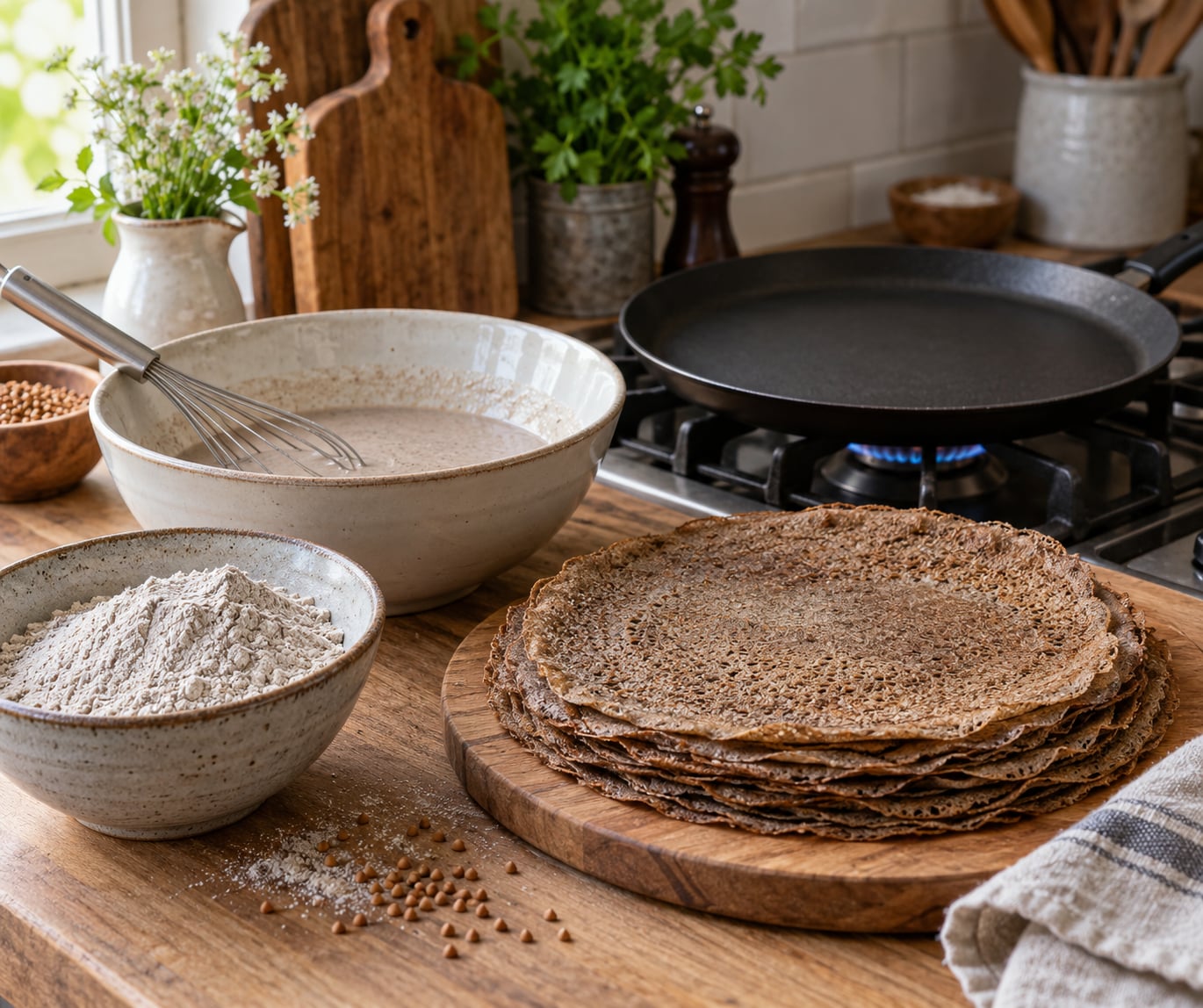
Buckwheat crepes are thin, lacy pancakes made with buckwheat flour instead of wheat, and they cook in about two minutes a side. To make crepes with buckwheat flour you whisk 1 cup buckwheat flour with about 2 cups liquid and a little salt, rest the batter at least an hour, then ladle a small amount into a hot nonstick skillet and swirl it into a paper-thin layer. The flour has no gluten, so resting is the step people skip that actually matters.
This is the vegan version, no egg required. Buckwheat is a pseudocereal, a seed from a plant unrelated to wheat, which is why the crepes cook up earthy and faintly sweet with none of the gluten structure. In France these are galettes bretonnes, or galettes de sarrasin, and a crêperie in Brittany will tell you the traditional batter is nothing but flour, water and salt.
The whole batch takes about ten minutes of active work plus rest time. If your first two come out ugly, that is normal and everyone in this sport has been there.
Table of Contents
- What You Need
- Two easy variations to know before you start
- Step-by-Step: How to Make Crepes with Buckwheat Flour
- Mix the Buckwheat Batter
- Let the Batter Rest
- Cook Thin Crepes
- Keep Warm and Fill
- Common Mistakes and How to Fix Them
- Frequently Asked Questions
- Can I make buckwheat crepes without eggs?
- Are buckwheat crepes naturally gluten-free?
- Why are my buckwheat crepes tearing when I flip them?
- How thin should the batter be when making crepes?
- Can I make the buckwheat crepe batter ahead of time?
- Can I freeze cooked buckwheat crepes?
- Conclusion
What You Need
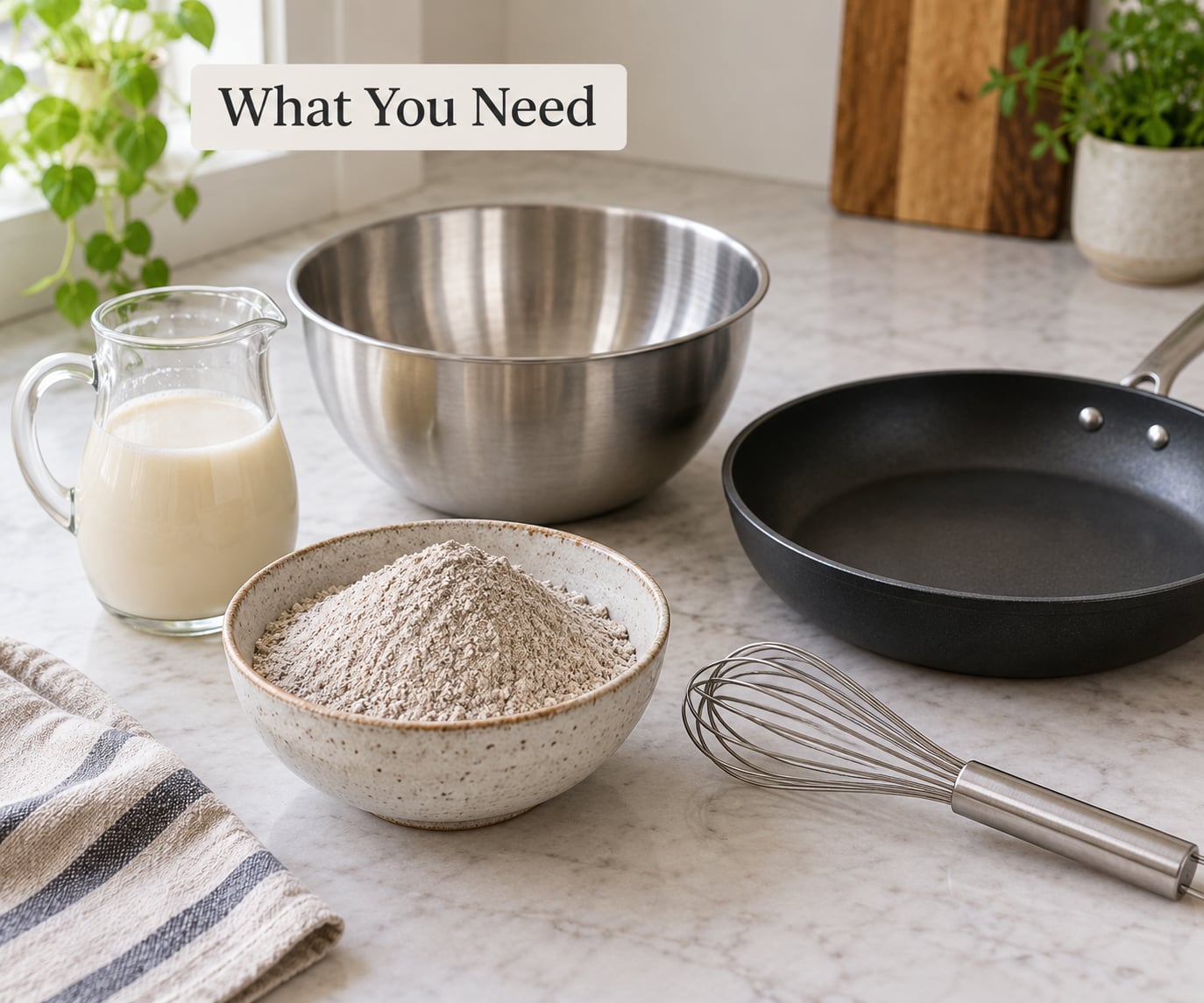
The base batter needs four things, and none of them are special.
- 1 cup (about 120 g) buckwheat flour for the nutty, earthy flavour and the naturally gluten-free character
- 2 cups liquid for hydration; use water for the traditional French version, or unsweetened plant milk for a richer, slightly sweeter crepe
- 1 tablespoon neutral oil or melted butter to tenderize the crumb and keep the edge from going brittle
- 1/2 teaspoon fine salt for seasoning, plus a small pinch of sugar if you want sweet crepes
That gives roughly ten to twelve crepes depending on how thin you go. A 9-inch skillet will not be the star here; a 10-inch gives you a crepe wide enough to fold around a filling without it sliding off.
For the pan, you do not need a crepe pan. A nonstick skillet is what most people use and it works well. Cast iron or a griddle also works, though cast iron holds more heat and wants a slightly lower setting, and a dedicated crepe pan with its low ridged rim gives you those lacy ruffled edges you see in French crêperie photos.
Two easy variations to know before you start
For a sweet batter, add 1 tablespoon sugar and half a teaspoon vanilla. For more structure in a gluten-free batter, swap 2 tablespoons of the buckwheat for all-purpose flour, which reintroduces a little gluten and makes flipping noticeably easier for beginners.
Step-by-Step: How to Make Crepes with Buckwheat Flour
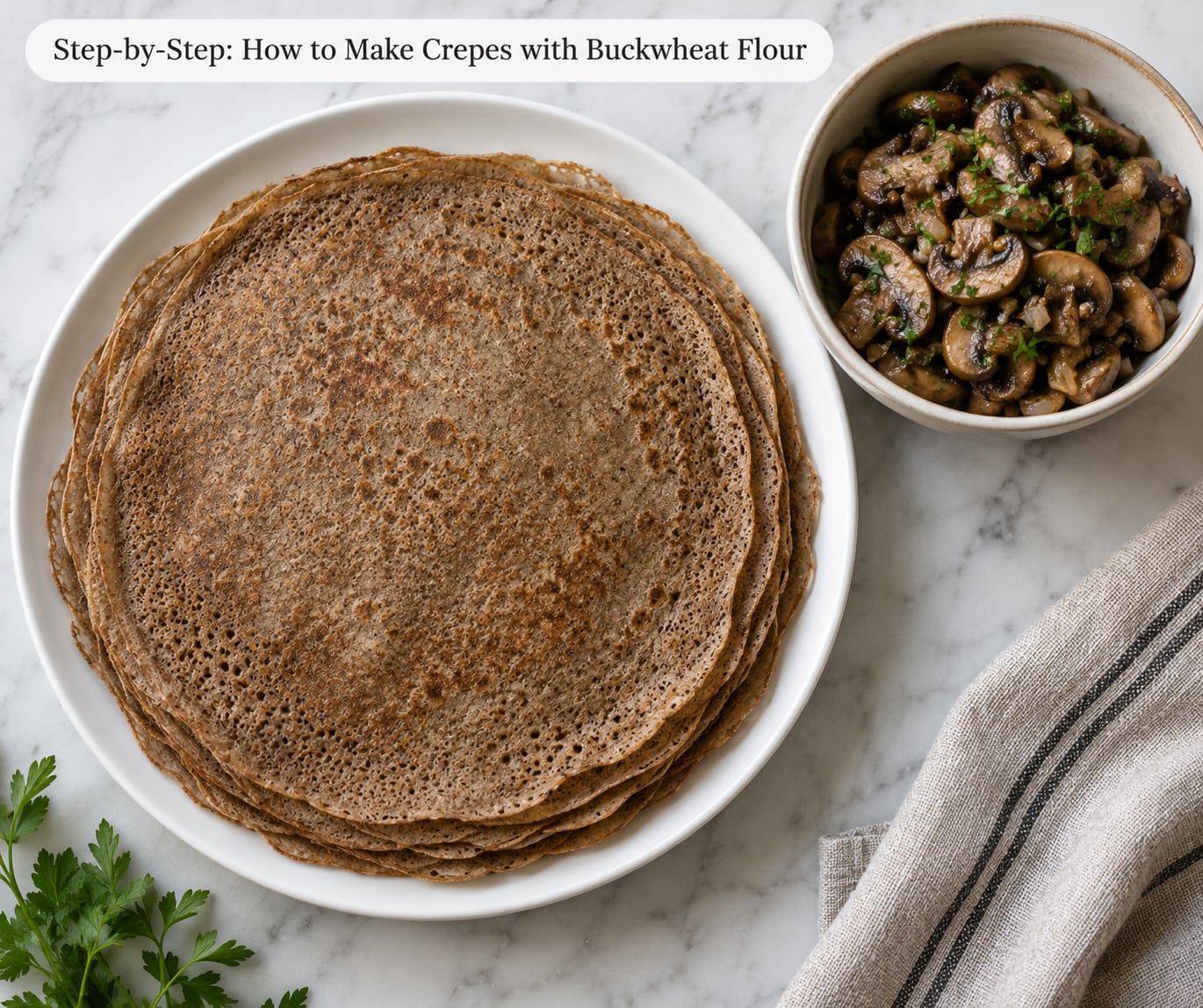
Read through the whole method once before you heat anything. The order matters because the batter needs to rest while you set up, and the pan needs to be hot before the batter is ready.
Mix the Buckwheat Batter
Whisk the buckwheat flour and salt together in a bowl first, dry and lump-free. Buckwheat flour arrives clumpy more often than wheat does, and starting with the dry mix is the cheapest way to avoid lumps entirely.
Then add about half the liquid and whisk to a thick paste before thinning. This is the trick that removes the last of the lumps: the paste stage gives the flour something to absorb into, so you never end up fishing for dry pockets with a whisk at the end.
Add the remaining liquid and the oil and whisk until it pours in a smooth, continuous ribbon. Buckwheat batter is meant to be thin, close to the consistency of thin cream. It will look watery and that is correct. If it holds a soft peak or leaves streaks on the whisk, it is too thick, so add liquid a teaspoon at a time.
Let the Batter Rest
This is where gluten-free crepes are won or lost. Buckwheat has no gluten to develop, but the flour still needs water to hydrate, and under-hydrated flour is exactly why crepes come out brittle and tear at the edges.
Three time tiers work, and you can pick based on your evening:
- 1 hour at room temperature for a same-night batch. Enough to hydrate, and the crepes will be slightly less flexible than a longer rest
- 4 hours in the fridge for the best balance, and the crepes pour a touch thinner after the chill
- Overnight, 12 to 24 hours for the most tender result; some cooks go to two days for a faintly fermented tang
A long rest does not make the batter go off in any harmful way. What it does is make it more sour-tasting and slightly thicker, which is exactly what a Breton galette is supposed to taste like. If it seems too thick after resting, loosen it with a teaspoon of water.
Cook Thin Crepes
Heat a nonstick skillet over medium-high heat until a drop of water skitters and evaporates in a couple of seconds. Wipe it with a paper towel holding a little oil, then put that paper towel back to work: the film should be a sheen, not a puddle. Pools of butter or oil fry the edge and make it greasy rather than lacy.
Ladle in roughly a quarter cup of batter, no more. Immediately lift and tilt the pan in a circle so the batter spreads across the base in a thin layer. If the batter sits in one spot, your pan is not hot enough.
Cook for 40 to 60 seconds. Watch the surface: bubbles open across the top and the edges start to lift and dry out. Those two cues together, not the clock, tell you it is time to turn. Run a thin spatula or knife under the edge, slide it all the way under, and flip in one confident motion.
Cook the second side for another 30 to 45 seconds, until the flip side shows freckled brown spots. Stack each finished crepe on a plate under a clean tea towel. Rewisk the batter between crepes, since flour settles at the bottom and the top of the bowl thickens.
Keep Warm and Fill
A loose towel over the stack is enough. Wrapping crepes airtight while they are warm traps steam and softens the edges into something chewy.
Fill within a few minutes of cooking. Savoury options that suit the earthy grain: crepe complete with ham, gruyere and a fried egg; creamed spinach with gruyere; sauteed mushrooms with thyme and a spoonful of goat cheese; smoked salmon, capers and dill with creme fraiche; or roasted peppers, ricotta and basil. Sweet options: lemon curd with berries, apple and cinnamon cooked down in a little butter, dark chocolate and flaky salt, or whipped coconut with roasted peaches.
Fold a round crepe in quarters like a napkin, or roll it loosely. If a filling is too wet, drain it first, otherwise the bottom layer goes soggy before you finish eating.
Common Mistakes and How to Fix Them
Almost every buckwheat crepe problem has a single cause behind it, and it is nearly always the batter rather than the pan.
The batter is lumpy and the crepes cook half raw. This is under-hydrated flour, and it is not really a whisking failure. Give it another 30 minutes of rest, then whisk hard enough that the batter slaps the bowl. A few lumps that survive will not matter; a batter that is thin and smooth cooks evenly.
The crepes are thick and blobby rather than thin. Your batter needs thinning. Add water a teaspoon at a time and stir until it runs off the spoon in a steady ribbon. Also drop your ladle portion to about two tablespoons; the first crepe you pour is almost always too heavy because people hold the cup longer than they think.
The crepe sticks to the pan. Three causes in order of likelihood: the pan is not hot enough when the batter goes in, the oil layer is too thick, or the crepe was not ready to flip and sat too long. Heat the pan fully each time, wipe on a barely-there film of oil, and use a drop of water to test the heat before pouring.
The crepe tears when you flip it. Flip too early and the centre is still wet, so it folds onto itself. Flip on the bubbles-and-lifted-edges cue rather than on the timer, use a thin flexible spatula all the way to the far edge, and make the flip a single movement rather than a scrape and a lift. Cool, fully rested batter also tears less than batter straight from the fridge.
The edges and underside go dark or scorched. Buckwheat browns faster and more unevenly than wheat because it has less protein and more free sugars. Lower the heat a notch, keep it moving, and pull the crepe off while the centre still looks faintly pale. Some darkness is the point. Fully black speckles with a bitter smell mean the pan was too hot or the oil was too heavy.
The crepe looks cooked but the centre is raw and chewy. That is a thickness problem, not a heat problem. The crepe should be thin enough to see the pan colour through the centre before you flip it.
The filling leaks out as you fold. Use less filling than looks right, thicken it first, and fold while the crepe is still warm, since a hot crepe bends more cleanly than a cool one.
One more thing worth knowing: buckwheat brands vary. Pale, mild flours drink less liquid, while darker gruau-style flours are coarser, thirstier and cook with more contrast. If your batter suddenly feels tight after you switch brands, loosen it with water rather than reaching for more flour.
Frequently Asked Questions
Can I make buckwheat crepes without eggs?
Yes, and the base recipe in this article already has no eggs. Traditional Breton galettes use only buckwheat flour, water and salt, with an equal weight of water to flour. Egg is an optional addition that makes the crepe more flexible and easier to flip, and it cuts the resting time because the protein helps hold the crepe together. If you are serving people who will flip with confidence, add one egg and treat the batter as the richer version rather than the necessary one.
Are buckwheat crepes naturally gluten-free?
Buckwheat is a seed from a plant completely unrelated to wheat, so the flour is naturally gluten-free on its own. Watch what else goes into the batter, though. All-purpose flour, regular milk, and oats that are not certified gluten-free will all reintroduce gluten, and cross-contamination in a shared toaster or fryer matters for celiac cooks. If you buy a bag of buckwheat, check that it is labeled gluten-free if that matters to you.
Why are my buckwheat crepes tearing when I flip them?
Three causes, in order of likelihood. You flipped too early, while the centre was still wet and it folded onto itself. You used a thick spatula that dragged the crepe instead of lifting it. Or your batter is under-hydrated, so the crepe is brittle, which is common with buckwheat flour that was not rested long enough. Flip on the bubbles-and-lifted-edges cue rather than a timer, use a thin flexible spatula, and rest the batter at least an hour.
How thin should the batter be when making crepes?
Thin, like thin cream, and closer to milk than you expect. It should pour in a continuous ribbon off the whisk or spoon and settle flat with no streaks left behind. If it holds a soft peak, holds a ribbon shape, or leaves lines on the bowl, add water a teaspoon at a time. Test the pan the same way: a drop of water should skitter across the surface and disappear in a couple of seconds.
Can I make the buckwheat crepe batter ahead of time?
Yes, and for this batter it is the recommended approach. Resting is not optional when the flour is gluten-free, because water has to hydrate the flour before the crepe can stay flexible. Mix it up to two days ahead, cover tightly, and keep it in the fridge. Give it a thorough whisk before cooking, since it thickens as it sits, and loosen with a teaspoon of water if it is no longer pouring in a ribbon.
Can I freeze cooked buckwheat crepes?
They freeze well for up to two months. Let each crepe cool completely, then stack them with a sheet of parchment paper or plastic wrap between every layer so they do not bond into one solid disc. Wrap the whole stack and freeze flat. To reheat, warm them a few at a time in a dry skillet over medium heat for under a minute per side, or microwave in short bursts. Frozen crepes lose a little suppleness, so fill them straight from the pan while they are still warm.
Conclusion
Four things decide whether a batch of buckwheat crepes turns out well: whisk the flour and salt dry first and work up from a thick paste, rest the batter at least an hour so the flour hydrates, keep the batter pourable enough to swirl into a genuinely thin layer, and flip on the bubbles-and-lifted-edges cue rather than on a timer.
Heat the pan properly, wipe on a sheen of oil rather than a pool, and keep finished crepes under a loose towel until you fill them. Everything else, including the colour, is normal for a flour that browns faster than wheat and tastes like it came from a field.