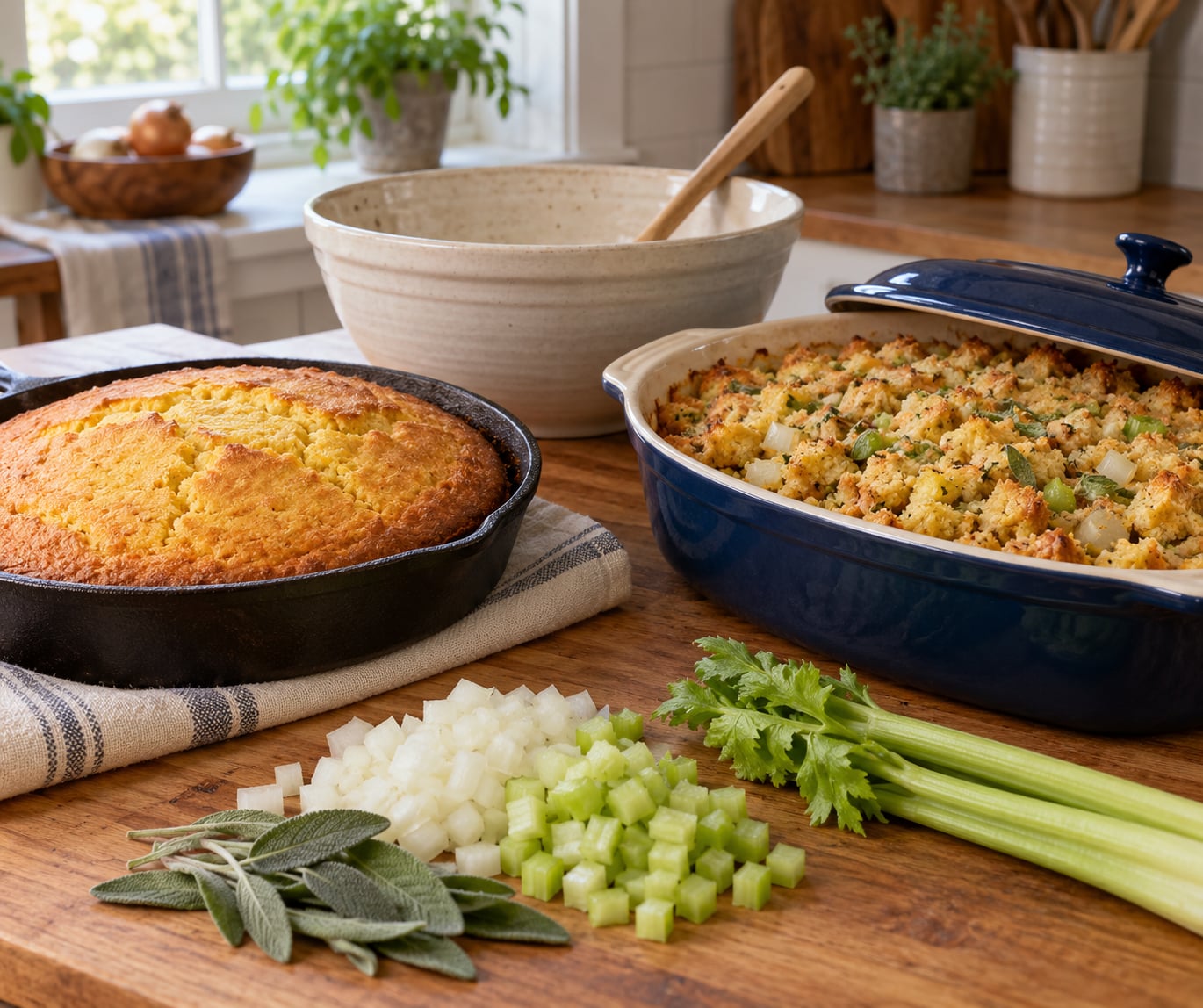
Yes, you can make cornbread dressing ahead of time, and most cooks find the ahead version tastes better than a same-day batch. The trick is to dry the cornbread so it can absorb broth, then assemble the wet mixture and hold it covered in the refrigerator for up to two days before baking. Bake it straight from the fridge with an extra ten minutes, or freeze it unbaked for up to three months.
I grew up in a house where dinner for twelve meant two ovens running back to back, and cornbread dressing was always the dish that got made the night before. Nothing about that process has changed. Knowing how to make cornbread dressing ahead of time frees up the one oven you have on Thanksgiving, cuts the counter clutter on cooking day, and gives the seasoning time to move all the way through the crumb.
Two days is the comfortable limit for an unbaked mixture in the refrigerator. Beyond that, freeze it. This guide covers the whole timeline, plus storage times, reheating, and what to do when ahead-prepped dressing comes out dry or mushy.
Table of Contents
- What You Need to Make Cornbread Dressing Ahead
- Step-by-Step
- How to Make Cornbread Dressing Ahead of Time: Bake the Cornbread
- Cook the Aromatics and Seasoning Base
- Moisten and Season the Cornbread
- Refrigerate the Unbaked Dressing
- Bake, Cool, and Store the Finished Dressing
- Common Mistakes
- Frequently Asked Questions
- Can I make cornbread dressing without baking it until Thanksgiving?
- How far ahead can cornbread dressing be made?
- Can cornbread stuffing be frozen after baking?
- How long does cornbread dressing keep in the refrigerator?
- How do I reheat cornbread dressing without it drying out?
- Can I make cornbread dressing vegan and gluten-free?
What You Need to Make Cornbread Dressing Ahead
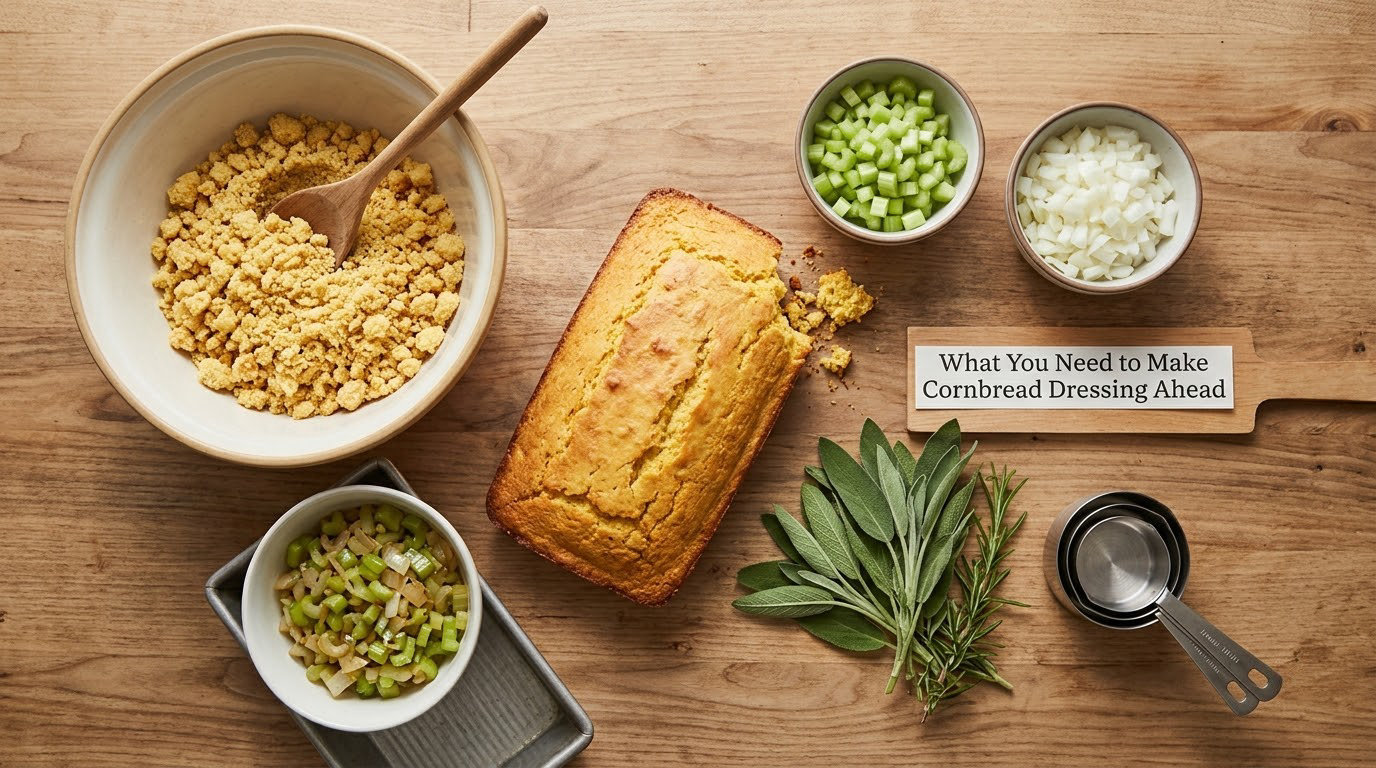
You need very little that isn’t already in a Southern kitchen. The cornbread is the only component you truly have to make from scratch, and even that can be swapped for a boxed mix in a pinch.
For the cornbread itself:
- Cornmeal, flour, salt, baking powder and an egg, or one box of a buttermilk cornbread mix
- Butter or oil, and buttermilk or milk if you are not using a mix
- A 9×5 inch loaf pan or a 10-inch cast-iron skillet
For the dressing:
- 4 to 6 cups of crumbled cornbread, dried uncovered for several hours
- 2 to 3 cups chicken broth, or turkey drippings saved from the bird
- 1 stick butter, melted and cooled, plus 1 to 2 eggs
- 1 large yellow onion and 3 ribs of celery, both diced small
- 2 to 3 teaspoons poultry seasoning, 1 to 2 teaspoons dried sage, black pepper and salt
For assembly and storage:
- A greased 9×13 baking dish, or the same skillet if you baked the cornbread there
- Aluminum foil and a tight-fitting lid or plastic wrap
- A shallow pan or baking sheet, for cooling the cornbread out flat
Adaptations barely change the method. For a vegan version, skip the eggs and butter, and use a vegan broth and a tablespoon of ground flaxseed whisked into a quarter cup of warm water if you want the same binding. For gluten-free, use a gluten-free cornbread mix and pure cornmeal, and check that your broth and poultry seasoning are free of wheat. Traditional Southern cooks add sausage, pecans, or dried cranberries, and those additions survive make-ahead prep fine as long as you cook the sausage first.
Step-by-Step
Read the whole timeline once before you start, because the order matters. The cornbread dries while you rest, the aromatics cool before they meet the bread, and the assembled mixture goes straight into the refrigerator without being baked first.
How to Make Cornbread Dressing Ahead of Time: Bake the Cornbread
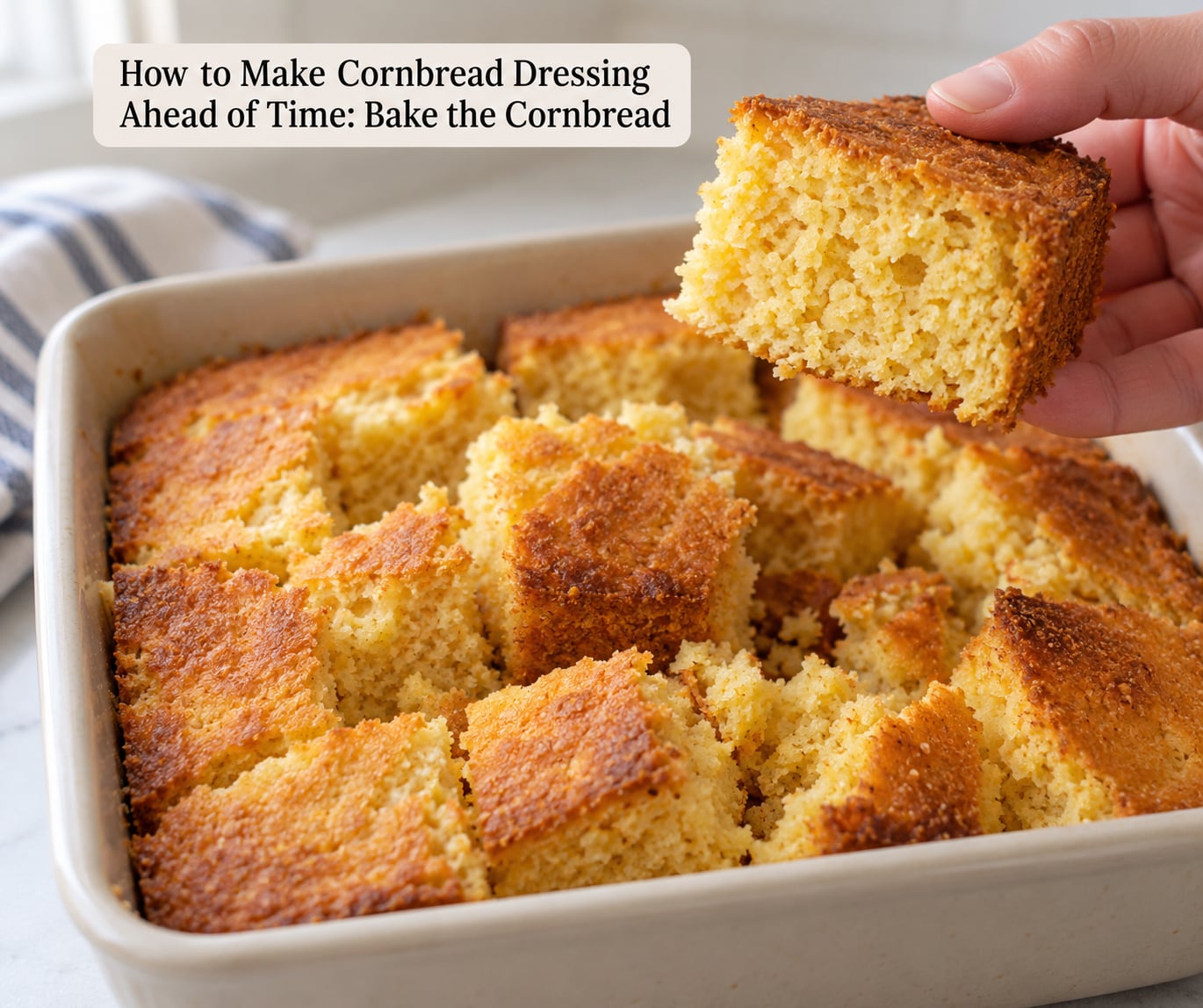
Bake the cornbread first, up to three days before you need the dressing. A loaf or a skillet of plain cornbread works; sweet cornbread does not, and neither does cornbread made with a lot of oil, because it does not crumble cleanly.
Cool it completely, then spread the cornbread on a baking sheet or in a single layer in a pan. Sit it uncovered on the counter overnight, or up to two days. That exposure is what dries the surface and firms the crumb so it drinks broth instead of dissolving into it.
When you are ready, crumble or cut it into irregular pieces about the size of a large walnut. Big uneven pieces are the goal. Nobody wants a bowl of fine crumbs, and small ones turn to mush before the middle of the pan sets.
This drying stage is about a make-ahead dish, so it is not a food safety question. Cornbread sitting uncovered on a counter for a day is a texture decision. The safety clock starts once eggs and broth are mixed into the dressing, and at that point the mixture belongs in the refrigerator.
Cook the Aromatics and Seasoning Base
Melt half the butter in a skillet over medium heat. Cook the diced onion and celery for 6 to 8 minutes until they soften and turn translucent, then stir in the poultry seasoning, sage, a few grinds of black pepper, and garlic if you like it.
Let the pan cool for 15 minutes or so. Adding hot butter to the cornbread melts the fat and makes a slick of oil at the bottom of the dish, which is the fastest way to end up with greasy dressing instead of moist dressing.
Skip the butter entirely and use olive oil for a vegan dressing. For gluten-free, read labels on the broth, since many brands of chicken broth carry wheat. The rest of the sequence stays identical, which is the nice thing about this method.
Moisten and Season the Cornbread
Put the crumbled cornbread in a large bowl. Pour over 2 cups of broth and the cooled butter, then toss with your hands or a wooden spoon until every piece is damp. Add the onion and celery mixture and mix again.
The mixture is supposed to look like a thick soup, and this is where most people quit. The cornbread should be swimming, with broth standing in the bottom of the bowl. Too dry is the more common failure, so err wet rather than cautious.
Take a handful and squeeze it. If liquid streams out freely, add another half cup of broth. If it holds together and drips slowly, you are done. A practical ratio for most households is about 1 cup of broth per 4 cups of cornbread, plus more if the bread was very dry.
Season in layers rather than all at once. Salt the cornbread before the broth goes in and the seasoning tastes better distributed, then taste the assembled mixture. It should taste slightly under-seasoned because baking concentrates everything.
Refrigerate the Unbaked Dressing
Scrape the mixture into a greased 9×13 baking dish and press it down flat with the back of a spoon. Pressing helps it bake as one piece instead of settling into loose crumbs.
Cover tightly with foil or plastic wrap and refrigerate for one or two days. Cold stuffing needs a longer bake than room-temperature stuffing, which is the only adjustment you have to make later.
Discard the mixture if it smells sour or off, if there is pink or grey liquid pooled in the dish, or if the surface shows fuzzy growth. Two days in the refrigerator is the outer limit for an unbaked mixture with eggs in it.
| How you stored it | Where | How long it holds | Bake or reheat from |
|---|---|---|---|
| Unbaked, assembled with eggs and broth | Refrigerator | 1 to 2 days | Covered 25 min, then uncovered 20 to 25 min at 350F |
| Unbaked, assembled with eggs and broth | Freezer | 2 to 3 months | Thaw overnight in the refrigerator, then add 10 minutes to the bake |
| Fully baked | Refrigerator | 3 to 4 days | Covered 25 min at 325F, uncovered 5 min to crisp |
| Fully baked | Freezer | 2 to 3 months | Thaw overnight in the refrigerator, covered 30 min at 325F |
| Dried cornbread crumbs only | Freezer | 3 months | Use straight from frozen in the mixture |
Bake, Cool, and Store the Finished Dressing
Take the dish out of the refrigerator while the oven heats to 350F, so it loses less of its chill. Leave the foil on and bake for 25 minutes, then pull it back, spray or dot the top with a little butter, and bake uncovered for another 20 to 25 minutes until the top is golden brown and the center no longer sloshes.
Because the dish starts cold, count on 45 to 50 minutes total. A knife inserted in the center should come out clean, and the internal temperature should reach 165F / 74C, the same safe minimum you use for any stuffing cooked inside a turkey. That check matters most if you are stuffing the bird early or reheating a dressing that sat on a buffet line.
Let it rest 10 to 15 minutes before serving. The crumb finishes setting as it cools, and a cut that is too early turns wet in the bowl.
For leftovers, cool the pan uncovered on a rack, then cover and refrigerate within two hours. Reheat covered at 325F for 25 minutes, take the foil off for the last five, and skip the microwave if you can. Microwaving makes cornbread rubbery, and reheating in the oven keeps the crust worth eating.
| Reheating method | Time and temperature | What you get |
|---|---|---|
| Oven, covered | 25 min at 325F, then 5 min uncovered | Crisp top, moist center, the best result |
| Slow cooker for a buffet | 2 to 3 hours on low, lid on | Holds warm for hours without drying out |
| Skillet | 10 min on medium, lid on, a splash of broth | Quick and good for a small pan of leftovers |
| Microwave | 2 to 3 minutes per serving | Fast, but the cornbread turns rubbery |
Common Mistakes
Almost every ahead-prepped dressing problem traces back to a handful of things: moisture, coverage, seasoning, or storage time. Most are fixable, and several you can fix after baking rather than throwing out the dish.
1. The dressing came out dry. Usually too little broth, or cornbread that was fresh from the oven and had no crumb left to absorb liquid. Fix it after the fact by pouring a quarter cup of warm broth over the baked surface, letting it sit 10 minutes, then reheating. For next time, use the squeeze test and add stock until the mixture looks like a thick soup.
2. The dressing came out mushy or gummy. This is over-wet crumb, cornbread cut too fine, or a dish that sat uncovered in the refrigerator overnight so the liquid kept soaking in. There is no good cure. Store it covered, cut the cornbread into large pieces, and resist adding more broth than the handful test calls for.
3. The top stayed pale. Assembled dressing bakes first under foil, and foil is the reason. Bake 25 minutes covered, then uncover for the last 20 to 25 minutes. A little butter or drippings brushed on at that point helps the crust color in the final stretch.
4. It tastes bland. Seasoning added to a wet mixture concentrates unevenly, and the bottom of the dish gets more broth than the top. Season in two stages: salt and sage at the mix, then pepper and a pinch of salt over the top before the uncovered bake.
5. The middle is underdone. A chilled dish needs 45 to 50 minutes, not the 35 minutes a room-temperature one takes. Bake to 165F in the center rather than to color alone, since a golden top can hide a cool middle.
6. It got watery or unsafe to eat. Eggs plus warm broth is a hospitable environment for bacteria, and room temperature is the danger zone. Two hours is the limit before it goes into the refrigerator, two days is the limit for unbaked dressed bread, and anything that smells sour or shows pink liquid gets thrown out no matter how long it has been chilled.
Frequently Asked Questions
Can I make cornbread dressing without baking it until Thanksgiving?
Yes, and that is the version most cooks prefer. Assemble the dressed cornbread in a greased 9×13 dish, cover it tightly, and refrigerate for one or two days. Bake it straight from the refrigerator at 350F for 45 to 50 minutes, covered for the first 25 minutes and uncovered after that. The mixture will look like a thick soup before it bakes, which is correct.
How far ahead can cornbread dressing be made?
Three days is comfortable if you split the work. Bake and dry the cornbread up to three days ahead, then assemble the wet mixture one or two days before serving. Fully baked dressing keeps in the refrigerator for 3 to 4 days, so baking it the night before also works. Beyond four days, freeze rather than refrigerate.
Can cornbread stuffing be frozen after baking?
Yes. Cool the baked dressing completely, wrap the pan in foil or portion it into freezer containers, and freeze for 2 to 3 months. Thaw it in the refrigerator overnight, never on the counter, then reheat covered at 325F for about 30 minutes. Unbaked assembled dressing also freezes well if you prefer to freeze it before baking and add 10 minutes to the bake time.
How long does cornbread dressing keep in the refrigerator?
Unbaked cornbread dressing keeps for 1 to 2 days covered in the refrigerator, because it contains eggs and broth. Fully baked dressing keeps longer, 3 to 4 days. Cool the pan on a rack first, cover it, and refrigerate within two hours of baking. Skip the pan if you are storing a large quantity in a slow cooker on low.
How do I reheat cornbread dressing without it drying out?
Reheat it in the oven, covered, at 325F for 25 minutes, then take the foil off for the last 5 minutes so the top crisps. Covering traps the steam that keeps the crumb moist, and the uncovered finish keeps the crust from going soft. A microwave works in a pinch but makes cornbread rubbery. A splash of warm broth or drippings before reheating helps a dry dish.
Can I make cornbread dressing vegan and gluten-free?
Yes. For vegan, leave out the eggs and butter, use vegetable broth, and mix 1 tablespoon of ground flaxseed with a quarter cup of warm water as a binder if you want the same set. For gluten-free, use a gluten-free cornbread mix and cornmeal only, and check that your broth and poultry seasoning contain no wheat. The method, times, and storage windows stay exactly the same.
Start with the cornbread. Bake it two or three days ahead, dry it uncovered, and crumble it into large pieces. That single step is what separates ahead-prepped dressing that tastes great from dressing that comes out dry or gummy, and everything after it follows the same simple path.